Comment of the Day: “Is a Transgendered Woman Ethically Obligated To Tell Her Boyfriend That She Used To be Male?”

You never know. My post about the ethics of withholding the fact of one’s past and altered gender from a potential spouse sparked the most passionate, erudite and instructive debate among readers that Ethics Alarms has seen in a long time, involving an all-star squad of some of this blog’s best minds. The prize goes to Zoebrain, though, who scores the Comment of the Day with this three part contribution. It’s long; don’t let that discourage you. It, and the whole thread, which you can find here, is well worth your time, because you will learn something. I did.

“May I give an extended set of replies here please? You see, this isn’t a hypothetical for me, it’s an actual. Continue reading

Unethical Quote of the Week: Senate Majority Leader Harry Reid

“He didn’t pay taxes for 10 years! Now, do I know that that’s true? Well, I’m not certain. But obviously he can’t release those tax returns. How would it look?… You guys have said his wealth is $250 million. Not a chance in the world. It’s a lot more than that. I mean, you do pretty well if you don’t pay taxes for 10 years when you’re making millions and millions of dollars.”

—-Senate Majority Leader Harry Reid, in an interview with The Huffington Post. Reid’s source for the accusation that Romney “did not pay taxes for ten years” is a an individual he refuses to name, and thus one whose allegations cannot be checked or substantiated.

Sen. Harry Reid

In the dirty, slimy world of politics, you can’t get much dirtier or slimier than Senator Reid. Richard Nixon would be proud of him;  Joe McCarthy would applaud, Joseph Goebbels too, and every low-life, gutter-dwelling lie-monger who has used innuendo and rumor to smear candidates, opponents and strategically-chosen victims in between.

Reid is a leader of the Democratic Party, and the Party is accountable for his words. Fair Americans have been justifiably disgusted with the likes of Donald Trump, who has suggested that President Obama’s reluctance to release his scholastic records, and before that his birth certificate, were proof of something nefarious. Guilty until proven innocent—this is the secret ingredient of Big Lie politics, and that is what Reid, who really is beneath contempt here, is practicing. Reid makes Trump look fair and Newt Gingrich look moderate by comparison, and any Democrat, whatever they think of Mitt Romney, that doesn’t have the integrity to condemn this kind of abuse should be have himself fumigated. Continue reading

Is a Transgendered Woman Ethically Obligated To Tell Her Boyfriend That She Used To be Male?

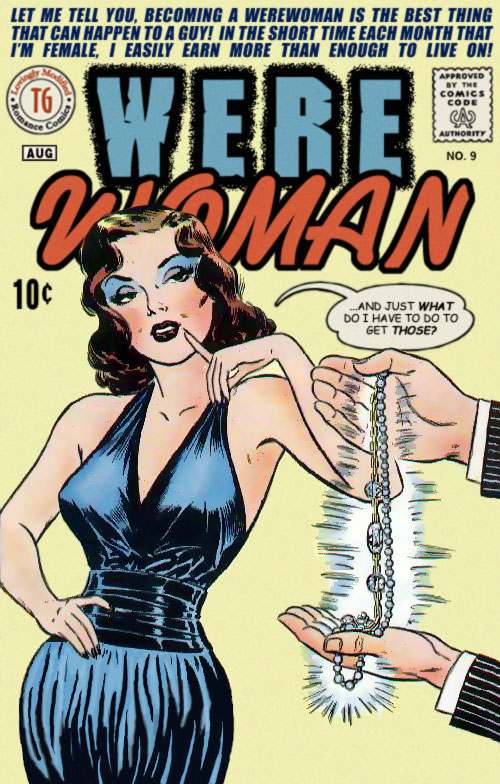
“Is this a bad time to tell you that I used to be a man?”

Sometimes I wonder if Emily Yoffe’s Slate advice column (“Dear Prudence”) is like the old Penthouse Forum, where it was clear to any reader who hadn’t purchased the Brooklyn Bridge twice that a team of giggling writers was coming up with the feature’s bizarre letters about orgies with amputees and people having sex in piles of fresh fish. But never mind: her most recent column makes an interesting ethical assertion is response to a woman who is troubled that her transgendered cousin refuses to tell her serious boyfriend about the jockstrap in her past:

“I think you should tell your cousin she’s living in a dream world and that she’s being unfair to John, even if he has a lack of desire for children. Of course, it could be that John flees, or it could be that he says, “She’s more than woman enough for me.” But it’s his right to know the crucial piece of history.”

I agree with Yoffe that the cousin is deluded if she thinks she can keep her past gender hidden forever if the relationship continues, and that the revelation of a secret of such magnitude is bound to be more disruptive the longer it is hidden. But is she correct that he has a right to know about it? Elsewhere Yoffe suggests that not telling him is dishonest. Why?

I understand the theory that couples shouldn’t withhold personal information from one another in the interest of mutual trust. Surely each member of a committed couple has an obligation to reveal any personal information that has the potential to affect the other. Is there an obligation to reveal personal information that one knows a boyfriend or girlfriend will be shocked to learn, or that will tap into visceral fears or biases? Author William Saroyan left his wife on their honeymoon when she revealed to him that she was Jewish, which highlights the irony of the problem: if a woman knows that a secret may cause a lover to reject her, however irrational that reaction would be, then is she ethically obligated to tell him but not obligated if she is sure he wouldn’t care? In other words, is one only ethically obligated to reveal the secrets that will destroy a relationship?

That seems strange. Continue reading

Comment of the Day: “Ethics Quiz: The Peculiar Ethics of Carnival Games”

Reader John Owens supplies  perspective and expertise on carnivals and local fairs in his Comment of the Day regarding the post “Ethics Quiz: The Peculiar Ethics of Carnival Games.”    Here it is: Continue reading

Twitter Ethics: The Guy Adams Affair

Twitter has come under fire from ignorant free speech advocates—essentially the same people who accuse me of “censorship” when I refuse to allow an anonymous comment, in violation of Ethics Alarms policies, on my own blog —because it removed a journalist Guy Adams’ account after he violated Twitter’s privacy rules by tweeting the email address of NBC executive Gary Zenkel over various Olympics coverage controversies. The main complaint is that apparently someone at Twitter notified Zenkel and alerted him to the process whereby he could get the tweet and the account taken down according to Twitter’s policies. Here is a representative reaction, from blogger Matt Honan at Wired:

 “Here’s an interesting thought experiment. Imagine that instead of going after an NBC executive, Adams’ target was a dictator. Imagine that Adams tweeted, say, Syrian president Bashar al-Assad’s email address, along with a call to action to protest his policies. Had Twitter worked back-channel with the Syrian government, showing it how to have Adams’ account taken down on a technicality, it would clearly be an indefensible act of censorship. Heads would roll.”

Heads might roll, but Honan is wrong. It would not be “an indefensible act of censorship.” It would not be censorship at all. Continue reading

Signature Significance, Jonah Lehrer, and That Sinking Feeling

Yes, uh, a little TOO MUCH creativity there, Jonah…

At the New Yorker, star writer Jonah Lehrer has resigned after it was shown that he fabricated quotes from Bob Dylan for his well-reviewed book “Imagine: How Creativity Works.”

This was the final shoe dropping that began with one untied shoelace, the discovery in June that Lehrer had plagiarized from himself, lifting a section of a piece published earlier in one publication to include in a piece written for The New Yorker. This is a minor ethical incursion—-Lehrer had represented the second essay as original, so using prior published material was dishonest even if he was the author—but it launched his employers on a mission of scrutiny, investigating to see if the one transgression was part of a trend.

When it comes to professional ethics, you see, it often is. The principle of signature significance holds that in some pursuits just one episode can be enough to make certain conclusions. A writer of true integrity never borrows from his own published work without flagging the fact. Doing so even once indicates shaky integrity, and a willingness to cut corners. It may well indicate a proclivity to cheat in more egregious ways. Continue reading

Ethics Quiz: The Peculiar Ethics of Carnival Games

The AARP website has a post about rigged carnival games, a topic that I have always found intriguing from an ethics perspective. The games…The Basketball Shoot, The Balloon Dart Throw, The Ring Toss, The Milk Bottle Pyramid, The Duck Pond and the rest…are rigged, and I can’t remember a time when I didn’t know they were rigged. It didn’t stop me from playing the silly things. A carnival is a state of mind, a flashback to the days of P.T. Barnum and flim-flam artists. An ethical carnival? Isn’t that an oxymoron? We eat terrible food, pay to go on disappointing rides, listen to barkers who we know are lying through their teeth, and play games that are scams in order to win cheesy prizes worth a fraction of what we paid out to win them and that we wouldn’t dream of buying outside a carnival anyway. That’s the carnival experience. It’s all unethical, and we consent to it.

Or is this just a rationalization? Is capitulation the proper ethical course, or should we carefully regulate carnival games, make sure all of the food is cholesterol-lite and sugar-free, and force the barkers to issue disclaimers and warnings like the recitations in TV drug commercials?

That’s your Ethics Alarms Ethics Quiz for the day, my friends:

Do traditional unethical practices become ethical in the culture of a carnival and similar environments, where the public voluntarily participates in and consents to its own victimization?

With cotton candy dancing in my head, corn dogs singing their siren song and images of the Wild Man of Borneo howling in my fevered brain, I have to confess that my inclination is to say, “Yes.”

And you?

_______________________________________________

Spark: AARP

Graphic: Photolibra
Ethically Excusable Self-Promotion

I’m going to be a guest on NPR’s “Tell Me More” with Michel Martin this morning, participating in a discussion of the Chick-fil-A controversy on which I have commented here and here. “Check local listings,” as they say.

Regardless of whether I say anything significant (you never know; miracle happen), Michel is superb, and her voice is Debussy and Grieg to your ears.

The Name Shame

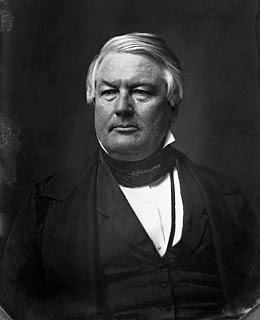
Millard understood.

Giving one’s children ridiculous, bizarre or otherwise perverse names is the height of parental arrogance and narcissism, an abuse of power in which Golden Rule considerations evaporate in the desire to place a distinctive mark on the child of one’s creation, like a brand or a particularly garish tattoo.

There is some weak historical evidence that an oddball name can point a child to leadership or other kinds of singular achievements by isolating him or her from peers. A number of U.S. Presidents have had rare names, with four using their middle monickers to be more distinctive, and one, Lyndon Johnson, being specifically named by his mother so he “would look good on a ballot.” But there is also evidence that strange names are handicaps, and no doubt at all that they risk making children a lot more miserable than calling them Ed, Elizabeth or Frank.

Over at Deadspin, Drew Magary has harsh criticism for the apparently rising trend of wacko names, and all power to him. He combed through a Parents Magazine survey of the names favored by 13,000 people, and arrived at the horrifying conclusion that “Americans are somehow getting even worse at naming children, and they show no signs of correcting themselves.”  Among his trenchant commentary on the names he discovered: Continue reading

Megan Merkel, Road Fick

This isn’t really Megan, just how I prefer to think of her…

We haven’t had a bona fide fick sighting at Ethics Alarms for a while, so welcome to Megan Merkel. A fick, you will recall, coined in honor of Michigan lottery winner/shameless food stamp recipient Leroy Fick, is someone who engages in outrageously unethical conduct and is defiant about it, an individual so ethically deficient that he or she can’t bring themselves to regret or show proper contrition for conduct that is undeniably wrong.

Ms. Merkel, 23, was arrested after her participation in this drama:

According to police, she was driving drunk at 7: 45 AM, northbound on Route 250 in Penfield, a suburb of Rochester, NY, alongside her recently-paroled boyfriend, 22-year-old Mark Scerbo. Scerbo, an idiot, was driving his motorcycle next to Merkel’s car and repeatedly passing it to do wheelies. He lost control of one of them, and hit Heather Boyum, a teacher and mother of two children, who was riding her bike on the shoulder. The impact threw the 40-year-old woman under the wheels of Merkel’s car, causing fatal injuries.  Merkel left the scene and was arrested for DWI.

But wait, there’s more! Continue reading