“Who Ya Gonna Call?” Paranormal Ethics, and the Irony of Same

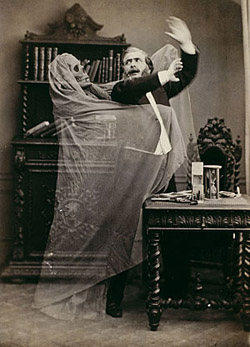
Here we see a common ethics violation: the paranormal researcher has allowed himself to become emotionally involved with his subject...

Any profession, no matter how strange, that thinks seriously about ethics is to be encouraged, and thus it is that Ethics Alarms gives a hearty shout-out to paranormal investigator L.S. Watts, 8 years a ghost-hunter and the co-founder of Grigori Research Institute of Paraspsychology. She has published a set of ethical standards for paranormal investigators that appear to be serious, thorough and well-thought out, addressing issues of professionalism, candor, honesty, conflicts of interest and fairness. Since her profession is by definition likely to be involved with a lot of people who are, shall we say, easy to deceive, and that must also attract more than its share of con artists, humbugs and frauds, there is an obvious need for a clear and sensible ethics code, for which her work would be an excellent starting point. Back in May of 2010, I noted that there was a planned “Town Meeting” on ethics in the field of paranormal investigation, and it’s nice to see progress has been made.

Ms. Watts seems sincere, so I can’t fairly apply the principle I am itching to state, which is that there are activities and fields like astrology, paranormal research, psychics, spiritualism, faith healing, creation science, loan-sharking and hacking for which the only truly valid Code of Conduct would be an extremely brief one that says, “Don’t Do This.” As long as these professions are with us, however, they might as well try to be as ethical as possible.

The Civil Forfeiture Outrage: American Government At Its Worst, So Naturally We Ignore It

Do progressives and conservatives have the courage to confront the illusion-shattering outrage of civil asset forfeiture in America? Not so far they haven’t. That shouldn’t be too surprising.

There are some things our governments do that are so frightening, wrong and un-American that we tend to look right by them—ignore them, pretend they aren’t happening, focus on other things—because their implications are too confounding to deal with. For fans of big government, who look to central authority to micro-manage our economy, distribute our resources, protect us from every threat and isolate us from the consequences (and often the benefits) of human nature, the fact that government power corrupts as surely as any power is an inconvenient (and undeniable) truth that threatens the foundation of their ideology. How irrational is it to place more responsibility on the government if we can’t trust the government, because we can’t trust the inevitably flawed and conflicted individuals who run it?

The willful blindness is no less insidious with conservatives, whose core belief is the inherent goodness of the American system and way of life, as defined by our founding documents. Accepting that the largest and oldest democracy on earth sometimes targets and plots against law-abiding citizens means accepting the possibility that the system itself doesn’t work, and that its supposedly sacred ideals—life, liberty, and the pursuit of happiness—are a cynical lie. Aiding and abetting the blindness is the traditional media, which is substantially populated by self-important, inadequately-educated, ethically-shaky pseudo-professionals who believe their duty to objectively tell the public what it needs to know should be tempered by what they believe will persuade members of the public to adopt the “right” views, and, of course, by what will pull their attention away from the competition. Better to have features about Michelle Obama’s healthy eating crusade than to tell Americans about government wrong-doing, especially when the journalists support the party in power.

As a result of this toxic mix of bias, self-interest, self-delusion and incompetence, many of the most illuminating examples of how far America can go wrong can take a long, long time to enter into public consciousness. A recent example is insider trading by members of Congress, which had been well-documented for a decade before a “60 Minutes” report combined with the Occupy protest visibility and the widespread distrust of Wall Street suddenly made it a significant public concern. But other equally important issues, like the abuse of U.S. convicts, including the tolerance of prison rape, haven’t broken through the willful blindness yet.

Neither has civil asset forfeiture, despite the efforts of libertarian activists, publications like Reason, websites like Popehat, and organizations like ACLU and  The Institute for Justice, a libertarian, human rights public interest law firm that I have been negligent in not plugging earlier. (I apologize.) Right now, the Institute is going to court in a Massachusetts civil forfeiture case, United States v. 434 Main Street, Tewksbury, Mass, that serves as an excellent introduction to the sinister nature of this institutionalized abuse of power. Here’s the story, from the Institute’s website: Continue reading

Teacher Alert: Students Are Not Your Trained Monkeys!

I really, really hate this.

You see, the Hitler Youth was BAD indoctrination and manipulation of children. Forcing students to protest budget cuts is GOOD indoctrination. Understand, students? .

Third through fifth graders at an elementary school in Michigan’s Walled Lake Consolidated School District were assigned by at least one teacher this week to write letters to Gov. Rick Snyder protesting his budget cuts. Students were told the best letters would be forwarded to the governor. According to one parent,  teachers prepped the students with explanations of the cuts—from the teachers’ perspective only, of course. Students also were asked to speak in front of their classmates about why they didn’t like the budget cuts, as if they could have any real understanding of the issue.

Teachers are engaging in gross misconduct and abuse of  power when they use children they have been entrusted to teach  to further their personal, political and economic agendas. This isn’t just indoctrination; it is forced labor and exploitation. The school board has apologized—wonderful. Now when will those teachers be sent packing? My kids and your kids are not trained monkeys to be programmed and manipulated into unwitting political combatants. These teachers are better than the child molesters, but not by much.

When, if ever, the deteriorating education profession agrees on a serious and comprehensive ethics code, it had better include a provision that prohibits this outrageous conduct in the strongest terms.

Funeral Ethics: The Embalmer, the Board, and the Bearskin Rug Baby

Troy Schoeller

Should the state board that licenses embalmers have yanked the license of Massachusetts embalmer Troy Schoeller after he described his work in graphic and disgusting terms to a reporter?

Schoeller is suing, claiming that the discipline violates his First Amendment rights, and I would think that he has a strong case. That’s a constitutional law question, however. My question is: did Schoeller do anything so unethical that it would justify taking his profession away…by telling the Boston Phoenix writer how he works to restore traumatized corpses, how the bodies of fat people react to the embalming process , how revolting the fumes emanating from bodies can be, and, most memorable of all, how he reconstructed the smashed body of a baby “that looked like a bearskin rug,” saying…

“I had to rebuild it in nine hours. I used everything: duct tape, masking tape, tissue builder, wound filler. … I put, like, coat hangers and caulk in there and put him into a little baby outfit. … He looked awesome.” Continue reading

Comment of the Day: “The Legal Profession’s Muddled Standard For ‘Fitness To Practice’”

...and that's why they wear masks!

Interested Blogger, or “IB,” makes some interesting observations about professional ethics enforcement generally and medical ethics in particular in the Comment of the Day, responding to the post, The Legal Profession’s Muddled Standard For “Fitness To Practice.” Her insight regarding the reasons why professionals are so reluctant to pull the licenses of misbehaving colleagues is astute, I think.  Lawyers and doctors are hesitant to punish individuals for doing something they could imagine themselves doing, though the Golden Rule is  being misapplied. It’s a disturbing thought, but an illuminating one: perhaps John Edwards keeps his law license because other male lawyers think, “Boy, that could happen to me: get smitten by some hot babe in the office, we fool around, she sandbags me on birth control…heck, I might panic. I might try a crazy scheme to cover it up, especially if it was all going to be played up in the tabloids. Poor guy! How can we disbar him?”

Here is IB’s “Comment of the Day”: Continue reading

The Legal Profession’s Muddled Standard For “Fitness To Practice”

OK, he has a temper, but hire him as your lawyer, and you can trust him with your life!

I confess: my profession’s standard for discipline bewilders me, and leads me to believe that nobody really knows what kind of conduct by a lawyer should dictate that he or she should be kicked out of the profession. I was reminded of this when I read a report about a former associate at a large New York law firm whose license was suspended for three years because he physically abused his girlfriend. A hearing panel had recommended a 60 day suspension, but the Appeals Court decided on three years.

Here is the basic rule regarding misconduct by lawyers, from the ABA’s Model Rules:

Maintaining The Integrity Of The Profession

Rule 8.4  Misconduct

It is professional misconduct for a lawyer to:

(a) violate or attempt to violate the Rules of Professional Conduct, knowingly assist or induce another to do so, or do so through the acts of another;

(b) commit a criminal act that reflects adversely on the lawyer’s honesty, trustworthiness or fitness as a lawyer in other respects;

(c) engage in conduct involving dishonesty, fraud, deceit or misrepresentation;

(d) engage in conduct that is prejudicial to the administration of justice;

(e) state or imply an ability to influence improperly a government agency or official or to achieve results by means that violate the Rules of Professional Conduct or other law; or

(f) knowingly assist a judge or judicial officer in conduct that is a violation of applicable rules of judicial conduct or other law.

Tell me: which provision did the brutal lawyer violate? Continue reading

Rush Limbaugh’s “Obamaphone” Smear

No, this isn’t what Rush Limbaugh was talking about (these phones are from Kenya). Or rather, this isn’t what Rush was lying about…

When you listen to Rush Limbaugh (something his most vociferous critics almost never do), you usually get one of five things: 1) reliably ideological and sardonically phrased criticisms of progressive and Democrat positions, statements and acts, many of them richly deserving of it, 2) welcome and cheeky tweaking of  favorite targets like the “drive-by media” and Hollywood, 3) over-the-top and pointedly politically-incorrect ridicule of progressive icons and illusions, specifically crafted to make people’s heads explode, 4) off-topic self-indulgent (and boring) discourse about football, cigars and 5) feigned egomania mixed with genuine egomania in such a way that it is almost impossible to guess when Rush’s tongue is in his cheek and when he really is in the midst of delusions of grandeur. All of these are delivered with relentless cheeriness, and with the skill of a marvelously gifted improvisational radio professional—and anyone who denies that really hasn’t listened to him, or hates him so much that objectivity is impossible.

Every now and then, however, Rush is brutally unfair to the point of deception, and when he is, it does terrible damage. He is by far the most listened-to human being on the dial, and when he passes on bad information to so many people who trust him, it triggers millions of e-mails, thousands of blog posts and mass indignation and anger over falsehood. Limbaugh’s negligence, in short, is more harmful than other media figures’ negligence, and he therefore has a special obligation to be careful. Yesterday he was reckless, and dishonest to his listeners. Continue reading

Unethical Quote of the Week: “Today Show” Co-Host Ann Curry

 “What about Caroline [Kennedy], who is still alive?…Did you think about, as you talk about unburdening yourself, the idea that you’ve burdened other people now with this?”

—-“Today Show” co-host Ann Curry,  interviewing Jack Kennedy mistress and teen-aged sex toy Mimi Alford on Thursday’s NBC and suggesting that Alford was wrong and greedy to share the story of how the late President used, abused, and sexually exploited her, as was his habit.

Ann Curry’s Law: “The important thing isn’t getting the true story, but to make sure to avoid telling the truth when it might upset people I like.” Got that, everyone?

That’s right, Ann…why reveal the nasty truth about the misogynistic and ruthless character of an American icon, when it is so much more pleasant to keep lies alive?

Curry is beyond belief. She is supposedly a journalist, and yet her professed concern is how Kennedy family members will react to credible information about one of their own. History, Ann? Understanding who America’s leaders are? Learning the truth? Exploding mythology burnished by a lap dog press and meticulously nurtured by a wealthy family with a well-documented history of adultery and misogyny? Do any of these seem like legitimate goals to Ann Curry? Alford, whose relationship with Kennedy has been thoroughly confirmed, was miserably treated by the sex-addicted President, and yet Curry thinks that the intern has an obligation to protect the Kennedy family. Continue reading

BREAKING NEWS: Whales Aren’t Slaves! PETA Shocked!

"Thank you! And for my next number, 'Nobody Knows The Trouble I've Seen!'"

PETA’s cretinous and offensive lawsuit equating Sea World’s whales with enslaved human beings—just the latest in the organization’s irresponsible “look at us!” tactics—was laughed out of court, as everybody but a breathless NPR interviewer knew it would be. This was yet another example of a lawsuit that any common sense-imbued layman would accurately call frivolous, but a bar association discipline committee would not. A lawyer can ethically take on a lawsuit he or she knows is stupid, foolish, silly, or a “hail Mary” shot, as long as there is a good faith belief that it might/could possibly/ gee, with a little luck and they don’t think about it too carefully prevail. And looking at some of the rulings that come down from various benches and verdicts that creep out of some jury boxes, that means almost no case is unethically frivolous in a legal sense. That doesn’t mean that it is responsible and right for lawyers to help plaintiffs like PETA bring such wasteful lawsuits, just that it isn’t a breach of professional ethics to do so. Continue reading

Ethics Dunce: Dennis “Oil Can” Boyd

Well, I can’t say I’m really very surprised.

And another mystery solved: Why was he called "Oil Can"? Because apparently that's what he has on top of his neck instead of a head.

Former Red Sox pitcher Dennis “Oil Can” Boyd, one of my favorite characters when he was active, admitted this week that he was stoked up on cocaine when he pitched more often than not. “Oh yeah, at every ballpark. There wasn’t one ballpark that I probably didn’t stay up all night, until four or five in the morning, and the same thing is still in your system,” Boyd told WBZ NewsRadio 1030’s Jonny Miller in Fort Myers, Florida, where the Red Sox are about to start Spring Training.  “Some of the best games I’ve ever, ever pitched in the major leagues I stayed up all night; I’d say two-thirds of them. If I had went to bed, I would have won 150 ballgames in the time span that I played. I feel like my career was cut short for a lot of reasons, but I wasn’t doing anything that hundreds of ball players weren’t doing at the time; because that’s how I learned it.” Continue reading