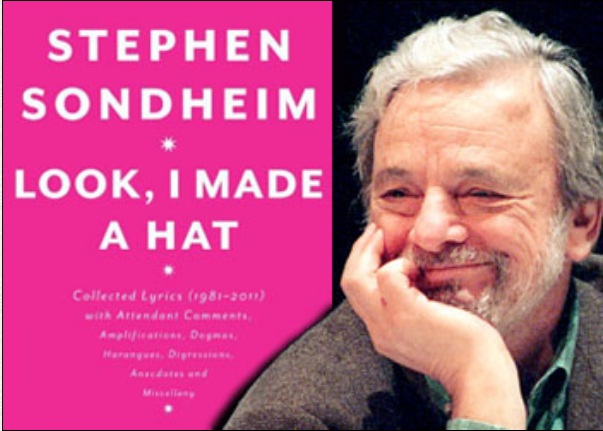
And an ethical hat it is, too!
Readers who are not interested in the art of lyric writing and the mechanics of constructing a Broadway musical should probably avoid the second and final installment of Stephen Sondheim’s chronicle of his creative life, “Look, I Made a Hat.” They will be missing something important nonetheless: a rare example of truly ethical memoirs.
As in his first volume, “Finishing the Hat,” America’s pre-eminent composer-lyricist for the stage reveals himself as a gentleman, an adult, and a thoroughly ethical human being, and does so not by proclaiming his virtues, but by demonstrating them in his writing. He is not uncritical, but always fair and kind. He accepts personal responsibility for projects that failed, and is generous with giving credit for projects that were successful. There is no false modesty in Sondheim about his own skills and achievements, but neither does he seem to overvalue them or seek his reader’s admiration by blowing his own horn.
The line Sondheim walks in both books is fine, and he walks it finely. For example, I initially thought his decision to only criticize the techniques of other lyricists who are dead was a cowardly one, but upon reading both books it is clear that the decision was motivated by kindness. Sondheim takes the craft of lyric-writing very seriously, and his integrity would not allow him to censor a critical observation regarding a colleague’s work when he believed the criticism was illuminating and had merit. Realizing how hurtful a critique from someone of his reputation and accomplishments could be, Sondheim restricted his frank and (mostly) fair assessments to writers beyond wounding. If Jerry Herman isn’t grateful, he should be.
Though Sondheim notes that theater collaborations, unlike those involved in movies, “leave scars,” he never indulges in score-settling. Sondheim makes rueful comments about the bad habits of directors, actors, singers and critics, but almost never designates an offender by name. In contrast, he delivers praise and recounts what he regards as professional and admirable conduct using names generously. There are no breaches of discretion or revealed secrets, no back-stage tales that seek to titillate or amuse at the cost of embarrassment to a past associate or a damaged reputation. How many authors of works about their own lives, especially from the infamously mean, neurotic and ego-driven world of show business, achieve this, or even make the attempt?
Most impressive of all, Sondheim’s books reveal him as possessing the key trait of an ethical person: the determination to engage in regular, unbiased, brutally frank self-examination of his past conduct, motives, and decision-making. It is clear, in fact, that he undertook these memoirs—though he denies they are that, in part because they do not include details of his personal life—precisely for that reason, among others. Sondheim wrote the book to learn about himself, perform brutal self-criticism, and continue to improve, both as an artist and a human being.
In his first volume, I was bothered by his sharp criticism of the lyrics of Oscar Hammerstein, who was Sondheim’s friend, teacher and mentor. It seemed disloyal to me, even though Hammerstein has been dead for half a century. I now realize that Sondheim’s criticism was an act of collegial respect. Hammerstein had been unrestrained in his constructive critiques of Sondheim’s early efforts, and Sondheim’s willingness to subject his own work to the toughest standards was nurtured by his friend and teacher. They didn’t lie to each other, and Sondheim’s critique of Hammerstein’s lyrics continues a relationship of honesty and mutual devotion to a difficult art. (And Sondheim’s criticism of Hammerstein’s lyrics as too frequently careless is spot on. How many times had I heard Mary Martin warble, on my parents’ well-worn LP of South Pacific, “When the sky is a bright canary yellow, I forget every cloud I’ve ever seen!” and thought, “When is the sky canary yellow, and wouldn’t that be a bad thing?” Stephen Sondheim’s explanation: it’s a silly and lazy lyric, that’s all. ) In “Look, I Made A Hat,” Sondheim continues to credit Hammerstein for his development as a lyricist, and quotes his mentor’s advice again and again as guiding principles. There is no betrayal here.
I also found a discordant note of a different sort in the final volume. At the end of the book, Sondheim examines assorted lyrics he has written over the years for special events–birthdays, tributes, and galas. The earliest is a song called “A Star is Born,” which the writer filled with period references and jokes about celebrities of the day, many of which are completely obscure now. In his brief commentary about the piece, Sondheim writes,
“Like one of the things I deplore about Noel Coward’s lyrics, this one has a preponderance of jokes about sexual deviance.”
My initial reaction was that this was a peculiar and callous slap at a large part of Sondheim’s most devoted fandom, the gay community. “Sexual deviance” is, at least to my ear, a pejorative term for homosexuality and gay sex, something I would expect to hear from Rick Santorum or Michel Bachmann, but not from the creator of Company.
Having thought about it some more, however, I am convinced that Sondheim deserves a pass. He’s 80 now; some of his word use, as much of a master of language as he is, reflects his generation. I don’t think Sondheim intended the term “sexual deviance” to be negative. I think his intent was to state that he believed making jokes about sexual orientation was rude and in bad taste….cheap. Sondheim also uses the term “chat rooms” when he refers to arguments on the web; he hasn’t quite caught up to blogs yet. His memoirs so solidly confirm his character as kind, fair and ethical that it would be foolish to interpret one off-key comment out of that context. Again, there is no betrayal here, just a poor choice of words.
My dawning admiration of Sondheim’s character as revealed in “Look, I Made a Hat” was not fueled by the kind of artist-worship so many of his followers exhibit. My respect for his work, technique and professionalism has no bounds, my ability to enjoy some of his work it does. I must mention, however, that I had a remote encounter with the man that was consistent with my judgement of his ethical nature. Several years ago, my theater company had tentatively scheduled a production of “The Frogs,” the short and peculiar Sondheim adaptation of Aristophanes originally performed in a swimming pool. Then we learned that the licensing rights had been pulled by the authors, because a revival was being prepared for Broadway. Since the revival would be substantially rewritten, I thought it was worth making the argument that the two shows would not interfere with each others, and I wrote to Sondheim pleading for a dispensation, pointing out that our season subscriptions had already been sold, and as a small regional company in Virginia, we hardly posed a realistic threat of competition. In such situations, and I have had them before, the usual responses are 1) nothing or 2) “No.”
To my amazement, Stephen Sondheim replied with a personal, hand-written letter. The answer was still no, but he explained why it was no, and also was genuinely sympathetic to our plight, and apologized for the conflict. The tone was genuine, friendly, and collegial.
That strongly suggested to me that he is an ethical person.
His books prove it.
 Ethics Alarms
I welcome your updated opinion and criticism, and can i borrow your copies? I’m really glad my gut feeling about him, from his work and interviews (including the live one a few years back at the KenCen), is borne out by the books.