"I'm sure there's a perfectly rational explanation for this. Let's go figure it out in a motel."
The Comment of the Day is an interesting one from Melissa Leath, a psychic who is published on the topic of psychic ethics. She is responding to the recent post here about proposed standards for paranormal investigators.
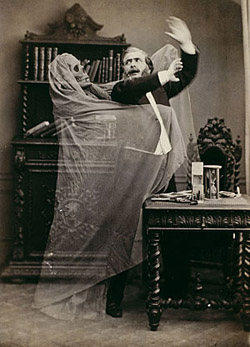
Her measured response forces me to confront my own ambivalence on this issue. I am, as she says, a skeptic; more than a skeptic, really, as I intellectually am committed to the position that all paranormal, psychic and spiritual phenomenon, including those in the realm of religious believe, are imaginary at best and fraudulent at worst. I would have said “unshakably committed, ” but emotionally, I have to confess am not as sure as I would like to be, or should be. Perhaps I watch too many horror movies. I don’t like Ouija boards, and won’t have the damn things in the house. If my kitchen furniture suddenly rearranged itself like it does in “Poltergeist,” or if my ultra-rational son started telling me that an old man in 1940s clothes kept appearing in his room at night and saying that he was going to hurt him, or if I saw dark, inky shadows crawling up the wall like in “The Grudge,” I can say with conviction that I would not be the one insisting that there must be a rational explanation and hanging around waiting for the bed to start raising off the floor. I would be the one out the door and checking into a motel, and from the safety of which insisting that there was a rational explanation, but also secretly fearing that my house had been built over a Native American burial ground.
I realize that this is inconsistent and silly. But I have a good friend who is as normal and sincere as someone can be who is a serious astrologer. And when I see the late Telly Savalas finally tell his personal ghost story in a YouTube clip, after personally watching him refuse to repeat it on TV talk shows for decades because “it was too scary,” I do wonder, even as I rebuke myself for wondering. Knowing that I wonder, however, it is only fair to give Melissa her say.
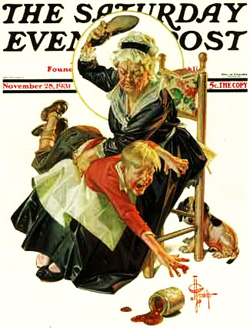
The societal approval pendulum has swung so far away from physically punishing children that a formal spanking risks an accusation of child abuse. The Hawaii Supreme Court, in the case of Hamilton ex rel. Lethem v. Lethem, in which a retraining order was issued against a father accused of abusing his 15-year-old daughter, pronounced guidelines for determining what constitutes reasonable and moderate corporal punishment of a child by a parent, ruling that such punishment is reasonable (and a Constitutional right ) when..
“…the parent’s discipline is reasonably related to the purpose of safeguarding or promoting the welfare of the minor,”
The punishment properly takes into account the nature of the misbehavior,
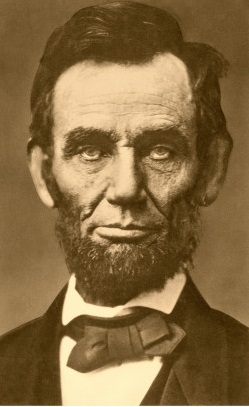
“Neither let us be slandered from our duty by false accusations against us, nor frightened from it by menaces of destruction to the Government nor of dungeons to ourselves. Let us have faith that Right makes Might, and in that faith, let us, to the end, dare to do our duty as we understand it.”
— Abraham Lincoln, 16th President of the United States, on February 27, 1860 in his Cooper Union Addressexpounding on the Founders’ beliefs regarding the regulation of slavery.
February 12 is the birthday of America’s most brilliant, bold and eloquent leader, Abraham Lincoln, born this day in 1809. You would hardly know it from the apathy of most of the news media, which is happy in its laziness to defer any honor of the man who saved the Union and ended slavery to “President’s Day,” which is still officially a celebration of George Washington’s birth. No slight against George, but Abe deserves better from us.
Happy Birthday, Abe. The nation can never repay its debt to you, but it can make itself better by striving to meet the aspirations you set for us
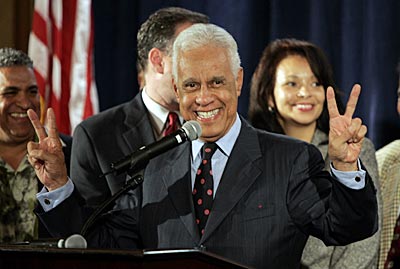
“Nearly 20 years ago, former Virginia governor Douglas Wilder announced that he wanted to create a museum that would tell the story of slavery in the United States. He had the vision, the clout, the charm to make it seem attainable, and he had already made history: the grandson of slaves, he was the nation’s first elected African-American governor.
“He assembled a high-profile board, hosted splashy galas with entertainer Bill Cosby promising at least $1 million in support, accepted a gift of some 38 acres of prime real estate smack along Interstate 95 in Fredericksburg and showed plans for a $100 million showstopper museum designed by an internationally renowned architect.”
And now? Now the U.S. National Slavery Museum project is bankrupt, filing for protection last fall. Claims against it total more than $7 million. The city of Fredericksburg has threatened to sell the land to make up for almost $200,000 in unpaid real-estate taxes. Officials have asked the court to either liquidate the organization or to appoint a trustee to oversee its finances. Through all of this, the Post reports, Doug Wilder has remained aloof, refusing interviews or even to answer phone calls. Having created the project, started an organization, induced collectors and other citizens to contribute priceless artifacts and documents to the aspiring museum’s collection, and accepted contributions, all in the justified belief that he, an established political leader, a powerful member of the African-American community and someone with access to resources and allies, would see the project through to a successful conclusion, whatever it took. Instead, Wilder abandoned the project he began completely, leaving to others the responsibility of organizing and guiding it, and making certain that its promises were fulfilled. Continue reading →
Whitney Houston, she of the musical gift we may see only once in a lifetime, is dead at 48. There has been no final determination, but there is little doubt: drugs killed her.
Houston, they say, and I have no reason to doubt it, was troubled by the pressures of show business, celebrity and stardom, and with a little help from her dead-beat, abusive husband, singer Bobby Brown, sought to relieve the stress with a variety of illegal substances, including cocaine. Over the past 15 years or so, Americans have been able to watch the relentless deterioration of Houston, once the epitome of a beautiful, intelligent, ebullient and charismatic presence, into an emaciated, ruined shell with only a hint of the glorious instrument that once, in the middle of a war abroad, delivered the most stirring rendition of the Star-Spangled Banner I have ever heard, or ever will hear.
This happened to Whitney Houston because when illegal drugs were among the options she could have chosen to accept or reject as a way to get through difficult days and troubled times, she did not have the instant reaction, hard-wired in her brain, that has to stop all of us from doing terrible, dangerous, irresponsible and anti-social things. There can be little doubt that some theoretical options would have triggered that reaction. They would be the options that did not seem like options at all, because the culture Whitney Houston lived in was unequivocal and unshakable in its verdict, a verdict virtually all members of that culture naturally adopted and accepted—because that’s what cultures do. And when that option presented itself, Whitney Houston, like the culture she was a part of, would have said “No.”
That she didn’t say no to drugs, and is dead because of it, was the direct result of an American culture that does not give its constituency a clear message and verdict. Instead, the clearest and most unequivocal signal from the culture, the fact that recreational drugs are illegal and that America enforces the laws against them, is progressively weakened by ridicule, attack, popular culture, and the defiance or hypocrisy of role models and public figures. Incredibly, though the deaths by drug-abuse among the tiny proportion of the world that is famous and talented—Michael Jackson, Amy Winehouse, Whitney—should make it obvious how massive the number of anonymous victims of drug abuse there must be, the destructive refrains grow louder: Legalize drugs! End the War on Drugs! And those calls weaken the cultural resolve further. Actually doing what they advocate would cripple it….and that day might come.
Whether they are preventing the culture from rejecting drug use because enforcement is expensive, or because they have a relative or friend in prison for drug-dealing; whether they are calling for legalization because they are libertarians and academics or Ron Paul, or because they are public officials who see a new revenue source; whether they are longing for the halcyon days of Haight-Ashbury and the Strawberry Alarm Clock, or just like getting stoned, these are the people whose advocacy continues to nurture a competing culture that killed Whitney Houston, as surely as if she had been shot her between the eyes.
I would say that if their insistence on legalization is followed, and the nation’s laws join the popular throng in pronouncing addictive and life-destroying drugs as legitimate “options,” many more like her will die….except there aren’t many more like her. But there are countless lives to destroy, and unimaginable losses to families, businesses and America to be endured.
I just watched the video of Whitney Houston’s glorious performance of our National Anthem at the Super Bowl, before the drugs had finished their work. She radiates confidence, strength and character, as well as that special joy that the fortunate few with magical gifts have. She brings a stadium full of Americans to their feet in cheers, with an exhibition of artistry that will continue to inspire forever. Drugs took all of that away, from Whitney Houston and from us.
Because our culture could not say no with enough conviction to save her.
Update (2/15/12): With some regret, I am closing comments on this post. Too many commenters refused to discuss the issue it was intended to raise, which was how cultural approval and disapproval of conduct is more powerful, ultimately, than the law in establishing standards. I have committed on this blog to responding to as many comments as possible, but the onslaught of pro-drug zealots whose tactic was to keep repeating the same arguments no matter how many times I gave my response led me into too many frustrated responses, too many nasty exchanges, and too many hasty replies that I wish I had stated more clearly. For those I apologize, both to the visitors involved and other readers. I also apologize for ending the discussion here, but I don’t have the time to monitor it. You are welcome to e-mail me personally.
The Martin Luther King Memorial Commission meets to address the quote controversy
When we last left the star-crossed Martin Luther King Memorial on the National Mall, Secretary of the Interior Ken Salazar had boldly declared that the Interior Department was ordering the embarrassing misquotation of the martyred civil rights leader changed, so he would not sound to future generations like “an arrogant twit,” in poet Maya Angelou’s neat phrasing. Now a war of words and intentions has broken out, with Salazar declaring that the entire made-up quotation (“I was a drum major for justice, peace and righteousness.”—something King never said, and probably never thought, either) had to be removed, and the correct quote (“…if you want to say that I was a drum major, say that I was a drum major for justice. Say that I was a drum major for peace. I was a drum major for righteousness. And all of the other shallow things will not matter.”) added, and Ed Jackson, the architect who oversaw the memorial’s development for years, saying that Salazar’s plan would wreck the structure. Asked if there was any way to remove the inscription from the memorial without destroying it, Jackson answered, “No.” Continue reading →
Here we see a common ethics violation: the paranormal researcher has allowed himself to become emotionally involved with his subject...
Any profession, no matter how strange, that thinks seriously about ethics is to be encouraged, and thus it is that Ethics Alarms gives a hearty shout-out to paranormal investigator L.S. Watts, 8 years a ghost-hunter and the co-founder of Grigori Research Institute of Paraspsychology. She has published a set of ethical standards for paranormal investigators that appear to be serious, thorough and well-thought out, addressing issues of professionalism, candor, honesty, conflicts of interest and fairness. Since her profession is by definition likely to be involved with a lot of people who are, shall we say, easy to deceive, and that must also attract more than its share of con artists, humbugs and frauds, there is an obvious need for a clear and sensible ethics code, for which her work would be an excellent starting point. Back in May of 2010, I noted that there was a planned “Town Meeting” on ethics in the field of paranormal investigation, and it’s nice to see progress has been made.
Ms. Watts seems sincere, so I can’t fairly apply the principle I am itching to state, which is that there are activities and fields like astrology, paranormal research, psychics, spiritualism, faith healing, creation science, loan-sharking and hacking for which the only truly valid Code of Conduct would be an extremely brief one that says, “Don’t Do This.” As long as these professions are with us, however, they might as well try to be as ethical as possible.
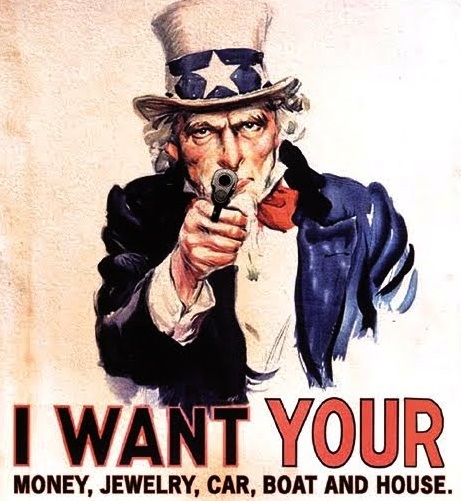
Do progressives and conservatives have the courage to confront the illusion-shattering outrage of civil asset forfeiture in America? Not so far they haven’t. That shouldn’t be too surprising.
There are some things our governments do that are so frightening, wrong and un-American that we tend to look right by them—ignore them, pretend they aren’t happening, focus on other things—because their implications are too confounding to deal with. For fans of big government, who look to central authority to micro-manage our economy, distribute our resources, protect us from every threat and isolate us from the consequences (and often the benefits) of human nature, the fact that government power corrupts as surely as any power is an inconvenient (and undeniable) truth that threatens the foundation of their ideology. How irrational is it to place more responsibility on the government if we can’t trust the government, because we can’t trust the inevitably flawed and conflicted individuals who run it?
The willful blindness is no less insidious with conservatives, whose core belief is the inherent goodness of the American system and way of life, as defined by our founding documents. Accepting that the largest and oldest democracy on earth sometimes targets and plots against law-abiding citizens means accepting the possibility that the system itself doesn’t work, and that its supposedly sacred ideals—life, liberty, and the pursuit of happiness—are a cynical lie. Aiding and abetting the blindness is the traditional media, which is substantially populated by self-important, inadequately-educated, ethically-shaky pseudo-professionals who believe their duty to objectively tell the public what it needs to know should be tempered by what they believe will persuade members of the public to adopt the “right” views, and, of course, by what will pull their attention away from the competition. Better to have features about Michelle Obama’s healthy eating crusade than to tell Americans about government wrong-doing, especially when the journalists support the party in power.
As a result of this toxic mix of bias, self-interest, self-delusion and incompetence, many of the most illuminating examples of how far America can go wrong can take a long, long time to enter into public consciousness. A recent example is insider trading by members of Congress, which had been well-documented for a decade before a “60 Minutes” report combined with the Occupy protest visibility and the widespread distrust of Wall Street suddenly made it a significant public concern. But other equally important issues, like the abuse of U.S. convicts, including the tolerance of prison rape, haven’t broken through the willful blindness yet.
Neither has civil asset forfeiture, despite the efforts of libertarian activists, publications like Reason, websites like Popehat, and organizations like ACLU and The Institute for Justice, a libertarian, human rights public interest law firm that I have been negligent in not plugging earlier. (I apologize.) Right now, the Institute is going to court in a Massachusetts civil forfeiture case, United States v. 434 Main Street, Tewksbury, Mass, that serves as an excellent introduction to the sinister nature of this institutionalized abuse of power. Here’s the story, from the Institute’s website: Continue reading →
You see, the Hitler Youth was BAD indoctrination and manipulation of children. Forcing students to protest budget cuts is GOOD indoctrination. Understand, students? .
Third through fifth graders at an elementary school in Michigan’s Walled Lake Consolidated School District were assigned by at least one teacher this week to write letters to Gov. Rick Snyder protesting his budget cuts. Students were told the best letters would be forwarded to the governor. According to one parent, teachers prepped the students with explanations of the cuts—from the teachers’ perspective only, of course. Students also were asked to speak in front of their classmates about why they didn’t like the budget cuts, as if they could have any real understanding of the issue.
Teachers are engaging in gross misconduct and abuse of power when they use children they have been entrusted to teach to further their personal, political and economic agendas. This isn’t just indoctrination; it is forced labor and exploitation. The school board has apologized—wonderful. Now when will those teachers be sent packing? My kids and your kids are not trained monkeys to be programmed and manipulated into unwitting political combatants. These teachers are better than the child molesters, but not by much.
When, if ever, the deteriorating education profession agrees on a serious and comprehensive ethics code, it had better include a provision that prohibits this outrageous conduct in the strongest terms.
Should the state board that licenses embalmers have yanked the license of Massachusetts embalmer Troy Schoeller after he described his work in graphic and disgusting terms to a reporter?
Schoeller is suing, claiming that the discipline violates his First Amendment rights, and I would think that he has a strong case. That’s a constitutional law question, however. My question is: did Schoeller do anything so unethical that it would justify taking his profession away…by telling the Boston Phoenix writer how he works to restore traumatized corpses, how the bodies of fat people react to the embalming process , how revolting the fumes emanating from bodies can be, and, most memorable of all, how he reconstructed the smashed body of a baby “that looked like a bearskin rug,” saying…
“I had to rebuild it in nine hours. I used everything: duct tape, masking tape, tissue builder, wound filler. … I put, like, coat hangers and caulk in there and put him into a little baby outfit. … He looked awesome.” Continue reading →




 Ethics Alarms