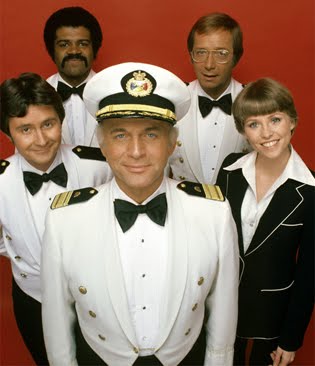
If Captain Stubing had been at the helm, a tragedy might have been averted.
Rescue is a frequent topic on Ethics Alarms, usually in a disturbing context. We all have a duty to rescue others in peril, but we should never underestimate the powerful forces that often work against that duty. Rescue can be dangerous or frightening, and often there are perplexing questions about when an individual has done enough to ensure a rescue, and what constitutes “enough,” especially if the rescue fails.
In March, the Star Princess—a luxury cruise ship operated by Carnival—was on a cruise around South America. Three of the passengers were bird-watchers, who eschewed shuffleboard and the other fun activities organized by whoever was the counterpart to Lauren Tewes on “The Love Boat” to use their binoculars and telescopes to spot seabirds from the ship’s decks.
It was March 10 when one of the bird-lovers, Jeff Gilligan from Portland, Oregon., saw a boat with a person standing up in it, waving a dark piece of cloth. The vessel was at least a mile away. Another Oregon bird-watcher, Judy Meredith, told reporters that when she focused her lenses on the boat, it was clear to her that the man waving the cloth was trying to get the Star Princess’s attention, and that the boat was drifting, without an engine. She went inside to try to alert the crew about the situation. After she talked to one crew member, she says, he called the bridge and she talked him through what she and Gilligan had seen.”I was trying to have a sense or urgency in my voice — and tell them that the boat was in distress, and they were trying to get our attention.” Another crew member used Gilligan’s telescope to look at the drifting boat, and confirmed their assessment. The boat was drifting in the open seas and in peril. Gilligan said that at that point “We were a bit relieved because he had confirmed that he had seen what we were describing. We expected the ship to turn back or stop or something.”
It did not do any of those things, however. The bird-watchers assumed, or hoped, that the captain had contacted authorities elsewhere to send a rescue operation. When Meredith didn’t hear back from the crew, she recorded the ship’s coordinates and sent an email to a Coast Guard website. There was no reply.
After the voyage, Meredith continued to be concerned about the fate of the drifting boat and its occupants. She contacted Princess Cruises, and learned that the Star Princess captain had not only failed to report the imperiled vessel, he had re-written the facts. The ship had been passing through a fishing fleet, his log claimed. Officials told her that the Star Princess contacted the fishermen on the boat and “that they were asking the [Star Princess] to move to the west, because they didn’t want their nets to be damaged. And that the ship altered course. And they were waving their shirts because they were thanking the ship.”
It was a lie.
Later, the Ecuadorean coast guard picked up a small fishing boat near the Galapagos Islands with one survivor aboard: 18-year-old Adrian Vasquez. Two other men on the boat were dead of exposure and dehydration. They had been adrift for 28 days.
Right now, Princess is in full defensive posture, using a lot of “allegeds” and suggesting that the captain’s account is accurate. But Vasquez was shown a photo the birder-watchers took of the fishing boat they saw. “That’s us,” he said.
A few conclusions from this tale:
- With the anniversary of the Titanic’s sinking still on our minds, it is hard not to wonder how often this has happened. In 1912 more than one ship, notably the California, were within range of a timely rescue of the doomed vessel and ignored Titanic’s distress calls, including its distress flares.
- After the performance of the captain in the Costa Concordia capsizing earlier this year, the revived memories of Titanic’s Capt. Smith’s foolishness in causing that wreck and his paralysis after it occurred, the way that purser got everyone drowned in “The Poseidon Adventure,” and now this, I’m not trusting cruise ship captains and crews. I don’t think ethics is on the ship manifests.
- The disgraceful actions of the Star Princess appear to violate maritime law, which require ships to come to the aid of other vessels…not that such a law—it’s a very, very old one— should be necessary.
- The bird-watchers, especially Meredith, did everything right, and fulfilled their obligations as rescuers by informing professionals who had the opportunity, the resources and the ability to complete the rescue. The fact that the Star Princess failed its duties does not diminish their status as ethics heroes.
- The diligence of Judy Meredith in following up on the incident is also praiseworthy, and will extract some good out of this episode. Thanks to her, the Star Princess captain and the cruise line may have to pay the price of the despicable breach of decency and maritime law. Also thanks to her, we have a clearer understanding of the character of the some—too many—of the professionals we entrust out lives to when we board “The Love Boat.”
[Thanks to reader Kevin Krasnansky for the tip and the angle.]
 Ethics Alarms
Oops. It happened on March 10. I was on board the Star Princess myself. I did not hear anything about this incidence on board the ship. That means this incidence was not elevated high enough to be considered urgent. I did not even hear anything from the dining room waiters or the buffet waiters or fellow passengers. How many people saw that fishing boat anyway. There were lots of people on the ship and why the 3 bird watchers not tell other peoples too if they believe that to be a distress fishing boat, they should do whatever they can including climbing up the life boat themselves to get the attention of the captain. Or ask somebody to climb up the life boat. May be they did not want to alarm other pasengers? This is life and deadth. I don’t mind to be alarmed. I think people nowadays are too apathetic. None the less, If I knew about the incidence. I certainly would not stop at anything until I saw the captain myself and ask for his explanation of why no rescue operation. The captain was a very nice guy and I do not believe that he will not rescue the fishermen.
If we do a Postpartum now about the incidence, there is a big question to ask.
Did the birdwatchers really believe that the fishermen were in trouble and required help?
If the answer is Yes, then it was the birdwatchers inability to raise this situation to the attention of the captain. There was no fault on the birdwatchers part because they told somebody. But, they certainly cannot be called Heroes. It was their inability or indifference that indirectly causes the death of the 2 fishermen. They would go to the room and used internet to notify some people while the help is right at hand if they stop at nothing until they got the captains attention and met with the captain face to face to discuss the situation. If they were real Heroes, they would stop at nothing until they got some response from the captain directly right there and then. Time is of the essence. Heroes go into burning houses to rescue people. Heroes stop at nothing until they got the results.
If the answer is No, then Case Closed and nobody is at fault, not even the captain, because people in smaller boats waived at big cruise ship all the time everywhere.
Pingback: Two die, due to Princess "breakdown in communication".