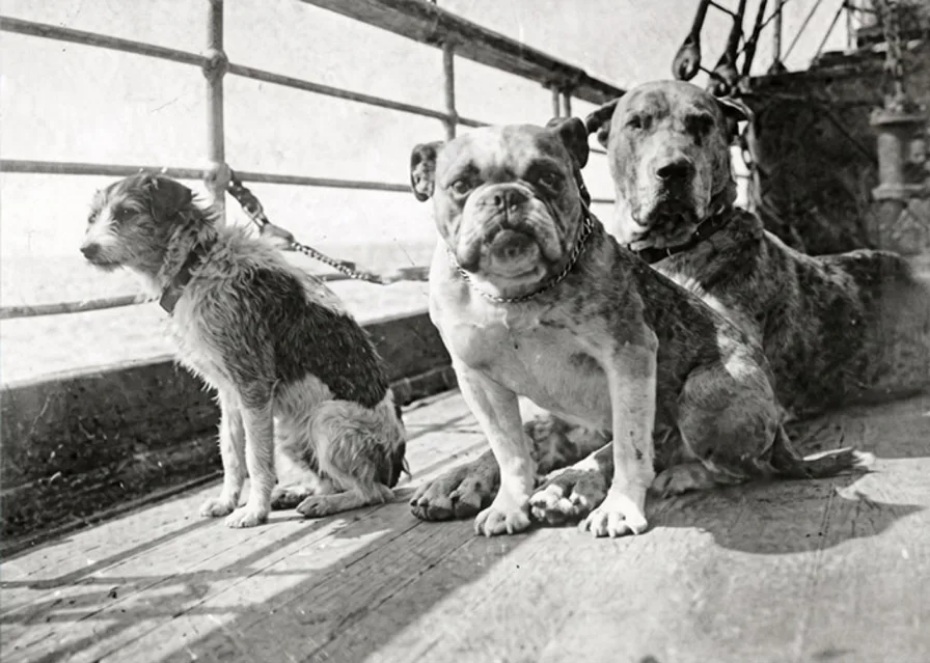
According to J. Joseph Edgette from Widener University, there were twelve dogs that have been confirmed as passengers on the iconic doomed ship, which sank in April of 1912. Three of the dogs survived; they were all small breeds that their owners could wrap up in blankets and hide in their coats. The crew told passengers (only the First Class passengers brought their dogs) that the limited number of life boats meant that dogs would have to be left behind.
When the ship struck the iceberg and it became clear that it was going down, the dog-loving steward in charge of the ship’s kennel released all of its canine occupants, which then ran all over the ship, surely confused, while the chaos intensified. (How did James Cameron not use that in his movie?) The three survivors were all kept in their owners’ staterooms. Lady, a Pomeranian belonging to passenger Margaret Hays, was one; Sun Yat Sen, a Pekingese belonging to Myra Harper and Henry Harper, was another, and a second Pomeranian owned by Martin and Elizabeth Rothschild was the third lucky dog.
The larger dogs that died included a King Charles Spaniel, a Poodle, a Borzoi, an Airedale, another large terrier, a Chow-Chow, a Fox Terrier, a French Bulldog and a Great Dane.
According to Titanic lore, Ann Elizabeth Isham owned the Great Dane pictured above. Rather than leave him to die alone, she chose to stay behind and comfort her beloved dog as the sea rushed in. Isham was one of the four first-class female passengers who lost their lives on the Titanic, but the only one who allegedly decided to die rather than leave her pet.
In fact, there is no evidence that she really died that way, or that she ever owned a dog, much less died with one. Nonetheless, Isham has acquired a saintly reputation among dog lovers, so let’s assume she did die rather than abandon her dog.
Your Ethics Alarms Change-of-Pace Ethics Quiz of the Day is…
Was that decision rational and ethical or emotional and irresponsible?
Would you do that under similar circumstances?
I’m pretty sure my late wife Grace would have.
Incidentally, there is another famous dog story about Titanic that has also been debunked. Supposedly a Newfoundland named Rigel belonging to Titanic’s First Officer William Murdoch was able to withstand the freezing waters after the ship sank. As the rescue ship Carpathia approached, nobel Rigel barked so loudly that the ship could locate the lifeboats.
The tale is fiction. Murdoch had no dog on board. No survivor mentioned “Rigel.” The story apparently first popped up in 1912, in “The New York Herald.” See? The news media was making stuff up even back then. The news reporter also claimed that Donald Trump was to blame for the sinking.
Kidding!
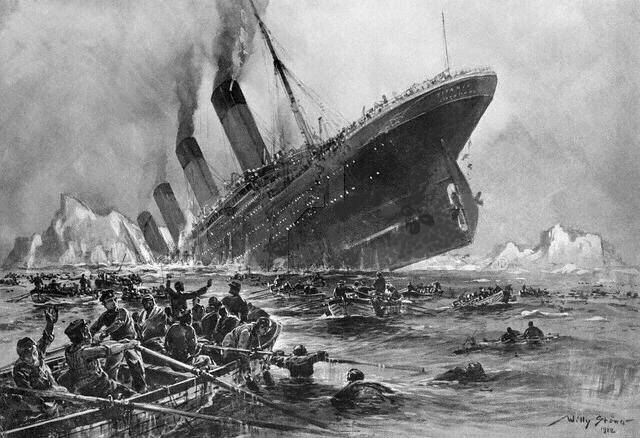



Michael West has written a remarkable Comment of the Day in several respects. For one thing, it is a comment on a post that is almost eight years old, a record for Ethics Alarms. For another, he becomes the first commenter to comment on the same post under two different screen names. Finally, there is the fact that his point is one with historic validity, yet seldom if ever mentioned by the many critics of James Cameron’s epic yet intermittently ridiculous film, including me. Follow the tag: there are a lot of references to “Titanic” here.
One note in prelude to Michael’s essay: the cruel misrepresentation he alludes to can be partially laid at the now dead feet of Walter Lord, who wrote the influential and popular account of the Titanic’s sinking, “A Night To Remember.” It is an excellent account, but he decided to use Charles John Joughin as comic relief, and the movies, including the one based on his book, distorted his portrayal, which itself seems to have been unfair.
Here is Michael West’s Comment of the Day on the 2012 post, “Titanic Ethics”