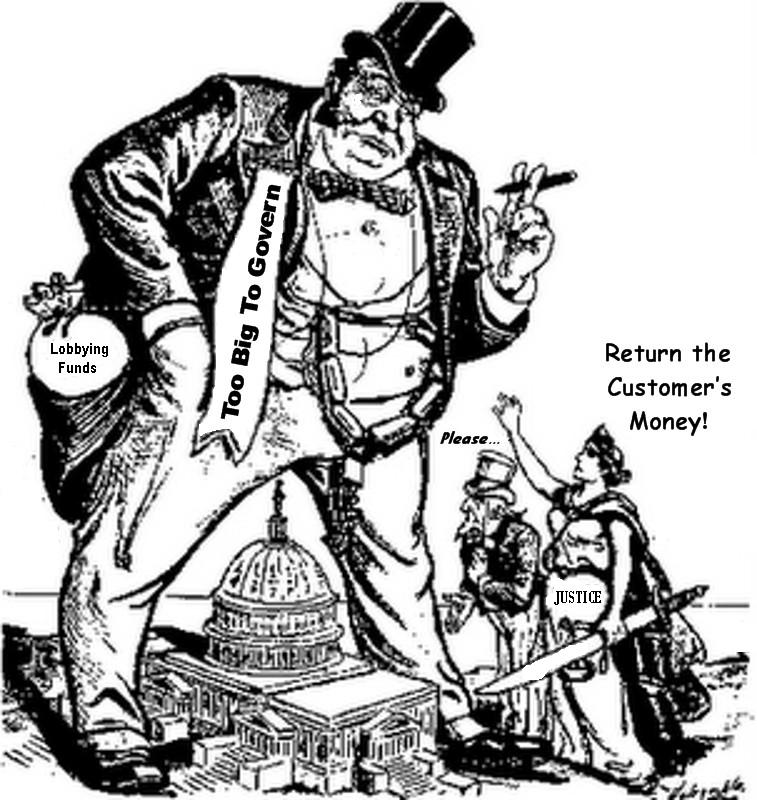
This was not my father. For one thing, he was shorter.
My sister and I finally settled up the estate of our parents after over a year of paper signing, meetings with accountants, and mind-numbing calculations. The estate, as my folks wanted it, was divided 35%-35%-30%, with the last portion going into a trust for the three grandchildren. The amount of money in the estate was a shock to my sister and me, and a very pleasant surprise, though for all the problems the money will solve, we would have forfeited all of it to have Mom and Dad alive today. Still, being able to give over substantial assets to their children and grandchildren was one of their lifelong goals, and they would have been satisfied and proud that they succeeded so spectacularly.
My sister, a good, reliable liberal, asked me whether I felt guilty about the inheritance. I said yes, in the sense that I wish our parents hadn’t been so resolutely frugal in their retirement, and had spent more of the money they earned and saved on more of their own pleasure and enjoyment rather than squirreling it away for us. But did I feel any pangs of conscience because the money wasn’t going to Uncle Sam’s coffers?
Absolutely not.
The reasoning behind the estate tax, now at a low ebb thanks to the Bush tax cuts but certain to rise precipitously soon, is hard to defend ethically. Most of the money in decedents’ estates has been taxed as income already. Why the death of the family members who earned the money should allow the government to claim a large chunk of it is hard to answer other than with the statement, “Because the government has the power to do it.” Harder to answer questions are these:
- Why shouldn’t a father and mother who sacrifice and save to provide a life foundation for their offspring and descendants be encouraged by government policy to do so?
- Why should the assets of families who plan and sacrifice for the future be taken by the government to redistribute to families that do not?
- If it is determined that the government needs to assist families in difficult financial straits, why should taxes for that purpose fall most heavily on the assets those who invest, save, and provide for their children, rather than those who are less responsible, generous, and frugal?
- Why should the government be able to arbitrarily decide what is “too much” for parents to pass on to their own children and heirs?
- What sense does it make to have laws in place that encourage parents to squander their money while they are alive rather than save it to provide their children and grandchildren with more resources and security?
In a case like that of my parents, the typical Occupy Wall Street arguments insinuating that accumulated wealth comes from fat, worker-exploiting robber barons who sit inert in plush leather chairs as the dividends roll in are inoperable. Both Jack and Eleanor were Depression kids in poor families. My father was raised by a single mother who had to move from one cheap rented home to another; my mother’s father was a cook. My mom never got to go to college, the disappointment of her life, because she couldn’t afford it; my father was able to do so only because of the G.I. Bill. Neither had much when they married; after the down-payment on the modest, two-bedroom Cape Cod house they bought in Arlington, Massachusetts (and where they lived for over half a century), they had virtually nothing at all. My mother stayed at home until my sister and I were in high school, and my father was never anything more than a middle manager at various companies, banks and associations. Yet they invested well, clipped coupons, and were grimly determined to make certain that their children and their children’s children had more to support their life’s goals than they had, and they succeeded spectacularly. Why is it right, or fair, for the government to take any of the results of their selfless project? By what logic or ethical reasoning can eliminating the estate tax, or limiting it, be fairly called “taking money from the poor to give to the rich,” when the estate tax foils the efforts of humble people like my parents?
I should make one thing clear: in the nation’s current precarious financial circumstances, I support an estate tax, and a fairly stiff one—not because it is fair, but because it is now unavoidable. The estate tax must be tightened, and applied directly to the national debt, not sent into the maw of general revenue to pay for mind-readers at GSA conferences, fake Presidential missions that are thinly-disguised campaign photo-ops, grants to the Muslim Brotherhood or loans to sleazy “green” energy start-ups. I was in favor of this before my parents died, too, but then, as now, I resented the argument that there was anything unethical in allowing my family or any family to proudly pass along their accumulated wealth to following generations. Incompetent and cowardly leadership may have made that practice incompatible with the nation’s fiscal survival, but they did not make it wrong.
____________________________________
Graphic: Jesse’s Cafe Americain
 Ethics Alarms
Why should the fruits of one’s life labors not go to one’s chosen inheritors? By industry and frugality were those assets acquired. Governments are non-industrious by nature and, even in the best of times, are hardly known for their frugality. Estate taxes, death taxes, capital gains, etc… all these are not only legitimized theft by government, but actually depress a free economy by discouraging the very virtues that made those assets possible. Taxes are a necessary evil. But taxes that inhibit the general welfare are destructive of the very purpose of a government in a free society.
Your case would certainly not be “taking from the rich and giving to the poor.” (1) What your parents did was loving in the extreme, and embodies the kind of financial responsibility that used to be a model American practice. (2) If your inheritance had fallen above the no-tax limit, I have no belief whatsoever that your tax would “go to the poor.” Surely it would go into the great maw of government funds, perhaps allow even more than the 50% of Americans who already pay no Federal tax, allow the Feds to negotiate even better government worker union rates, blow more money on useless projects and outrageous “parties” for government workers, etc. and ad nauseum.
Your points are well made, but is there any reason why estate taxes are more unethical than any other tax? Almost all taxes involve taking money from people presumably earned it, obtained it as a by-product of saving (in the case of dividends and capital gains) or received it as a gift or bequest from someone who earned and saved it. Given that, as you say, taxes are necessary for the functioning of society and for paying down the national debt, what is the ethical thing for governments to do (aside from not wasting money)?
Sure—because the money has been taxed once already, by the people who earned it. After that, they should be able to do with it what they want. The logic behind other taxes is that the government deserves a fair share—the psychology behind estate taxes is punitive, for conduct that should be encouraged and rewarded.
But the same logic would apply to consumption taxes. If I earn money, I am taxed on it first through income tax and then another time when I spend it.
Most taxes can be seen as “punitive” in a sense. An income tax punishes me for earning money. A consumption tax punishes me for buying things. A dividend or capital gains tax punishes me for investing money. The only “non-punitive” tax would be a poll tax, and I suppose even that punishes me for existing.
This and the preceding post probably make me sound like an anti-tax crusader. I’m not. I acknowledge that taxes are necessary and that all methods of collection have benefits and drawbacks.
No, because you have a choice not to buy the commodity—it is the conduct being taxed, not the money.
I don’t think an income tax punishes us for earning money. An income tax is a reasonable way to assess the real costs of the benefits conferred by a nation on its citizens, while making sure that those who can pay the most without hardship do so.. An estate tax, in contrast, is based on the undemocratic concept that the government “owns” everything, and we get to keep it via the noblesse oblige of the state, if we’re lucky.
When income taxes become punitive,and are designed to “level the playing field”,I have the same objection to them. That’s not an ethical function of taxes. Taxes have to pay for what the government legitimately spends, and by that standard, we are under-taxed.
Okay, I think understand what you mean.
Both income and consumption taxes reduce the incentive to work hard throughout our productive lifetimes. Right now I’m trying to decide whether I want a career which judging by the pay scale, society values highly or one that pays less but is probably more enjoyable. I am acutely aware of how income taxes will alter the base salary of these two options. By the time the estate tax is even on my radar screen I will be close to or past retirement and it will only influence whether I consume or pass down my savings, assuming I even have kids. This incentive against saving is mitigated by the fact that the gross amount I pass down would be much more important to me than what my kids would actually get after taxes. The influence the estate tax would have on my decision to spend or save is also not nearly as large as the influence of other government programs like social security and reverse mortgages. I also think there is something very unseemly about the children of wealthy parents living opulent lifestyles without having to work. Perhaps your parents could have afforded college with government assistance paid for by an estate tax while at the same time providing people like Paris Hilton a reason to stop taking drugs and get a job.
Pingback: Death to the ‘Death Tax’ | Daily Political View