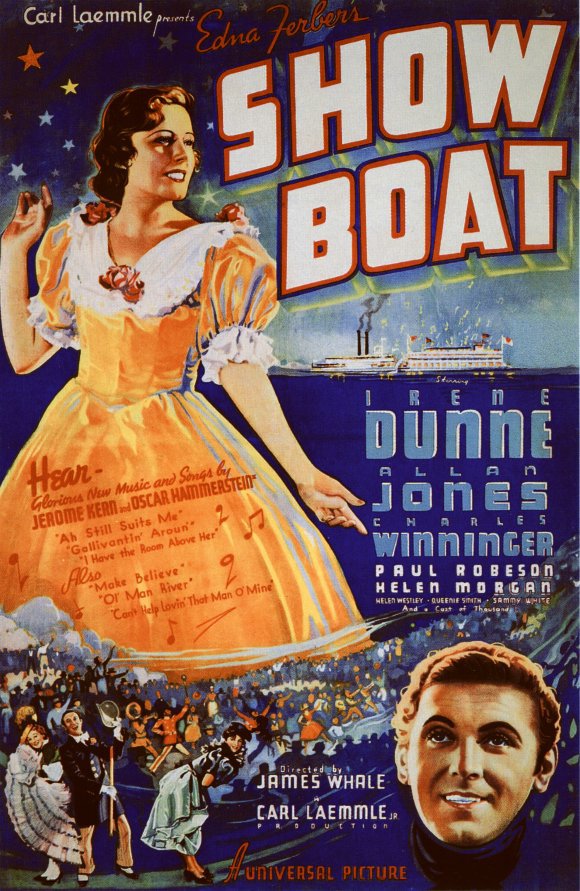
 I frequently discuss the concept of deceit in ethics seminars, and my favorite example, which I have also used on Ethics Alarms, is the famous “Does your dog bite?” gag from “The Pink Panther Strikes Again!” This morning I was reminded of an even better example, though not so funny, while watching Turner Movie Classics. TMC was showing the 1936 Hollywood adaptation of “Showboat,” the black-and-white version directed by James Whale of “Frankenstein” fame, that is richer and more faithful to the original Oscar Hammerstein-Jerome Kern Broadway musical than the later, color version starring Ava Gardner, Kathryn Grayson and Howard Keel.
A key sub-plot in “Showboat” involves Julie LaVerne, the show boat’s leading actress, who has been passing as white in the post-Civil War South despite having a black mother. She is married to the show boat’s leading man, Steve Baker, who is white, and thus in violation of the strict miscegenation laws then in force in the South. Alerted that the sheriff of the Mississippi town where the show boat has stopped to entertain is on the way to arrest the couple, Steve cuts his wife’s finger with a pocket knife, and swallows some of her blood in front of the boat’s captain and his family as well as others. When the sheriff arrives to arrest him, Steve provokes the sheriff to confirm that in Mississippi, the law regarded a man as legally black if he had “one drop of Negro blood” in him. Steve then announces that he has “more than a drop” “in” him, and will swear to the fact. He also declares that everyone in the room can also swear that they are certain that he has “a drop of black blood in him”‘ and thus there can be no accusation of an illegal inter-racial union with his black wife.
One by one, all of the witnesses to Steve’s blood-sucking tactic swear that Steve Baker is telling the truth. One such witness, the ship’s navigator, employed the sheriff years ago, and reminds him that he “would never lie” and can be trusted implicitly when he says that he knows Steve has “Negro blood in him.” The sheriff, convinced, leaves without making an arrest.
It is a profoundly ethical scene, but also an ethically misleading one. The show boat family and staff properly and bravely rally to the defense of Steve and Julie against an inhuman and ignorant law. This was a controversial scene in 1951, a courageous scene in 1936, and a flat-out amazing scene in 1927, when the musical (adapted from the Edna Ferber novel) opened on Broadway. Anti-miscegenation laws were on the books in many Southern states, including Mississippi, until 1967. Everyone is lying, but the lie is justified under utilitarian principles: the law is unjust, and lying is a lesser breach of ethics and morality than the enforcement of the anti-miscegenation law against a loving husband and wife for doing nothing more than living together.
Nonetheless, everyone is lying. The lie is textbook deceit, a statement that is literally true but carefully phrased to make the gullible listener believe something that is not true. They are all swearing that Steve “has a drop of black blood” in him because they just saw him suck on Julie’s finger wound. That is not what the sheriff, or the law he has come to enforce, means by “a drop of Negro blood,” and everyone knows that’s not what he means. They also know that the sheriff won’t realize what they really are swearing to when the confirm that Steve has “black blood in him.” They deceive him using words, and that is what lying is.
This scene, and others like it in popular culture, help reinforce the popular misconception that deceit is somehow better than lying, rather than being a particularly effective and seductive variety of it. It would be fascinating to screen the scene from “Show Boat” for an audience of politicians, and poll them regarding whether or not they believed the characters who vouched for Steve were lying.
I’m pretty sure I know what the results would be.
_______________________________________________
Spark: Turner Movie Classics
Graphic: Moviegoods
 Ethics Alarms
Excellent. It is one thing to try to justify deceit; it is quite another to claim that it is not lying.
The Ethics of Bloodsucking! That IS a moral dilemma, isn’t it? In Southern society of that era, laws like this were considered necessary. However, for this travelling company, it was a stricture that imposed an intolerable burden. Thus, they used this ploy to sidestep the law rather than break it outright.
That, of course, is a slipperly moral slope in the broad aspect. It’s led many to rationalize true criminality. Deceit IS lying. But deceit is also a weapon against injustice and tyranny. Then again, who decides whether a law is unjust and a society tyrannical? This is where a code of moral standards becomes necessary.
Strictly speaking, the Showboat people were wrong. This was a classic case of “rendering unto Caesar”. If a local authority objects on a legal basis, the answer is to move on to the next port. Besides, the burden of proof was the sheriff’s. “Can you prove my wife has Negro blood in her, sir? For myself, I can neither confirm nor deny it, standing on my and her rights under the Fifth Amendment.”
In Southern society of that era, laws like this were considered necessary.
“considered necessary” by who? In any case, they were pure bigotry.
Thus, they used this ploy to sidestep the law rather than break it outright.
They absolutely were breaking the law by being an interracial couple. What they sidestepped was being arrested for breaking the law.
Strictly speaking, the Showboat people were wrong. This was a classic case of “rendering unto Caesar”. If a local authority objects on a legal basis, the answer is to move on to the next port.
Really? If a law is immoral or bad, just ignore that place. Ugh.
I’d agree that the Show Boat folks were actively resisting an immoral law, and as was later settled, an illegal and unconstitutional one. Also, as the Elizabeth Warren-as-Indian case illustrates, an uncommonly stupid one. The only justification for the “one drop” rule is utter ignorance of genealogy and logic—why someone who is 7/8 white should be called black, legally or otherwise, has never been satisfactorily answered, but we still gravitate to it.
Cause the blackness poisons the children and all white is the default state. Duh.
I understand the theory—I just don’t understand why it persists pretty much everywhere, to this day. Why aren’t Mariah Carey and Derek Jeter regarded by the media as Irish? Now the position seems to be that black blood isn’t poison, but magic. Just as silly, but in a nicer way.
Or, as I have wrestled my tongue to the ground not to point out, since so many people I don’t like much are already doings so,why is George Zimmerman being called a “white Hispanic” by the NY Times when under the rules that had been in force right up until Trayvon breathed his last, he would have been called a “black Hispanic”?
No, TGT. Like many who set themselves up as historians, you make the classic error of condemning those in the past based on your attitude under current conditions. I wasn’t attempting to support or vilify the slavery system of that period. I was referring to how one, living IN those times, would deal with it under the given circumstances and why those circumstances would exist. The ‘why” of it was, I thought, self-evident. Therefore, I didn’t go into more detail. I will now.
A great weakness of any society with the institution of involuntary servitude is that it must maintain a rigid separation- by law and custom- of freeman and slave. There are a great many examples of this throughout history. In the South of this period, that destinction was easier to make than in many such past societies as the slaves were of a distinct physiology. Thus, to maintain this distinctiveness, rigid laws were in place to prevent interracial breeding. If the two populations become blurred, the slavery system becomes unstable. And, when it becomes destabilized, the second great bane of slave societies threatens; that of a bloody slave revolt. It was through this latter fear that the people of the South, the vast bulk of whom were not slaveowners, supported such laws.
Despite this, such events did, of course, occur. Human nature is what it is. In fact, some studies have indicated that, even prior to the end of the Jim Crow laws, more than half of all black Americans had white blood in them. Nor were these intermarriage laws enforced in a like manner from place to place. In Louisiana, racial admixture was not only unofficially tolerated, but there existed the otherwise unusual situation of large numbers of black freedmen before the War… some of whom were slave owners themselves!
To judge past times, you must KNOW about past times in detail and thus be able to understand why people behaved as they did. That takes time and research. Otherwise, you fall into the trap of condemning blindly through ignorance and arrogance.
Great rationalization. It doesn’t matter that people thought it was good or right at the time. It was still bigotry. In this case, it was bigotry to prop up a system of greater bigotry and discrimination. Putting this in context makes it worse, not better.
You said the appropriate response to such laws was to avoid the places that had them. You put the blame on the riverboat for going to such a place, and that they should have followed the law while they were there. By your logic, you can’t complain about any laws or societal standards in the U.S. If you don’t like them, you should leave, not fight the unjust ones.
Your narrow universe doesn’t allow for much deviation, does it? You confuse rationalizations (something your are well known for) with reality (something for which your are not). I’m merely pointing out that slavery WAS the reality of that time and had been for many generations. I wasn’t attempting to draw any moral inference. When you are a visitor in foreign climes (which is just about what it amounted to then, North vs. South) or even visiting a county where the laws are not to your liking, you still have to either respect those laws while they’re in force or move on. Unless, of course, you want to wind up in jail with your boat impounded. There are many laws today that I could gleefully dispense with and hope that it happens. But until they are, you can protest them, decry them and organize for their repeal, but you’d be wise to observe them while you’re in that jurisdiction. Otherwise, chug along to the next port of call where things might be a bit friendlier.
But until they are, you can protest them, decry them and organize for their repeal, but you’d be wise to observe them while you’re in that jurisdiction. Otherwise, chug along to the next port of call where things might be a bit friendlier.
That’s safest for the individual, but worse for the nation as a whole. I don’t fault the person who wants to save their skin, but standing up to the injustice makes someone a hero.
I don’t deny that standing up for what you think is right is wrong. Hardly! But again, the issue here is how it was done.
Badly worded! I meant, of course, that standing up for what you think is right is, of course, right and proper. No argument there.
This is a toughie for me, because I do believe that deceit is a form of lying, and that it is usually employed for unethical, illegal, and/or nefarious purposes. However, I am reminded of deceit used by leaders of just political revolutions (here and around the world through history), by members of, say, the anti-Hitler military and the anti-Nazi underground, e.g. Not sure how to balance the two… Help!
You just balance the two, that’s all. The point is that deceit weighs no less heavily against ethical conduct than any other lie. Some lies can be justified on a utilitarian scale–resistance efforts against totalitarian regimes are good examples. But lying of the greater good is always a slippery slope, and should always begin with the presumption that it is wrong. The burden of proof is always on the lair.
Pingback: Ethics Articles | Pearltrees
You blog moves so fast that I feel awkward about responding to something that’s more than a day old, but I think it’s worth mentioning that I don’t agree. I think there are significant differences between lying and the kind of tactics highlighted in this post.
I define lying pretty strictly as the deliberate provision of false information. I’d say that you can mislead or withhold information and still be abiding by a proscription against lying as long as you’re willing to provide true information when pressed.
In the “black blood” scene they were not so much exploiting the gullibility of the sheriff as they were exploiting the absurd vagueness of the law. It could be argued that their reasoning was truly based on the perception that if Mrs. Baker’s could be considered black despite passing for a white woman, on the basis of any presence whatsoever of “black blood,” the literal presence of black blood in an actually white person should have the same effect.
As it is, they all benefited from the sheriff’s intellectual laziness, but I’d like to think they were all prepared to make a legitimate argument. If he’d not been an intellectually lazy character, he might have reasoned out the absurdity of the law on his own, or failing that he would have asked for more detail and placed the Bakers and their allies in a position of having to either lie or face the music.
Theirs was a contest of wills, and the sheriff forfeited either because he was stupid or because he didn’t really want to enforce the law in the first place. Yet it was a fair contest, as nobody’s ability to rationally argue his position was handicapped by literally false information.
“I define lying pretty strictly as the deliberate provision of false information. I’d say that you can mislead or withhold information and still be abiding by a proscription against lying as long as you’re willing to provide true information when pressed.”
Bill Clinton loves people like you, Ed. Especially that last part, which I read as, “You can try to deceive people by your choice of words as long as you ‘fess up once you’re caught.” That’s a very convenient definition for extremely good liars, and a ticket to ride for scam artists, con men and frauds.
In “Showboat,” the participants in the deception—surely you don’t question that iy was deception?—established the terms under which the sheriff defined “legally black” and carefully chose their words to describe Steve’s condition so that it fit that description. So their words “he has Negro blood in him” was the equivalent of saying, “he is legally black” or “his lineage meets the legal definition of being black in this state,” despite the fact that they knew that Steve was NOT legally black, and the manner in which he had “black blood” in him did not meet the legal definition as the sheriff almost certainly meant it. Therefore, if you agree that they could not have said, “he’s legally a black man, and we will swear to that” without lying, then you must agree that what they did say, a deceitful version of the same thing, was similarly a lie. Same facts, same intent—to deceive—and same result: the sheriff believes something that is not true, to Steve’s advantage and their disadvantage. Bill would say, “it depends what the definition of “in” is.”
If an ignorant American goes to France and asks, ‘Where can a rapid Ohio State fan see a football game in this here country?”, and a puckish native, not liking Americans and knowing that he means American football, sends him on a fools mission to a soccer game 100 miles away, saying, “Football? Why, there is a wonderful game being held tomorrow in Lyon!”, that is deceit, and that is lying. Being stupid or ignorant doesn’t make it ethical for people to intentionally deceive you, or all scam artists would be ethical people.
Therefore, if you agree that they could not have said, “he’s legally a black man, and we will swear to that” without lying, then you must agree that what they did say, a deceitful version of the same thing, was similarly a lie.
I don’t agree with that first premise. They began their argument by establishing that the law was vague and overly broad. I believe they were saying that if the letter of the law seeks to exclude even terrifically remote black ancestry from intermarriage by using the language “a drop of black blood,” then it ought to cover anyone who willfully takes on black blood. I suppose there’s a question of intent here. If their intention was not to deceive but to persuade, it is entirely the sheriff’s fault that he allowed himself to be persuaded too easily.
Similarly with Bill Clinton, if he truly believed that oral sex was not an instance of “sexual relations,” then he truly wasn’t lying when he said he did not have sexual relations with that woman. Instead, he was making a dumb argument, and it was stupidity, not deception, for which he was culpable. It’s far more likely, though, that he did not really believe what he was saying, but said it anyway because he thought it plausible that somebody might believe it. That’s a lie, which is to say that it is an actual misrepresentation of the facts. But what he’s deliberately misrepresenting in that case is not his behavior but his own beliefs.
Bill Clinton loves people like you, Ed. Especially that last part, which I read as, “You can try to deceive people by your choice of words as long as you ‘fess up once you’re caught.”
No. If you haven’t provided false information, there is no “fessing up.” If you’ve made a conscious effort not to lie, all you can do is elaborate on your argument until either you win, you lose, or your opponent forfeits.
Being stupid or ignorant doesn’t make it ethical for people to intentionally deceive you…
True, but being stupid and ignorant doesn’t make it unethical for your opponent to use all the rational and rhetorical devices at his disposal to challenge your position.
You seem to be fudging the essential nature of deceit, Ed. The issue isn’t what Clinton personally believed—we know his beliefs were flexible according to his immediate needs—but what he knew his listeners believed. And he knew his listeners assumed that sex included oral sex. In trial, that kind of lie, if shown to be intentional, will make you guilty of perjury. So would what the crew of the show boat said.
The law wasn’t vague at all, by the standards of the day. “One drop” meant “any Negroes in your ancestry, no matter how far back.” Everyone in the conversation knew it. It was the dissemblers who were playing dumb, to each other. They all knew that swallowing blood wasn’t the same aa having “mixed blood.”
In the last version of Show Boat, Hollywood changed the scene–Steve doesn’t swallow his wife’s blood, he mingles their blood by cutting his own hand too, and letting their blood mingle. Some people actually believed that was enough to make a white man black under the law—OK, in THAT scene, you have an argument. Not in this version. Their intention was to deceive…you can’t say “they were saying” something that they were going out of their way not to say, because they knew it wouldn’t work.
No one’s beliefs are flexible according to his immediate needs. You can change the way you represent your beliefs – you can lie about them – but you can’t willfully change what you believe.
If the law wasn’t vague by the standards of the day, then the standards of the day were terrible. If it had meant “any Negroes in your ancestry, no matter how far back,” then it should have said just that. So long as it didn’t, the Bakers were exploiting the vagueness, else why would Steve have bothered swallowing his wife’s blood? If they all believed they were conveying false information, what reason could there be for taking steps to change the facts of the case? If there was deceit involved, they were primarily concerned with deceiving themselves. They must have believed they were telling the truth, even if they believed it falsely. But their statements lack the intentionality to rise to the level of lying.
Of course deliberate deception is perjury, but there’s a slight grey area between deliberate deception and the mere misalignment of different people’s perceptions. You can’t reasonably be expected to account for what everybody else believes, and if that’s enough to rise to the level of perjury, I’d be surprised. I would expect it to be considered perjury if a person’s testimony can be shown to deliberately contravene an objective, legal definition of terms, but not if it disagrees with a definition that is merely more popular.
You deceive your opponent if you provide demonstrably false information, which is lying. If your opponent fills in existing gaps with false information that you haven’t provided at all, he deceives himself.
Now, I know it may seem like I’m rationalizing dishonesty for the sake of convenience, but I truly think the distinction is meaningful for the sake of my overall ethical point of view. I’d rather argue over the meaning of honesty than argue over when honesty is applicable. I take the latter to be the consequence of your utilitarian perspective, which allows that the Bakers would have been justified in lying outright. I consider my view to be decidedly less convenient.
But their statements lack the intentionality to rise to the level of lying.
Are you kidding? They intentionally equivocated on “drop of Negro blood”. They knew the law’s meaning and were attempting to deceive on that score.
This isn’t a case of different perceptions.
Again I ask, if their intention was to deceive the sheriff, why have Steve swallow the blood at all? They could have deceived him by lying about the man’s ancestry. There must be some difference there. If the intention is the same, why take the path of greater resistance? Sure they equivocated on “drop of Negro blood,” but in so doing they sought to manipulate the meaning of the law itself, not the sheriff’s gullibility.
Ed, the point is that most people, including Clinton, ane maybe Edna Ferber, who wrote the book for “Show Boat,’ are under the misconception that deceit isn’t lying…that’s it’s better somehow, because you are literally stating fact, even though it is being done in a way that deceives. That’s why I hate scenes like that: they teach the false lesson that deceit is OK. It isn’t OK. In legal ethics, for example, it is grouped with fraud, dishonesty, and misrepresentation—other forms of lies.
Steve sucked the blood so that he and everyone else could, he thought, deceive the sheriff “honestly.” But you can’t deceive honestly, if that’s your intention.
Oh, goodness yes. Of course I agree that you can’t deceive honestly. That is an oxymoron, and if anyone has that as their intention, they are trying to hold two contradictory propositions at once. However, I think intention is very important here, such that the appearance of deceit isn’t always actual deceit. If you’re literally stating a fact which you’re willing and able to back up in context, but you’re not asked to do so, I cannot count that as on par with lying.
You just said that skillfull deceivers aren’t as bad as guardian variety liars. If you know your audience will interpret your words/actions in a way that is not true, then you’re lying. It’s that simple. Just because there’s a rhetorical trick to say your words could be true, doesn’t mean you’re telling the truth.
I agree that the appearance of deceit isn’t necessarily deceit, but the intent here IS to deceive.
Along with what Jack said, the scene plays better that way. It shows the stupidity of the law in a way that just lying to the sherrif wouldn’t.
Does the intention of showing the stupidity of the law, rather than just exploiting the stupidity of the sheriff, not at all affect the ethical status of the act?
We’re in agreement that the act here was ethical, but that doesn’t mean it wasn’t deceit. Deceit can be ethical. Whether Steve had swallowed his wife’s blood or not, the lying would be ethically justified, but in both cases, it’s still lying.
Deceit can be ethical.
But you see, that’s just what I’m arguing against. I don’t accept that lying is ever ethical, but I believe that it pushing for an ethical outcome, one can utilize whatever tools are at their disposal within the confines of true facts.
Just because there’s a rhetorical trick to say your words could be true, doesn’t mean you’re telling the truth.
Agreed. It’s not sufficient to believe that your words could be true, in theory. You have to actually believe that they are true, even if you know that there are multiple ways of interpreting them.
You laid down a rule: “lying can’t be ethical”, and now you’re going through contortions to explain why this rule doesn’t apply to this situation.
By your logic, if you helped slaves escape north in the 1800s and the authorities came and asked “are you a part of the underground railroad?” It may or may not be ethical for you to say “no.” If you mean: “no, i’m not helping slaves escape”, you’re unethical, but if you mean: “no, I don’t work for a project to run trains under the earth,” then you’re ethical.
It doesn’t make sense. In both cases, your intent is to deceive the questioner and in both cases you are deceiving the questioner.
You created a system where lying is okay, so long as you can come up with an alternate meaning of the words, one that is not meant in this context, where your statement would be true. Yes, it’s true that you don’t work on the project to run trains under the earth, but that’s not what your statement meant in context.
Now, if you actually believed the authorities were asking about this subterranean steam engine company, you wouldn’t be lying. If Steve Baker and the the rest of the characters actually believed the sheriff was talking about imbibed blood, they’d be telling the truth. It’s clear that neither of these are the case, so the responses are clearly lies.
So you have a choice, either the behavior “Show Boat” and my example are both unethical, or your rule isn’t correct. Give it up.
Give it up? Come, now, you may consider your position to be obvious, but I don’t really feel like I’m on the ropes here. I don’t acknowledge the choice that you’ve offered, and I certainly don’t accept that my rule is incorrect; I just think you’re repeatedly mischaracterizing it.
First of all, I’m not committed to proving either that the Show Boat scenario was ethical or that it was not deceitful. I’m merely saying that the intentions and beliefs of the people involved matter in determining whether it was. Your underground railroad hypothetical is apropos of nothing. “The underground railroad” is a fixed, objectively-defined concept. Interpretation has no bearing on the truth or falsity of whether one is a part of it. That’s not the case when talking about racial identity and drops of blood. Baker introduced the topic and he asked whether the letter of the law accepted “one drop of blood” as proof of black identity. He was not asking the sheriff for his personal views, so he was not answering to them. If the phrasing can be reasonably identified as abstract, then both parties are free to interpret it how they will, until such time as the meaning is objectively clarified. Until there is such objective clarification, it’s just an appeal to popularity. In the state of Mississippi at the time, the ancestry definition would have won out, but on the boat it was the more literal interpretation that did.
It seems to me that by your standards, if I really believed I was financially poor, it would still be deceitful of me to describe myself to you in those terms if I expected you to have a different opinion of what qualifies as poverty. That sure doesn’t seem right to me, because I’m certain that if I were to make that claim, I would start by simply asserting it, and then, as needed, I would get into the argument over whose definition of poverty was superior. If my beliefs are genuine and you don’t challenge me, I haven’t lied to you.
Your underground railroad hypothetical is apropos of nothing. “The underground railroad” is a fixed, objectively-defined concept. Interpretation has no bearing on the truth or falsity of whether one is a part of it. That’s not the case when talking about racial identity and drops of blood.
“drop of Negro blood” was a well defined concept.
If the phrasing can be reasonably identified as abstract, then both parties are free to interpret it how they will, until such time as the meaning is objectively clarified.
…
In the state of Mississippi at the time, the ancestry definition would have won out, but on the boat it was the more literal interpretation that did.
But it’s clear that Steve and his cohorts knew what the phrase meant under the law and how the sheriff would take it. If there’s a legitimate disagreement in the meaning of the term such that each side doesn’t know what the other means, then you are right, but there is no legitimate disagreement in the terms here.
It seems to me that by your standards, if I really believed I was financially poor, it would still be deceitful of me to describe myself to you in those terms if I expected you to have a different opinion of what qualifies as poverty.
If you know how I interpret the term poverty, then you absolutely are being deceitful. You’re making a statement you know I will take in a way that is not true. You are intentionally misinforming.
If you honestly believe that X means Y and don’t know that I understand X to mean Z, then talking about X to mean Y is not deceitful. If you know that I understand X to mean Z, and you don’t inform me that you are using X to mean Y, then you are intentionally misleading me. That’s deceit, and that’s the case we have here.
I’m merely saying that the intentions and beliefs of the people involved matter in determining whether it was.
This calls out your problem. The Show Boaters intended to deceive and had full knowledge of how the sheriff would interpret their words.
I just want to say thanks to all who’ve commented here; this has been a really robust dialogue, helping to articulate the distinctions between deceit and lying. Thanks to all.
I agree, Charles, and this is an every day issue that needs to be discussed more often. And I just happened to turn on that scene in “Show Boat” Sunday morning. Great ethics issues turn up when you least expect them.
Thing is, Steve has made himself black. If he wants to stay on the Mississippi, if he wants to stay in showboat show business — an extraordinaery and unique niche at the time — or even just stay in show business — he’s black from here on out. He may be deceiving the sheriff about his ancestry, but in so doing, he’s making that lie the social and functional truth. I doubt a 1927 audience would see this as something he could just walk away from — if “one drop of blood” can make a person black, how much more so does declaring oneself black, and having witnesses swear that one is black? Can he ever go to court and declare himself not black, when the sheriff, at the very least, can swear that he is? This is, IMO, a huge, huge piece of the dramatic and ethical core of the story.