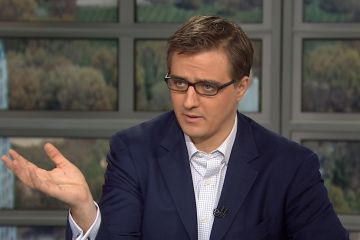
To be fair, while Chris Hayes is ill-informed, ungrateful and arrogant, at least he’s incoherent.
As anyone could have predicted, MSNBC host Chris Hayes had to issue an apology after his fatuous and inarticulate comments about Memorial Day. If you were lucky enough to miss them, here they are:
“I think it’s interesting because I think it is very difficult to talk about the war dead and the fallen without invoking valor, without invoking the words “heroes.” Why do I feel so [uncomfortable] about the word “hero”? I feel comfortable — uncomfortable — about the word because it seems to me that it is so rhetorically proximate to justifications for more war. Um, and, I don’t want to obviously desecrate or disrespect memory of anyone that’s fallen, and obviously there are individual circumstances in which there is genuine, tremendous heroism: hail of gunfire, rescuing fellow soldiers and things like that. But it seems to me that we marshal this word in a way that is problematic. But maybe I’m wrong about that.’
With so many interesting, thoughtful, perceptive and provocative statements being written and uttered every day that vanish forever, never to be repeated or published, it is cruel irony to confer immortality on cretinism like that, but I digress. My commentary on Hayes’ statement is here. His apology was pre-ordained, because he insulted so many, so deeply, so pointlessly and so arrogantly, at the worst possible time, that a national outcry was guaranteed, and the eventual directive, “Apologize or pack!” from his MSNBC overlords was a forgone conclusion.
As forced apologies go, how did Hayes’ rank?
Here is what he wrote—so far, he hasn’t apologized on the air:
“On Sunday, in discussing the uses of the word “hero” to describe those members of the armed forces who have given their lives, I don’t think I lived up to the standards of rigor, respect and empathy for those affected by the issues we discuss that I’ve set for myself. I am deeply sorry for that.”
“As many have rightly pointed out, it’s very easy for me, a TV host, to opine about the people who fight our wars, having never dodged a bullet or guarded a post or walked a mile in their boots. Of course, that is true of the overwhelming majority of our nation’s citizens as a whole. One of the points made during Sunday’s show was just how removed most Americans are from the wars we fight, how small a percentage of our population is asked to shoulder the entire burden and how easy it becomes to never read the names of those who are wounded and fight and die, to not ask questions about the direction of our strategy in Afghanistan, and to assuage our own collective guilt about this disconnect with a pro-forma ritual that we observe briefly before returning to our barbecues.”
“But in seeking to discuss the civilian-military divide and the social distance between those who fight and those who don’t, I ended up reinforcing it, conforming to a stereotype of a removed pundit whose views are not anchored in the very real and very wrenching experience of this long decade of war. And for that I am truly sorry.”
To begin with, I’m not exactly certain what he is trying to say. I thought his convoluted attack on honoring fallen soldiers as “so rhetorically proximate to justifications for more war” —you know, like honoring fallen fire fighters is rhetorically proximate to justifications for more fires—-was the product of a flustered and unprofessional newscaster speaking before he had gathered his thoughts, but now I think Hayes is just plain inarticulate. But back to the apology: what exactly is his statement apologizing for? He is apologizing for two things, apparently, from what I can decipher from Hayes’s prose:
- First, for not “living up” to the standards of rigor, respect and empathy for those affected by the issues we discuss that I’ve set for myself.” What does this mean? Who are “those affected by the issues we discuss” when Hayes suggests that honoring fallen soldiers as heroes is tantamount to war-mongering? The dead soldiers? Their families? The armed services? How would meeting those standards of “rigor, respect and empathy” have changed what Hayes said? Would have said it more clearly (rigor)? Would he have said it more gently (respect)? Or would he have waited until after Memorial Day to say it (respect)? It is impossible to tell, but one thing seems clear to me: he isn’t retracting the opinion. That’s fine; he’s a pundit, and people say idiotic things on MSNBC around the clock, seven days a week. Al Sharpton, Martin Bashir and Ed Schultz work there, after all. He has a right to his opinion, and anyone with any decency, logic and sense of history has a right to conclude that anyone holding such an opinion is an irredeemable jerk whose continued presence on cable TV is an insult to every soldier who risked his life for his country.
- Second, Hayes apologized for “reinforcing” the “civilian-military divide and the social distance between those who fight and those who don’t,” and “conforming to a stereotype of a removed pundit whose views are not anchored in the very real and very wrenching experience of this long decade of war.”
Again, whatever this blather is supposed to mean, Hayes is not retracting his opinion, but merely apologizing for reinforcing a condition he intended to criticize and undermining the force of his opinion by appearing to be a stereotype. Well, I’m glad Hayes realizes how incompetent he is and is feeling sorry for himself, but that wasn’t the issue. The issue was the inexcusable ignorance and offensiveness of an arrogant pacifist pundit refusing to give proper honor and admiration to those who were and are superior to him in every respect, and to whom he owes his job, his life, his quality of living, and the freedom to expose himself as a jackass on TV. Hayes didn’t have the decency or the courage to apologize for that, even making allowances for his difficulties with the English language and sentence construction. If he had made a sincere apology, and was truly sorry for what he said rather than the time and the manner in which he said it, he would have written something like this:
“Yesterday I suggested in my remarks on this program that those who fight and die in this nation’s armed conflicts are not heroes, and that regarding them as heroes encouraged more wars. I had not thought my comments through sufficiently before speaking, and as a result made a statement that was hurtful, offensive and wrong. At the end of my statement, I said “maybe I’m wrong,” and I was wrong. I was wrong not to recognize that there can be no greater expression of one’s love of country and devotion to its values than to risk life and limb in its defense, and that to do so, no matter whether I or anyone else agrees with our participation in the conflict. is the essence of courage and heroism. I was wrong to utter words that could only be hurtful to the many families who have surrendered loved ones to their nation’s hours of need. And I was especially wrong to make such ill-considered comments on a weekend dedicated to the memories of the fallen.”
“Our battle dead and their living comrades are heroes, and I deeply regret suggesting otherwise. Instead of trying to take their deserved honor from them, I should have communicated what every American should feel on Memorial Day, and every day: gratitude, and admiration.
“I was wrong, and I’m sorry.”
On the Ethics Alarms Apology Scale, which ranks apologies from 1 to 10, 10 being the worst, I rate Hayes’ attempt a near the bottom of the barrel 9, a deceitful apologies “in which the wording of the apology is crafted to appear apologetic when it is not (“if my words offended, I am sorry”) or where the individual is “apologizing for a tangential matter other than the act or words that warranted an apology.”
________________________________________________
Facts: Weekly Standard
Source: Huffington Post
Graphic: Global Post
Ethics Alarms attempts to give proper attribution and credit to all sources of facts, analysis and other assistance that go into its blog posts. If you are aware of one I missed, or believe your own work was used in any way without proper attribution, please contact me, Jack Marshall, at jamproethics@verizon.net.
 Ethics Alarms
Let’s see — ill-informed, ungrateful, arrogant, fatuous, inoherent — why are you being so kind to this fellow?
You’re right; I should have just called him an ass-hole and saved time.
No, I disagree. Ass-holes are useful, without them everybody would be full of shit!
One assumes Hayes has one, Errol, and he’s STILL full of it! As Jack said, both his initial comments AND his “apology” were so rambling, illusive and incoherent that nobody could make much out of it… except that he doesn’t hold veterans in the highest regard. Well, the feeling is mutual. To hell with him.
I have no problem with people discussing if we over use the word hero when it comes to the military but to do this weekend of all weekends is self serving and in bad taste . And to doi it in such a way that you sound like a drunken asshole barfly makes it even worse.
James Bradley did it so much better in Flags of Our Fathers and he at least had a point unlike this jackass.
“I finally came to the conclusion that he maybe he was right. Maybe there’s no such thing as heroes. Maybe there are just people like my dad. I finally came to understand why they were so uncomfortable being called heroes. Heroes are something we create, something we need. It’s a way for us to understand what’s almost incomprehensible, how people could sacrifice so much for us, but for my dad and these men, the risks they took, the wounds they suffered, they did that for their buddies. They may have fought for their country but they died for their friends. For the man in front, for the man beside him, and if we wish to truly honor these men we should remember them the way they really were, the way my dad remembered them.”
Another applicable quote from an American masterpiece:
“All of which could have been brought to my attention YESTERDAY!”
In the heat of battle, men DO fight and die for their buddies. But what brought them to that battle in the first place? Even the draftee has the option of fleeing to a neutral country. A number have… but remarkably few. What are the initial motivators of a soldier? God, country and family. The crucifix or star of David around his neck, the tattered colors above the fire base and the pictures of loved ones and their letters he carries with him. These things matter. The words “hero”, “brave” and “courage” ARE used frivolously these days and often in reference to people whose character is dubious. But to deny it to combat veterans is to deprive those terms of any remaining meaningfulness.
This may be one of the only times you and Gene Weingarten agree.
I’ve agreed with him before. I’ve also laughed at him—he can be pretty clever. Nice guy, too—when I wrote him about a column I disagreed with, he answered, and conceded that he might have gone over the line. I like Gene.
His icon certainly makes a point!
I don’t think it is fair drawing the analogy of fires to wars. You can’t impose sanctions on a fire or diplomatically reach an agreement to stop burning the building down.
I think there is a debate to be had on sensationalising war. Whether describing dead soldiers as ‘Heros’ creates more wars of itself is a step too far but I think it adds to a general sensationalism which can be utilised by politicians / media to perpetuate their agendas.
However, there is a time and a place to raise these debates.
It’s a perfectly good analogy, as far as comparing soldiers to firefighters. Soldiers don’t negotiate or prevent wars; they fight them, just as firefighter can’t be blamed for the fires. They are not responsible for them; that illusion is offensive, but typical of the logic of the likes of Chris Hayes. Yes, if every soldier refused to fight, there would be peace forever. God. Kindergarten stuff.
I don’t know what sensationalizing war means—warfare is sensational…blood, death, heroism and violence, but it’s real, so its more sensational than “Die Hard.” Sure heroes get exploited, but that’s not the fault of the heroes, and not calling them heroes won’t make them less heroic. Te problem isn’t sensationalizing war, but sanitizing it. Hayes’s incoherence makes me angrier the more I think about it—the fact that war is horrible and should be seen as horrible makes those who fight in it more heroic, not less. Calling people who put their lives on the line for us isn’t “sensationalizing” anything. It is giving proper recognition and gratitude. That’s all.
I don’t think anyone has alluded that soldiers start wars, even Mr Hayes. It is the use of the word ‘Hero’ which he feels uncomfortable with and that if justifys further war. The point is around the language used during a war, he isn’t saying soldiers start wars. Soldiers don’t call themselves ‘Heroes’. The general media and politicians coin the term ‘Heroes’ this is why I feel your analogy isn’t useful.
By sensationalising I think you hit the nail on the head with “Die Hard”. I don’t believe the realities of war are fully reported…the blood, death and voilence you have to go through to become a ‘hero’. I’m willing to suggest that some soldiers go out to war wanting to be John McClane, funniliy enough, a modern day hero, based on preconceptions painted through propoganda. At the end of the day you go out into war and you are at a very high risk of dying. Do some make the decision to go out to war based on the belief they want to be ‘Hero’s’ in the eyes of the media and poiticians? If the term ‘Hero’ isn’t used would the general appetite within the country be the same for war. If each time a soldier dies the front headline is “Another Loving Father Of Three Dies” would the country be more willing to exhaust all other options before finally commiting to war, would the country tire of war quicker. Hayes, I agree, rather incoherent point, is around the use of language. Whether you agree with the point or not there is a debate there to be had on language used within wars and its potential to perpetuate one.
“Not calling them heroes won’t make them less heroic” but if not calling them heroes makes them more alive is that not worth exploring?
Whilst the term does give proper recognition to the actions it also has other connotations and consequences and is immature to ignore this.
It’s also interesting that you agree heroes are exploited. How are heroes exploited? Who exploits then? Is propaganda and language not a form of manipulation. Should we not be debating the use of language?
Again though, for Mr Hayes, it was the wrong time and place.
Sure, debate it. But that has nothing to do with the issue being discussed, which is withholding hero status from legitimate heroes, who are not at fault for how they are exploited (See Clint Eastwood’s “Flags of Our Fathers” as a good entry in the debate.) If Hayes point was that heroism doesn’t automatically validate a war, I’m with him all the way—he didn’t have the brains, competence or decency to say that. Instead he said that soldiers who put their lives on hold and risk death and disability to fight for their country aren’t heroes. That was wrong, dumb, unfair, and yes, miserably timed.
I think I have to call you on one of your own comment policies. ‘4) Don’t put words in my mouth, or ascribe opinions to me that I have not stated. I hate that.’
At what point in what Hayes says does he state that we should withhold hero status or say that soldiers aren’t heroes.
Hayes makes his first point here: “Why do I feel so [uncomfortable] about the word “hero”? I feel comfortable — uncomfortable — about the word because it seems to me that it is so rhetorically proximate to justifications for more war.” – A legitimate point as explained in my previous comment which can be argued either way.
Next point is here: “But it seems to me that we marshal this word in a way that is problematic.” – Again, another legitimate point. Problematic because as he states before this, there are genuine acts of heroism which deserve the term but its use may carry further potential consequences.
He even states that there are times when the term is warranted
“….obviously there are individual circumstances in which there is genuine, tremendous heroism….”. So, he clearly is saying there are times when the word applicable.
Furthermore, the context of his comments is in opening a discussion. These aren’t his conclusions, they are opening comments to start a debate. “But maybe I’m wrong?”. You don’t write a book review based solely on the introduction.
Others who have commented also believe there is a debate:
Bill – “I have no problem with people discussing if we over use the word hero when it comes to the military….”.
Mr Hayes is guility of two things, incoherence and bad timing, that is all. Your rhetoric is concerning because it is attacking the idea that even dicussing the use of the word ‘Hero’ within the media is out of bounds.
First and foremost, Mark, thanks for actually reading the comments policies.
And when I have as much trouble articulating an unconvoluted thought as Hayes, I will a) grant waivers to that particular policy and b) conclude that blogging after a major stroke is probably not a good idea.
But I didn’t say that Hayes advocated withholding hero designations from all military heroes, but that he was apparently objecting to calling fallen soldiers heroes who undeniably deserved to be called so. The fact that he grudgingly acknowledged the appropriateness of doing so in special cases of valor—situations where the courage is regarded as “beyond the call of duty” doesn’t change the fact that he suggested that an ordinary soldier killed in the line of duty was not entitled to be called a hero. He was not just wrong. The opinion itself shows a shocking absence of gratitude, appreciation and respect of the heroism inherent in serving in battle and risking one’s life. Nobody has to do it, especially now, when there is no draft (though draftees can duck too, as many of my contemporaries did during Vietnam.
You can debate anything; I am not denying that. That does not change the fact that some positions demonstrate a mindset that cannot exist without basic ethical ignorance. Hayes—I suppose, for who really knows what he means; I would argue that a broadcast professional should be estopped from using unprofessional incoherence as a defense when he is called on the apparent meaning of his words—thinks calling heroes heroes is debatable because of his fluffy and self-back-patting—you’re sooo humane, Chris!—objections to war, meaning, obviously, that since in his a-historical, fatuously abstract eyes, all war is wrong, someone should not be praised merely for fighting them. He is wrong. Heroism applies to courageously doing the right thing, and it also applies to doing one’s duty as one perceives it at personal sacrifice for others. How Chris Hayes may see that duty—“Ewww, they’re shooting at people! How can that be heroic?” is irrelevant. Am I saying that his position, which I have listened too from non-combatants my whole life, is dead wrong, and the kind of thing someone can only believe with stunning tunnel vision and insensitivity? Yes. Chris Hayes would have been with the jackasses abusing Vietnam vets, who put up with as awful conditions and horror as any soldiers in US history, because they were “tools of oppression.”
“Maybe I’m wrong?” cuts no ice with me. “Gee. like I’m starting to think that the best thing might be to put gay people in concentration camps—but maybe I’m wrong.” “I’m uncomfortable with not racially profiling every black man who walks down the street—after all, they commit 50% of the crimes! But maybe I’m wrong.” That’s not “I’m up for debating this!”, but rather, “I’m a weasel, and not willing to be accountable for my own offensive opinion.”
The argument that soldiers killed in the line of duty aren’t heroes is unfair, disrespectful, ungenerous and ungrateful. a.k.a. unethical, and Hayes’ willingness to waive his objections for those who throw themselves on live grenades is not mitigation. And the theory that calling someone a hero in their participation in a cause or effort requires endorsing that cause is just flat-out wrong.
I didn’t put words in Hayes’s mouth, but if I had, they would have done him more credit than the words that were in there already.
“But I didn’t say that Hayes advocated withholding hero designations from all military heroes but that he was apparently objecting to calling fallen soldiers heroes who undeniably deserved to be called so.”
Jack Marshall
May 31, 2012 at 11:20 am
“Instead he said that soldiers who put their lives on hold and risk death and disability to fight for their country aren’t heroes.”
This is the statment I read along with the comments policies.
Furthermore, you say it here, again. “doesn’t change the fact that he suggested that an ordinary soldier killed in the line of duty was not entitled to be called a hero. He was not just wrong. The opinion itself shows a shocking absence of gratitude, etc etc”
So what the hell do you mean Jack?
Hayes is not saying they don’t deserve to be called ‘Hero’s’ even those who don’t end up performing some ‘heroic’ act.
His point is around the use of the word in the media, that it’s “rhetorically proximate to justifications for more war” and “problematic” both legitimate points which you haven’t yet seemed to disagree with throughout these comments? How can it show ethical ignorance to raise valid points for debate?
“The theory that calling someone a hero in their participation in a cause or effort requires endorsing that cause is just flat-out wrong.” But if the cause is wrong or failing, and calling someone a hero helps continue that cause, what then? You can’t be so naive that you actually think that calling soldiers ‘Hero’s’ in the media has no effect whatsoever on general public appetite for war, starting and continuing it.
Furthermore, just because heroes aren’t at fault for being exploited in the media by those with agendas doesn’t mean we should continue to a blind eye on it either.
The “maybe I’m wrong” point was to try to put some context on the comments. Haye’s view isn’t extremist like the mocking examples you’ve stated, for the reasons I’ve outined earlier, there is a case for over use of the word ‘hero’ in the media, as others have agreed in these comments and there is an argument it may contribute to perpeptuating war. Therefore, “I’m up for debating this?” is a perfectly reasonable assumption for that phrase.
I think this article is a worthwhile read to add to the debate:
http://www.guardian.co.uk/commentisfree/2012/may/29/chris-hayes-heroes-hazing
Particularly pertinent is this:
“Yet, the vast amount of coverage and commentary about the US’s men and women in uniform uses the personal bravery of soldiers to stifle criticism of those causes: causes that those soldiers never choose.”
This is Hayes point, about the use of the word ‘Hero’ and how it is used by the media, not that soldiers, ‘ordinary’ or otherwise, don’t deserve to be called heroes.
It’s obvious what I mean, just as it was obvious what almost everyone who wasn’t making excuses for Hayes took him to mean. He took pains to say that not all soldiers killed in the line of battle weren’t heroes, but suggested that except for certain exceptions, he was uncomfortable giving them credit for heroism. I said that he suggested that “an ordinary soldier killed in the line of duty was not entitled to be called a hero.” Which he did. If you are saying that he really meant that deserved to be called heroes but shouldn’t be because that gives validity to war, 1) there is nothing in his statement to suggest that 2) that would be idiotic and 3) it is only a valid topic for debate in the sense that any fool idea can be debated. It is offensive, illogical, insulting and disrespectful.
The media using an appropriate term to describe personal conduct, when the news media is supposed to issue facts, not euphemisms crafted to satisfy pacifists is not a rational topic of criticism. You are free to debate it; it is waste of my time, because it is elf-evidently wrong, and debating it gives it status it doesn’t warrant.