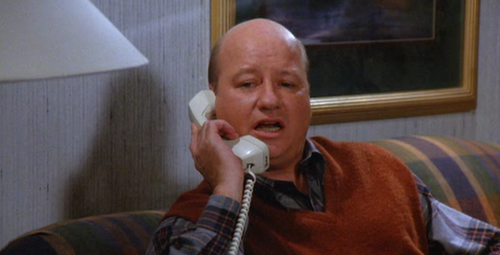
I think I know where he works…
I have no idea what to make of this: I feel like I fell into a “Seinfeld” episode. Remember the “high talker”?
I received an e-mail yesterday from the executive of a large company inquiring about an ethics training. The first name of the executive was Edward, but when I called the listed number, a very high, very female voice answered the phone. I asked to speak to the executive, and received a perky, “I’m Edward! Thanks for calling me back.”
Come on. Edward? What woman goes by Edward? I was about to make a comment like, “That’s an unusual name—how did you come by it?” when I had an image of “Seinfeld’s” high talker, a short, fat, bald guy, becoming irate when callers mistook him for his girlfriend over the phone. This was a potential client, and I didn’t want to annoy her—or him. On the other hand, surely she, assuming it is a she, knows that her masculine name causes confusion. I searched through her e-mail messages for any hint of her—if she was a her—gender, and found nothing. Wouldn’t it be reasonable and fair to at least confirm that yes, she was a woman, or yes, he was a male counter-tenor, or yes, he was indeed a castrati, or at least do something to clear up what he…or she, dammit… had to know was confusing to anyone meeting her over the phone?
Or was I the one who was supposed to mention it? Maybe she–or the high talker—had a regular, standard story to tell, since this had to have happened literally all her life, or his since puberty passed. Maybe she or he was making all sorts of negative assumptions about me because of what I didn’t say. You see? This is driving me crazy!
Did either of us have an obligation to take the step necessary to clear up my disorientation, which is no way to have to engage in a business meeting? Once my “Seinfeld” flashback had passed, I was suddenly in an old (unfunny) “It’s Pat!” skit from “Saturday Night Live.” I hated those skits, and I hated Pat, who had to know that it was impossible to tell whether he/she was male or female, but who refused to give any hints at all. (Then Julia Sweeney made that terrible movie…but I digress.)
I am assuming Edward is a young woman, and now that I have the contract, I’m probably going to meet her. Just watch: Edward will be a 6’4″ baritone with a beard, and swear he has no idea what woman I think I was talking to.
And I will have to shoot him.
_________________________________________
Graphic: Seinfeld Wiki
 Ethics Alarms
JULIA Sweeney.
Her parents were clearly Cowboy Bebop fans.
Actually, I take that back. THAT Edward was a bit of weirdo, and I hope no parents want to wish that sort of karma on their little girl.
But it also reminds me of the WB TV show “Angel” which had a female character named “Winnifred”, who went by the nickname “Fred”. They milked that for a little bit of comic relief many times.
–Dwayne
Maybe she is the Cowboy Bebop fan… as Ed was a psuedonym the character used. Her name was Françoise.
(Don’t be impressed, I had to look up the actual name.)
Looking forward to the follow-up story to this!
Heh. I’ve had a few amusing instances of a similar problem in email conversations with people from the UK, where names like Evelyn and Beverly are still men’s names. I assume I’m exchanging messages with a woman, and then they drop something into the conversation that makes me realize my image of them is all wrong.
My mother told me a story last night about having issues determining gender. A fellow player at a bridge game was talking about her son’s international wedding and had brought the invitation: Something like “Brian and Jan”, but in Dutch and English, and no clues over whether Jan was the English female name or German/Dutch male name. It was no issue either way for my mother, but she couldn’t get the frame of reference, and couldn’t figure out how to ask, as she didn’t want to set off a political argument with the 60 to 90 year old women.
Fortunately for her, someone else made a comment about the bride a ways in, and the mother of groom 1 pointed out there was no bride.
“Did either of us have an obligation to take the step necessary to clear up my disorientation, which is no way to have to engage in a business meeting?”
No, at least not the alternative steps you suggest. You have the obligation to get over it. Edward has no obligation whatsoever. The real question here, from an ethics perspective, is: why is it so important for you (or anyone in your position) to be certain of Edward’s gender? You’re not looking for a date, you’re looking for a business relationship.
Yes, what you describe is outside the norm, but, as evidenced by Pat and “the high talker,” common enough that many people can relate to the situation. Most people can also all relate to the disorientation that accompanies seeing a person with some physical characteristic outside the norm (e.g., burn scars, more or fewer digits than the usual 5, a “lazy” eye). That we are disoriented doesn’t create any obligation in the other person to explain why he/she looks the way he/she looks, nor does it give us a right to pry into his/her private life to get an explanation that might ease our disorientation. The discomfort is instinctual, but the ethical person works to overcome instinct and act with thought.
Edward may be a man with a high voice, a woman with an odd name, or something else entirely. So what. He/she is a person and, in the kind of relationship you describe, his/her gender is irrelevant. Unless, of course, you treat men with whom you do business differently than you treat women with whom you do business. If that is the case, then there are (in my humble opinion) greater ethical questions at issue.
Most (if not all) of us generate mental pictures of people and things based on relatively small bits of information. When we have conflicting information, our brains work on that and it makes us difficult to focus on the task at hand.
Having a model of someone doesn’t mean we will treat them differently, it’s just something our brains like to have. The conflicting information is difficult on us. This occurs in other realms to. If you intentionally mix up the words in a sentence, anyone listening will be working to put them in the correct order and may miss the next thing you say. It’s the same principle.
I’m over it; I never felt it was anything to get over. I just thought it was strange, and as someone who does a lot of work over the phone, a bit off. If I’m hoarse on a call, I say, “I’m sorry, I’m a little hoarse.” I have the same name as my father—if I thought someone was under the impression I was he, whether it made any difference to the substance of not, I would clear that up. In a phone relationship you can’t see who you are talking to, but you want to know as much about them as possible, within reason. We usually know the gender, age, even race and regional origin of someone based on speech. Being uncertain of an individual’s gender adds another layer of uncertainty and lays the groundwork for a faux pas—yes, I think the kind and mannerly thing to do is to clear that up. Men and women talk to each other differently, I think—differently doesn’t mean better or worse, and denying it or making it somehow sinister is unwarranted.
As for the “greater ethical questions at issue”—boy, do I ever hate that. This was the 3006th post here, and I have 11,538 distinct tags. Ethics Alarms has a myriad of posts about life, death, war, religion, AIDS, abortion, child abuse, violence, public trust, suicide, education, fraud, crime, murder, sex offenders and drug policy, and also baseball, puppets, cartoons, TV commercials, “It’s A Wonderful Life,” clown make-up, zombies, “The Good Wife,” Red John, Marlene Dietrich, Star Trek, and flossing one’s teeth in public. Among others. It’s hardly fair or logical to suggest that by writing about a possible high talker I am neglecting world peace.
(1) My apologies. Your post implied that you were over it as a practical matter. You did pose an ethical question, however, and I was responding directly to that question. By using “you” in my response, I did not mean to imply that (1) you were not over it or (2) you should have done anything other than what you did or (3) you were otherwise acting inappropriately. Reviewing my comment, I see that “we” and “our” would have been more appropriate and more accurate than “you” and “your” in virtually every instance I used the latter terms. It was unreasonable to seem to be excluding myself from the group. Indeed, the fact that I have experienced the discomfort you describe is what made me understand the humor in the situation.
(2) As for the “greater ethical question”: You presented one question. I see the situation as raising other important issues. Perhaps they are not “greater” (i.e., more important) than the issue you raise, but, perhaps, they are. Have you written about “greater” things. Yes. And kudos to you for doing so. Does that mean you must do so every day? No, it does not, and my comment was not intended to suggest otherwise. On the other hand, the open discussion format does allow people to present different takes on a given situation. You presented this as something of a comedy of manners. To me it is something else and, to me, the questions I raise are more important (i.e., “greater”) than the one you raise. I can see the humor in something and still find it worthy of serious discussion and I am certain that you can, too. No reason to suggest I am being unfair or illogical by doing so.
(3) Accepting tgt’s comments and your’s about how difficult it is to deal with gender uncertainty, I’m still left wondering: Why are we so uncomfortable when gender is in question? Why are we so inclined to put people into gender boxes? How do our tendencies in this regard affect how we behave? Do they affect us more than we like to think they do? As you say, “men and women talk to each other differently. . . .” I agree. I also agree that “differently doesn’t mean better or worse,” in some circumstances. In other circumstances, “differently” does mean better or worse. Denying that fact is unwarranted; it can, in some circumstances, rise to the level of sinister and, in other cases, it is just a convenient cop-out. I’m not suggesting which it is in this case. I am only suggesting that asking why we feel the disorientation you describe and asking whether we should accept it or work against it could go a long way to greater equality for men, women, hermaphrodites, transgendered people, cross-dressers, gays, lesbians, straights, and bisexuals (did I miss anyone?) in the workplace and in the world in general.
Why are we so uncomfortable when gender is in question? Why are we so inclined to put people into gender boxes? How do our tendencies in this regard affect how we behave? Do they affect us more than we like to think they do?
Why are we so uncomfortable when syntax is unclear? Why are we inclined to put words in grammatical boxes? How do our tendencies in this regard affect how we behave? Do they affect us more than we like to think they do?
am only suggesting that asking why we feel the disorientation you describe and asking whether we should accept it or work against it could go a long way to greater equality for men, women, hermaphrodites, transgendered people, cross-dressers, gays, lesbians, straights, and bisexuals (did I miss anyone?) in the workplace and in the world in general.
I’d say we feel the disorientation because our brains like to have images. The solution to this could be some combination of the confusee being free to ask and the confuser to be expected to explain a little.
Another possiblity would be training our brains to look at unknowns as a blank box or something or other known generic object. Once we have something to work with, our brains should be free to move back onto the important matters.
I think flagging the greater issues lurking here is indeed worth doing…I’m sorry I misunderstood the thrust of your comment. I don’t have ready answers. Does it matter if the person I’m talking to is a child or a senior, a Southerner or a parent, a lawyer or an engineer, short or tall, gay or straight, attractive or not? It depends, and I’m not able to articulate “on what.” I do think that any communication that communicates something that is either misleading or untrue should be cleared up, one way or the other.
Thanks. No ready answers here either. That’s why I pose the questions.
My brother Pat has dealt with such things all his life. Then there’s Gene and Jean, and a French Jean is often a man; Frankie is often Francis or Frances; I knew a female Sidney.
Must be a slow news day.
So let me get this straight—your brother Pat has a speaking voice like Emma Stone? Really? Did you even read the article?
I see — no, years ago, pre-puberty, if he answered our phone at home it would often happen. He now sings baritone in a local choir. I should have read more carefully.
I agree with Lorraine’s initial comment. Unless you would have a different conversation with a woman vs. a man in the call, it doesn’t matter. If it was bothering you though, you should have asked. You say you didn’t want to offend a potential client. If I am Edward, I am more offended by name becoming a topic of conversation on the internet than I would be by a potential vendor asking me privately. Perhaps the distinction is that it is OK to offend an actual client, just not a potential one? Or do you really think this was less offensive than asking on the first call?
Not sure how ethical I am, but I think in a business setting the gender of “Edward” really doesn’t matter. I would continue doing business with the person, essentially getting to know them and all will be answered in due time. Us Americans always want answers now… reasons for things that fit our fancy, and it must make sense to us. If you were to ask “Edward” that gender question and she confirms she is a woman…trust me it won’t stop the questions. Now if you want to date…ask away!
Jack,
I had a related but not exact situation today, but in person, a true Pat situation. I had a doctor’s appointment, a specialist who I have never met before. Name tag has only last name, unisex garb, voice, gestures and associations all could go either way. Body shape was non-distinct. I don’t want to insult them as everyone has their own idea of how they present themselves either over the phone or in person, but in your case as well as in mine there is a real risk of insult. For me the moment was rapidly approaching where a yes sir or yes ma’am is required, awkward pause follows, and I am still not sure if I guessed correctly. Hopefully when I get the paperwork the full name will be on it.
The dilemma had nothing really to do with gender but with civility and respect.
I have no answer for you but thought you might enjoy someone else’s discomfort from a similar situation.