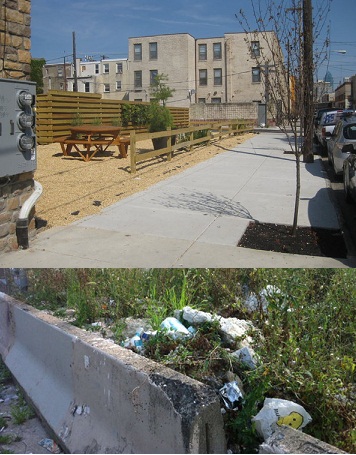
The photo on top is how the lot looks today, thanks to a generous citizen. Philadelphia wants it put back to the way it looked in the lower photo. Wait…WHAT?
Can an act that benefits everybody still be unethical? That’s the underlying conundrum in this week’s Monday Warm-Up Ethics Quiz.
In the Point Breeze neighborhood of Philadelphia, a city-owned lot was in nightmarish condition, filled with trash, weeds and rats. Ori Feibush owned a coffee shop that backed onto the lot, and had repeatedly petitioned the city to do something about it, like clean it up. Feibush, who also is a real estate developer, says he submitted seven written requests to buy or lease the land, calling the Philadelphia Redevelopment Authority about it 24 times. There was no response to any of this, and the city claims that it has no record of any inquiries.
Finally, Feibush couldn’t stand the mess any more. He spent more than $20,000 of his own money to clean up the lot, removing more than 40 tons of junk, garbage, and trash. Point Breeze residents are thrilled.
The city, however, is threatening to take legal action against Feibush for trespassing, explaining through a spokesman that “Like any property owner, [the Philadelphia Redevelopment Authority] does not permit unauthorized access to or alteration of its property. This is both on principle (no property owner knowingly allows trespassing) and to limit taxpayer liability.” It is demanding that Feibush return the land to its original condition—that is, fill it up with garbage so it is an eyesore, dangerous, and useless again.
Your Ethics Quiz:
Who is in the wrong, the city, or Ori Feibush?
This is a classic ethical conflict, in which important ethical principals are aligned at opposite sides of the controversy. The city owns the land, and is quite correct that a citizen can’t just do what he wants to with it absent authority or permission, whether he improves it or not. In addition, precedents are important. If the city establishes one that says that anyone can just decide to “improve” someone else’s property as long as he spends his own money, it is opening a very large can of very unpredictable worms. On the other side of the argument is that fact that the city was being negligent, wasteful and irresponsible. It had an obligation to sell the land or at least lease it to make some revenue, rather than allow it to become a public nuisance. Feibush’s conduct benefited everyone, except the city officials that it exposed as lazy, incompetent fools. Meanwhile, the city’s insistence that the lot be wrecked again qualifies as civic insanity, even in the service of “principle.”
Both Feibush and the Authority are in the wrong, but the city’s conduct is infinitely worse. If Philly has any sense of common sense and justice, it will allow Feibush pay a nominal fine for his trespass, and sell him the land. Yes, he was wrong to take the law into his own hands, but the government was being negligent. Call it civil disobedience, and agree that he made his point.
___________________________________
Pointer: Legal Blog Watch
Facts and Graphics: Philly.com
Ethics Alarms attempts to give proper attribution and credit to all sources of facts, analysis and other assistance that go into its blog posts. If you are aware of one I missed, or believe your own work was used in any way without proper attribution, please contact me, Jack Marshall, at jamproethics@verizon.net.
 Ethics Alarms
I think it is more complicated that that. Fiebush was fined by the city for the litter on “their” property. They are the city, not a private individual and he is a citizen. Finally, The city was negligent in their care for the property to the extent that, had it been in private hands, it would have been condemned and sold to someone like Mr. Fiebush.
In your contention that it is illegal to go in and “improve” someone’s private property without their knowledge or consent, that isn’t exactly true. I don’t know the specifics in Pennsylvania, but most of the states I have lived allow it. If there is an abandoned property adjacent to my property, I can maintain it if I so wish. If I maintain it for a specified period of time, I can petition to have the ownership of said property transferred to me as well. Currently in Texas, some people are moving into vacant, foreclosed houses. After notifying the city, they are allowed to turn on the power (in their name) and occupy the property. If they maintain it for a certain amount of time without the registered owners evicting them, the property transfers to their name.
The thing is, a city can’t exactly “abandon” property by mere neglect. Unlike an individual, a city doesn’t live on a property, and it it is actively trying to sell it, as the city claims, then that alone means it isn’t abandoned. The city owns it, is keeping t on its books and is all around it—I doubt that a claim that the property was abandoned would fly anywhere, in any court. I also suspect that cities having neglected lots in their possession for years is hardly unusual.The guy needed to bring an action in court to try to force the city to care for its land before unilaterally cleaning it up. On the other hand, I suspect that there would be a duty on the city’s part to mitigate damages and tell him to cease and desist the clean-u before it was complete and he had spent $20,000. But these are legal issues, not in my field, and the ethical ledge has to go to the developer.
What the hell is going on in Philadelphia?
I think you missed my point. I was suggesting that a city should have the same responsibility to keep up their property as a private individual. I am pretty sure that a private citizen who had a lot that looked like that would have it condemned by the city and seized. I don’t think the city should be allowed to behave in a manner that they wouldn’t tolerate from a private landowner.
Fiebush claims he did try to buy it, and it would make sense that he would before spending as much money as he did to make it as nice as he did, but the city refused to sell. Someone whose defense against an abandoned property seizure is that it is for sale probably wouldn’t get very far if they don’t respond to repeated enquiries to buy it.
I also live in a state where this is legal and it is done. Part of squatter’s rights is that you are FORBIDDEN from having the owner’s permission to be on the land. If the owner of the vacant lot next to me does not mow it for several years, and I mow it for 7 years (current state) in full view of others, I can claim it. If the owner finds out that I have been doing it, he can forbid me from doing it and I will be guilty of trespassing after that point, but not for the previous mowing (because he had been negligent and left it in an apparently abandoned state). He also will be liable for not taking care of the property if I complain.
I was trying to make the argument that the city should be held to the same standard as a private citizen on the care for its property. Cities have laws about picking up trash and mowing lawns because these issues affect the neighbors, not just the property owners Even though it may not be the law, I think the city has an ethical duty to be as good a neighbor as they require of everyone else.
Right. The problem is that until that the law, the citizen that behaves as if it is is still violating the law. That’s why I likened it to civil disobedience.
According to the article, he was cited “for the trash on the lot”.
the city apparently treated him as if he was responsible.
Either the City had plans for the property or some insider had first dibs. Knowing Philly, I’d say the latter. Point Breeze is No Man’s Land and real estate can go for a song. I see from Wiki that a number of neighborhood groups are involved in revitalizing this “close-in” section. The latest on this standoff has the City backing off: http://articles.philly.com/2012-09-23/news/34023169_1_point-breeze-new-website-city When news of a fight over an abandoned lot reaches Pakistan, it’s time to sell – probably at a better price!
Legally, I have no expertise. Ethically, I can only shake my head and say, “Bureaucrats!” Reminds me of 50 yrs ago in Lewis & Clark County (MT), when I asked the elderly employee a WHY question, she replied, “It’s just our policy.” She hadn’t a clue. Not unusual.
I think the city owes Feibush a credit for municipal taxes on his business, equal to the expenses Feibush incurred to do the clean-up. Call it an “ad hoc, off budget, out of cycle” re-development case. The city could rightfully fine him for trespassing, too. For the city to do those two things (credit and fine) and call things “even” (with significant net award to Feibush) would seem to be the course of fastest, lowest cost to all for the greatest benefit.