 As I noted earlier, I am in New Mexico talking to journalists here about the Pat Rogers affair. You can sample one of the fruits of my labors here, a story in the Santa Fe New Mexican. It’s pretty accurate, as press interviews go, though the last quote was botched. I didn’t say that I was a “Greek American conservative Democrat with an anti-war war hero father,” but that my diverse views were the product of “a Greek American conservative Democrat mother and an anti-war war hero father.” [ UPDATE: This has been corrected.]
If you’ve missed the various posts on this issue, you can find them here, here and here.
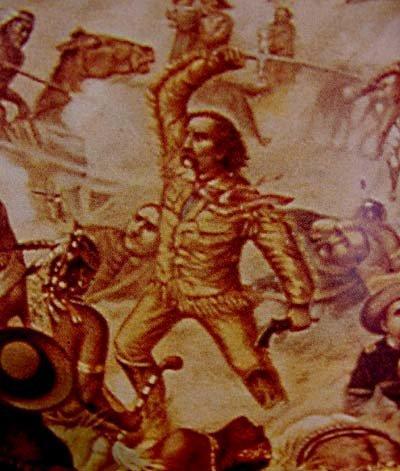
One odd note: during my meeting with several reporters from the paper, one of them suggested that making a joke about Custer’s Last Stand was like making a joke about the Holocaust. I let it pass, but the comment seems bizarre to me. Custer, after all, got himself and his men killed, and it was his opposition that was the object of genocide, not the cavalry. Why would ridiculing Custer offend Native Americans?
 Ethics Alarms
Custer was an idiot , a very brave man , but an idiot.
Bingo.
Sorry, but while Custer had his faults and certainly made mistakes in Montana, he was anything but an idiot. He had a brilliant career as a cavalry commander during the Civil War — even in that war, it was a rare man who rose to Major General at the age of 25.
The events and course of his last campaign are confused and filled with questions and questionable actions. Certainly some of his military contemporaries were harsh in their assessment of his actions, but the other commanders on the field that day have also come in for their share of criticism. It was and remains a hot topic of discussion in militrary history.
Regardless, to dismiss Custer as simply an ‘idiot’ is simplistic and misleading, whether the outcome that day was the result of an egregious blunder, a tactical miscalculation, unclear orders, or other factors — all compounded with the fog of war, as usual.
========================
p.s. Speaking of Custer jokes, do you recall the Bill Cosby routine ‘Toss of the Coin’? Hilarious!
Well put. Your words (and handle!) mark you for a veteran and a student of military history. As I once related on this site, to understand G.A. Custer, one should read his book. “My Life On The Plains”.
He begins the book by quoting a newspaper article. “There are two classes of people who are always eager to get up an Indian war- the army and our frontiersmen.”
Sounds like a modern column, doesn’t it? Custer replies thusly.
“I quote from an editorial on the Indian question which not long since appeared in one of the leading New York daily newspapers. That this statement was honestly made I do not doubt, but that it could not have been farther from the truth I will attempt to show. I assert, and all candid persons familiar with the subject will sustain the assertion, that of all classes of our population the army and the people living on the frontier entertain the greatest dread of an Indian war, and are willing to make the greatest sacrifices to avoid the horrors.”
Love him or hate him, his narrative (which includes his appraisals of many colorful characters- white and red) and his description of the Washita Campaign make for fascinating reading.
Cocky, pushing arrogant, is much better to describe Custer than idiotic.
He was methodical in his assessment of any situation, after careful consideration, he would follow with what was described as ‘recklessness’. Hardly. Although appearing reckless, any action deemed feasible after careful reconnaissance and planning, and executed with zeal is best described as aggressive. And something the modern military still teaches.
Custer’s fault leading to his demise at the Little Bighorn owed very much to a sort of laziness…the type that sets in when a soldier grows accustomed to his enemies behaving the same way over and over again.
All experience had shown that a Native American group or village consistently gave ground and withdrew before a sizeable force of US Army. Custer, having success before, had little reason to believe this group of Native Americans would not act differently. By the time he did realize they weren’t going to give ground it was too late.
His error at the Little Big Horn was due to not conducting a truly thorough reconnaissance prior to attacking because he was cocky and made assumptions at just the wrong time. He may very well have been conducting his thorough reconnaissance and just gotten too close.
It’s difficult to pin down details on the Little Big Horn engagement, since the only real source is what can be gleaned from Indian accounts- many of which were fading memories in the minds of old men when they gave their testimony. It seems evident that Custer was deliberately using his center column (composing half the strength of the 7th Cavalry) as bait. His big mistake, it seems, was his underestimation of the numbers he faced and the unity among the formerly interbelligerent Indian nations provided by Sitting Bull, plus the field leadership of Crazy Horse. Nor did he count on his two supporting columns (Reno & Benteen) being pinned down early and unable to consolidate with him. He acted as successful cavalry leaders usually did when faced with a challenge- attack swiftly and boldly, relying on surprise and mobility. Unfortunately, the Indians reacted quickly and with greater mobility. I’ve been fascinated by the Indian accounts that seemed to indicate that George Custer may have been seriously wounded or dead by the time the central column collected on Last Stand Hill, and that Major Keough may have been in actual command. When I was in the Army, I had a buddy named Keough who was a direct descendent of the major. His family apparently thinks likewise. The Indians describe how one brave officer strove to bring order among the demoralized troopers in those final minutes, but didn’t identify him, leaving it open that Keough, as the next senior, was the man in question. We’ll probably never know.
Definitely agree with your description of that subset of the battle.
The indians definitely got inside Custer’s OODA loop. His element was rapidly overpowered, and he made the quick decision to withdraw from the battle, but unfortunately was rapidly overwhelmed. All evidence points to a very well ordered displacement despite the numbers, until the movement up Last Stand Hill.
At that point it seems soldiers encumbered by the wounded could not outpace the Indians. One interesting note is how the bodies were arranged by company, implying one of two things:
At the moment of being completely overrun, each company essentially made its own little last stand.
Or as I suspect, Custer or Keogh, seeing the inevitable, detached one company to delay the indian advance, while attempted to disengage the majority of his element. Once the delaying force was eliminated or overwhelmed, another may have been tasked with delaying.
I do feel that had Benteen and Reno remembered their duty and pushed on to Custer (Benteen certainly had orders to do so and Reno ought to have done so) then Custer’s element may very well have been disengaged with at least some survivors.
Although Reno’s element had been repulsed and bloodied, they certainly had already rallied and could have continued disengagement instead of hunkering down on the defensive.
Reinforced by Benteen
The original plan of attack clearly scrapped
All audible evidence that Custer was in trouble
A temporary lessening of the attacks by indians on their position
Reno and Benteen should have bypassed any immediate threats and attempted a link up with Custer.
Which is why both Reno and Benteen were court-martialed. Speed and aggressiveness are the key to successful cavalry operations. When Custer re-assumed command of the 7th, he found it in an ill-disciplined and demoralized state under Reno’s temporary rule. His biggest mistake, in hindsight, may have been his decision to leave the Gatlings behind at Fort Abraham Lincoln. Another may have been putting Reno in command of the flanking column instead of Keogh. “Hold your friends close… and your enemies closer”! And Reno openly hated Custer’s guts!
Dang, I’d forgotten Reno received a court-martial. I recalled Benteen’s court-martial.
What I love, is all the histrionic revisioning of the battle and its aftermath, the more and more study done of it, the more it seems the most accurate and fair report/reaction was the earliest.
Ah, you’ve brought up all the fun memories of Battle Analyses we ran during our Officer Professional Development classes. Now, I’m going to go on a research binge.
I’m assuming from your handle that you’re an A&M grad of 2004. Gig ’em, Aggies! I’d agree with your assessment that the earlier studies of the engagement were likely more accurate than what we encounter today, as the very name “Custer” is still high on the politically incorrect list. Of course, the Army board of inquiry of 1877 was under a lot of political pressure itself. This small, but influential tragedy received a lot of public scrutiny, coming as it did on the national centennial year and involving a military hero. This was compounded by the presence of Libby Custer, who steadfastly defended her fallen husband and, until her death in (I believe) the 1920’s, remained a venerable figure for the Army as a whole. While George Custer probably didn’t deserve the iconic reputation he thus acquired in that time, neither did he deserve the blanket condemnation of the counterculture era. Hollywood is a good indicator of this 180 degree shift. We’ve gone from the hero of “They Died With Their Boots On” to the repugnant villain of “Little Big Man”. Both films were historically inaccurate in the opposite extremes. But I’m just an old Errol Flynn fan! One last note. Very few people seem to remember Captain Tom Custer, the recklessly brave younger brother of George Custer; a rare double Medal of Honor winner who also died at Little Big Horn. His story alone is worthy of study.
Good forensics on my name. I am a fightin’ Texas Aggie class of 2004.
As for George Custer, there’s a fine line between violently aggressive (which is a invaluable trait of a combat leader) and reckless.
George Custer walked that fine line… and once too often. He may have come to believe his own legend about “Custer luck”.
Why would ridiculing Custer offend native Americans? The final comment regarding Custer and native Americans and the holocaust underscores the continuing decay in thinking and discourse in our culture. It is akin to Robert Frazier’s take on magic in “The Golden Bough.” The symbol for an object becomes that object ie kewpie doll, and possesses any of the object’s noted characteristics. It seems as if any association with almost anything negative can be then thrown into the fray as forbidden. In essence nothing can be brought up if someone can somehow find a way to spin it so that offense is taken….which, understandably, makes the resolution of serious and volatile issues even more difficult. This sounds like someone who would have condemned “Hogan’s Heroes” because a link could be made between the humorous show, WWII and the terror of the holocaust. “F troop” would certainly be on the same list.
Great comment.
I miss F-Troop.
First they classified you demographically and then they tried to pigeonhole you politically. That was just the introduction. Talk about cheap, politically correct journalism! And where the hell does the Little Big Horn fight even enter into the discussion? When you see this sort of thing, it’s best just to sweep it under the rug. There’s no intellect or integrity to deal with. I hope you at least had an otherwise pleasant trip!
You commented about someththat occurring in Montana and it became an issue with a journalist in New Mexico. What’s wrong with this story? Is somebody’s ox itchy?
…”making a joke about Custer’s Last Stand was like making a joke about the Holocaust.”
I THINK the editor might have been trying to convey the idea that making a joke about Custer was like making a joke about Hitler. Maybe he was suggesting that Custer, like Hitler, should not be trivialized by jokes, satire or parody because trivializing these men also trivializes their actions.
You got it right on what the editor was trying to convey, but he is confusing the outcome. Making a joke about a tragedy is not necessarily trivializing the tragedy, but a coping mechanism, a way of speaking, black humor. In this day and age, some groups are way too thin-skinned and/or just take offense at everything. Unless you’re a vampire, I don’t see how the sight of a cross can hurt you. And I hope Jack fares better than Chief Illiniwek.
Tell it to Mel Brooks (and that’s what I told the reporter, too.)