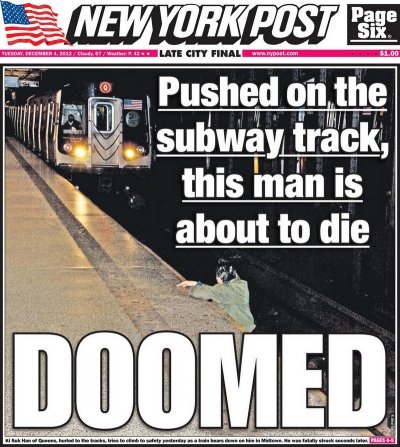
It is destined to become a classic case in photojournalism ethics. Someone pushed 58-year-old Ki Suk Han pushed onto a 49th Street station subway track in New York City. R. Umar Abbasi, a New York Post freelance photographer was on the platform when it happened, and took a photo as the subway train bore down on the terrified man. He was killed, and the photo became a lurid, if dramatic, Post front page.
There have been many ethical questions raised about the incident. Let’s examine them.
Was it ethical for the New York Post run the photo?
This is the easiest of the issues: of course it was. The photo is dramatic, the incident was news, the paper had an exclusive, and readers were interested. The Post might have decided that it would be in better taste not to run the photo, and that decision might be praiseworthy. Still, there is no good argument to be made that such a photograph is outside the range of acceptable items for publication. By the ethical standards of 21st Century journalism, admittedly low, the Post’s call isn’t even close to the line. Objections to the photo on ethical grounds are pure “ick factor.”
Should the photographer have been taking photographs when a man was in mortal peril?
He says he wasn’t. Abbasi claims that he ran toward the train, repeatedly firing off his flash to warn the operator, not to photograph the scene. “I just started running, running, hoping that the driver could see my flash,” he has told reporters. He said the train’s driver saw his camera flashing but told him he couldn’t stop the train fast enough. We can only take him as his word, so criticism of his actions as inadequate has to be placed in the category of hindsight bias and Monday morning quarterbacking. If the driver had stopped the train in time because of Abbasi’s flashes, he’d be hailed as a quick-thinking hero. This is just moral luck: he did what he did (if indeed this is what he was really doing) and it didn’t work.
OK. But what if Abbasi is just covering for himself, and his first instinct really was to get the photo rather than to save the man? Wouldn’t that be unethical?
Not necessarily. Journalists, including photojournalists, are professionally obligated to record what happens, not participate in the event. What a journalist should do when remaining an observer also means allowing harm to come to people and property is a matter of long-standing debate. The ethics code governing Abassi, for example, says nothing about an obligation to try to rescue imperiled subjects—quite the opposite. The National Press Photographers Association Code directs its members…
- “While photographing subjects do not intentionally contribute to, alter, or seek to alter or influence events.”
- “Strive to be unobtrusive and humble in dealing with subjects.”
- “Respect the integrity of the photographic moment.”
Nonetheless, the position that a journalist should stand by and allow someone to be killed or injured if they have the opportunity to prevent the harm is ethically untenable. Not taking action is action itself, and a photographer who allows a horrible event to occur that a normal bystander in his position could have averted is altering and influencing events as much as one who takes the initiative to stop it.
Does that mean that if Abassi’s first instinct, seeing the developing tragedy, was to take a photograph of it rather than to try to save the victim, he should be condemned as callous and irresponsible?
No, I don’t think so. This returns us to the Mike McQueery issue in the Penn State scandal. Why didn’t McQueary step in and rescue the boy he saw being molested in the shower by Jerry Sandusky? After the fact, everyone commenting on this incident was certain that he or she would have acted differently than the assisatant coach, and rescued the boy. As I wrote at the time, this was unfair. Most people freeze when confronted with an unexpected crisis, not because they are uncaring or cowardly, but because they are startled, shocked, and unsure what to do. People who are trained as rescuers act differently than the rest of us. Abassi was trained to react by taking pictures. Perhaps if he had immediately sprinted to the edge of the platform and tried to haul Han to safety, the tragedy might have been averted. Nevertheless, it is profoundly unfair to criticize the photographer for not instantly divining, in the midst of rapidly unfolding events, what the best course should be. Perhaps he chose wrongly. Would you want your actions in such a crisis to be second guessed by armchair heroes? The Golden Rule applies here.
My conclusion is that this was a tragedy involving a train. It was not an ethics train wreck.
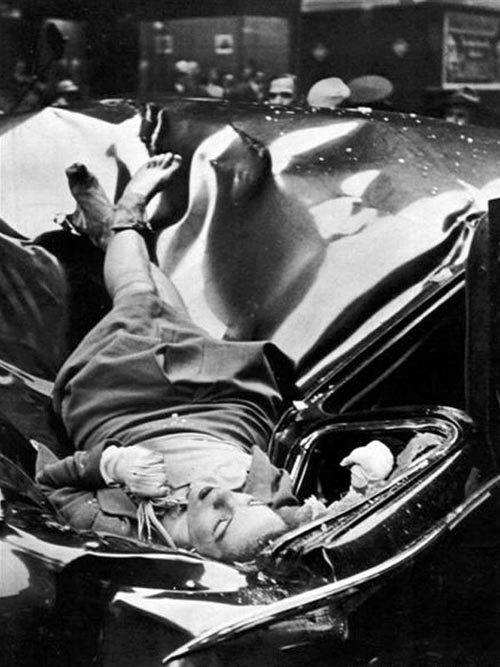
UPDATE: In the comments, I alluded to a famous Life Magazine photo of a suicide, a woman who had jumped from a skyscraper in New York. My point was that because the New York Post is regarded as a rag, its dramatic photo was attacked as sleazy. Life’s photo, in my view more lurid and less newsworthy, was acclaimed as art. You can find it here.
______________________________________
Pointer: Patrice Roe (Thanks, Patrice!)
Sources: Poynter; Forbes; WTOP
Ethics Alarms attempts to give proper attribution and credit to all sources of facts, analysis and other assistance that go into its blog posts. If you are aware of one I missed, or believe your own work was used in any way without proper attribution, please contact me, Jack Marshall, at jamproethics@verizon.net.
 Ethics Alarms
Personally, I couldn’t live with myself if I hadn’t thrown down the damned camera and sprinted over to the ledge to pull the man out. Even a non-New Yorker like myself would realize that the subway operator couldn’t stop his train in time. The law of inertia applies in NYC, too. That was also a very good picture for someone who was just thumbing off his camera to warn the train with his flashbulb. That excuse is just plain ludicrous.
Then, to compound this transparent lie, the photog submits this chilling image to his newspaper… and it’s printed! Thereby, the entire world can enjoy the last seconds of a man’s life before he’s smashed into ruin. I’m sure this man’s family and friends appreciated it, too. Maybe, if this Abassi creature had been a little quicker, he could have caught the moment of impact. Better luck next time.
The counter argument: in all likelihood, you’d end up not saving the man AND not getting the photo—and his job is to get the photo. I hope I would do what you say you would do—I’m just not so certain that I would have the presence of mind to do it. “Hmmm…how much does that guy weigh? Can I pull him up? Might he pull me down? Is someone else closer to him than I am? Can he haul himself up? Can I stop the train somehow?”
You try to save a man’s life; first and foremost. To Hell with the two-bit job. This takes utter precedence over that. And just what did “doing his job” entail? Sharing with everbody an image of a man staring at imminent death? Your “job”, as a man, is to try to help. This photographer failed pathetically in a fundamental test of ethics and of manhood. So did his editor.
Regarding Abassi’s instinct to take the photo, I’ve done a little amateur photojournalism, and one thing I learned was that pausing to think about whether to take a picture is a good way to miss the shot. I’ve tried to train myself that if I even start to think “I wonder if that will be interesting to photograph…” I immediately bring up the camera and start composing the picture. It’s not hard to imagine that Abassi started taking pictures before he had entirely figured out what was happening.
After that, I can’t tell from the story how long it took for all this to happen. Probably just a few seconds, so maybe not much could have been done.
I do have a problem with the Post’s decision to run the story so prominently — man-killed-by-train would be a routine small story if they didn’t have such a dramatic photo — but it’s not really an ethics issue.
I’m puzzled at the criticism of the Post. Life magazine once printed a full page photo of the corpse of dead woman, a beautiful one, who had just jumped to her death from a NY skyscraper and landed on the roof of a car, caving it in. It was reprinted in a “Best of Life” anthology. What was so newsworthy about a routine suicide? 1) She was gorgeous 2) It was a dramatic photo.
I think this is confirmation bias at work—people think the Post is sleazy, so the shot is sleazy. If Life printed it, it would be “art.”
Some people might think so. I wouldn’t. This is “journalism” at its most repugnant.
Would you run this?
Sorry, Jack. My computer has been giving me fits for days now. Can’t access your link. Is that the Life Magazine photo you referred to earlier?
Yup. Can’t figure out how to make it show.
I probably wouldn’t want to witness it, anyway. Naturally, it’s not always wrong to publish photographs of corpses. When those bodies are identifiable, though, it becomes an issue of decency. When people are shown with with the obvious intention of horrification (or, as in this instance, when still alive seconds before a terrifying death) it becomes a moral issue.
The most terrible incident of this I ever witnessed was as a child when watching Walter Crankcase on his “The Twentieth Century” program. It involved the story of a number of Navy personnel who were pulled aloft while trying to secure an airship on the ground and didn’t let go in time. I still recall watching in horror the film of one of them falling from a vast height… and impacting the ground in a cloud of dust. Disgusting. His family knew who it was, too. That made it even more disgusting.
Of course, the cameraman could do nothing to help in that case, so his filming of it was not necessarily a breach of ethics. Publically presenting it was. This further reminds me of some of the telephoto images printed in Time Magazine of clearly identifiable people leaping from the Twin Towers during 9/11. Another disgusting episode of sensationalism disguised as journalism.
BTW: The problem with my computer is this lousy wireless connection!
I disagree about showing the jumpers from 9-11. People need to be reminded what happened that day. Not showing the jumpers is as bad the netwroks not showing the Twin Towers collapse because its upsetting to people and may inflame peoples passion.
Bill: I’m referring to some full color, closeup shots taken of people in the act of jumping. They were not only identifiable, but you could even see the expressions on their faces. That was crossing the line big time.
Ok that i agree with. I thought you were referring to the ones showing them from the distance.
The photo no longer loads.
well THAT one is everywhere….I’ll fix it.
It just loaded fine!
I guess I think of it as questionable news judgement. There was a story on all the news channels around here a few years ago about a woman beating her daughter in a parking lot. It was a routine family violence incident: The daughter was not seriously hurt and nobody in the story was a public figure. It was a story only because a security camera had captured it and all the stations had the video. The real story wasn’t “Woman beats daughter” but “We have great video!” Not exactly news that people need to know. So if you’re publishing news, it probably doesn’t belong on the cover. On the other hand, if you’re publishing photojournalism as art, it’s a great photo. But it’s still not a major news story.
My only issue is with this:
Not taking action is action itself, and a photographer who allows a horrible event to occur that a normal bystander in his position could have averted is altering and influencing events as much as one who takes the initiative to stop it.
I disagree. Not acting is a decision the photographer made, but it’s not an influence of events. If the photographer was not there, would anything different have happened? No. Therefore, the photographer did not influence the events.
Can’t you even grasp how pathetically devoid of logic and principle that statement is, TGT? What’s happened to you? You used to be able to present an argument that had SOME debatable point of merit.
General accusation. No specifics. Again.
Still doing your “duck and cover”. Again. You’ve sure exposed yourself on this one, Tiggy.
Exposed myself how? Exposed myself where?
Oh, dry up.
A switchman’s decision not to switch the tracks of two trains on the way to collision would meet your conditions too. So would those EMT’s off-duty when the pregnant woman was having a heart attack while they were eating bagels. When Regina refuses to give her husband his nitro pills as he’s having a heart attack in “The Little Foxes”—is that non-influence? Really? I doubt you believe that.
Choosing not to influence events the average person would feel an obligation to influence is action, in my book, and I think in the view of most.
Which is exactly my point, Jack. In a healthy society- where individual initiative and responsibility are considered meritorious- this is understood.
I may have been unclear. The switchman doesn’t match, as it is his job to switch the tracks. If he wasn’t there, someone else with that job would be. That doesn’t apply to the photographer or any other bystander. Bystanders, by definition, are not involved in the situation. Regina and the switchman are directly involved.
The EMTs are a more interesting case. They are bystanders, but they also trained to help in this specific circumstance. I think they have the opportunity to influence events, and not doing so would have been unethical, but that doesn’t mean that not jumping in was influence.
Your last sentence shows the issue well. An action not to influence events, while an action, doesn’t influence events.
Bvuh.
Job? Being a responsible human being is everyone’s first job. A bystander who remains one while someone is in peril is just as guilty as if he had shot the victim for good measure. This is the mentality of someone who’s rejected God in their life.
Where have I said that there wasn’t a duty to rescue or anything like that? I’m attacking Jack’s preposterous redefinition of “influence”. Heck, I even explicitly said that EMT’s in Jack’s example would be unethical to not help.
Look back on your own comments, TGT. You’ve said that a man’s job outweighs his personal duties as a man to come to the aid of someone in imminent danger. Place yourself in the position of that man on the tracks. One extended hand can save you from terrible death… or that hand can push the button on a camera to record your last second of life. What would you prefer? What would you have done if your hand was the one in question? Frankly, I find your comments on this abhorrent.
You’ve said that a man’s job outweighs his personal duties as a man to come to the aid of someone in imminent danger.
I never said that. I said the job makes him part of events, not a bystander.
Place yourself in the position of that man on the tracks. One extended hand can save you from terrible death… or that hand can push the button on a camera to record your last second of life. What would you prefer? What would you have done if your hand was the one in question?
What does that have to do with anything. I haven’t said anything about the ethics of the photographer in this thread.
Frankly, I find your comments on this abhorrent.
You find my comments on the English language abhorrent? Or are you reading things into my comments that are SPECIFICALLY DECLAIMED by my comments?
Now you’re really getting pathetic, TGT. Your words were as plain as day. TOO plain, apparently.
Please point to the words that mean what you claim.
It doesn’t matter if someone is a trained medic, a cop or whatever. A “bystander” is… what? Anyone who’s present during a life or death emergency has an inherent human duty to act in defense of another’s life if they can possibly do so. This is one of the values that charcterizes a free society of citizens. Personal responsibility. Without that, we become a Marxian “mass” of herded animals.
I don’t see any of my words there. Are you granting that I never said a man’s job outweighs his personal duties?
No.
Then what was the point of that diversion?
Where do I claim that “a man’s job outweighs his personal duties as a man to come to the aid of someone in imminent danger”?
TGT: I can read. So can the other posters, or they wouldn’t be here. You seriously need to get a life.
Being able to read doesn’t mean being able to understand. Your being able to read also has no bearing on whether or not I said something. If you can’t point it out, that’s evidence that it’s not there. If you refuse to point it out, that’s evidence that you’re arguing in bad faith.
I disagree with the blanket characterization in your last sentence Steven.
There are plenty of people who reject G-d and yet still believe that “being a responsible human being is everyone’s first job”, or some equivalent.
You must have a very very sterile and clinical view of the world. You don’t think people have an ability or authority or obligation to act unless they are specifically tasked or trained by some higher power in the areas in which action may be called upon?
That is appalling and devoid of any principle.
I didn’t say those things at all. I’ve asked Steven already to point to where I said similar things. Your turn.
I’ve been discussing whether a bystander who does not act in events should count as influencing events. The only spot I’ve put an ethical judgment is for off duty EMTs who fail to help a pregnant women having a heartattack. I called that unethical.
TGT: You excused the non-action of that photographer as that of ethics, plus the incredible statement that his presence had no impact of events, offering as evidence some of the most twisted logic I’ve ever read, All of this points to your believing that Journalistic Ethics placed this man above any moral duty and that personal responsibility is meaningless. Your excuse for this wandering pappo (“journalist”, hell!) parallels that of Monsieur Rat (real name), the French photog who defended his standing by Princess Diana’s wrecked car and taking pictures of her while she lay dying. He, too, was a Journalist!
Personally, I’m sick to my stomach with arrogant “reporters” and ambulance chasers who cite their modern semblance of ethics as a means of setting themselves up above their fellow citizens and as an excuse for despicable conduct. Elsewhere, it was mentioned how Mike Wallace- a truly disgusting example of this elitist mindset- once defended American journalists being embedded with enemy forces and standing by while they killed Americans. With this mentality and these “ethics”, what crime cannot be excused?
When you stand by and allow a man to die (after he’d been pushed onto the tracks!) for the sake of selling a photograph for publication, that’s a crime. When you use every expedient of legal trickery to allow a killer, traitor or sex criminal back on the streets- knowing full well his guilt and that he’ll strike again- that’s a crime. When you record- up close and peresonal- the slow and painful demise of a traffic accident victim without lifting a finger to render aid or comfort, that’s a crime. When you accompany terrorists into the streets of an Iraqi city and televise the ambush killing of an American soldier, THAT’S a crime.
Not ethics. Not just a breach of ethics. It’s a crime before Man and God. And when you defend it as ethical or inconsequential… that’s criminal, too.
Got it?
You excused the non-action of that photographer as that of ethics
Where did I do this?
plus the incredible statement that his presence had no impact of events
What’s incredible about this statement? What’s the difference between a present nonactor and a nonpresent person?
offering as evidence some of the most twisted logic I’ve ever read,
What logic do you find twisted
All of this points to your believing that Journalistic Ethics placed this man above any moral duty and that personal responsibility is meaningless.
Well, if all your premises were true, and you throw in a couple more of my actual statements, your conclusion would only be a little bit hyperbolic. Not too shabby. Too bad the stated premises are all false.
Your excuse for this wandering pappo (“journalist”, hell!) parallels that of Monsieur Rat (real name), the French photog who defended his standing by Princess Diana’s wrecked car and taking pictures of her while she lay dying. He, too, was a Journalist!
I didn’t defend him for a second prior to my previous comment (and what defense I have given now is just that his behavior is understandable based on journalistic experience, not that it’s right).
—-
The rest I’m ignoring as irrelevant to this subpoint. (Yes the rest is relevant to the overall thread, but it has nothing to do with what the word “influence” means or to whether I had called a person’s behavior ethical.)
“What’s the difference between a present nonactor and a nonpresent person?” -TGT
Nothing in terms of results for the poor bastard on the train tracks. Everything in terms of whether or not the present non-actor was right or wrong in being a non-actor. Which is what the discussion is about. The difference between being an actor and non-actor. It is just more TGT-esque diversion to bring in a comparison between present and non-present.
“All of this points to your believing that Journalistic Ethics placed this man above any moral duty and that personal responsibility is meaningless. -SMP
Well, if all your premises were true, and you throw in a couple more of my actual statements, your conclusion would only be a little bit hyperbolic. Not too shabby. Too bad the stated premises are all false.” -TGT
“what defense I have given now is just that his behavior is understandable based on journalistic experience, not that it’s right).” -TGT
Precisely one of the main points we’ve been driving at. You fully believe that an entire industry is good when following a ethical code that allows wrong to occur, when it is within their power to affect it, just to get the story, even though there will STILL be a story even if good is brought about by their actions. Bizarro-world standards actually allowed to flourish in the real world.
We wonder why we have problems.
Sorry for the extreme delay, I just saw this (due to SMP’s post).
Present nonactor
You went off on a tangent here. This sub piece traces to the second part of this mangled sentence: “You excused the non-action of that photographer as that of ethics, plus the incredible statement that his presence had no impact of events”.
As noted, a present nonactor has no impact on events. We can argue about the ethics of a nonactor (and we have been), but SMP implied that a present nonactor is actually affecting events. That was stupid.
next chunk
You, again, have lied about what I said. I said that if a system does many small goods and a few very bads, it’s possible for the small goods to outweigh the very bads. I think that the code of general noninterference meets this criteria. You ignore the goods and claim that if any bads happen, it’s bad. By your logic here, every code of ethical conduct fails. All real world codes involve tradeoffs.
I think you’ve completely abandoned any sense of right or wrong, TGT. Not only in your outlook on the matter in question, but in your manner of response as well.
Another general attack without anything specific.
The examples you cited – “the switchman would change tracks because that is his JOB”, “the off duty paramedics must help because they are TRAINED to do so”…tempered by “this doesn’t apply to the photographer”.
That all rounds out into the ugly implication which I pointed out as part of your sterile and bureaucratic worldview.
You then even contradicted yourself when you play a nickpicky word game about ‘bystanders’. Bystanders by definition are not involved is defined by you as people who are not involved. You try to save yourself through circular logic. Correct they are ‘standing by’ BECAUSE they CHOSE non-involvement. By that definition Regina not doing anything IS a bystander and you have contradicted yourself.
Congrats, the photographer has chosen to be a bystander when he had all the ability to help. He chose not to. He did not cause the outcome of the man’s death (which is why there is no criminal guilt here) but he certainly chose not to keep the man from being killed (plenty of room for ethical guilt).
You have already identified you consider his lack of action to be wrong. So quit with the childish obfuscation about the definition of the word “influence”. Seriously, you are about to give a name to this irresponsible message board technique.
Just as Godwin’s law states, “over time the likelihood of a discussion bringing up a comparison to Hitler or the Nazi’s increases to 100%”
Here is TGT’s tactic – “don’t like the judgement call of the moderator? bring up a word you feel has been misused and argue that ad nauseum”
My supposed implication
I still don’t see it. I was differentiating someone already involved with a situation and someone who is not yet involved.
Bystander
See above. A bystander is someone who was not already involved in the situation for some reason. There’s no circular reasoning in my argument.
Being specific
It’s not childish to point out individual places of disagreement.
TGT’s tactic
Considering that I agreed with judgment call, the law wouldn’t make sense. Whether I agree in result or not, bad arguments are still bad arguments and should be fought against.
“I still don’t see it. I was differentiating someone already involved with a situation and someone who is not yet involved.”
And yet you obligated the involvement of off-duty paramedics because it was their JOB they were TRAINED to do. That invalidates that and reasserts my original comment on your implication (however unintended).
You didn’t like Jack’s use of the word “influence”, the proceeded to devote a great deal of time spiraling down that rat-hole. Unnecessary.
And yet you obligated the involvement of off-duty paramedics because it was their JOB they were TRAINED to do. That invalidates that and reasserts my original comment on your implication (however unintended).
Nothing’s invalidated. Here’s my previous comment: “The EMTs are a more interesting case. They are bystanders, but they also trained to help in this specific circumstance. I think they have the opportunity to influence events, and not doing so would have been unethical, but that doesn’t mean that not jumping in was influence.”
That non acting EMT bystanders are unethical doesn’t imply that a nonacting photographer is ethical (or unethical).
You didn’t like Jack’s use of the word “influence”, the proceeded to devote a great deal of time spiraling down that rat-hole. Unnecessary.
I made 2 comments on influence. It went Me, Jack, Me. That was it. Everything past that has been you and SMP misreading ethics into my statements.
I think we read them plain enough, TGT. Your Marxist concept of Mankind was in full display.
SMP, Even if I said what you and Michael/texagg04 claim I said, it’s not Marxist.
“Nothing’s invalidated. Here’s my previous comment: “The EMTs are a more interesting case. They are bystanders, but they also trained to help in this specific circumstance. I think they have the opportunity to influence events, and not doing so would have been unethical, but that doesn’t mean that not jumping in was influence.”
That non acting EMT bystanders are unethical doesn’t imply that a nonacting photographer is ethical (or unethical).”
You OBLIGATED involvement of the EMTs specifically because their life experiences empower them to try to save a person’s life and not just stand-by doing nothing.
Even the most lowly schmoe walking down the street is empowered to try to save someone stuck on train tracks and not just stand-by doing nothing.
So your comment is still invalidated.
If the photographer wasn’t there we wouldn’t be questioning his ations. He was there, and that makes this scenario NOT comparable to a hypothetical that does not involve him.
Taking no action certainly by a technical reading of the sentence means he is not influencing events. Still does not exhonerate him from taking no action. He COULD have helped. He DID NOT. It is as simple as that.
Based on all discussions I’ve seen you contribute to in the past, I think you are in the business of justifying and apologizing for questionable behavior.
Jack brings up the valid point that in emergency situations, our brains typically revert to instinctive behavior and our decisions are often not thought out. However, that instinctive behavior is often indicative of the upbringing of an individual and how their subconsious decision-making processes have been shaped by their environments.
I agree to paragraph 1 and 2, and I have not said differently.
Paragraph 3 boils down to “I don’t have the same ethics as you” with a heaping dose of “I am likely misrepresenting your positions in my mind”.
Paragraph 4 sounds good to me to. People do what the sum of the their experiences say to do. I’d say that a photographer who has practiced being detached from situations probably gets some slack when he reacts to situations. So taking a picture here, while likely not something we would call ethical behavior, is completely understandable behavior.
It’s “understandable” only in your corner of Hell, TGT.
So, if someone is trained to treat the world as if it’s a movie screen, you don’t see how that person might not immediately jump through the movie screen to help someone?
You associate the word liberal with ideas you don’t like. You immediately call someone a liberal now when you don’t agree with their ideas, even if their ideas are libertarian or conservative. It’s not right, but it’s understandable based on your prior experiences and how you’ve trained yourself.
“Paragraph 4 sounds good to me to. People do what the sum of the their experiences say to do. I’d say that a photographer who has practiced being detached from situations probably gets some slack when he reacts to situations. So taking a picture here, while likely not something we would call ethical behavior, is completely understandable behavior.”
And yet we thoroughly disagree here. The photographer has practiced being detached from situations……good lord, ok, got it. He has detached himself from his humanity. You know who else does that? Serial killers…sociopaths. Listen to yourself….
When I say that our behaviors are reactions based on our experiences in life, I don’t say that as an excuse for our behavior. I say it as an indictment on our behavior. If you want to really use my paragraph for your purposes, then there ought not to be laws, crime OR punishment…cuz hey, murderers are just products of their environment right?
I say this as an indictment on our behavior, because even if our behavior is a product of our experiences….each of us is responsible for how we let our experiences shape our outlook on right and wrong.
Sociopathy isn’t necessarily a negative.
Detached photographers are beneficial to our society. Just like it’s necessary for scientists, doctors, and economists to be detached.
You say that being detached is an indictment on an individual, but completely ignore the repercussions of such.
The comment about laws is just out of left field. While I may understand why a murderer committed a crime, that doesn’t mean they shouldn’t be punished for it. Deterrence is hugely important.
The closing is also ridiculous. Are we talking about a photographer who thought it was right to let someone die? No.
“Detached photographers are beneficial to society”
Not so detached they can’t try to save a man’s life. Again, there will always be a story to report. That man’s life can’t be saved now.
Detached scientists, doctors, and economists don’t let a person struggling to save themselves die when they could have helped.
I didn’t mention law. I pointed out that if you use the idea that our life-experiences can be used to justify our behavior and clear us of it (which you implied) then that can be extended to all mis-behavior.
“The closing is also ridiculous. Are we talking about a photographer who thought it was right to let someone die? No.”
Uh, he certainly valued his picture over the man’s life.
Not so detached they can’t try to save a man’s life. Again, there will always be a story to report. That man’s life can’t be saved now.
First, BS. As noted above, if your photographer isn’t detached enough to let horrible things happen, then the photographs won’t represent reality, and will mislead.
Second, how do you suggest someone become detached to the right level? How does one become detached until someone’s life is in danger?
Detached scientists, doctors, and economists don’t let a person struggling to save themselves die when they could have helped.
Scientists, doctors, and economists are detached in their specific realms: learning about the world through science, performing medicine, and working on economies. The photographer’s realm is visualization of the world. Anyway, doctors absolutely do (and should) sometimes let people die when it might be possible to save them. Sometimes because their time can be spent more fruitfully elsewhere. Scientists, as well, sometimes have to let people die. It’s rare, but it occurs.
I didn’t mention law. I pointed out that if you use the idea that our life-experiences can be used to justify our behavior and clear us of it (which you implied) then that can be extended to all mis-behavior.
You absolutely did mention law: “then there ought not to be laws, crime OR punishment…cuz hey, murderers are just products of their environment right?”
Nowhere did I imply that our life experiences clear us of ethical duties. You keep reading things into my comments that aren’t there. I can absolutely understand why someone did something while still saying what they did was bad.
Closing
You switched between when people the photographer did to what the photographer things back to what the photographer did. It doesn’t work that way. Even if the photographer just took the picture and did nothing, that does not imply that he thinks what he did was right. Are you saying that you believe that everything you have ever done was correct?
Wiggling on the hook like crazy! And “sociopathy isn’t necessarily a negative”?? A sociopath is, in some ways, worse than a psychopath. A psychopath doesn’t know right from wrong. A sociopath does. He just doesn’t give a damn! The White House is brimming over with those. And ever one is a clear and present danger to society. As I’ve often stated, if you support a cause, you become one with it.
First, psychopaths can know right from wrong.
Second, not all sociopaths know right from wrong.
Third, your attack on the democratic White House is a non sequitur.
Fourth, nothing you said actually counters my comment that sociopathy is necessarily a negative.
“First, BS. As noted above, if your photographer isn’t detached enough to let horrible things happen, then the photographs won’t represent reality, and will mislead.” -TGT
That is actually BS. If a journalist (just like any human) witnesses a horror within his/her power to correct and DOES correct, the story becomes a far better one about a problem being fixed and is still rooted in reality. If a scenario is out of the journalist’s (just like any human’s) power to correct OR if others are there doing the good to an extent that the journalist’s additional effort would make no appreciable difference, then fine, let the journalist set about his/her calling.
“Second, how do you suggest someone become detached to the right level? How does one become detached until someone’s life is in danger?” -TGT
Implied in my response above.
“Anyway, doctors absolutely do (and should) sometimes let people die when it might be possible to save them. Sometimes because their time can be spent more fruitfully elsewhere. Scientists, as well, sometimes have to let people die. It’s rare, but it occurs.” -TGT
That depraved statement needs no response and further underscores that your value judgments come straight from the heart of Bizarro-World.
“Closing
You switched between when people the photographer did to what the photographer things back to what the photographer did. It doesn’t work that way. Even if the photographer just took the picture and did nothing, that does not imply that he thinks what he did was right. Are you saying that you believe that everything you have ever done was correct?” -TGT
This is diversion into the topic of regret or repentance. This is all related to discussing things AFTER the bad decision is made. This has no bearing on the thought processes leading to the bad decision.
But, just so I can give you the opportunity to further obfuscate this discussion with logical fallacy and rhetorical irresponsibility, let us stipulate that the photographer DID think standing there doing nothing was wrong PRIOR to the event of the man being killed. That would only identify him as a coward or a ‘deer caught in the headlights’. Both conditions of which have been discussed ad nauseum within other sub-threads.
Journalist’s representing reality:
You skirted the issue. Some things will get sanitized by interference. Some story’s may become more uplifting if the journalist interferes, but by doing so, the journalist sugercoats what happened. The picture of tank man from tiananmen square is extremely powerful. And it looks like the man is in danger for his life…a life that could have been saved by the photographer. If the photographer had interfered, we wouldn’t have that powerful image any more. We’d be missing a piece of incredible reality that has had meaning through multiple generations. if the photographer had tackled tank man out of the way, there would be no story.
How to be the proper amount of attached
You didn’t imply how to do such. You just said to do such.
Doctor’s letting people die
You didn’t explain anything wrong with the statement. Your response is a common dodge for when people don’t like a value judgement, but can’t argue against it.
diversion- regret/repentence
I didn’t discuss regret or repentence at all. This is discussing decision outside of time. Looking at the ramifications to determine what actions would be appropriate. If you don’t think looking at the results of an action should go into the decision making process for a given action, I don’t think we can possibly find common ground.
stipulation
Why in the world would I stipulate to that? Why would you even request that I stipulate to that? It’s a completely new situation that we haven’t been discussing.
Journalist’s representing reality:
“Some things will get sanitized by interference. Some story’s may become more uplifting if the journalist interferes, but by doing so, the journalist sugercoats what happened.” -TGT
You are attributing dishonest behavior before it occurs. A simple hypothetical —
A journalist can happen upon a man aiming a gun at a young child preparing to pull the trigger.
One of several things can happen, we’ll limit it down to 2 polar opposites for simplicity:
A) The journalist can start taking notes and allow the child to be murdered, then report the gruesome details the next day. According to value statements you have made, this is perfectly acceptable behavior of a journalist.
or
B) The journalist can attempt within his/her power to stop the murder from occurring.
For the sake of your quote above, we’ll say the journalist picked option B and saves the young girl. Your claim is that the journalist would sugar coat the would-be murderer’s behavior while reporting the story of the attempted but thwarted murder. You are attributing dishonesty to the journalist before an act even occurs. Likely the journalist can easily report with accurate detail the who, what, when, where of the murder attempt as well as the who, what, when, where of the would be victim and the actions taken to save said child. The TRUTH is still told (so the journalist has done his/her job) AND a life is saved.
“The picture of tank man from tiananmen square is extremely powerful. And it looks like the man is in danger for his life…a life that could have been saved by the photographer.” -TGT
A good example, and yet it fits with the algorithm we are discussing at the bottom of this page. The journalist ought do everything WITHIN his power to help the man to whom he is not obligated while not increasing to REASONABLE CERTAINTY his own demise. That journalist must be 100 yards away, in an elevated position, getting that image. Hardly in the context of helping that man within his power. Not to mention the entire clause “while not increasing to REASONABLE CERTAINTY his own demise”. Did you see the tanks? Did you know the massacre occurring at Tianmen Square was pretty good indication of the Chinese Government’s resolve.
“if the photographer had tackled tank man out of the way, there would be no story.” -TGT
If the scenario had been such that photographer would not have been in serious danger himself saving the man, there would have been no story either.
“Doctor’s letting people die
You didn’t explain anything wrong with the statement. Your response is a common dodge for when people don’t like a value judgement, but can’t argue against it.” -TGT
Doctors must attempt to save lives. Part of their obligations. It is right to do so. If you wish to bring up the exception of patients voluntarily electing to be labelled as Do Not Resuscitate, that is an exception to the rule based on a comparison of 2 different value statements.
diversion- regret/repentence
“I didn’t discuss regret or repentence at all. This is discussing decision outside of time. Looking at the ramifications to determine what actions would be appropriate. If you don’t think looking at the results of an action should go into the decision making process for a given action, I don’t think we can possibly find common ground.” -TGT
“Even if the photographer just took the picture and did nothing, that does not imply that he thinks what he did was right. Are you saying that you believe that everything you have ever done was correct?” -TGT
The comment “does not imply that he thinks what he did was right. Are you saying that you believe that everything you have ever done was correct?” is opening a whole new discussion of his ‘feelings’ after an action which is questionable, specifically the feeling of regret. Perhaps your wording on that comment is not clear.
And nowhere have I stated we ought not to consider potential results of an action. We are getting the aforementioned feelings of regret from wrong decisions mixed with predictable tangible results of an action.
“stipulation
Why in the world would I stipulate to that? Why would you even request that I stipulate to that? It’s a completely new situation that we haven’t been discussing.” -TGT
I’m prepared to cease that segue since it appears the confusion is arising from a difference in what we thought we were discussing– I thought you were initiating an evaluation of the emotions associated with wrong actions (regret in this case), but I think you now meant to discuss evaluating beforehand possible results of actions.
Journalist’s representing reality
I was actually thinking of grander scale bad behavior. If a photojournalist goes to a poverty stricken country and feeds everyone they encounter, despite doing individual goods, their whitewashing the much larger overall bad.
This should have been clear by my comments that it’s understandable that it may be hard to switch off the filter and act in one-off situations.
Now, if it was a government official during a war where there are random child killings, the photo of the child’s death may have more positive affect than saving .1% of the killed children. (Also, Journalists are protected as civilians in the rules of war. If they start engaging, they lose that protection.)
tank man situation
Yes, based on where the photo was taken, involvement was likely not possible, but you’re wrong on thinking that the photographer not being in serious danger but being able to help would have made it a nonstory. I’m sure of that, as tank man LIVED. His apparent danger does not imply that someone helping him wouldn’t be in danger as well.
Doctor’s letting people die
I didn’t mean the exception of DNRs.
I think I was unclear here. I didn’t mean to suggest that doctors won’t attempt to save someone that’s coding, just that they do not give the same aid, and the unequal level of aid does allow some people to die, without directly saving someone else. If a hospital spent all it’s resources on someone with a 75% chance of death, they might be able to bump it down to 50%, but they’d sacrifice dealing with all sorts of nonfatal incidents.
diversion/regret/repentence
Here was my comment, in context: “You switched between when people the photographer did [(should have been “what the photographer did”] to what the photographer thin[k]s back to what the photographer did. It doesn’t work that way. Even if the photographer just took the picture and did nothing, that does not imply that he thinks what he did was right. Are you saying that you believe that everything you have ever done was correct?”
I’m not trying to diverge into regret and repentence. I’m making the point that the actions we perform don’t always live up to our beliefs of right and wrong. Why was I making that point? Because of this comment”I say this as an indictment on our behavior, because even if our behavior is a product of our experiences….each of us is responsible for how we let our experiences shape our outlook on right and wrong.”
We had been talking about the slow response time being based on prior actions. We hadn’t discussed the the photographer would think it was wrong to act in a one-off situation.
Potential results of actions:
“And nowhere have I stated we ought not to consider potential results of an action.”
“[Your comments here are] all related to discussing things AFTER the bad decision is made. This has no bearing on the thought processes leading to the bad decision.”
To me, this second quoted implied that you don’t consider results when looking at what to do. Now that I’m looking at it again in the context of my previous comments, it probably just means that my horrible typos made it difficult for you to parse what I was saying.
Stipulation
We’re on the same page. Go us.
The first paragraph is stupidity. The second is misstatement… followed by a snide attack on my military background. “Trained myself”? I guess I just grew up in a time and place where citizenship and common decency still meant something. If so, I thank God for it.
I’m referring here to TGT’s 9:04 PM comment.
The 9:04 comment says nothing about your military background.
The first statement that you claim is stupidity says you deny we are the result of our experiences. What’s stupid about that?
For the second statement… how does improperly calling people you disagree with “liberal” have anything to do with citizenship and common decency?
1. It was intended. I know your style.
2. It was. I know their style.
3. It wasn’t improper and it has everything to do with it.
1. Clearly not. It’s directly parallel to my photographer comment. It had nothing to do with the military.
2. no response to my question.
3. Being liberal is against common decency and citizenship? You’re insane.
1. No
2. None needed.
3. Liberalism IS all that… and insane besides.
1. You’re insane. If you tell me you didn’t mean an attack, I’d take your word for it. I can understand how you saw my comment as a gibe on your military background (based on your assumption that I’m an anti-soldier elitist), but I did not mean an attack. I don’t see a military background as a negative or being self taught as a negative. My job actually supports the military, and I’m proud to do it.
2. You think its stupid, but you refuse to say what’s stupid about it. I really should go back to my boilerplate.
3. *sigh*
Not stupid. Just insane. Your’s, not mine.
I’ll take this all up later, folks. Have to run for work, now.
■“While photographing subjects do not intentionally contribute to, alter, or seek to alter or influence events.”
■“Strive to be unobtrusive and humble in dealing with subjects.”
■“Respect the integrity of the photographic moment.”
What a buch of bullshit. That may be fine in some fantasy land but when push comes to shove you help people. Maybe these ideals work work when you can be impartial, but not today , not when someones life is on the line.
I think the ideals are so that the photographer captures the moment accurately, and so they aren’t encouraged to create fake moments.
If we didn’t have these rules, the brutality of war and famine would be, essentially, sugarcoated in pictures.
I agree that one-off events are more important to be a part of then to photograph, but it’s not as simple as “when someones life is on the line”.
I think it’s a mistake to use those ethics rules to address this kind of issue. Those rules seem to address the ethics of producing accurate and fair images — no staging or interaction — not the question of whether or not there are more important things than getting the shot. I think intention also matters: If the photographer had interfered for purposes of getting a better photo, that would have been unethical, but interfering to help would not.
I agree completely, but a lot of famous and honored journalists did not and do not. One of them was Mike Wallace, who I heard argue vociferously in an interview that a a reporter should record the story rather than take action to prevent harm coming to an innocent as a result of the event unfolding.
I think there’s an argument for non-interference in cases where the reporter would not have been allowed to be present if it had been known he’d interfere. For example, if a group of Occupy Walmart protesters invite a reporter along while they break into a closed store at night to occupy it, he shouldn’t call 911 to report them. If they’d known he was going to do that, they wouldn’t have invited him along. The break-in would still have happened — the harm would still have occurred — but he wouldn’t have gotten the story. I’m not sure I buy that argument, but it clearly doesn’t apply to accidents and natural disasters.
Anyone justifying it that way must first make the step to detach the journalist from the human. The journalist is human FIRST and is obligated to assist if possible.
High ranking/well respected journalists defending this particular photographer’s behavior carries little weight as it could be said they are only protecting their profession.
I’m not unsympathetic to this point of view, but the fact is that it runs counter to the essence of professional ethics, in all professions. A human being might feel he should blow the whistle on a guilty murderer, but a lawyer who has that murderer as a client may NOT do that, and remain a lawyer. A human being might feel that the moral and ethical course is to let a genocidal dictator die on the operating table, but a doctor may not do that—it is counter to professional ethics. A human being who has information that will lose an election for a beneficent leader and give power to a devious crook might choose to withhold that information, but an ethical journalist may not.
Journalists who argue for non-involvement aren’t protecting their profession; they are defining it, as a professional ethics do. You and I might argue for a different definition, but the fact is that professional ethics have different priorities, and must have.
Interesting analogies. But here is my reply…and my apologies for duration.
The accused murderer (analogous to all those who read the New York Post) have a right to be defended, just as the readers have a right to the story they paid for. But, the lawyer (analogous to our photographer), belongs to a larger system that includes a prosecutor, a judge, and a jury. All of whom are acting in a system that provides a service to society as a whole. If this lawyer betrays his obligation to the defendant (analogous to all of those who read the New York Post) then he has cheated the defendant as well as besmirched the trust people have in attorneys (someday the guy may be defending me, and he may think I’m guilty…what would he do?) However, the photographer does not betray the trust of his clients (the readers) by helping the man about to be run over. If anything, the readers just get a different story (which is *ok*, because prior to the train hitting the man, when the photographer made his decision, there was NO STORY TO TELL). This different story is one that actually increases man’s trust in his fellows and actually strengthens their trust. Any profession that justifies allowing someone to die (when capable of saving them) just to get a story by claiming professional ethics, has issues to begin with.
As the client of the photographer (the readers) is now in the analogy of the doctor. Our dictator (analogous to the readers, as receivers of the service provided) is being rendered the obligatory services of the doctor (analogous to the photographer). Our dictator is a cruel and inhumane man, committing crimes of atrocious scale, the doctor knows this, yet much treat him anyway. If the readership also consisted of cruel and inhumane individuals, our photographer just as obligated to give them the story, regardless of what he knows. So yes, that is a fair analogy. But again, the photographer can still save the man’s life and still provide a story to his client. Again, a profession that justifies allowing someone to die, when saving them is within their power…questionable. This profession still consists of humans…they aren’t detached from the same mortal obligations the rest of us have.
The politician and his partisan supporter are a more troublesome analogy, as the partisan supporter (analogous to our photographer) is professionally bound to his immediate client (the politician), but being part of a political effort, is ultimately bound to their constituency and the body politic at large. And by that great amount of muddling, I’m not sure I can reconcile the intricacies of that relationship with the pure simplicity of the photographer, the about-to-be-killed-man, and the readership.
In summation, I understand that every profession has its code of ethics governing its behavior. But if one profession can set aside the original principle of preserving, within one’s power, innocent life in immediate danger in order to fulfill its supposed service… hm…
Another way of analyzing these analogies:
In each analogy you have an Actor: An professional, within an industry that is governed by ethical codes. One is a defense counsel, one is a doctor and one is a campaign adviser.
Each analogy has established in it certain relationships between the Actor. Each one has an IMMEDIATE relationship with their particular client (who I will call Group A)– One of whom is the accused murderer, one is the genocidal dictator, one is a politician with incrimination information.
Each analogy also establishes indirectly, a broader relationship with the body of potential clients as well as the even broader relationship with society as a whole (who I will call Group B) — one is all potential defendants and then society as it benefits from a judicial system, the second is all potential patients and then society as it benefits from the medical industry, the third is the political constituency and then the voting people as a whole.
Each analogy further stipulates a specific third parties, who are in direct opposition to the members of Group A (who I will call Group C) — in the first, the victims of the murderer/society, in the second, the victims of the genocide/society, in the third, the opposition party/society
Each analogy further requires a comparison of greater good…a conflict between the IMMEDIATE beneficiary of the relationship (group A) and the beneficiaries of the broader population (group C, who are presumed innocent). Either the Actor benefits group C, by unethically failing to render services to group A. OR Actor benefits group A by conducting business professionally, thereby knowingly perpetuating great evils to group C.
Here’s where the analogies do not match the original scenario.
The photographer (Actor), is obligated to get the information of the story to his IMMEDIATE clients (Group A types), who are his readers/viewers. His obligation to do such comes at a horrendous cost to the man being hit by the train. Not only does the man being hit by the train fail to mirror any of the analogous groups B or C, but Group A in this case, the readers, fail to compare to the evils of the murderer or the dictator. Therefore the value relationships established in the analogies DO NOT exist for the actual scenario in question.
And let’s stipulate that they do and therefore I must make a decision based on those analogies. So, good of the man’s life is being compared to the good of the readers getting their story…. the readers will STILL get a story…and a factual one at that…if the photographer attempts to save the man’s life.
In conclusion, to use the Lawyer Analogy from above, I’ve modified it in such a way that I feel it is more basically comparable to the actual scenario:
If a lawyer were walking down the street and observed a man draw a firearm on an innocent bystander — ought that lawyer rush to stop the murder? or ought he wait and then offer his services to the killer when the act is complete?
Fascinating musings. But that last analogy doesn’t fit, because the lawyer walking down the street has no professional duties that conflict with his human duties. But a lawyer who sees his client commit a crime, even a violent crime, right before his eyes is prevented by his ethical; rules from reporting it to authorities.
A journalist, or photo journalist, witnessing a news event has a conflict. Professionals are not defined by clients; a professional has a duty to society, and the journalists is to inform and report without interference. That’s why this is a conflict. I agree with your conclusion regarding the choice the journalist should make in the case at issue.
And yet, nothing is a news story until it is a news story. When the photographer had the choice presented to him – help the man in imminent danger or do not help the man in imminent danger – there was NO news story…the news story could have been
“man hit by train, pictures at 6!”
“man saved by photographer, story at 6!”
“local photographer killed saving man’s life, tragic story at 6!”
“local photographer dies failing to save another man’s life, tragic story of the death of 2 at 6!”
“train derails just prior to hitting one man on tracks, lucky blighter survives, 124 others killed, local photographer pulls survivors from wreckage, story at 6!”
The point is, regardless of what ultimately happened, SOMETHING newsworthy was going to happen.
Journalists are thoroughly obligated to document, say, a mass killing that they are essentially powerless to stop, even if it is occurring before their very eyes. Although I would submit if they had some power to affect it in even a minuscule amount without losing their own life (such as safeguarding just one victim from a thousand), they ought to–because minus pictures, they can still report the whole thing.
This boils down to whether or not the observing journalist has any power to effect additional good for others during a story. If they do, they can hide behind journalism since they have a professional cover story, but be completely wrong. If they do not, such as the negative Actors are too overpowering to counteract OR there are other positive Actors such that the journalists additional effort would increase the aggregate good of those others, then by all means document document document.
But if an entire industry has woven into its ‘ethical code’ an opt-out for letting people die whom they are capable of aiding, then journalism can stuff it.
OK. You are sent as an embedded journalist to write and report in a foreign war zone. You have a chance, many in fact, to try to rescue endangered soldiers at personal risk. What is your duty? (Hint: it isn’t to be rescuing people.) How do you distinguish this from an urban reporter whose job is to chronicle the life and drama around him?
A lot of criminal defense lawyers can’t handle representing guilty criminals. It’s not for everybody–the professional ethics are tough. Ditto journalism. It’s a nasty job sometimes.
One name. Ernie Pyle.
OK. You are sent as an embedded journalist to write and report in a foreign war zone. You have a chance, many in fact, to try to rescue endangered soldiers at personal risk. What is your duty? (Hint: it isn’t to be rescuing people.) How do you distinguish this from an urban reporter whose job is to chronicle the life and drama around him?
A lot of criminal defense lawyers can’t handle representing guilty criminals. It’s not for everybody–the professional ethics are tough. Ditto journalism. It’s a nasty job sometimes.
If there are other positive Actors such that the journalists additional effort would *not* increase the aggregate good of those others, then by all means document document document.
Then the subway incident qualifies. The photo has probably saved lives, prompting consideration of safety features, making others consider what they would do in similar circumstances. On balance, a win for society. Right?
I didn’t mean to make my embedded journalist comment sound utilitarian. I meant to say, an embedded journalist in a perhaps a fire fight that is going south, certain can do his job. If there is a wounded young soldier within his power to pull to safety while not excessively increasing his own likelihood of dying, then yes, that journalist as a human ought to seek to save that life. However, in general the military has systems in place to police their own.
Even from a utilitarian point of view it is a very very big stretch to say the photographer’s decision was beneficial in that it brings to attention the need for additional safety protocols. Especially, since I’d give the journalist exactly .0002% likelihood that that consideration even crossed his mind.
Ernie Pyle died trying to pull a wounded GI to safety. He wasn’t the only one, either. Pyle was an “American” before he was a journalist. When he saw neglect or incompetance among military leaders, he went to their superiors and got action, rather than printing up a glaring expose that would only have given comfort to the enemy. The soldiers loved him and the officers respected him as his stories were those of the common GI in war. He was the antithesis of the Edward R. Murrows of the world, whose disciples dominate the press rooms today.
Well worded.
So, according to you, Ernie Pyle hid the truth from the people he was supposed to be informing. Awesome.
Hey, I’m not endorsing the “no interference” journalistic ethic, just explaining the ethical theory. Sure, Pyle sacrificed one duty for a higher one. He did the right thing.
My Dad was supposed to be an observer during D-Day, which meant he wasn’t supposed to get involved in combat, or get himself killed, since they needed someone with military experience to watch and take notes, so to speak. Would he have abandoned his post to save a soldier? Sure. And, he said, might well have been punished for it, with some commanders. Luckily for him and me, he was wounded before the invasion, and couldn’t go.
He did nothing of the sort, TGT. He saw his job in a vastly different light than do the self-seeking, anti-American ideologues of today who call themselves journalists. He never lied to anyone. He never falsified or “politically enhanced” a story to gain notoriety. He later published some of those stories (with due discretion) because he realized that he also had responsibilities to the soldiers. Sometimes, more can be accomplished by putting a word in the ear of a commanding officer of a potential problem he’d seen here or there than to broadcast it out to the world in the midst of its greatest war. The generals and admirals listened and acted on his advice because they respected his knowledge and integrity. He saw his job not only as a gatherer of stories, but as an ombudsman for GIs. He did that job well. Remember, this was the man who died trying to save the life of a wounded soldier. The very concept of embedding with his country’s enemies would have been alien and repugnant to him. He was an American journalist. There are so terribly few of those left.
Jack,
I was responding to SMP. I should have said that. I wasn’t taking issue with your comments.
SMP,
So, the journalist wasn’t really a journalist. He was a soldier and propagandist. For a journalist, failing to report the truth is lying.
I’m sure Pyle was a courageous fellow with great loyalty to the country and the military, but that doesn’t mean he was an ethical journalist.
I eventually figured that out. Caught in the crossfire again!
Pyle was a paragon of ethical journalism. He understood what journalism is all about far better than you, TGT, or the pseudo journalists of today. He observed and reported his findings to whomsoever it would do the most good. He realized that his words could do more harm than good to the soldiers in the field if he lambasted an occasional incompetant officer in print. He therefore usually went to a superior officer and tried to get the situation resolved in that manner. Because his integrity was known on all levels, this most often led to a quick correction of the problem and likely saved American lives in the process. Isn’t this at the heart of what journalists are supposed to do? Isn’t this why a free press was considered so vital by the Framers? With Ernie Pyle, being a journalist wasn’t all about him. It was, first and foremost, about his fellow citizens whom he served. It was also about the soldiers. He kept faith with them all. He died in the fulfilment of that service. He deserves our respect.
SMP,
A free press is supposed to save the people from the government. Yes, going to superiors (if they actually changed things) would perform a part of this task, but it misses the larger issue. Pyle’s more important responsibility was to keep the citizenry informed so that they could make appropriate decisions about their leadership. I’m willing to give Pyle respect for his accomplishments as a person, and they may outweigh his failures as a journalist, but that doesn’t mean he was a good journalist.
The difference is that Pyle was a RESPONSIBLE journalist. It’s in that qualifier that modern pseudo-journalism is lacking so pathetically.
Last week’s episode of “Fear the Walking Dead” (the interesting sort of spin-off, now sort of cross-over of the floundering “Walking Dead”) entitled “The Wrong Side of Where You Are Now”, brings this topic up.
There are essentially 3 clusters of characters interacting this season. The “protagonists”, which are the core of the original characters from the last 3 seasons, who, through a broken time line we know have been ousted from the baseball stadium they converted into a long-term home are on a mission of revenge against the “antagonists”. The “antagonists” are a group of nomads whose modus operandi is to keep moving for survival and to compel settled communities to join their nomadic lifestyle or face being raiding by them. The third group or a second cluster of “protagonists” includes people who were never native to either of the first two groups and includes a cross-over character from “Walking Dead”, Morgan, whose entire motivation is to get people to stop fighting each other.
This cluster of characters includes a cowboy type on a mission to find a woman he’s in love with who we subsequently learn is a woman who had fallen in with the protagonists but more recently had fallen in with the nomadic antagonists. This same woman, Naomi, can also be considered part of this third cluster. There is also a lone journalist type whose self-proclaimed mission is to document the ‘zombie apocalypse’.
In the opening scene of this episode we find the 1st group in a firefight with the 2nd group, the 3rd group caught hopelessly in the middle of it. From the outset, the cowboy had been shot in the gut and was down and Naomi, also a nurse, was trying to save him. The journalist, Althea or Al, who has been on her mission in a salvaged SWAT MRAP that she’s modified with remote controlled machine guns, stays off to the side of the fire fight filming the battle.
Morgan rushes to her and tells her (I don’t recall the exact words): “This is not the time to be apart. A good man is about to die and you can change that.”
She ends up driving the MRAP up to the wounded man and trains her machine guns on one of the fighters who is lining up to kill Naomi.
I don’t think the episode justifies my belief that journalists who can reasonably impact a situation for good without significantly increasing their own risk *should get involved at the cost of their story*, because any screenplay can be choreographed to show any action to be correct. The episode merely reminded me of this discussion and so I pondered it again and am content to see my ideas before haven’t changed.
However, in light of the current journalistic/media/entertainment industry attempt to overthrow our Republic, I do think it worthy to emphasize that the rule for journalistic involvement should really only be pigeonholed to situations where lives are at stake and they can save a life where no one else can. Otherwise, journalists should butt out of ongoing situations and just report.
And no, our nation was not facing an existential crisis worthy of their involvement. However, their involvement IS creating an existential crisis for our national culture.
Wasn’t that in a roundtable discussion with Peter Jennings and a Marine general- among others? I remember THAT one quite well.
Posting the photo add value to the story of the man being pushed. With a respectful headline, it could have had equal merit to the similar photo Time published.
However, the Post’s headline is exploitative and indefensible. I never saw Time’s photo, but I know from their reputation that it was not written in bold, lolcat-style text saying, “THIS WOMAN JUMPED… SHE IS DEAD!!!”.
The Post’s “rag” reputation caused by the context rather than the content of the photo.
This guy R Umar Abbasi isn’t even a photojournalist. He’s never had photos in the NY Post before. Abbasi has had a few amateur fashion photos of scantily clad women on a couple of websites. No one has ever heard of him before. So why is he claiming to be a “photojournalist”? Something is fishy here with Abbasi.
From the photo, there’s no way the photographer could have gotten to the victim in time to do anything.
I would have tried anyway, but not beaten myself up too much when I didn’t get there in time.
A more graphic example that illustrates this issue is this one:
WARNING – NOT SAFE FOR WORK, HOME, OR ANYWHERE ELSE. IT WILL ENDANGER ANY FAITH YOU HAVE IN HUMANITY
http://www.liveleak.com/view?i=dae_1236854361
Had the photographer tried to interfere, the mob would have attacked them too.
Pingback: The Man On The Subway Tracks | Ethics | Scoop.it
I was wondering why this photo is even considered newsworthy. This photo and the accompaning headline is not anything special compared to some of the more iconic photos of the past which were even more graphic and much more disturbing. However, the quality that made each of these historical photos so iconic is that the photo depicted an equally disturbing reality which many people didn’t want to face. The photo made it real in a way that written words couldn’t. As I look at this photo, I wonder if it has a certain Kitty Genovese quality to it? Maybe there is a disturbing reality in this photo that we don’t want to face. As a society have we become so indifferent to others that not a single person would help this man? This certainly isn’t an isolated case. I think the fact that the man is about to die is sensationalism. I think the fact that no one is willing to help him is the real story.
This is my first time leaving a comment. I love the blog. I do know for sure that if any of your readers were in the situation of the man on the tracks they would much prefer Steven Mark Pilling as the photographer rather than the editor.
In similar videos where a person has fallen onto subway tracks, there are many people trying to flag the train at a minimum, and sometime pulling the person up if he’s near the platform. In this photo, nobody is shown nearby. I wonder if the circumstances of the situation influenced the crowd; the man was pushed, and the man who pushed him was later arrested for murder.
Intervening in physical confrontations is much more likely to result in injury to bystanders, and every training manual I read advises staying back and indirectly intervening at least initially. The fact that this was a homicide, rather than an accident, makes the incident notable and makes the crowds actions understandable.
Excellent insight, Rich.
One slight issue. At the time of intervention, it’s a fight/assault/attempted homicide, not a homicide.
The key is that there is a physical altercation and a party shows they are dangerous, not that a specific result occurred afterwards.
Irrelevant. You save a life. The whys and wherefors are for later.
And if you kill yourself jumping onto train tracks, the whys and wherefors are for later. I’m sure you were a great MP. If someone was violent, I bet you just shot at them, and damn the consequences to everyone around.
Now you’re getting hysterical! Obviously, you don’t commit suicide in a plainly hopeless endeavor. But this wasn’t that, was it? The man had a arm up on the ledge, but was unable to hoist himself up. One strong hand on his belt could have lifted him to safety. I’ll just ignore that last pathetic remark.
Pathetic. You’re the one that claimed that it doesn’t matter the situation. I just pointed out that situation matters. You’re moving the goalposts.
TGT: You’ve torn down the goalposts! Of course the situation matters. What you’ve been doing is setting up false situations. You’ve also rejected the concept of personal ethics over the alleged professional ethics of a journalist… who wasn’t even that! A man died because some lousy wandering photog wanted a sordid picture to sell to the tabloids. Well, he got it. He also likely got a ticket to Hell when his own train rolls in. A heavy price.
Me: The key is that there is a physical altercation and a party shows they are dangerous, not that a specific result occurred afterwards.
SMP: Irrelevant. You save a life. The whys and wherefors are for later.
If that’s not saying the situation doesn’t matter, then I don’t know what it’s saying.
You’re just making excuses, TGT. As I pointed out, it would only have taken one arm to have hoisted this man to safety. The photo makes that obvious. How far from this man was the photographer? In a subway station, how far away could he have been? The fact that no other person present attempted the man’s rescue is no mitigator.
I think the supposed danger posed by the alleged assailant is an after-the-fact rationalization for inaction. Don’t you?
No. I’ve been in situations where I actively didn’t help someone because I was thinking of the danger to me to help them. Think high school. If you saw a big guy beating up a little guy, did you immediately jump in to stop the big guy? Some people do, and I commend them for it. I have both gotten involved and stayed away. In high school, as an 120 lb 5’7″ “nerd”, I pretty much always stayed away. In college when I had filled out a bit and picked up some status, I started jumping into fights and pre-fights. When I felt I could do it relatively safely, I did. When I thought I couldn’t, I didn’t.
I can agree with that rationalization IF life-threatening force were involved. Otherwise, this algorithm applies:
do for others you for which you have no obligation that which is within your power to intervene for good, without increasing to certainty the likelihood of life-ending actions.
Otherwise you are just a damn coward.
There are times in my high-school experience that, given a great deal of 10-year-later-introspection, I wish I hadn’t cowarded out when I saw similar episodes.
And those who do intervene, when life-threatening force IS involved, therefore violating that algorithm on the side of good….well, we call them heroes.
Boiling down my 10-year-later introspection:
The value of a few bruises and bloody noses to myself would have been diminished to 0 compared to the value of a reminder that bad people are not tolerated and even the physically weak in society can hope there are others who will stand by them in the face of brutes.
Very good remarks, Aggie!
BTW: Johnny Manziel just became the first freshman to win the Heisman. There are going to be a lot of great parties in Bryan tonight! It’s a good year for Texas A&M.
Definitely a plus!!
You say coward. I say sane.
What rationalization?
Your algorithm is bunk, as it requires everyone to give up pretty much all their possessions and free time.
I think even Jesus would have despaired of you, TGT. What an attitude!
Because I pointed out an ethos is unworkable and pretty much nobody follows it. Hell, you don’t follow it (Every second you spend writing on Ethics Alarms is a second that could be spent helping people.)
Are you just being contrary for the sake of it?
TGT, your defense by generalizing my comment to be taken in a specific context is merely betraying that you know you are wrong. That your whole position relies on accepting that it’s ok to stand-by when you are in the presence of wrong occurring that you have power to change.
My algorithm is thoroughly valid in the context we are discussing, you are attempting to defend your own shaky footing by use Generalization. Arthur Schopenauer would be ashamed you read his book and took it seriously.
As for your assertion that it your decision is ‘sane’. Sanity has little to do with it. A sane person may stay out, a sane person may wade in and help those who need it at the time. Good attempt to project an undesirable trait onto desirable action.
TGT, your defense by generalizing my comment to be taken in a specific context is merely betraying that you know you are wrong.
Your comment was given as a general. If it’s not a general ethos, when does it apply? Why does it apply then and not in all cases?
That your whole position relies on accepting that it’s ok to stand-by when you are in the presence of wrong occurring that you have power to change.
I have never suggested this. Where did you get it from?
As for your assertion that it your decision is ‘sane’. Sanity has little to do with it. A sane person may stay out, a sane person may wade in and help those who need it at the time. Good attempt to project an undesirable trait onto desirable action.
What projection did I do? In the context of your statement being a general ethos (where my comment was used), it is completely insane to follow. No projection necessary. You can argue that your statement is not a general ethos, but you can’t say I projected the sanity dichotomy against a nongeneral ethos.
“Your comment was given as a general. If it’s not a general ethos, when does it apply? Why does it apply then and not in all cases?” -TGT
In this situation, duh. Because taken to the extreme as a general rule for an individual’s relationship with the entire world, it forces neglect towards one’s obligations and immediate duties. The algorithm can easily apply to the an individual’s relationship with the everyone by adding back in certain clauses to the algorithm that allows for the value judgments necessary to assist in making those judgments.
“I have never suggested this. Where did you get it from?” -TGT
From your ardent defense of the photographer standing around while wrong is occurring.
“What projection did I do?” -TGT
The projection I explained in the very paragraph you apparently did not read. Which you immediately follow with an irresponsible diversion by claiming your sanity comment was addressing the behavior algorithm. Amazing since the sanity comment came before.
More and more my responses to you center around addressing your logical fallacies and rhetorical irresponsibility as more and more your responses to me are based on logical fallacies and rhetorical irresponsibility. This develops impossibly long responses that only muddle the substantive discussion, yet are painfully necessary.
When the ethos applies
In this situation only? Seriously? You have an ethos of “do for others you for which you have no obligation that which is within your power to intervene for good, without increasing to certainty the likelihood of life-ending actions.” for when someone’s been pushed on the train tracks? Or when someone’s in life threatening danger? Why is it so generally worded if it doesn’t apply generally. Also, if it doesn’t apply generally, IT’S NOT AN ETHOS. It’s a lie.
if it’s ok to standby
I haven’t defended the photographer’s ethics in not interfering. Where do you see that? I’ve said that the behavior was understandable and to be expected, but I don’t recall saying (and can’t find saying) that the specific lack of action was good. Again, please point out where I claimed this.
The projection/Diversion
Asking for where I projected there was a rhetorical device. I explained why my comment wasn’t projection immediately afterwards. You called it diversion, showing that you have some serious difficulty unpacking arguments.
Along with the difficulty with logic, you now seem to have difficulty with telling time. Your algorithm comment was at December 8, 2012 at 11:44 am. My sane comment was December 10, 2012 at 7:13 pm, and was a reply to your self-reply (essentially addendum) to the original comment. Looks like your comment came first.
Logical fallacies
What logical fallacies? You didn’t list any. This is another SMP general accusation.
Rhetorical irresponsibility
What does that mean to you? Google only shows a few contradictory usages.
When the ethos applies
“In this situation only? Seriously? You have an ethos of “do for others you for which you have no obligation that which is within your power to intervene for good, without increasing to certainty the likelihood of life-ending actions.” for when someone’s been pushed on the train tracks? Or when someone’s in life threatening danger? Why is it so generally worded if it doesn’t apply generally. Also, if it doesn’t apply generally, IT’S NOT AN ETHOS. It’s a lie.”
-Yes seriously. You are again generalizing a specific. Further irresponsibility on your part. You are the one implying that this ONE RULE is my only rule. An Ethos is body of many guiding principles and ideas that govern how we make value judgments and ethical decisions.
And the situation is obvious: when someone in your immediate vicinity is in danger. You are beginning to split hairs in order steer this conversation elsewhere. It is leaning towards hysteria for your part.
if it’s ok to standby
“I’ve said that the behavior was understandable and to be expected, but I don’t recall saying (and can’t find saying) that the specific lack of action was good. Again, please point out where I claimed this.”
I don’t recall you specifically stating that it would have been GOOD to save the man’s life, however you subtly imply this. Even if not, I can at least ascribe this consideration to you. You have CERTAINLY stated that it is GOOD for the photographer to ply his journalistic trade. You have weighed those two GOOD’s and determined it is BETTER for him to ply his journalistic trade than to save the life.
I haven’t accused you of condoning no action on the part of the photographer. I have called into question your value judgment between the photographer’s decision to take pictures vs saving the life. Where you see me accusing you of condoning the photographer’s decision, is actually me disagreeing with you in the other hypothetical scenarios involving bystanders doing NOTHING. I think that confusion actually helps point towards flaws in those analogies to begin with.
“Rhetorical irresponsibility
What does that mean to you? Google only shows a few contradictory usages.” -TGT
Wiki summary: http://en.wikisource.org/wiki/The_Art_of_Being_Right
Somewhat entertaining summary: http://logicien.fr/extension-schopenhauer.html?5a047cb9c00d6d9dee9d9f3a4a4b3f50=a915729cadd17d8d164851414f14ea28
tex,
I don’t think I’ve seen you use formatting. If you’re interested: [b]text[/b] will bold. [i]text[/i] will italicize and [cite]text[/cite] will italicize and put on a separate line. All those commands actually use angle brackets (shift-comma, shift-period), not regular brackets, but I’m not sure how to disply the angle brackets without them being picked up as code.
Ethos
I still think your statement uses language that suggests generality: “do for others you for which you have no obligation that which is within your power to intervene for good, without increasing to certainty the likelihood of life-ending actions.”
If it was just about situations of life and death, or just about situations where one party is hurting a second party, I wouldn’t use “do for others [for whom] you have no obligation”. I took it as general, so my responses related to it as a general statement.
As a standalone, it seems to be cherry picking a rule for this specific situation instead of applying a more general rule. It’s a fine rule to believe in (even if I think it’s oversimplified), but it doesn’t back up your position, just clarifies your position. If that’s all you intended, then, well, ok. I assumed you meant it as support for your position.
if its ok to standby
We have some agreement on what I’ve said now, but I think we break down on something I (incorrectly) assumed you would think as well. The chance of a photographer being in position to save a life is incredibly low. And there’s an even lower chance that someone else won’t be in the same position and act. It’s considerably more likely that a photographer will have multiple opportunities to do smaller good with their photography, which may require detachment from considerably milder harms (and joys and neutrals). On balance, I suspect the relatively common minor positives will outweigh the very uncommon big negatives (maybe not for a specific individual, but on a whole). That other people would likely be able to handle the big negative situations, but nobody else would be able to capture the small positive situations puts it over the top for me.
backing the photographer/misunderstanding each other
I haven’t intended to imply that it’s good for other bystanders to not act to save a life. I think there are situations that may tip the ethical calculus to difficult, and situations where nonaction is understandable, but, generally, not acting to save someone when you could do so would be unethical. Most of my comments about bystanders hadn’t been about the ethics of what they did, just about what I thought was a poor word usage by Jack…and then discussions with you over whether I was talking about ethics or just the word “influence”
rhetorical irresponsibility
The one link is just the logical fallacy of overgeneralization. The wikisource link is a whole host of fallacies. Are you using rhetorical irresponsibility to mean “invalidly arguing”? That’s a definition I hadn’t seen for that term.
my style
I argue pretty vehemently for positions I believe in, but I try to base my arguments on sound logic and as few a priori assumptions as possible. I have been known to change my mind on positions from a well reasoned argument (and people pointing out assumptions I didn’t realize I was making or, occasionally, that I erroneously thought were facts). In any argument, my goal is not to be right, it’s to get to the right information. Please do continue to call me out if you think I cheat somewhere, but (1) know that it’s not intentional, and (2) I’d appreciate specifics. I can’t correct myself or defend myself from general accusations.
Ethos
“I still think your statement uses language that suggests generality” -TGT”
Ok, I’m sorry you took it out of the context of our discussion, now that I’ve clarified, we can get back to discussing the viability of this algorithm
“do for others [for whom] you have no obligation”
I specifically include that clarification because it differentiates the value between two relationships. Nature does not obligate me to do a DAMN thing for any shmoe walking down the street. Nature does obligate me almost 100% to go very near the ends of the earth, hazarding life and limb, to rescue my son or my daughter or my wife.
Since the scenario in question does pertain to someone whom I am not obligated in normal life, the extreme situation in which I could assist without risking myself greatly does imply it is RIGHT to assist.
“As a standalone, it seems to be cherry picking a rule for this specific situation instead of applying a more general rule.” -TGT
That criticism is fair enough. However, I kept it simple and specific for 2 reasons. I have not fully refined the other clauses that cover other scenarios, other relationships, other external considerations or other information available at the time and place of decision. Inserting any of those raw statements could only ever confuse more than what has already occurred. I’m also to the point where one all-encompassing rule covering all considerations, although ideal, would likely be syntatically impossible and grammatically cumbersome. So, I’ll have to stick with breaking it down into several clear concise rules of thumb.
“We have some agreement on what I’ve said now, but I think we break down on something I (incorrectly) assumed you would think as well. The chance of a photographer being in position to save a life is incredibly low. And there’s an even lower chance that someone else won’t be in the same position and act. It’s considerably more likely that a photographer will have multiple opportunities to do smaller good with their photography, which may require detachment from considerably milder harms (and joys and neutrals).” -TGT
Yes, it is a very very very slim chance for the conditions met in this scenario to happen almost identically again any time soon. The bum pushing the victim onto the tracks (the guilty party), the other onlookers who could have helped (but didn’t), and the photographer (who chose to ply his trade over saving a life).
A local radio commentator brought up the Genovese syndrome. Everyone around paralyzed by an almost uncomprehensibly horrifying situation and also paralyzed subconciously by the assumption that ‘someone else will surely help’. Unfortunately, I can’t buy that, the photographer was lucid enough to take several GOOD photographs, he was not paralyzed by the events.
“On balance, I suspect the relatively common minor positives will outweigh the very uncommon big negatives (maybe not for a specific individual, but on a whole). That other people would likely be able to handle the big negative situations, but nobody else would be able to capture the small positive situations puts it over the top for me.” -TGT
I cannot accept a utilitarian view of this. Even if I did the man’s loss of life and the bystander’s associated apathy will take a great deal of accounting to find enough minor positives to outweigh them.
“backing the photographer/misunderstanding each other” -TGT
Accepted.
rhetorical irresponsibility
“The one link is just the logical fallacy of overgeneralization. The wikisource link is a whole host of fallacies. Are you using rhetorical irresponsibility to mean “invalidly arguing”? That’s a definition I hadn’t seen for that term.
I argue pretty vehemently for positions I believe in, but I try to base my arguments on sound logic and as few a priori assumptions as possible. I have been known to change my mind on positions from a well reasoned argument (and people pointing out assumptions I didn’t realize I was making or, occasionally, that I erroneously thought were facts). In any argument, my goal is not to be right, it’s to get to the right information. Please do continue to call me out if you think I cheat somewhere, but (1) know that it’s not intentional, and (2) I’d appreciate specifics. I can’t correct myself or defend myself from general accusations.” -TGT
A) I hate using ‘fallacy’ to describe what is explained in the links. They aren’t fallacies themselves. Arthur Schopenhauer observed debates his whole life and documented in detail the ways that irresponsible rhetoricians used to ‘beat’ their opponents. He wrote his book as a satire, making it sound as though he were giving debate advice, when really he was lampooning the irresponsible debate techniques.
Each of the tactics he described are usually based on INTENTIONALLY manipulating a logical fallacy or informal fallacy with well crafted words or ACCIDENTALLY doing the same in order to appear as though an argument defeats an opposing view. So, since by themselves they are not fallacies, I’ve struggled to find a good term to describe those techniques. I’ve wavered between “academic irresponsibility”, “rhetorical irresposibility”, and others. The only good description I know of is too long to constantly repeat: “irresponsible debate techniques”
Arthur Schopenhauer’s list is exhaustive, but not complete.
B) The one link was not to a specific ‘fallacy’ I was accusing you of, rather just to a jump off point to see links to all the fallacies (with humorous cartoons explaining them)
C) The other link is just a summary of all the ‘fallacies’
D) The reason I harp so often on these is because no matter how ‘correct’ someone’s final conclusion could be, if they communicate it irresponsibly, an opposing side has little reason to trust that conclusion.
For example, during a legalization of drugs debate. I’ve found myself on the pro-legalization side after a great deal of begrudging and loathesome introspection…I can’t stand drugs or drug users.
During the discussion, another pro-legalization advocate asserted “regardless of legality or illegality, drugs are here to stay, so might as well make them legal”.
I immediately responded with “that is the stupidest thing I have ever heard”
Baffled, he asked “I thought you were on our side”
My response “I am. But, I’m more on the side of logically reaching a conclusion and responsibly communicating that conclusion. Stupid assertions like that can only degrade people’s trust in the reliability of our actual LOGICAL assertions.”
Tex/Michael,
I’m restarting this thread at base level. this deep is getting taxing on me.
I’m trying to help you, TGT. A vain endeavor, it seems!
I can’t track this back to anything.
Only if taken out of the context of our discussion. Nice over-generalization.
My response to your 12:02 comment covers this.
“do for others [for whom] you have no obligation”
I was pointing out here that you were just referencing “others”, not people in imminent physical danger. I can see quoting that idea, but there wasn’t anything else that limitted the others.
cherry picking/grand theory
A grand theory isn’t really possible. No matter how specific it is, there’s always a case that fails. My point was really that after we had established different points of view on a topic, just saying that a specific rule defines your point of view doesn’t get us any further.
genovese syndrome
I was not saying the photographer was not lucid in this occasion. I was saying writing the background pluses and minuses for why detachment is okay for photographers. I wasn’t saying the photographer was thinking “someone else will surely help”. That’s an unethical rationalization in any given situation, but it is rational to think that in most public situations you will encounter in your future, someone else will help.
utilitarian belief
You missed the context. I’m not matching what this photographer did vs the rest of this photographer’s life; I’m matching the benefits of all photographer’s being detached against the likely future costs to determine if it’s rational for detachment.
I was pointing out here that you were just referencing “others”, not people in imminent physical danger. I can see quoting that idea, but there wasn’t anything else that limitted the others.
I would submit, that helping others isn’t limited to just imminent physical danger, and the level of ‘inconvenience’ to the ‘helper’ is directly related to the level of need to the ‘helpee’.
“A grand theory isn’t really possible. No matter how specific it is, there’s always a case that fails. My point was really that after we had established different points of view on a topic, just saying that a specific rule defines your point of view doesn’t get us any further.”
No, we don’t. I just boiled mine down to a simple rule of thumb which further shows based on pretty sound premises that the industry of journalism, degrading a human life to less than valuable than getting a picture is an indictment on the industry.
“the background pluses and minuses for why detachment is okay for photographers.”
We’ll continue to disagree. They’ve dehumanized themselves. Just because an established industry has collectively chosen a degraded ethical standard does not make it right.
Do for others
You’ve been arguing the whole time that it was specific, and now you “submit” that it applies generally. If so, then all my previous comments apply and you have to work with them head on.
Rule of thumb
What? Your simplificiation does not do as you claim. First, journalism doesn’t degrade human life to being worth less than a picture. That’s blatant misrepresentation. Second, when you simplified, you removed information without reason. In your closed system, yes, detachment is bad, but the world isn’t your simplification. You made an attempt to argue by misleading bumpersticker.
detachment
I’ve explained my side of the argument and why it trumps your previous statements. Your response is to beg the question (that the journalistic standard is worse than other standards), and attack a strawman (nowhere have I claimed the standard is good because it’s been adopted).
“You’ve been arguing the whole time that it was specific, and now you “submit” that it applies generally. If so, then all my previous comments apply and you have to work with them head on.”
Keep trying, now you are just arguing ad nauseum hoping I’ll get tired. The rule IS still specific. You’ve been hitting at straw men and splitting hairs this entire sub-thread trying to avoid admitting it is a sound rule of thumb.
“First, journalism doesn’t degrade human life to being worth less than a picture. That’s blatant misrepresentation.”
Yes it does. Your fervent defense of Journalism has cited many hypotheticals and a few factuals in which you consider it completely ok that a Journalist did not intervene to save lives within their power.
“Second, when you simplified, you removed information without reason. In your closed system, yes, detachment is bad, but the world isn’t your simplification. You made an attempt to argue by misleading bumpersticker.”
No, I didn’t and no, I didn’t.
“nowhere have I claimed the standard is good because it’s been adopted”
You’ve harped on and on about how their detachment is good. That detachment is based on their professional ethics. So yes, you have defended their ethical code.
Changing your mind
We went on a whole roundabout that your rule was not general, and then you said this: “I would submit, that helping others isn’t limited to just imminent physical danger, and the level of ‘inconvenience’ to the ‘helper’ is directly related to the level of need to the ‘helpee’.”
That was in my response to claiming that your language in the rule was general: “I was pointing out here that you were just referencing “others”, not people in imminent physical danger. I can see quoting that idea, but there wasn’t anything else that limitted the others.”
Was it supposed to be general or not? If you call it a rule of thumb, that’s general. If you make it general here, then all my complaints about the statement as a general rule apply.
Here’s a rewrite of why it doesn’t work. There would be relatively minor inconvenience to me to donate $10 month to feed starving children compared to the good that would come of it. After donating $10/month, this is still true. This is true down to the point where I barely have money for food.
detachment/degradation
Continued blatant misrepresentation.
You ignored the positives to say it was bad:
“I just boiled mine down to a simple rule of thumb which further shows based on pretty sound premises that the industry of journalism, degrading a human life to less than valuable than getting a picture is an indictment on the industry”
A valid simplification would be along the lines of “there are a great number of small benefits and some occasional large benefits balanced against occasional large negatives.” If you believe the negatives override the positives, you can explain why. Pretending there are no positives (or that positives don’t matter) is not valid logic.
false accusation
tex: “Just because an established industry has collectively chosen a degraded ethical standard does not make it right.”
tgt: “[N]owhere have I claimed the standard is good because it’s been adopted”
tex: “You’ve harped on and on about how their detachment is good. That detachment is based on their professional ethics. So yes, you have defended their ethical code.”
*sigh*. Yes, I backed the ethical code. No, I did not back the code because it is the adopted code. You accused my of making an argument X => Y. I pointed out that I never made that argument. And then you said I did make that argument because I said Z => Y, even though Z and X are completely different things. I recommend you take a basic logic course.
Michael/texagg
More continued:
rhetorical irresponsibility
I don’t see where the need for the term came from. It seems to be a combination of intentionally committing fallacies and unintentionally committing fallacies. Why doesn’t saying “illogical” not suffice? I’d actually consider using a term like this that is unknown to be an appeal to confusion.
D)
I can see a difference here…but then using the term only makes sense if you agree with the person’s conclusion. You’ve been accusing me of this term while also denying my conclusions.
Aside: I don’t remember you being in the pot threads on ethics alarms this year. If you weren’t, then you might be entertained to see that I argued against the arguments of both sides more than I argued for any specific position.
“Illogical” does not suffice. An conclusion can be reached logically, but communicated in an irresponsible or sophistic manner.
Yes, I do accuse you of utilizing irresponsible rhetorical techniques while denying your conclusions, mostly because I abhor them. This also lends energy to why our discussions tend to linger on without conclusion. Most people do not even realize they use these devices.
Why then is it important to point them out, you may ask? Because many times irresponsible rhetoric betrays illogical reasoning. Point out the fallacy in discussion and you may invite the asserting party to reevaluate the logic by which they came about a conclusion.
“Illogical” does not suffice. An[y] conclusion can be reached logically, but communicated in an irresponsible or sophistic manner.
Not all conclusions can be reached logically.
You seem to be making a distinction between the logic used internally to come to a decision and the logic used externally to back a decision. I don’t see any need for this diistnction.
Yes, I do accuse you of utilizing irresponsible rhetorical techniques while denying your conclusions, mostly because I abhor them.
And you do so generally. I can’t see one specific example that held up under scrutiny. I can’t see one spot where I deny my conclusions.
To me, it looks like our conversations linger because you have difficulty with complex ideas. Instead of seeing and responding to the points made, you read in simple ideas that don’t exist and attack them.
“Not all conclusions can be reached logically.”
Diversion or splitting hairs. Regardless of how the conclusion is reached logically or not, the rhetoric used to defend it is still separate and open to impropriety.
“You seem to be making a distinction between the logic used internally to come to a decision and the logic used externally to back a decision. I don’t see any need for this diistnction.”
Nope. The logic used to reach a conclusion as distinct from the rhetoric or dialectic used to explain it. They are distinct, and responsible dialectic IS necessary should one wish to be credible.
“And you do so generally. I can’t see one specific example that held up under scrutiny. I can’t see one spot where I deny my conclusions.”
Again, no. I cite exactly how you err. They don’t hold up, in your opinion, because many times I’m pointing out failures in dialectic before I even have a chance to address your point. You see, it is hard to glean what is a logical conclusion and therefore address it accurately, when you have communicated it irresponsibly.
“To me, it looks like our conversations linger because you have difficulty with complex ideas. Instead of seeing and responding to the points made, you read in simple ideas that don’t exist and attack them.”
Nice try. More likely you have difficulty communicating complex ideas. Those difficulties leading directly to your rhetorical errors.
Differences between invalid logic and rhetorical irresponsibility
It was not diversion or splitting hairs to point out that you said something factually false. If true, your statement would have shown a need for a distinction.
Responsible dialectic is just valid logic. Yes, the logic someone comes to their decision from doesn’t necessarily have to be the same logic they explain it as, if the explanation is logically incorrect, you can just call it logically incorrect. I still don’t see the need for a separate term… especially a separate term that has no agreed upon meaning.
My rhetorical irresponsibility
Point to one that you think still stands. Right now. You’ve attempted to point out failures, but you’ve failed miserably at it. You think you’re finding diversions, but what you’re really finding is places where you failed at parsing basic logic… like when you thought I diverted into the topic of repentance.
Lingering
If person A says X, and person B hears Y. The problem could be on either side. If person A then corrects person B and says they weren’t talking about Y, and shows that Y wasn’t in there words…repeatedly, but person B still claims that person A was talking about Y….well, that’s on person B.
In this subthread, Jack and I were going back and forth and seemed to be understanding each other. You jumped in with something unrelated, and, refused to believe that it was unrelated. You have been making ridiculous leaps of logic throughout this thread, yet somehow it’s my fault?
Differences between invalid logic and rhetorical irresponsibility
“Responsible dialectic is just valid logic. …. I still don’t see the need for a separate term… especially a separate term that has no agreed upon meaning.”
Distinction is entirely necessary. One of these days you may support a conclusion that is reached logically AND I may agree with it if communicated properly. But God only knows how I or anyone else could trust that conclusion if communicated irresponsibly.
My rhetorical irresponsibility
“Point to one that you think still stands. Right now.” -TGT
10 December, 7:12 PM – Generalizing then arguing against. Taking an assertion out of the context and applying universally. That’s your ‘rebuttal’ that spun the entire sub-thread off topic. All dialectic irresponsibility used by you after that is irrelevant.
“In this subthread, Jack and I were going back and forth and seemed to be understanding each other. You jumped in with something unrelated, and, refused to believe that it was unrelated. You have been making ridiculous leaps of logic throughout this thread, yet somehow it’s my fault?” -TGT
Lingering
Back and forth? Barely. 2 comments from you, one from him.
Understanding each other? Not quite.
My comment unrelated? Not at all.
Please review the segue into this:
“One slight issue. At the time of intervention, it’s a fight/assault/attempted homicide, not a homicide.
The key is that there is a physical altercation and a party shows they are dangerous, not that a specific result occurred afterwards.” -TGT
“I think the supposed danger posed by the alleged assailant is an after-the-fact rationalization for inaction. Don’t you? ” -Jack
“No. I’ve been in situations where I actively didn’t help someone because I was thinking of the danger to me to help them. Think high school. If you saw a big guy beating up a little guy, did you immediately jump in to stop the big guy? Some people do, and I commend them for it. I have both gotten involved and stayed away. In high school, as an 120 lb 5’7″ “nerd”, I pretty much always stayed away. In college when I had filled out a bit and picked up some status, I started jumping into fights and pre-fights. When I felt I could do it relatively safely, I did. When I thought I couldn’t, I didn’t. ” -TGT
“I can agree with that rationalization IF life-threatening force were involved. Otherwise, this algorithm applies:
do for others you for which you have no obligation that which is within your power to intervene for good, without increasing to certainty the likelihood of life-ending actions.” – Texas
Differences between invalid logic and rhetorical irresponsibility
Distinction is entirely necessary. One of these days you may support a conclusion that is reached logically AND I may agree with it if communicated properly. But God only knows how I or anyone else could trust that conclusion if communicated irresponsibly.
Still don’t see the need of the different term. Saying your argument is illogical covers it.
My rhetorical irresponsibility
10 December, 7:12 PM – Generalizing then arguing against. Taking an assertion out of the context and applying universally. That’s your ‘rebuttal’ that spun the entire sub-thread off topic. All dialectic irresponsibility used by you after that is irrelevant.
Except, that’s not what occurred. At worst, it was a miscommunication. When you clarified what you intended, I responded to it directly: “As a standalone, it seems to be cherry picking a rule for this specific situation instead of applying a more general rule. It’s a fine rule to believe in (even if I think it’s oversimplified), but it doesn’t back up your position, just clarifies your position. If that’s all you intended, then, well, ok. I assumed you meant it as support for your position.”
Would you like to try again?
Lingering
Brainfart. I meant to reference the chain in the poem thread.
No, TGT. The ethical consideration is actually quite simple. Your extended verbiage is merely a smokescreen to attempt to cover the fact that you’re dead wrong. You often resort to this on such issues, trying to wear out the thread with smoke and mirrors. But you’re still wrong. People DO have an inherent responsibility to act in the defense of their fellows when conditions permit. The only real items of contention are, 1) was the photographer in a position to aid the man on the tracks and, 2) was he right to photograph the man’s last moment of life in any case? The answers are (respectively) likely yes and no. That should summarize the entire extended debate.
I was not on Ethics Alarms during the aforementioned Drug Legalization debate.
I joined about 2 months ago after finding an Ethical analysis of Walking Dead.
While there are quality journalists there are also many wannabe hot shots who are scum e.g. photographers who stalk celebrities, stick cameras up Women’s skirts etc (just imagine if any guy did that! Prison….)
Likewise, you get journalists who choose to go into dangerous places e.g. taliban regions of Afghanistan who get kidnapped and then expect to be saved. Special forces go in, sometimes they are killed or wounded, familys mourn but the journalist gets their story
The photographer is discusting, plain and simple. He is watching a man about to die an avoidable death and does nothing. Thats bad, he should of just left right away. INSTEAD he decides to make a quick buck selling the photo. OK… sell the photo, make some money, keep it secret, it’s damm fucking disgusting but as it’s not criminal then fine, he walks away for free. But hell and behold he associates himself with the photograph, does TV interviews etc. Thats disgusting, the majority of people see that as disgusting but to the world of ‘journalism’ he’s a great guy, gets back slaps and applauds from other people in the industry. That man who died had a family, had friends, had aquitances. People will be so upset and mourn for him while someone else makes a quick buck of it. Urban situations cause humans to lose emphathy for others but the photographer was just shocking, espically in coming out in public and making some fucking lame ass excuse. If you can’t help him out atleast fucking wave your arms around to signal to the driver to slow down!
TGT your digging your own whole and by responding through a wall of text attempting to diminish people’s arguments against because they paraphrased you is see through BS stuff. You said it was ethically acceptable to do what the photographer did.
If Anonymous and all those hacking groups are around I dam well hope they slander the fucking shit out of this guy. Theres lots of bad feckers in this world but to behave like this guy is just plain disgusting. I would like to see this guy runined unless he apoligise and do something productive in the world.
Also, no need to reply with some eloquent journalistic reply with all the journalistic argumentertive devices. Journalists are generally nothing.
TGT your digging your own whole and by responding through a wall of text attempting to diminish people’s arguments against because they paraphrased you is see through BS stuff. You said it was ethically acceptable to do what the photographer did.
You clearly missed my various arguments completely.
If Anonymous and all those hacking groups are around I dam well hope they slander the fucking shit out of this guy. Theres lots of bad feckers in this world but to behave like this guy is just plain disgusting. I would like to see this guy runined unless he apoligise and do something productive in the world.
And you show your lack of ethics well.
Also, no need to reply with some eloquent journalistic reply with all the journalistic argumentertive devices. Journalists are generally nothing.
Appeal to stupidity.