
Where Is “Mr. C” When We Need Him?

"Sing to me, Mister C!"

Perry in 1993: “Sing to me, Mister C!”

The holiday music is upon us and unavoidable, and one of the recordings that it is annoyingly ubiquitous is Perry Como’s “Home for the Holidays,” though you often hear the Carpenters’ version too. Como was a big TV star in the Sixties— bigger, really, than Andy Williams, who died last month, but who managed to linger in the public consciousness longer. Perry, unlike Andy, never had his “Moon River”—he was just an easy-going, smooth-singing B-list Bing Crosby baritone without the movies,  the comedy, and all the iconic songs, but for a while tuning in to hear “Mr. C” sing the hit ballads of the day was a middle America tradition. As I heard Perry, smooth as ever, sing his one holiday standard, it occurred to me that without that recording, he would be forgotten completely today. Sic Transit Gloria.

Yet Perry Como would still have something to contribute. For example, his last hit record, “It’s Impossible,” could become a useful public anthem to croon to Republicans as we all head over the so-called fiscal cliff.  Here’s Perry:

And here’s what he could croon to the GOP Congress today, changing just a few words:

Irresponsible, take a pledge to never tax, it’s irresponsible!
Irresponsible, and forget about the facts, it’s irresponsible.

Can we pay back all the trillions, and not raise some extra billions?
Cut the budget and not bother with the debt? So irresponsible.

Will Obama make the cuts that must be made? He’s irresponsible.
Does his folly mean you still don’t have to trade? You’re irresponsible.
And tomorrow, when we’re belly-up like Greece, I’m sure you’ll tell us
That your pledge cannot be blamed for what befell us.
You’re a miserable disgrace—and irresponsible.

We miss you, Mr. C.
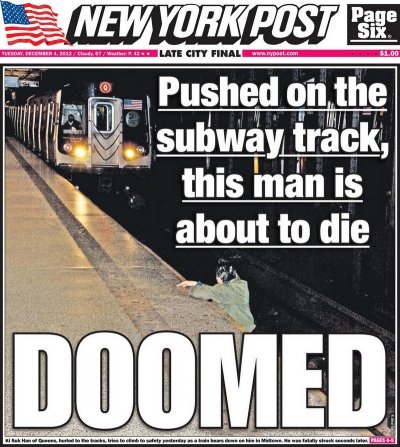
The Man On The Subway Tracks


Subway Headline

It is destined to become a classic case in photojournalism ethics. Someone pushed 58-year-old Ki Suk Han pushed onto a 49th Street station  subway track in New York City. R. Umar Abbasi,  a New York Post freelance photographer was  on the platform when it happened, and took a photo as the subway train bore down on the terrified man. He was killed, and the photo became a lurid, if dramatic, Post front page.

There have been many ethical questions raised about the incident. Let’s examine them.

Was it ethical for the New York Post run the photo?

This is the easiest of the issues: of course it was. The photo is dramatic, the incident was news, the paper had an exclusive, and readers were interested. The Post might have decided that it would be in better taste not to run the photo, and that decision might be praiseworthy. Still, there is no good argument to be made that such a photograph is outside the range of acceptable items for publication. By the ethical standards of 21st Century journalism, admittedly low, the Post’s call isn’t even close to the line. Objections to the photo on ethical grounds are pure “ick factor.” Continue reading

Incompetent Elected Official of the Month: Rep. Tim Ryan (D-Ohio)

Ah, yes, those old football injuries that tighten up and cause you to walk like you're drunk after going to a wedding where nobody drank to excess. Who hasn't been in that situation?

Ah, yes, those old football injuries that tighten up and cause you to walk like you’re drunk after going to a wedding where nobody drank to excess. Who hasn’t been in that situation?

Let’s be clear, now: Rep. Ryan is not politically incompetent, no sireee! He’s no fool; he knew that an arrest for public intoxication in August might be a high hurdle on the route to his re-election, especially since the matter wouldn’t be resolved until after the November 7. So when the rising star of a congressman, seeking election, now safely accomplished, to his sixth term, was arrested in Virginia, Ryan’s staff managed to keep the embarrassing incident out of the papers, cable news broadcasts and political junkie blogs. He had been  stopped by a police officer who observed him staggering along the sidewalk, and Ryan refused to take a Breathalyzer alcohol test as the officer requested, precipitating his arrest. The incident, after all, might have been misunderstood. Can’t have that. Continue reading

Fair Is Fair: The Times Isn’t Perfect, But It’s Time I Paid For It

nyt-paywallEver since the New York Times instituted its paywall system, which forces you to subscribe to its cyber-version once you use the site more than 20 times in a 30 day period, I have been economizing on my Times use rather than pay its (reasonable) subscription fee. One reason was money; one reason was that I usually don’t have to use the Times more than 20 times a month, with other good news sources out there that charge nothing at all; and a last reason is that the Times annoys me with its hard left-wing bias, well to the left of the Washington Post, which is hardly balanced, and inappropriate, in my view, for the publication that holds itself up as the exemplar of American journalism. The exemplar of American journalism should be objective and non-partisan, damn it, or at least try to be.

I have to admit, however, that even with its biases, the New York Times is still the best news source I know. I get the Post delivered to my door every day, and read the print copy of the Times only when I am on the road. I am always struck at how often a Times story or feature is directly relevant to my work, compared to any of its competition, including the acclaimed publication I read every day. Yesterday I learned that the Times has scheduled yet another round of lay-offs and buy-outs. It is in financial trouble, like all newspapers, and I can no longer justify refusing to do my part to help it survive as long as it can. The Times has given a lot to me, my readers and my field, and what it has provided has come with tangible expenses that are becoming more difficult to cover. The paper drives me crazy sometimes, but it remains a vital resource; it is unfair to focus my disillusionment with the journalistic field at the best of it, much as I would like to see the Times set an even higher standard. Right now, the battle is to allow the Times to maintain the journalistic standard, however flawed, that it sets now.

I just signed up for a cyber-subscription. The Times has earned my support, and with it struggling to keep the print flowing, I can no longer justify taking my 19 free articles a month and giving nothing back in return.

The Messy Redemption Dilemma of Greg Hall

Redemption is beautiful. And a lot rarer than we'd like it to be.

Redemption is beautiful. And a lot rarer than we’d like it to be.

Maryland belongs in the elite group of states—Illinois, New York, New Jersey, Alaska, D.C. of course, and a few others—where corruption at the local government level is the status quo, and seemingly will always be so. Thus what could have been a straightforward dilemma regarding the character requirements for public office—does a criminal past render a citizen unfit for appointment?—has been confounded by matters of comparative disqualification. Maryland State Delegate Tiffany Alston (D-Prince George’s County) took money out of her campaign funds to pay for her wedding expenses, and stole $800 from the General Assembly to pay an employee of her law firm. She cut a deal with prosecutors to avoid a trial, and, astoundingly, is arguing that since she thus avoided a “conviction” for a crime, under Maryland law she should be able to continue serving as delegate.

Alston is a current crook. Maryland Democrats decided to designate a past crook as her replacement: Greg Hall, who twenty years ago was a crack dealer, spent time in prison, and barely avoided a murder charge for the death of a thirteen-year-old boy killed in the cross-fire of a gun battle he was engaged in. Only in a state like Maryland would Hall be considered an upgrade over the current occupant of a legislative seat, and Maryland’s Democratic governor, Martin O’Malley, has so far refused to follow his party’s directive and seat Hall. The problem is that under the Maryland Constitution, O’Malley has no choice in the matter: it says that the governor shall appoint whomever the party designates to replace a delegate who has been removed. Now there will be two hearings, one to determine whether Alston is correct that she can remain in office because she hasn’t technically been “convicted” of crimes she has admitted to, and another to determine whether the governor can refuse to appoint a convicted felon to take her place. Continue reading

Presenting Rationalizations 28-31: The Altruistic Switcheroo, The Prospective Repeal, The Troublesome Luxury, and The Unethical Role Model

The Ethics Alarms list of rationalizations—the lies and fallacies we seduce ourselves with to make unethical conduct seem reasonable— continues to grow. Here are some worthy additions, bringing the current total to 31. I doubt that we have them all captured yet…not by a longshot.

28. The Altruistic Switcheroo: “It’s for his own good” – This rationalization is a pip, because it allows one to frame self-serving, unethical conduct as an act of good will and generosity. Cheating the young sprout will teach him to be more careful the next time, and it’s just a pleasant coincidence that you benefit from the deception. It is true that misfortune carries many life lessons, that what doesn’t kill us often makes us stronger, and that what hurts today may be the source of valuable wisdom and perspective later, but it really takes a lot of gall to cheat, lie to, steal from or otherwise harm someone else and claim it will be a good thing in the long term. Yet an amazingly large number of people possess this much gall, because the Altruistic Switcheroo is very popular, especially among parents who want to convince themselves that bad parenting is really the opposite. A marker for this rationalization is the statement, “You’ll thank me some day”—the specious theory of the sadistic parent who named his son “Sue” in the famous Shel Silverstein song made famous by Johnny Cash. No, he won’t. Continue reading

The Ethics Attic: Notes From Around The Web

messy attic

[I’m still feeling lousy, so in an effort to conserve some energy while keeping the torch high, I’m presenting a few links that the ethics-minded might enjoy visiting. Normally I would write about some of these, so consider yourselves lucky.]

  • Historian Paul Finkleman delivers that harshest verdict yet on the hypocrisy of Thomas Jefferson regarding civil rights and slavery. You should then read David G. Post’s splendid contra essay here. (The last two sentences in Finkleman’s op-ed are pretty much indefensible.)
  • A fascinating reflection, inspired by the movie “Lincoln,” on Utilitarianism and “the ends justifies the means.”
  • In fact, the program is a benign one, but considering the issue raised in my last post, it is hard to imagine more perfect symbolism for the American public trading self-sufficiency for government protection than the trade described here.
  • If you missed the recent George Will column, a frightening one, about the assaults of free speech and thought around the campuses of American universities, you have another chance to read it, here.
  • I only recently learned that 3-D copiers are a reality, and Dr. Chris MacDonald, on his always excellent Business Ethics Blog, has some insight on their ethical implications here.
  • Once again this year, I have an essay in The 2013 Hardball Times Baseball Annual, and publisher Dave Studenmund references my analysis of the Stephen Strasburg affair here.
  • Finally, thanks to Mary Wright on the HR Gazette for posting the Ethics Alarms Apology Scale.

The Inconvenient Truth About The Second Amendment and Freedom: The Deaths Are Worth It

carl-with-a-gun-The shocking murder-suicide of of the Kansas City Chiefs’ Jovan Belcher has once again unleashed the predictable rants against America’s “culture of guns” and renewed calls for tougher firearms laws. Yes, reasonable restrictions on firearms sales make sense, and the ready availability of guns to the unhinged, criminal and crazy in so many communities is indefensible. Nevertheless, the cries for the banning of hand-guns that follow these periodic and inevitable tragedies are essentially attacks on core national values, and they need to be recognized as such, because the day America decides that its citizens should not have access to guns will also be the day that its core liberties will be in serious peril.

Here is Kansas City sportswriter Jason Whitlock, in the wake of Belcher’s demise:

“Our current gun culture ensures that more and more domestic disputes will end in the ultimate tragedy and that more convenience-store confrontations over loud music coming from a car will leave more teenage boys bloodied and dead. Handguns do not enhance our safety. They exacerbate our flaws, tempt us to escalate arguments, and bait us into embracing confrontation rather than avoiding it… If Jovan Belcher didn’t possess a gun, he and Kasandra Perkins would both be alive today.”

I don’t disagree with a single word of this. Yet everything Whitlock writes about guns can be also said about individual freedom itself. Continue reading

Keeping Secrets and The Worst Case Scenario

whisperOn Thursday, federal prosecutors in Manhattan charged Thomas Conradt of Denver and David Weishaus of Baltimore, two former stockbrokers, with insider-trading in a sequence of events that netted them more than $1 million in illegal profits.  The scheme was built on confidential information about International Business Machines’s $1.2 billion acquisition of analytics software maker SPSS in 2009, and it was relayed by a trusting young attorney who told his closest friend about some details of the deal. The whole sorry tale can be read here.

The name of the lawyer, an associate who worked for the Manhattan mega-firm Cravath, Swaine and Moore, has yet to be revealed. It is fair to say, however, that his career is in the crapper, and he is likely to face ethics charges, civil penalties and quite possibly legal charges as well. His mistake was a fundamental ethics breach  that I suspect is made every day, in various settings, by hundreds of thousands of professionals including lawyers, accountants, doctors, researchers, law enforcement officials and government agents. He shared confidential information in a casual setting with a close personal associate whom he trusted. Continue reading

Comment of the Day: “The Asperger’s Child, the Company With A Heart, and the Cheapskate Parents: A Cynical Ethics Tale”

Death StarFrom new commenter Ron Bishop, a Comment of the Day on the post, The Asperger’s Child, the Company With A Heart, and the Cheapskate Parents: A Cynical Ethics Tale, It is self-explanatory. I would like to know, however, and have asked, what these parents would have done if, after all their son’s toil and planning, the Death Star had cost a hundred dollars or so more than he could raise. Would they have had him ask LEGO for help, or helped him out themselves?

“I believe it’s a real story, because my family has lived a very similar story. My 11 year old with Aspergers Disorder, also a Lego fan and in a social skills group, wanted the $400 Death Star set. Sensing a “learning moment”, I told him, if he saved up the money, he could purchase it. Continue reading