Things are stranger than ever, it seems, in Times Square.
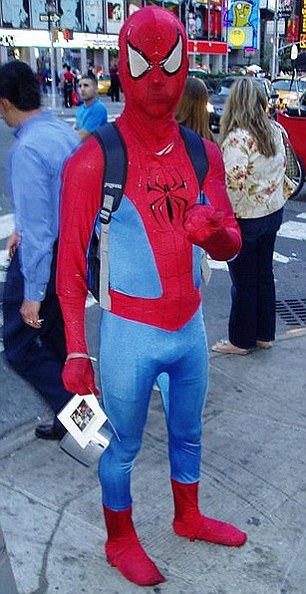
Chelsea? Is that really you?
Philip Williams, 35, is one of many individuals who makes a living of sorts in Manhattan’s famed pop-culture and commerce jungle by dressing up as a colorful character to amuse tourists. In Williams’ case, it’s Spiderman. He is currently charged with assault and harassment for punching a woman who asked him to pose for a photo with her kids, then after getting her picture, refused to pay him the customary tip when he asked for some money.
“Sorry, I don’t have any,” said she. “You’re crap!” said Spidey, and socked her. Williams claimed in court that his punch was in self-defense, because, he claims, the woman threw a snowball at him. This is disputed.
Williams’ arrest came when police intervened to stop the assaulted woman’s husband from squishing Spiderman, which he was endeavoring to do with a packpack. Initially, the woman had fingered another Times Square Spiderman as her assailant, but the husband was paying better attention, and knew which one to pound on.
I love this city!
I have some brief observations, with the Applebee’s incident in the rear view mirror. Unlike refusing to tip a restaurant server or to remit the entire “mandatory tip” amount, not tipping a costumed wacko in Times Square who poses for a photo at your request is theft. Posing for photos is a service rendered, and compensation for the task is obligatory. The woman asked for the photo with her kids knowing she couldn’t pay for it: that’s dishonest, and unfair. Spidey was right, if not as civil as a super-hero should be. She is crap.
What can Spiderman do about it? Not much. He can call the police, but he’d be laughed at. He can scream obscenities, but that is both futile and disturbs the happy environment for innocent New Yorkers and tourists. He can pound her—in fact he did— but that’s illegal, and pure vengeance. There isn’t much he can do at all. In this case, if Spidey got a good cell phone photo of the woman and posted it on Reddit noting that she was a cheap welcher, I would have no ethical objections. The Times Square Spiderman franchise is his own. He was the one stiffed unfairly, and he has good reason to alert the other unsuspecting Spidermen out there that this woman is looking to steal their celebrity for a cheap photo-op.
Now, if unemployed Applebee’s waitress Chelsea Welch was the other, unjustly accused Spiderman, and so incensed over this example of Time Square Spiderman abuse that she decided to handle the web-shaming of the shameless tourist, that would be perfectly ethical, unlike the conduct that got her de-Applebeed. (Unless she is a member of some Spiderman impersonator association or something that specifically prohibits customer shaming as bad for business…I don’t want to think about it.) In contrast to her ill-fated waitressing experience, she would be acting as a free agent, and protecting all of the potential Spiderman victims of this woman’s photo scam by giving them fair warning.
____________________________________
Facts: NY Post
Source and Graphic: Daily Mail
 Ethics Alarms
If I make all of the assumptions you’ve made, I’d agree. However, that’s a lot of assumptions. Was it clear that “Spider-man” was offering a for-profit service? Was his rates published? Did it say somewhere that a gratuity was required? I’m getting this “technical” for a couple of reasons:
1) Being that it’s Times Square and NY currently has the Broadway Spider-man show, a person might reasonably believe that a Spidey is out there to help promote the show as a marketing campaign.
2) If he’s not licensed by Marvel/Disney to represent their character, how can one justify abetting intellectual property theft by paying for this stolen good? One might say that he wasn’t running a business just offering himself for free and accepting tips.
Well, if he’s accepting tips (gratuities) and tips are optional, how can someone be in the wrong of deeming it not worth the tip, especially if they didn’t have money to begin with and it wasn’t clear that a tip was expected?
1) Being that it’s Times Square and NY currently has the Broadway Spider-man show, a person might reasonably believe that a Spidey is out there to help promote the show as a marketing campaign. Great point: I can honestly say this never occurred to me. It is true that Spidey should have made a fee clear before posing, if that was the expectation. I have to say, though, since Times Square is a veritable zoo these days with all sorts of costumed people soliciting tourist photo ops, the reasonableness of the assumption that Spidey is promoting the show rather than exploiting the presence of the show is dubious.
2) If he’s not licensed by Marvel/Disney to represent their character, how can one justify abetting intellectual property theft by paying for this stolen good? One might say that he wasn’t running a business just offering himself for free and accepting tips. I’m assuming he didn’t steal the costume, which is a fair assumption. Marvel licenses the costume for sale, and a costume isn’t worth much if you can’t wear it. I haven’t researched this, but I’m pretty certain Marvel would have a tough time arguing that their accepting money to allow a Spidey Costume to be sold includes the implicit license to wear the costume in public. It isn’t intellectual property theft.
I’d have to know it “tip” was his term, or the reporter’s term—I suspect the latter. I see this as no different from taking a bite out of an an apple from a homeless street vendor and refusing to pay, saying you assumed the apple was free. Is it really likely that someone would hand out in Times Square during the day posing with tourists as a hobby, or should it be obvious that the individual considers this work?
I’m not in agreement with you on #2 and it seems I might have something to offer and your research if you get to it can confirm.
When Marvel sells the suit, it sells it for you to wear personally, but not for profit. I think there’s a limited amount of fair use when you use it for parody, but if your business is based on being someone else’s copyrighted character, that’s a no-no. (and actually, Sony may have the performance rights to Spidey currently.)
Which brings us back to his “business”. He doesn’t have one, technically. What he has is a pajama set that he wears around town and he collects gratuities when an opportunity presents itself.
But if you disagree, I might hang out in Times Square next time dressed as Captain Compliance. That’s been a dream of mine for 2.5 months now.
As long as you pay for the suit. Actually, Captain Compliance is a trademarked image that I don’t own, but that I am granted permission in perpetuity to use the name and image. Nobody else is. And there is a competing Captain Compliance, too. It’s complicated.
Hello again.
I’m firmly with Tim on this one. Can the legal rules governing the sale of a Spiderman costume really be so much different from the legal rules governing the sale of a Spiderman film? I’m sure that if I bought the DVD, I’d be presented with a screen explaining that this copyrighted work is licensed from private viewing only. If I screened it publicly and sold tickets, surely I would owe Disney royalties. If, however, I screened it to all of my friends and they each decided to show their gratitude by tipping me with snacks, services, or cash, I haven’t broken copyright law because there was no transaction. Right? And if that is right, how is the situation any different with a costumed performer?
Even allowing that he is running a legitimate business, I see some problems with your ethical judgment of the woman’s actions.
Dubious to you, but what of the average tourist, who is unfamiliar with New York? The fact that Times Square is filled with costumed people only adds to the confusion a tourist might face over whether any given individual is rendering a service or just having some fun. If this particular Spiderman didn’t make it clear that the act of posing came with a fee, he was performing a sort of bait-and-switch.
I lived in New York. Unless things have changed quite a bit since then, people perform in public as a hobby all the time. Many of them expect to make money off of the performance, but they do so through tips, not by charging for a service. Unless Spiderman was standing beneath a sign that said “Photos: $5” even I wouldn’t know that failing to give him money would make me subject to assault. I don’t see why an oblivious tourist should be any more in the know.
On the copyright/trademark issues, it is a bit different. When the holder of intellectual property rights fails to take steps to enforce them, it can be interpreted as a permissive waiver unless the rights holder is unaware of the use. My guess is that such uses of costumes just isn’t enforced by the rights holders or anyone else, because its minimal money, it arguably does serve as PR for the character (and the show), and its not worth the bother to enforce. If that’s the case, Spidey has colorable consent. If the license owners don’t care, he’s not stealing from them.
I’m persuaded by you and Tim that the woman may have legitimately believed that no fee was required. Certainly Spidey needs to make the fee known up front of he’s going to flip out. On the other hand, if you ask for a service and get it, your ignorance regarding its cost doesn’t excuse the obligation to pay. Her husband was with her. Is it credible to both of you that neither she nor her husband had 5 bucks to give the guy, once he made it clear that the photo came with a fee?
Regarding the idea of a permissive waiver, you indicated that that only applies if the trademark holder is aware of the use. Is there any reason to suppose that Disney or Marvel are aware of this particular Spiderman using their character’s image in a money-making venture? It may be that they wouldn’t care because it’s a small amount of money and because it’s publicity (though it would also be publicity if he wasn’t charging), but isn’t the legality of his action up in the air until Disney is asked about it and either offers or withholds consent?
Either way, my point isn’t that he’s stealing from the corporation, and I don’t think that was Tim’s point, either. It’s just that if he isn’t officially licensed he doesn’t have a legitimate business. What he’s doing is an amateur performance.
As a performance, it might be good for a tip, but your assertion is that failing to tip him is stealing in a way that refusing to tip a server at a restaurant isn’t, and I don’t see why. In fact, I disagree with your claim that ignorance of cost doesn’t excuse one’s obligation to pay for a service. Not so if the service provider was a party to that ignorance. In an earlier comment, you said that this situation is the same as taking a bite of an apple from street vendor and then claiming that you thought it was free. But if the woman in this case asked Spidey whether she could take a picture of him with her child, and he said “yes” and didn’t add “for a fee,” then it’s reasonable of her to assume that its a free service. If that’s the case, to my mind the analogy would be more like if somebody handed me an apple and said, “here, have an apple,” then waited for me to take a bite out of it before saying, “it’s a buck fifty for that apple.”
If I’d been in this tourist’s place and a price was quoted to me only after the service was provided, I probably would pay it, but I’d also have some seriously harsh words for the performer. Or, if I didn’t have five bucks, I’d delete the picture in front of him. If that doesn’t absolve me of the obligation to pay, the failure to quote a price is doubly deceptive.
In an age where some people use credit for absolutely everything, it is possible that the woman and her husband didn’t have five dollars, though it is extremely unlikely. Maybe they didn’t pay him because they’re just cheapskates. On the other hand, maybe they refused to pay him as a matter of principle when he tried to demand payment of an unstated fee. That’s not the most ethical way to handle the situation, but I’m sure it doesn’t constitute stealing.
Maybe they considered his service to be unworthy of a tip once he broke character in front of their son in order to start demanding money. Is he automatically owed a tip even if he provides unsatisfactory service? Why would it be different with waiters? I don’t see it.
1. I’d say they are under constructive notice that Spidermen are out in Times Square, since they have been since before the musical opened. I also think that horse left the barn long, long ago. They don’t enforce that minor form of trademark infringement, so its essentially not an issue.
2. “It’s just that if he isn’t officially licensed he doesn’t have a legitimate business. What he’s doing is an amateur performance.” Huh? If you charge for it and you make a profit on it, it’s “professional.” The distinction you posit doesn’t exist. Amateur means “for love.” By definition, if he’s asking a fee, its’ not amateur.
3. It’s not deceptive; it’s risky, as this incident proved. But if a consumer takes and consumes a product without asking the price, or a service without doing likewise, that typically constitutes as agreement to pay whatever fee us being charged, within reason.
4. The issue then comes down to whether a tourist reasonably thinks this guy was offering photos in a hot costume during the day for his health. I don’t think it’s reasonable.
5. “If I’d been in this tourist’s place and a price was quoted to me only after the service was provided, I probably would pay it, but I’d also have some seriously harsh words for the performer. Or, if I didn’t have five bucks, I’d delete the picture in front of him.” Both are fairer than what the actual tourist did.
6. EXTREMELY unlikely. To the vanishing point.
7. The contrast offered was between withholding a fee for a service received and withholding a tip to a salaried server. In the Times Square case, the service provider gets nothing, and the customer gets the service. That meets the definition of stealing.
8. “Maybe they considered his service to be unworthy of a tip once he broke character in front of their son in order to start demanding money.”
Now you’re really stretching!
9.“Is he automatically owed a tip even if he provides unsatisfactory service?” The posing for the photo was the service. He didn’t have to swing on a web. And this isn’t a tip–it’s a fee. The newspaper called it a tip.
10. “Why would it be different with waiters?” Because the waiter gets paid for the service whether there is a tip or not.
I’ve not been commenting because my web experience has diminished.. I can’t see what I type. All I can say though is that Spidey in this case is busking. He is a street performer. He is akin to musicians, jugglers, dancers, etc. No law applies to their location or their performance because they “aren’t working”. If some strangers just happen to leave money with them, who are they to say ‘No.’ It’s a decent arrangement because it gives them near complete freedom.
That being said, I think we are all in agreement that Spidey is working for gratuities with no guaranteed salary. To that end, I will back off my defense of the tourist in this situation because she did approach a street performer with a special request, which indicates a forthcoming gratuity.
It can’t be a fee because that would require a business license and IP licensing, and anyone that says it’s a fee is only harming Spidey because fees and pricing are required to be displayed or noticed in advance. Additionally, if he is running a business, he’s subject to location requirements deemed suitable by NYC, limiting his exposure. I doubt any business licenses are granted for the middle of Times Square, since it’s a bit of a free for all.
So, it’s a gratuity.
And this isn’t a tip–it’s a fee. The newspaper called it a tip.
Keep in mind what the title of your post was: “When skipping the tip is theft.” I took that to mean that you were accepting the newspaper’s characterization of the payment. If we’re talking about a fee, of course it’s different, but payment only counts as a fee if the price is declared in advance or if there’s no room for a reasonable assumption that the action is a favor, rather than a service. There room for that assumption in this case.
Your analysis hinges on the idea that it’s unreasonable to assume that this Spiderman was an amateur in the sense of dressing up “in a hot costume during the day” “for love” of the performance. I don’t think that’s correct, if only because it’s New York. Each Halloween when I lived in New York, I would put on elaborate theatrical makeup, march in the Greenwich Village Parade, which extends down dozens of blocks of Sixth Avenue, and then spend the rest of the evening hanging out in Union Square. For me and more many other well-costumed revelers, the entire day consisted of entertaining requests to stop and pose for photographs. As far as I can tell, it never crossed the mind of any photographer or any photograph-ee that this might be construed as a service.
You say it comes down to whether a tourist can conclude that a person is “offering photos” “for his health.” But was Spiderman offering photos, or was he just hanging out when somebody asked him for a photo? When I march in the parade, I’m not offering photos, even though I end up posing for them. The discomfort of my makeup doesn’t make it a service, and neither does the amount of work I put into it. What would make it a service is if I took to yelling “come get your picture taken with a zombie,” but even then I’d be busking, meaning that unless I specified a price, I’d be working for gratuities.
A waiter gets paid something regardless of the tip, but it’s less than minimum wage and he does more work. One could argue that a waiter’s wages are not for the time that he spends serving the customer, but for the time that he spends serving his employer in between visits to each table. If you stiff a service provider, it’s equally wrong regardless of whether he has another source of income.
Why don’t we just lock up and/or fine all the little kids who dress up as Spiderman for Halloween? After all, they go door-to-door “demanding” candy in what I assume is a copyrighted costume.
That’s personal use and the expected fair use.
I would submit that regardless of supposed understanding that people there do this for money, unless spider man guy let’s people know he is charging, then all he really is just an eccentric curiosity. Sans warning people that a photo op costs money, he’s giving away his novelty service.
When we visited Rome, by the coliseum, a group of locals dressed up as legionnaires for photo ops, they did not hesitate to let us know what a photo with them cost, another group failed to tell someone and were chastised and didn’t push the issue.
I’d say spider man guy needs not to assume he is understood.
Lest we convert our society completely to one where every little request you make of a stranger ought to be accompanied with some monetary compensation.
My analysis changes here only a little. Posing with a costumed character whom you know isn’t salaried (as in Disneyland)still suggests a tip/fee. Whether or not Spidey mentioned it up front, the kind, reasonable and correct thing to do would have been to give the guy a couple bucks. “I don’t have any” is lame, and almost certainly a lie–he thought so, anyway. Right up until he clocked her, Spidey was the aggrieved….certainly not Marvel.
My, my, what a tangled web we weave . . .
Except the woman may not have intended to take a picture – the Spidy insisted she take one when her kids ran to hug him, and she gave in – unfortunatelly.. . She may not have had any cash in the pocket or was not aware that the guy does not work for one of the stores in the square… either way, calling her “a peace of sh….” in front of her children because she didn’t tip him is not something that should be tollerated by anyone who cares about Time Square’s reputation as a tuorist-friendly, safe place to visit…
Not intended? Did the performer force her? He suggested she use his services. It’s called sales. Nobody is defending his conduct after she didn’t give him anything.