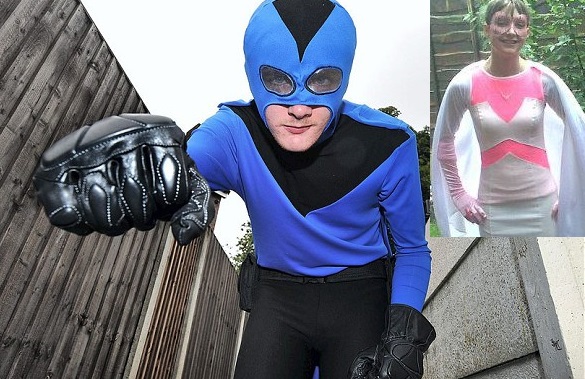
Knight Warrior and Knight Maiden
Actually, his first mistake was probably revealing his secret identity, but that’s not today’s topic, which comes from the little explored realm of Ethics Alarms known as “Wacko Ethics.”
For there dwells Roger Hayhurst, also known as Knight Warrior, a self-proclaimed British superhero who began fighting minor crime and disturbances near his home in Swinton, Greater Manchester. Hayhurst wears a custom-made blue and black lycra costume and even had a sidekick, his 18-year-old fiancee Rebecca. She is called “Knight Maiden.” Now, however, Roger and Rebecca may be out of the superhero business, because some young toughs in Clifton beat the snot out him while he was “on patrol.”
“My face was all swollen,” Knight Warrior sniffed. Now he’s discouraged, and confesses, “I mainly dress up for charity appearances.” Rebecca, meanwhile, has turned in her tights.
I’m sorry to be unsympathetic, but Roger was engaged in outrageous hubris and false advertising. If you are going to call yourself a real life superhero, at least take some karate lessons. Getting beaten up by run-of-the-mill punks is disgraceful enough, but quitting because of it? Did Spiderman quit after Doctor Octopus mopped the floor with him? Did Batman retire the first time the Penguin bested him? Did Green Lantern…oh, never mind. Knight Warrior has made all superheroes look bad. A few basic rules:
- Don’t claim to be something you’re not.
- Don’t start a job you’re not prepared to finish.
- Don’t say you’re a hero when you lack the essential quality of a hero: courage.
- Don’t raise people’s expectations and then let them down.
Or maybe we can summarize all of these for Roger by simply noting that if you have no superpowers, don’t say you’re a superhero. It’s misleading, it’s dangerous, and it’s idiotic.
What a weenie.
 Ethics Alarms
One more factor. Live in the real world. It’s not a movie and it’s not a comic book. There are no such things as superpowered heroes. That belongs in the same category as girls falling into a love triangle between a vampire and a werewolf. Alternate universe, kid. If you want to be a hero, learn to be a man first. Consider joining the Royal Marines, perhaps?
I changed the background of the blog just for you.
Raising ethical dilemmas using fantasy characters like vampires and zombies is no more illegitimate than using talking animals in Aesop’s Fables. Hypotheticals are all metaphorical. Frankenstein is an excellent basis for bioethics discussions. Batman raises excellent vigilante-related issues. The issues discussed on Law and the Multiverse are clarified by their application to comic book situations, and I couldn’t disagree more about the “Walking Dead.” The leadership issues especially are profound, and Apocalypse scenarios nicely define the law vs ethics dichotomy—there are no laws: do the ethics change? If you are operating on a different ethics system than everyone else, can you trust anyone? Should you? These aren’t frivolous questions, and if they are delineated by fantasy settings and aid in sharpening analysis, why does it trouble you so much that some of the creatures involved aren’t real (yet?)? Science fiction has probably raised more profound ethics issues than any other genre of literature.
However, you can discuss bioethics with someone reasonably without dressing up like Captain Marvel and setting yourself up to (inevitably!) getting your butt kicked on some street corner. I agree wholeheartedly that good science fiction literature and classical mythology can form an excellent basis for deeper discussion. I’ve been reading those since I could read. Comic books don’t qualify! It’s one thing to read the Norse myths about Thor’s adventures. It’s quite another to act like Stan Lee’s version- particulaly when you’re a 90 pound teenage nerd with a cut-and-run girlfriend sidekick who’s equally dumb. And if I see one more zombie picture, I’m saying “SHAZAM”, flying off to Hollywood (sans airplane) and do a Chloe Moretz on every filmmaker who ladles out this ongoing assault on my sensitivities. I have spoken.
Reality gets so messy that it gets hard un-peeling all the criss-crossing layers of right and wrong. Everyone is selfish to a degree, everyone is undisciplined to a degree, everyone slips up, that any real life story of good and evil can be sharpshooted (?) as per whatever narrative you want to push. Why can’t we extol the heroism of the Texans at the Alamo? Because some were slave-owners. There are countless examples. Fictional stories allow us to communicate specific ideals, shielded from background or side “noise”, they also allow us to show flawed characters come to correct decisions before the end of the story, whereas in real life, a ‘character’ may only come to 80% of their decisions to be correct.
Try to pull a specific ideal out of a real life story and any number of naysayers could find a thousand rationalizations that say “oh, that isn’t an ideal, that was just accident” or “that wasn’t an ideal, they did that to get this” or “that wasn’t an ideal, they don’t really believe that, someone made them do it”.
I discussed the cultural appeal of zombie scenario in the Walking Dead post from last week. But it has a discussion-invoking appeal as post-civilization stories create what I like to call “divides by zero”. Situations in which a lot of things we’ve taken for granted now HAVE to be considered. Situations in which two ‘absolutes’ which ordinarily exist comfortably with each other, now are in massive opposition, forcing us to weigh which one is truly more important to us.
I thought the background was a picture of Occupy Wallstreet. Or maybe a recent graduating class of the University of Texas.
Or become a writer or artist.
Even the heroes without powers in those worlds work their tails off, training for years before they went on the streets. Then they still get beat on occasion. Has he ever heard of Bane, the one who broke Batman’s back?
Or join a neighborhood watch and do some real good instead of playing make believe and feeding his own ego. This wasn’t about stopping crime but about him getting attention.
Admit it—you were one of the guys who beat him up.
No, but I would have laughed my ass at him.
Wow…
I meant for dressing like an idiot NOT for getting beaten up
I would have laughed while he got beat up – it was the logical conclusion to a really stupid idea.
Such things amuse me.
http://www.nbc.com/saturday-night-live/video/snl-digital-short-hero-song/n12208/
So, let’s see… He wanted to fight crime, and the second a criminal bested him, he’s giving up…
Sounds like he’s a sure-fire for the Neville Chamberlain Award for Moral Courage…
It is a testament to the material success of Western Civilization that ordinary folk have enough time on their hands to wander the streets in such a manner.
Back when Western Civilization was still recovering from the fall of the Roman Empire and was scratching out a bare survival minimum, folks such as this survived only under the patronage of a Noble while jesting their court.
Something tells me that the young man’s (and I use that word quite loosely) biggest regret is the lycra tights – He probably wishes he’d sprung for something with a bit of padding, and maybe a helmet with a face-guard…