“It’s not the role of our media and our journalists to shield us from truth; it’s their job to confront us with it. In this respect, the plurality of imagery is both a blessing and a curse, because in the sort of panic that follows an event like yesterday’s bombing, anything could be real. But equally, it’s also the volume of images and coverage — graphic and otherwise — that help us get a clearer picture of reality than we ever did in the days when our opinion was shaped by one journalist and a few photographs.”
—- Tom Hawking in his essay “The Ethics of Disaster Photography in the Age of Social Media,” discussing the controversy over whether graphic images from catastrophes like the Boston Marathon bombing ought to be published by the mainstream media, or should be toned down, edited, or withheld altogether.
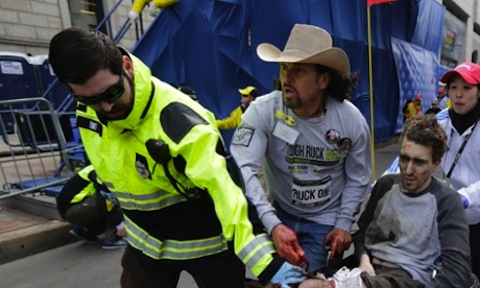 Hawking’s conclusions are spot-on, and you should read the entire essay here. Obviously horrendous photographs shouldn’t be thrust in readers’ and viewers’ faces; we should all have the opportunity to avoid seeing images we know would upset us. ( I have not looked at any of the graphic images from Boston. The text descriptions are plenty for me, thanks.) Leaving it to editors and journalists to decide how much realism we can stand, however, is folly. To be blunt, there is no reason to trust them. One of the blessings of the web and social media is that the traditional media no longer have the power to withhold information based on their biased and paternalistic judgement, which they are thoroughly unqualified by intellect, education to render.
______________________________
Source and Graphic: Flavorwire (Tom Hawking)
Ethics Alarms attempts to give proper attribution and credit to all sources of facts, analysis and other assistance that go into its blog posts. If you are aware of one I missed, or believe your own work was used in any way without proper attribution, please contact me, Jack Marshall, at jamproethics@verizon.net.
 Ethics Alarms
I agree, absolutely. But then how do you handle the right to privacy of the victims?
That is a balance. Although certain individuals were physically maimed during the attack, the victims of this were not just them, but the everyone.
Not like a murder in a house where certain levels of privacy would be maintained.
When you are involved in an event with news significance, you have no privacy expectations or rights. It’s as simple as that. When the media tries walking the tight-rope it almost always gets it wrong. Why are the men accused in a rape story exposed in news reports, but the alleged victim/accuser protected? If its a news story, all participants should be treated the same, and Bill is right—privacy in public places is a myth.
Expectations? You’re right that there can be no expectations of privacy. But what about compassion? Granted, the media will get it wrong. But how do we, the consumers of media reporting, respect that privacy? Choosing not to look requires discipline and compassion, two things that many people lack. And sometimes we choose not to look out of squeamishness, not out of compassion. But I am in a dilemma, because I can see how it is necessary for people to be aware graphically of the horrors of such things. So, I don’t know how to resolve this. Just random thoughts, I guess.
From my point of view, my compassion actually increased when I saw the images and videos.
Hearing reports of it made me sad and aggravated for the invisible and generic people that this happened to, but I was at work and I had work to do. So, bluntly, my compassion was there, but it was pretty limited in scope.
When I got home and saw the images later that night and the video of the soldiers and policemen trying desperately to the get the crowd control barrier down while incapacitated and maimed fellow Americans lay helplessly where moments before they had been doing nothing but minding their own business and enjoying a race. Yeah, my compassion as well as my anger ratcheted up considerably.
Patrice in her reply above brings up the privacy issue. Years ago these pictures would have taken days to get out and only have been seen in local papers and on Television, giving people a chance to prepare for their release or ignore them. But today with everyone having smart phones and the internet they are out their instantly, no one has any privacy anymore. I’m not saying thats good or bad , I’m just stating the fact of the situation.
As long as there are warnings about the graphic nature of the pictures i believe that they should publish them.
The full version of the cropped photo that Jack is using in this post is so horrific that people were arguing that it was photoshopped. Which tells me that a lot of people have no idea what actually happens to people when they are the victims of a terrorist act. I think that by “protecting” the public from these images they are doing us a disservice. The more widely spread they are and the more people who come to see what these terrorist acts do to living breathing people the better. Maybe then and only then can we get each other to stop trying to impose our will and our beliefs on each other by killing each other.
I’ll bet the terrorist training manuals refer to TV producers as “useful idiots.” Their directives probably read something like: “Don’t worry if you only set off one or two bombs. The useful idiots in the media will show your bomb blasts over and over and over again so they will have the effect of a thousand thousand bombs in every home in the country.” And then we have Erin Burnett prodding peole with: “What did you see? What did you see?” To which the decent interviewees answer with descriptions such as “It was pretty graphic.” Of course the answer Erin was looking for is “I saw gallons of blood pumping out of arteries in the stumps of people’s legs and arms. I saw severed arms and legs strewn all over the street. And I smelled burning human flesh.” The television people seem to consider it their duty to make sure the entire nation is traumatized, not just the relatively few poor souls who happen to be at the scene.
What are they thinking? It’s moronic. And wrong.
People do love to look at gore but for the rest maybe we could having Warning:Graphic Images. I do remember Walter Cronkite bringing disturbing images of the Vietnam war into American livingrooms. Did it have the desired effect? Did it turn us against the war? What is the purpose of showing the horrors of the Boston bombings?
I’d say the purpose is to know what happened. “Three killed” doesn’t begin to explain what occurred, does it?
“Three killed and one hundred sixty-eight injured, dozens critically” works for me. Can’t we use our imaginations?
Our imaginations don’t generate the facts.
And if a verbal report is given that really describes what is in the images, then read the verbal report.
Otherwise the old adage, “a picture is worth a thousand words”, makes use of images alot more efficient at showing our imaginations what actually happened.
Precisely, think of the power of the images from Auschwitz and other death camps. We can be told “millions of people were murdered in a systematic and industrial fashion”. We can even try to process it. But only the images of the actual people that went through it can truly convey the horror of what happened.
I believe we, the viewer, should be given the choice if we should see these images. Warn people of its graphic content. Let them make the decision. As to the privacy of the victims, especially the photo that Jack used and has been referenced, that image shows a man in a terrible situation, one we should hope to never experience. But it also tells the story of the people who rushed to help him, first responders and good Samaritans, and saved his life. Its hard to look at, but there is power in that image.
Indeed. It communicates the civic behavior demanded of all of us in an emergency.
It’s hard to imagine what one cannnot conceive. Before you know it, you aren’t covering the Gosnell trial, because it’s “sickening.”
“What is the purpose of showing the horrors of the Boston bombings?”
I’m certain there are plenty of imbalanced people out there who look at the stuff cuz they like seeing gore and suffering. But those people aren’t our problem. They can live in their dark soulless world.
Those of us who are balanced and whole react to the imagery quite differently as alluded to in my post above, and the imagery does bring what would have been an abstract distant bombing to a very real cowardly mass murder.
“Those of us who are balanced and whole react to the imagery quite differently as alluded to in my post above, and the imagery does bring what would have been an abstract distant bombing to a very real cowardly mass murder.”
Well said!
Thanks!
Bang on the nose with that last sentence Jack. The media is so unqualified to make any judgment it is not funny.
He’s attempting to excuse the feckless, we-must-be-the-first-to-be-wrong nature of reporting. Virtually NOTHING the media has said since the moment the bomb went off has been accurate, and he is telling us that is a GOOD thing.
Well, he’s wrong. The rush to get SOMETHING out there is how people come to think that Loughner was a member of the Tea Party (as were every other shooter/attacker of any kind since 2008), and that Richard Jewell was the man who tried to bomb the Olympics in Atlanta. Not only do they not expand our awareness of reality, they actively damage our understanding.
Should the Media report on it? Of course…
But apparently it is too much to hope for, that they wait until they know something is true before they put it in front of millions and millions of people.
I think this comment was the exact opposite of what you suggest. It’s not excusing bad journalism, it’s demanding good journalism.Pictures of what happened are not rumor.