Supreme Court Justice Powell’s Ethical Dilemmas

Supreme Court Justice Lewis Powell

Supreme Court Justice Lewis Powell

The New York Times, anticipating next year’s Supreme Court consideration of the gay marriage problem, tells a fascinating story about the late Justice Lewis Powell, who was the swing vote in the 1986 case of  Bowers v. Hardwick, which was overturned in 2003, upholding a Georgia law outlawing sodomy.

During the consideration of the case, Powell told his colleagues that he had never met a homosexual, though in reality he had more than one gay law clerk during his tenure, and according to at least one of the former clerks, knew it.  (Powell even quizzed one of them about the mechanics of gay sex.) The reason he told his fellow Justices an untruth, the theory goes, is that he knew there was a stigma in the legal profession and in Washington connected to being gay, and he wanted to protect his law clerks.

Yet Powell, after flip-flopping on Bowers, finally came down on the side of a state’s right to make homosexual sex a crime. Continue reading

Self-Webshaming At Dunkin’ Donuts

(Watch this after you’ve read the post. Kind of like dessert..)

The ethical considerations one should review when pondering whether to engage in webshaming nicely evaporate when the subject has chosen, though unwittingly, to webshame herself. Thus Ethics Alarms has no qualms about presenting for your consideration, revulsion, and rejection if she ever applies for a job from you, one Taylor Chapman, a 27-year-old woman who lives in the vicinity of Fort Lauderdale. She eagerly and proudly posted to her Facebook page the phone-video above, of her abusing an impeccable Dunkin’ Donuts employee, annoying a customer, and making serial statements with signature significance—no decent human being would utter even one of these appalling comments in public unless suffering from a brain trauma or extreme intoxication.

Chapman was angry because she and her friends had not received a receipt along with their large drive-thru order, and angrily (and abusively, based on Chapman’s manner, but we can only guess) demanded to receive their order free of charge, as Dunkin’ Donuts now promises as part of a service pledge. The employee handling the order apparently did not know how to proceed, and told the group that they would have to come by the store and see her manager the next day.

[An aside: That’s not good customer service, DD. If you make a guarantee that is supposed to mean anything, you have an obligation to train employees how to deliver on it. Telling customers who have not received the promised service that they have to come back to the establishment another day to receive what they are owed is unreasonable and a bait-and switch. I would have said to forget it. I would have written a letter. I would not have done what Chapman did, and I don’t know anyone who would.]

What Chapman did was to return the next day and demand her free order, tossing obscenities at the extraordinarily polite and unflappable employee (his name is Abid Adar, and you should send him flowers) on duty while she recorded the encounter as if it were a health department sting. Continue reading

Ethics Quiz: Butt Slap In Court!

skd250141sdc

Once again the issue at hand is judicial restraint, as another unfortunate individual incurred judge’s anger with inappropriate courtroom conduct and paid a heavy price. The question is, was it too heavy?

The object of robed wrath this time  was the former NFL star Chad Johnson, better known as Chad Ochocinco,  in court for violating his parole arising from a domestic abuse conviction (he head-butted his wife—nice), which also ended his NFL career.  His lawyers had worked out a plea deal giving Johnson community service and requiring him to attend  counseling sessions, and the judge had approved it.  But then Broward County Circuit Judge Kathleen McHugh asked the athlete if he was satisfied with his lawyer’s performance,  and in response, Ochocinco slapped his lawyer on the butt. The entire courtroom laughed.

Judges don’t usually like to hear laughter in their courtrooms, unless they’re telling the jokes.

Judge McHugh proved to be no exception. “‘I don’t know that you’re taking this whole thing seriously,” she said. “I just saw you slap your attorney on the backside. Is there something funny about this? ‘The whole courtroom was laughing. I’m not going to accept these plea negotiations. This isn’t a joke.’’ Johnson tried to pacify her, but it didn’t work. She ordered him jailed, and the deal cancelled.

Thus, your Ethics Alarms Ethics Quiz is:

Was Judge McHugh unfair?

I think so. This was the worst possible combination for Johnson: domestic abuse conviction, a female judge, physical contact, though obviously playful, and laughter from spectators. Remove any of those factors, and I think the ex-player gets his deal. The judge over-reacted.

I’m betting she lets him cool in the cooler while she cools off herself, and reinstates the deal.

Or do you think levity when domestic violence is involved is especially obnoxious, and deserves what Chad O got?

__________________________________

Facts: The Inquisitor

Graphic: Adriatique

Ethics Observations On The NSA Surveillance Revelations….

NSA

My current ethics observations on the unfolding NSA story:

  • I do not have enough facts to conclude that what NSA whistleblower Edward Snowden did was truly heroic, but if one is going to be a whistleblower, Snowden did it the ethical way. Snowden decided not to hide his identity, and accepted responsibility for his actions. If his motives are as he has represented them-“I understand that I will be made to suffer for my actions,” but “I will be satisfied if the federation of secret law, unequal pardon and irresistible executive powers that rule the world that I love are revealed even for an instant,” he wrote in a note accompanying his first set of leaked documents—-then he acted courageously and selflessly. Whether or not he also acted responsibly depends on whether he correctly weighed the possible harm of his leak against its benefits. Since its benefits include exposing what may well be ruled to be an unconstitutional and overly broad violation of citizens’ rights, I’m not certain any harm would sufficiently outweigh them in ethical balancing.
  • If it is true, as he says, that Snowden himself had the power to examine private communications of citizens who were not suspected of any crime, then the representations of Sen. Feinstein, the President and others that the NSA program was reasonable and not an abuse of power is not only untrue, but a lie. Snowden is a high school dropout, a consultant, about whose judgment, reliability and trustworthiness the NSA knew next to nothing, and what they thought they knew was obviously wrong, since he betrayed the agency. If such massive power to invade private communications and thoughts is casually placed in the hands of such an individual by a security agency, what other faceless future power-abusers have been similarly armed? Continue reading

Ethic Dunces: CNN Morning Anchors John Berman and Christine Romans

Attacked and attacker. Guess which one the CNN sympathizes with?

Attacked and attacker. Guess which one the CNN sympathizes with?

[Update and Correction: When I wrote this post, the designated Dunces were identified as Chris Cuomo and Kate Bolduan, the new kids on the CNN block. I thought I verified that on CNN’s site, but a helpful reader told  me that Cuomo and Bolduan haven’t debuted yet. Which CNN anchors it was who egged on the egger were in doubt, so on June 11, I changed the post, discussing the issue but only referring to “CNN anchors.”  I also apologized to Chris and Kate, and put out a call for the right names. And promptly forgot about it: with everything else going on, this was neither a major ethics issue nor a two-day story. Then, today, June 13, Joe Concha of Mediate posted a full-fledged smackdown of me, Ethics Alarms and my research skills, and helpfully provided the correct identification in the process

I’m grateful to Joe, who also preserves my original correction, which this replaces. Once again, I apologize to CNN, Chris Cuomo and Kate Bolduan, and also to my readers for mucking up this one so thoroughly. ]

“It’s about time,” snickered  CNN early morning male anchor John Berman, as his partner Christine Romans smiled and nodded. They were approving of a man being assaulted live on TV while doing his job, a job he performs better and more profitably than anyone else in the world.

The man is Simon Cowell, late of “American Idol,” and an angry musician from the studio orchestra seized the opportunity to run onstage during the finale of  “Britain’s Got Talent” and hurl five eggs at Cowell from the stage. The woman, Natalie Holt, had been a contestant in the past, and the assault was part revenge for her own group’s harsh treatment on the show last year, part vainglorious stunt to punish Cowell, she claimed, for his “influence,” and part stupidity. After the show, Holt apologized to the two finalists whose performance she marred, but not to her victim, saying: “I want to apologize to Richard and Adam for overshadowing their performance. I’ve never done anything like this before and in hindsight I have realized it was a silly thing to do.”

But to listen to the CNN pair, what Holt did wasn’t silly, but hilarious, and justified. Continue reading

Unethical Quote Of The Week: Strobridge Elementary Principal Charles Hill

“If we want older kids to not think guns are cool, we need to start early.”

-Charles Hill, Principal of the Strobridge Elementary School in Hayward, California, advocating his school’s toy gun buy-back program.

Cool!

Cool!

I would also nominate this as the most chilling quote of the week, the month, and perhaps the year. It is an admission that this principal, and this school—and, like cockroaches, there is never just one rogue school—are interested not in education and the conveyance of knowledge, but indoctrination, compelling children how to think and what to believe, regardless of the desires of their parents and the values of the nation. Continue reading

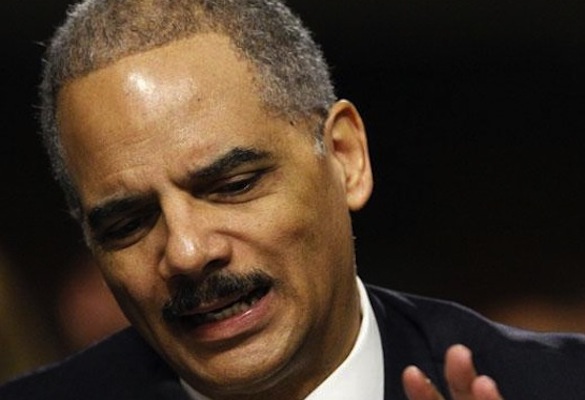
Eric Holder Has President Obama’s “Confidence”—What Does That MEAN?

Uh, Mr. President? When "mediocre" is puffery, something's wrong.

Uh, Mr. President? When “mediocre” is puffery, something’s wrong.

Two weeks ago, the various pundits on multiple current events talk shows agreed that the hopeless, untrustworthy, bunging and double-talking Attorney General, Eric Holder, would remain in office despite evidence beyond a reasonable doubt that he is a liability in the job, as long as “he retains the President’s confidence.” Sure enough, after another week in which Holder’s Justice Department came under even more bipartisan fire, White House political hatchet-woman Valerie Jarrett told the press that Holder  “will be in his position for quite a while” and “continues to have the president’s full confidence and respect.”

Not to be unkind, but this tells us that… Continue reading

“The Ethicist” Gets Lost: Bad Advice, Worse Defense, In The Case Of The Self-Plagiarizing Student

Oh, Chuck, Chuck, Chuck...

Oh, Chuck, Chuck, Chuck…

Chuck Klosterman,The New York Times’ third “Ethicist,” ruffled ethics feathers last week when he decreed that submitting the same paper to multiple college courses was ethical. (You can read his advice to a guilty-feeling student here.) Essentially, his argument in the column came down to three rationalizations, The Compliance Dodge (No rules were broken!), the Trivial Trap (It’s no big deal, and nobody was hurt ) and my least favorite of all, The Comparative Virtue Excuse ( “You’re not betraying the public’s trust,” Klosterman says—in other words, “At least you didn’t kill someone.”),with nods to several more. On the first, which is a close relative of Marion Barry’s Excuse, so you know what I think of it, Klosterman essentially argues that following formal rules constitutes sufficient ethics, which is the hallmark of the unethical. On the second, he himself cheats: he says no one was harmed, yet he ignores the fact that the student intentionally kept the fact that he used one paper for two assignments from the professors involved. Why was that? The student didn’t tell the professors because he knew they wouldn’t approve. Thus the student withheld information that was material, that would have resulted in negative consequences, and that the professors making the assignment had a right to know. That’s a failure of candor and a breach of the duty of honesty in communications. That’s unethical. Continue reading

Bad Valedictorian Ethics, Round #2: The Cut-Off Mic

This one is easy.

I would have pulled the plug too.

I would have pulled the plug too.

At  Joshua (Tex.) High School, a Valedictorian, in this case one Remington Reimer, agreed to deliver school-approved text and nothing else as his graduation speech. Following the unethical example of double-crossing Valedictorian Roy Costner, recently slobbered over by Fox News as if he were a hero (imagine if Costner had torn up his promised speech and began bashing the Tea Party—do you think Megyn Kelly would have been kissing his shoes on the air then?), Reimer decided to grandstand as well, changing his speech from what he had assured the school he would be delivering. But while he broke his promise, the school, to its credit, did not. He had been told that if he pulled a Costner, his microphone would be turned off. As the wags at Fark neatly put it,  “If you go off-script during your valedictorian speech and mention that you were threatened with having your microphone cut if you were to indeed go off-script, then your microphone just might get cut off for going off-script.” That’s what happened to Remington.

Good. Continue reading

Still A Jerk After All These Years: Jimmy Connors Takes Revenge On Chris Evert

"Chris! Chris! Run away! What are you thinking?"

“Chris! Chris! Run away! What are you thinking?”

Why anyone would want to read the autobiography of former tennis bad boy Jimmy Connors is beyond me. When he was playing, Connors personified poor sportsmanship and a confrontational attitude toward authority and the world in general. The only cause women’s tennis icon Chris Evert ever gave me to doubt her character was the fact that she actually was romantically involved with such a creep. She’s paying the price now.

In his new tell-all memoirs “The Outsider,” published this week, Connors decided to settle scores with Evert for the reason for the disintegration of their engagement. He writes, vaguely but pointedly, that Evert became pregnant during their relationship and had an abortion without consulting him, though, he says, he was prepared to “let nature take its course.” “Well, thanks for letting me know. Since I don’t have a say in the matter, I guess I am just here to help,” is what Connors says he told Evert over the phone, shortly before they broke up.

As despicable celebrity breaches of confidence and privacy go, this may not be the worst, but it is cruel and ugly. Continue reading