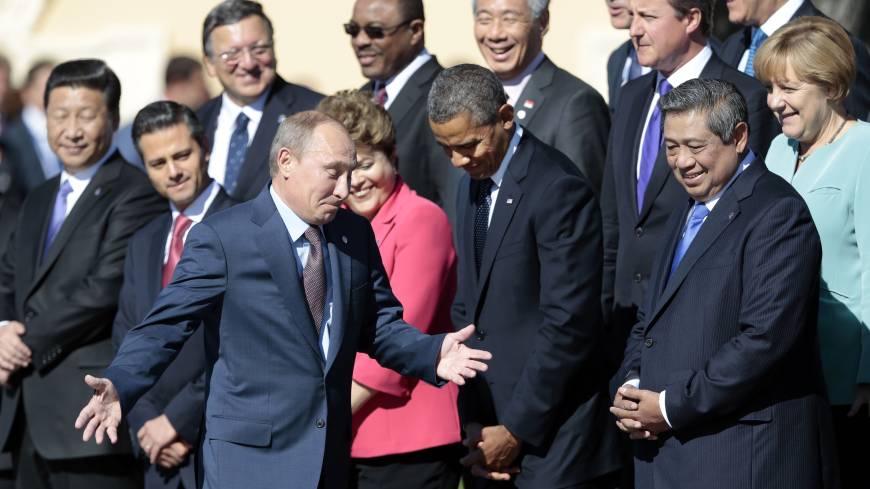
I am looking at a black and white AP photograph re-published from the Washington Post’s front page on September 7. It is similar to the one above, taken seconds before it, and from straight on rather than an angle. That photo, like the one above, shows Vladamir Putin, joining the other attendees at last week’s Group of 20 summit for their formal group photo, but in the one I am looking at Putin is striding across the group to the end of the line, eyes forward, as the rest look on. President Obama alone is standing head bowed as Putin passed, while the other leaders look forward. Unlike the photo above, Obama’s bowed head appears to be in reaction to Putin, but not an effort to listen to something the Russian leader is saying or has said, which is how I would interpret the photo above. The photo above seems relaxed and collegial; the one I am looking at depicts tension. [UPDATE 9/21: A much closer version of the photo is question can be seen here.]
That photograph prompted these criticisms from two Post readers over the weekend.
Mary-Anne Enoch wrote in part…
“I was upset by the photo chosen for the Sept. 7 front page, showing the assembly of the Group of 20 leaders for their traditional “family photograph.”
In that photo, Russian President Vladimir Putin is confidently striding across a stage while others are smiling and probably paying no attention to him. Except for President Obama: In sharp contrast to the rest, he appears to be subservient, shrunken and diminished. His stance reminded me of Forest Whitaker’s portrayal of a long-serving White House butler in a recent movie….it is outrageous that The Post should have selected [ the photo] to accompany an article on the very important and delicate negotiations involving the United States, Russia and Syria.”
Reader Charlotte Stokes had a similar reaction:
“Surely, the wire-service photographer took dozens of pictures, including at least one when the Group of 20 leaders formally posed. So why did The Post choose this one to grace the front page? The photo presented our president in a less-than-honorable light. Given the challenges he faces internationally, why cast doubt on his abilities by sending subliminal messages of this kind?”
[I recognize that it would be better if you could see the actual photo rather than read my description of it accompanied by one that is similar but not quite the same. Interestingly, the Post appears to have purged the picture I am writing about from its website: it does not even use it to accompany the letters about the photo, which it normally would, and which good practice would demand. The photo above, which was widely used by other sources, is the closest I could find, other than the print version that was in my Post on Saturday. If someone can find the actual photo and send me the link, I’d be very grateful.]
Here is your Ethics Alarms Ethics Quiz to kick off what promises to be an ethically alarming week, on the always tricky topic of photojournalism:
Was it unethical for the Post have prominently run a photograph that presented President Obama in an unfavorable, arguably subservient or weak posture?
My take:
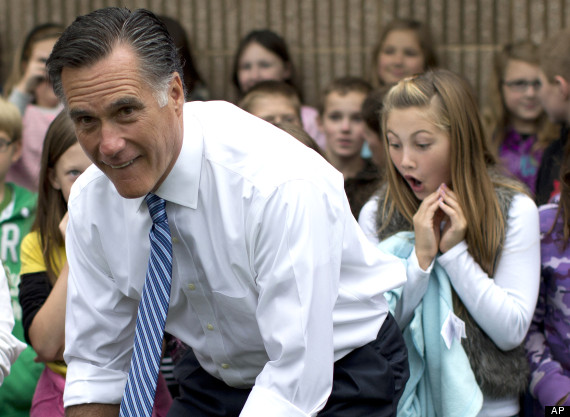
It is a surprisingly complex question, I think, and an ironic one. There are few figures in American history who have been the beneficiary of supportive photojournalism more than Barack Obama, or less often a victim of unflattering photography. While photographers often took glee in taking, and newspapers in running, unflattering and negative images of such U.S. Presidents as Nixon and George W. Bush, as well as Obama adversaries like Sen. McCain and Mitt Romney (Remember this?)
…from the beginnings of his candidacy, Barack Obama has been graphically portrayed in not merely flattering but often fawning and even worshipful fashion, reaching levels of image manipulation by the media that has reminded some critics, including me, of totalitarian state propaganda. Thus I agree with the readers that the Post’s decision to run the photo it did, at the time it did, was provocative, and I doubt it was accidental. The photograph did indeed appear to be making a critical statement. Was it fair?
I find no source that would justify calling the photograph itself an example of unethical photojournalism. (You can check out the National Press Photographers Association Code of Ethics here.) The image (as far as we know) was not manipulated, and the moment it shows actually occurred. A persuasive argument could be made, in fact, that the photo is an example of excellent photojournalism. By capturing an image that focuses attention on Putin and Obama, even in the presence of the other leaders, while also reminding a viewer of the tense relationship between the two and Putin’s current upper hand as a result of the President’s inconsistent pronouncements on Syria, the photographer was able to memorialize a formal event, make it visually interesting, provide context, and make a point. Photographers get awards for this.
If the photograph itself was not unethical, how could it be wrong for the Washington Post to use it? Well, arguably, and I would say probably, Obama’s body language is apparent rather than real; while the photo makes him seem submissive to Putin or even ashamed, there are dozens of other plausible explanations for his stance. Thus, as an accurate presentation of reality, the photograph is misleading. Photo journalism, however, aims to find additional meaning in images, and suggesting symbolism and context by freezing a moment in time is why photographers are artists, and not mere technicians.
I think the photograph is intentionally critical of President Obama, and it is not unethical of the Washington Post to veer from the usual media practice of trying to present him in the best possible light at all times. News media criticism of the President, any President, by is not unethical or inappropriate, and if there was ever a time when criticism was warranted, this is it. It is the job of journalists to “cast doubt” on the President’s “abilities’ when the facts support it, just as it is not the media’s job, as Mary-Anne Enoch suggests it is, to avoid criticism, implied or otherwise, when President Obama is engaged in “important and delicate negotiations.” The routine kid-gloves treatment President Obama has received from the public and the media serves neither him nor the nation well, and the Post does not behave unethically when it alters its habits.
The unethical act here was removing the photograph, not in publishing it.
_________________________
Facts : Washington Post
 Ethics Alarms
Short answer: if the image actually supports the story being reported then, yes, it’s ethical to show the image. Like the image of Romney above, if the story was “Intrepid journalist discovers secret Romney fetish to stick his behind at young girls” then the image is *honest*.
So, if the report discusses Obama’s weak, incompetent and accidental handling of the Syria debacle, while commenting on Putin’s confident and somewhat skilled out maneuvering of our ‘leader’, then why wouldn’t the newspaper run an image supporting that assertion?
Like you said, our nation doesn’t need to white wash out leaders and develop their cult like modern totalitarian states and those of yore. That certain media outlets do religiously mirror the tactics of totalitarian propagandists should have you worried.
Amen to your last paragraph. We don’t need a “cult of The Great Leader” here in America. Maybe Putin does with his horseback riding and bad imitation of Peter The Great.
News photography is supposed to be an accurate depiction of the events occurring in front of the photographer. So it doesn’t matter if the report is discussing “Obama’s weak, incompetent and accidental handling of the Syria debacle.” What matters is how he was conducting himself at the event depicted in the photo and described in the accompanying copy. If the image is representative of that, it’s fine. But if it’s a moment grabbed out of an otherwise different occasion, it’s misleading.
The rules may be different for opinion pieces, especially satirical ones, where the picture isn’t necessarily supposed to depict an actual event described in the text.
Hence my commentary. And hence my request below for the actual article.
I’d be far less willing to accept the photo as a representation of reality if he hadn’t already and repeatedly displayed a willingness to defer and submission to so many other world leaders. Accompanied by stern denunciations of anyone who dared suggest that he was doing so, naturally.
My take exactly, Aaron.
I would say it is unethical if the presentation of the photographic is done in a dishonest way.
Let’s say I took pictures of you in rapid succession. One of the pictures I take has you mid blink. I publish that picture, making it look like you are asleep. Is that ok?
I would argue that all news should be presented to accurately reflect the truth. If it is not presented in a way that accurately reflects the truth then it should be considered unethical.
I think Dan hit it on the head. If this is an accurate portrayal of what happened, it would be unethical NOT to publish it just because someone thinks it shows the President in an poor light. If they took rapid fire shots for 2 minutes and used one from the 3 seconds he looked like this during the ceremony, then it is misleading.
I’m pretty sure that it was the latter (and the angle), aren’t you?
Sounds fair, in practice, it’s very difficult. Are we talking literal truth or symbolic truth? Symbolically, I think the bowed head with Putin in command is accurate. Literally, I think it’s a second that misrepresents the tenor of the event.
I will respectfully disagree with you on symbolically. I have an issue with viewing Obama as weak (as some are saying) by using thre threat of our military force to get a desired result without having to fire a shot.
But if one was using a picture to capture a perceived symbolism that is not literally what the picture is doing, then as long as that somehow is conveyed I wouldn’t have a problem with it (even though I might disagree with the application of the symbolism).
Threating someone doesn’t automatically convey strength. Especially given the context of the threat; that is — the corner the president haphazardly painted himself into with the red line comment, the waffling over taking responsibility for that comment, the foot dragging prior to even making the threat, the back pedaled attempt to get others responsible for the threat, and the lackadaisical and tired attitude of war-weariness.
Everyone doesn’t have to think he’s weak for it to be legitimate photojournalism. Also…
1.President Obama isn’t weak. He’s UNBELIEVABLY weak.
2. More than “some” are saying it. Try “most.”
3. And there you have it. A threat when everyone knows you won’t fire a shot is no threat. An “unbelievably small” military attack is no credible threat. And if the desired result is only to cover a leader’s bluff that he wasn’t planning on carrying out at the loss of a few innocent human lives, it’s not worthy of respect.
4. In other words: weak.
I really don’t want to turn the thread about photojournalistic ethics into one about if Obama was weak or not in this (or other issues). However, everyone seems to be forgeting the example set by Bush with Libya. The threat of American force was enough there to convince Libya to drop its WMD program and let inspectors in.
So people wonder how Obama could have known that by threatening force and making that threat credible that it could acheive the desired result? Well there it is. It worked in Libya and seems to now be working in Syria.
A small attack by our military is still a very threatening thing. Who wants to be at the end of an attack from our military? They are the best in the world. Obama and Kerry were just being clear about not wanting to put US boots on the ground.
Obama knows (and everyone else who wants to be honest about this situation should know) that Russia doesn’t want the US exerting strength in its backyard. So Putin convinced Assad to take action because it knew the threat of Obama striking was credible (since Obama kept pushing for it even though the action was unpopular at home).
Again, how people can view Putin and Assad backing down to the credible threat of force by Obama as weakness on Obama’s part is beyond me.
“More than “some” are saying it. Try “most.””
The appeal to the majority is a logical fallacy. Many times people are wrong and are easilly manipulated.
Although I agree with you in spirit, I just have a hard time stating that this should be done intentionally. What if he had just sneezed? I know that is how the press has portrayed conservatives, I just hate letting the press interpret an event.
Do you have a link to the actual article that had the upsetting image on it? I’m having trouble finding it.
As I said, I think the Post was the only one who used it, and they got cold feet and killed it. I tried to scan it, and in came out too dark. If its on the web, I can’t find it either.
Oh I thought you said they pulled the image only. I didn’t know they pulled the whole article.
My mistake—I didn’t mean to convey that. I don’t know that there IS an article. I’d go to the Post archives and check the print edition for that date, September 7.
Believe me, I wouldn’t ask for help if I hadn’t exhausted what search means I know. Maybe I’m illiterate with the Washington Post’s archive system, but I keep only finding an archive search dialog, and merely typing the date in fails to produce anything less than 6,000 hits, none of which come from the 7th of September.
Perhaps then the image was not linked to an article or even a headline.
Was it this? http://i.dailymail.co.uk/i/pix/2013/09/11/article-2417977-1BA87039000005DC-719_638x369.jpg
No. The photo the Post used is striking. Obama is in the center, with Putin, looking resolute and cocky, is mid-stride, looking straight ahead as he passes in front of the line. Every other leader’s head is up, smiling or looking to the side. Only Obama stands with his head bowed. I cannot find it anywhere, except right in front of me, in the Saturday Post.
Pingback: Update: “Ethics Quiz: Photojournalism And The President’s Meaningful, Meaningless Bowed Head” | Ethics Alarms
Pingback: Ethics | mvc92052