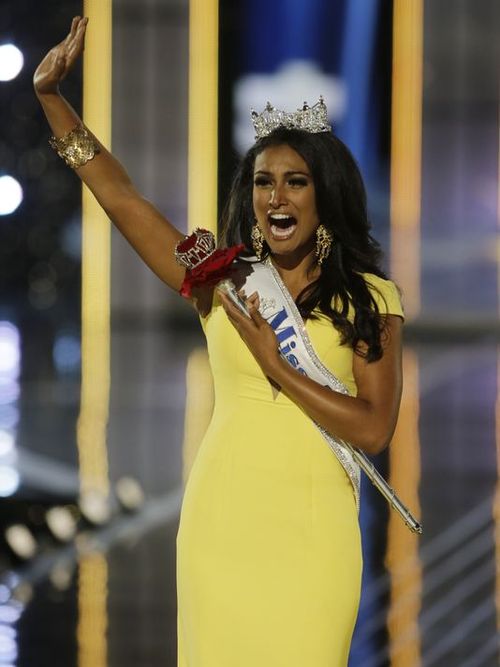
Hmmm..is it unfair to point out that tweeters who called the 2013 Miss America a terrorist and “not American enough” because of the color of her skin are bigoted morons? Let me think…
Popehat virtuoso Ken White has posed what we would call on Ethics Alarms an ethics quiz on the topic of web shaming. Is it ethical to post the embarrassing tweets of non-celebrities and public figures for the purpose widespread and national ridicule? Ken lays out the Pros and Cons thusly (these are direct quotes):
Pro:
1. It’s entertaining. Human frailty is the oldest and most consistent funny subject. People who are constantly incensed at brown people and can’t tell Arabs from Muslims from Indians are foolish and foolishness is amusing.
2. It’s whistling past the graveyard. Bigotry exists; ridiculing bigots is a mild act of defiance.
3. It’s supportive. Bigots exist; ridiculing and calling them out tells people subject to bigotry that we support them.
4. It’s a pressure release. The ability to ridicule bigots publicly reduces pressure to make the government regulate speech.
5. It’s socially transformative. Ridiculing bigots causes people to rethink being bigots.
6. It’s Darwinian. Twitter and Facebook, aided by Google, help those of us who hire employees distinguish between morons and people of normal intelligence.
Con:
1. It’s disproportionate. Though Twitter is public, people don’t expect their worst moments to be publicly searchable forever, which can have real-world impact like loss of jobs or relationships.
2. It’s out of context. It’s too often difficult to tell if something is satirical or tongue-in-cheek. [Edited to add: Patterico suggests, plausibly, “When something like this happens there is often at least one person mocking the bad guys who gets lumped in with them.”]
3. It chills speech by subjecting it to nationwide attack.
4. It encourages “mob rule” by directing large numbers of people to attack someone for expression of opinion.
5. It’s arbitrary, in that there is an inexhaustible supply of derpitude out there, and these people are having their derpitude irrationally singled out.
6. It doesn’t contribute to a dialogue on the situation, only an attack.
7. It treats minors and adults equivalently, and unkindly preserves youthful idiocy.
We are seeing more and more of this phenomenon, with a new website now being launched (and added to the Ethics Alarms links) for the purpose, “Public Shaming.” As Ken notes, those who have their ridiculous tweets held up to ridicule often delete their accounts, withdrawing into monk-like cyber-solitude.
I have registered my objections here to web-shaming when it involves communications and even conduct intended for a small audience or in a private exchange or interaction, primarily based on the first two of Ken’s “Cons.” These don’t apply to Twitter, public Facebook comments, or blogs, however. They are public statements, broadcast to all and accessible to all. They contribute, if only in a tiny way, to collective cultural consciousness, and when such statements and opinions are destructive, misleading and vile, they ought to called out for condemnation, no matter how old or naive the author may be. All of Ken’s “Pros” are valid and persuasive; none of the “Cons” are. There is no good reason why anyone should feel that they have the right to publish poorly considered, hateful, illogical, cruel or stupid opinions online without consequences—there is no societal value in that at all. Ill-informed, reckless and badly-motivated opinions pollute public discourse. If the enthusiasm of irresponsible, bigoted and unintelligent people for spewing rancid, badly-chewed garbage into the marketplace of ideas is stifled, good.
All one should have to do to confirm this is to read the two topics of the tweets singled out by Public Shaming so far. If this is the standard for what we shame—essentially res ipsa loquitur bigotry—I don’t see how anyone can find the process unethical, or anything but a positive development.
___________________________________
Pointer and Source: Popehat
Source and Graphic: Public Shaming
 Ethics Alarms
“1. It’s disproportionate. Though Twitter is public, people don’t expect their worst moments to be publicly searchable forever, which can have real-world impact like loss of jobs or relationships.”
Same rules apply as if this were a town meeting on the commons or in front of city hall or at a public market with the whole town in attendance. Just this time, the public forum includes EVERYBODY. If an individual were to say something appalling on the town square, everyone has a right to shun them or oppose any argument they make. Any arguments made of a decidedly uncivil nature, certainly cannot warrant anything more than social stigma, but certainly doesn’t require less.
“2. It’s out of context. It’s too often difficult to tell if something is satirical or tongue-in-cheek. [Edited to add: Patterico suggests, plausibly, “When something like this happens there is often at least one person mocking the bad guys who gets lumped in with them.”]”
Everyone who posts to twitter knows this limitation and therefore composes their tweets at their own risk. If anything, knowing how limited twitter is in establishing context, you’d think tweeting would be overly cautious on the side of civility…but unlike the town square, in which the public nature of communication goes hand in hand with a physical presence, Twitter has a certain level of anonymity to protect people who wish to say the vilest of things.
“3. It chills speech by subjecting it to nationwide attack.”
It empowers speech by giving a nationwide audience.
“4. It encourages “mob rule” by directing large numbers of people to attack someone for expression of opinion.”
This has validity, but that’s just the free market of ideas. As long as the “mob” does nothing more than stigmatizing and arguing back there is no problem. Were the mob to become violent or seek political means to stifle free speech in an effort to undermine a person’s right to have their ideas, then we’d have an issue.
“5. It’s arbitrary, in that there is an inexhaustible supply of derpitude out there, and these people are having their derpitude irrationally singled out.”
This sounds like a rationalization, but I don’t recall which one.
“6. It doesn’t contribute to a dialogue on the situation, only an attack.”
Twitter’s 140 character limit doesn’t allow for a dialogue on any situation. Only attacks. See this.
“7. It treats minors and adults equivalently, and unkindly preserves youthful idiocy.”
It treats minors like minors, and adults who wish to behave like minors on twitter, probably behave similarly, when pressed, in real life.
Regarding #2 (It’s out of context): “Everyone who posts to twitter knows this limitation and therefore composes their tweets at their own risk.”
That fact that you know I might take your satirical tweet out of context is a fair point when judging your decision to post a satirical tweet — you could have behaved more wisely. But that doesn’t excuse me from my duty to make sure I’m representing your tweet accurately. However unwise it may be to post a satirically racist tweet, it’s still unethical to mischaracterize a satirically racist tweet as sincere (assuming you knew or reasonably should have known).
I think the more general version of this is a new candidate for Jack’s list of Unethical Rationalizations and Misconceptions. Call it “You should have seen it coming.” E.g. “My neighbor should have seen it coming that if I caught his dog in my yard again I would stomp it.” “My boss should have known that if he yelled at me one more time I would punch him.” “I know I said there wouldn’t be mass layoffs when I took over this division, but everybody knows I always do mass layoffs.”
That’s a great one, Mark, and I’ll both add it and credit you. Thanks.
I feel dirty after having read all that. Unbelievable.
I actually do have some sympathy for this argument, especially if the person who tweeted is very young. I really believe that all of us are more than our worst moments. (I sure hope I am!).
On the other hand, I think Ken exaggerates the harms. The truth is, most people who get web-shamed eventually return to be being web-obscure, unless they’re famous for some other reason (e.g., Micheal Richards). Google searches put more recent things on top, and years-old items tend to be buried deep in the results.
So on the whole, I agree with you.
Speak because you have free speech. Think before you speak because other people also have free speech, and there are always consequences for actions.
Many of the problems with free speech would be eliminated if offensive speech had equally applied and agenda free consequences, but it isn’t. This is a harsh reality that everyone has an opportunity to learn the hard way.
Oops! It doesn’t not it isn’t.
I don’t know. On the one hand, I appreciate the self-regulating nature of the internet. On the other hand, doesn’t this open the door to more Justin Carters and tip-shaming? If a person abuses twitter, I feel the reactions should be limited to twitter. That is the audience they spread their filth to, and that is the appropraite place for humiliation. Let him have to close his account, let him be banned. Let everyone in the theatre laugh at his humiliation – but don’t take out an ad in the new york times, or put it on the marquee outside. That seems like a golden rule violation.