The web is abuzz over this viral video, in which a young woman, aided by a videocam-wielding minion, goes to excessive lengths to provoke a young man of significant size:
The question being debated: Is it ever ethical for a man to strike a woman?
If you are a feminist, or accept the premises of feminism, this question has to be folded into the question of whether a man should ever strike a smaller, weaker, more vulnerable man. The idea that a man should never strike a woman is rooted in chivalry and the special status women were once accorded due to their child-bearing function to the species, making them relatively more valuable to society and, for example, justifying excusing them from military combat. It proved impossible to maintain these traditions of keeping women as a special and separate breed of human without also accepting the accompanying biases and discrimination that such status appears to support. If women have to be protected and pampered, then they must be less capable, weak, and untrustworthy. Feminism has rejected that trade-off, for sound reasons. But women cannot claim equality and special status at the same time.
Thus, if this woman is threatening me…

or this one…
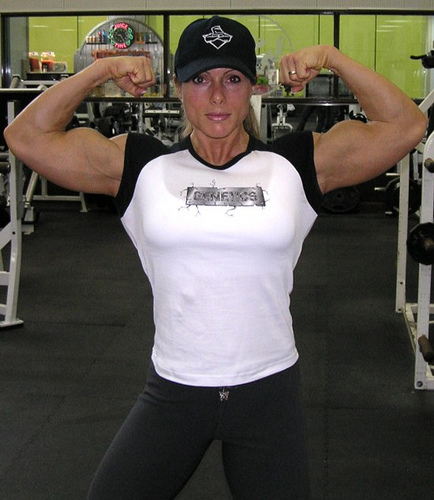
and I can’t outrun her, I’m going to try to break her nose to slow her down. Don’t tell me that’s not chivalrous; it’s self-defense. Similarly, I don’t think relative genders have anything to do with the right to self-preservation if this relationship turns violent:
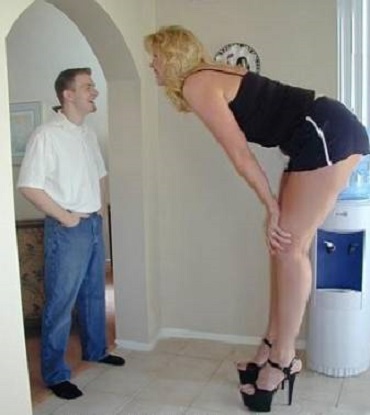
Agreed?
Now let’s consider the situation in the video. The aggressor-female is not physically imposing, but she is engaging in egregious bullying behavior, taunting the man, violating his personal space, and engaging in assault. Not only that, but her accomplice is sticking a video in the victim’s face, essentially daring him to respond with excessive force. Should he walk away? Yes, just as he should walk away if this were an aggressive, offensive little man doing the same thing, because avoiding violence is the most ethical course if nothing of substance is being surrendered in the process. He is not ethically obligated to walk away however: chew on this one, “stand your ground” opponents. Why should anyone be required to yield to someone who abuses, provokes and humiliates him like this, while using the cultural bias against a man striking a woman as a shield for threatening behavior?
Once she touches, him, however, the man is within his rights to protect himself. If that means knocking her down, or out, so be it. He has to be careful not to use excessive force, and juries might not be rational in this sort of confrontation. The law might well find fault with an ethical response here. But if there was ever a bully who deserved to have her lights punched out, this woman is it.
So the answer to the question, “Is it ever ethical for a man to strike a woman?” is unequivocally yes.
This video is a perfect case in point.
_____________________________
Spark, Pointer, Source: The Blaze
 Ethics Alarms
Is the woman hitting me, attempting to hit me, hitting or attempting to hit someone else, or behaving in a bullying manner to someone who can’t defend themselves?
If yes, then yes.
I have taken lots of grief for that position, from massive retards.
Agreed.
I think his only mistake was not hitting her hard enough to get his point across — that is to say “get away from me”.
I’da punched her fucking lights out, the bitch. (Disclaimer – I never use that word. I hate that fucking word. But in this case, it’s the only word I can think of that accurately describes the utter distaste I have for that little punkass bitch.)
Discussion here…
http://www.debate.org/opinions/is-it-ever-acceptable-for-a-man-to-hit-a-woman
A contrasting hypothetical case would be if she hadn’t been a troll on video but had instead been someone with a violent mental health problem.
My gut reaction is that nothing more than gentle restraint would have been justified in such a case.
It was easy to tell the difference in this case. The friend taking the video settled that question. In general, though, they might not be as easy to tell apart.
Then comes a broader question, tangential but fascinating. Most would agree that a responsible person should know how to use a fire extinguisher, and develop other skills for uncommon emergencies. On the same principle, should everyone take a Management of Assaultive Behavior class? Is it a duty? I’ve seen more assaults in my life than I have fires.
Great observation,, Fred, and one I have never considered.
I don’t care what your mental state is – you act like that to someone (at least me) you are very probably getting slugged.
There is no logic that compels the victim of assault to have to deliberate and analyze the possible mental disabilities of the one committing the assault.
There is also no logic in assuming the average layman has the knowledge or skill to make an instantaneous diagnosis of any of the more violent mental disorders defined in the DSM. While I was at work, I was bound by the rules and ethics of my profession. Walking on the street, I no longer considered my self a psychologist and my response would have been in line with AM’s response.
So we agree.
The video made me wonder what the Stand Your Ground laws are in the state where this happened. Learning those would be a valuable part of that course Fred suggests, I think.
The only ethical defence for violence is self-defence. As no reasonable physical threat existed, violence is not ethical (though richly deserved).
The woman has such clear intent to ‘procure a reaction’ that if she is stupid enough to press charges, she may end up herself in a cell. But the citizen’s ethical duties are clear. He must walk away. For the sake of others in the neighbourhood and the general ‘peace’.
Whatever issue is between the two of them doesn’t matter. Nor does relative size, muscularity, gender, social history, musical preferences or anything else, all irrelevant. Male pride – irrelevant. A philosophical preference to robust individualism – irelevant.
You cannot stand up for yourself and for the rule of law simultaneously in that situation. . So self-interest takes 2nd place. And you walk away.
But then I’m a brit. For me, no one in the video acts ethically. The ‘1st person’ camera operator should stop filming and intervene or yell for help.
False. Compelling victims to run away only empowers the miscreants to further miscreance. The best cure for a bad person wielding force in the name of badness is a good person wielding force in the name of goodness.
That man can walk away, but then she feels empowered to continue her abuse of others.
That would be a matter for the courts. If individuals decide who is or is not ‘good’ and what penalty to apply…. put it this way would you trust Her judgement on who was good? Your ‘code of the west’ (a good person… in the name of goodness) in reality produces only a ‘war of all against all’ given that every B*******d has a brother.
False. The “wild west” where stark individualism was the norm was not “wild”. Don’t let Hollywood fool you.
Yes, it would be the matter for the courts, and the good people would win. And falsely self-styled “good people” (vigilantes) would be punished. And they would be exceptions to the rule anyway…but I know collectivist cultures like to end good rules because of exceptions.
I assume you are making the illogical step to conclude I am discussing vigilantism. You’d be wrong if that is your assumption.
When one person is minding their own business, and another assaults them, it isn’t hard to discern good from bad.
I’ll try to be Holy fool not a Hollywood fool. That’s as much as I can promise. I think you are discussing not vigilantism but something like ‘victim’s justice’ at the instance of the crime. Regarding discernment – having been in two such situations myself I can honestly say that as an observer I found it very hard to judge at the time or now who or what was good or bad, and as a victim I found the court very lenient to my assailant who falsely pleaded ‘provocation’ extenuating his admitted guilt. But who am I to say what’s good on behalf of everyone? After all I am a fool aren’t I? As are we all in matters of self interest. Or so it must ne assumed, I think.
“‘victim’s justice’ at the instance of the crime”
What the hell kind of newspeak is that? That sounds like an attempt to reword “self-defense” (a natural and self-evident right) so it can be argued against. Won’t work.
Your last few sentences arguing against self-defense since it doesn’t fly in y’alls courts doesn’t make sense to me. You want me to believe, that because your society which doesn’t empower the citizen, utilizes a court system that continues to debase citizen empowerment and inevitably skews its decisions wrongly, we would be illogical then to try the opposite system?
By victims justice at the instant I mean the summary imposition of the penalty the victim would want rather than that which a court would otherwise decide.
For me self defense is not punitive, only protective. It’s the minimum of force.
If there is a cultural difference between us, we’d better just describe it and accept it. But i thought self-defense was a common term with my definition. If yours is different I’m curious. As for the rest I’m sorry if my meaning is lost on you. Perhaps it might be clearer if I say I have learned to be cautious in using my own judgement in matters which concern my own interests against another’s. I do not feel I have the right to choose who is to be punished. If in your world of empowerment every citizen is a ‘court of one’ I am very curious about how such an arrangement can hang together. But it may not bear on ‘should a man hit a woman’ so we should probably leave it there.
And by all means try a different system, it couldn’t be worse than ours.
Deterrence is a legitimate component of self-defense. Than can mean, in some cases, disabling an attacker to stop future attacks.
Thanks. Yes, i agree. In the actual exchange. But not a detterent to all posssible future actions in a week or a month say. Just the minimum to preserve safety until the police arrive. At least that’s what I would understand.
Your hasty generalization to blood feuds is amusing and also fallacious
Granted, comment withdrawn. Open to mis-interpretation. Lets instead say ‘Given that natural affections can skew a sense of rght and wrong in favor of those we love and thus recruit large followings to both parties regardless of the facts’.
Except the problem with your rebuttal to me is that you are arguing against a strawman.
Included in my argument is already that people who start these assaults are bad people. My justification only applies to those being assaulted… they ARE entitled to self-defense, albeit much sooner than just physical assault, as Jack alludes to above, if something of substance must be surrendered.
Once you generalize my justification to include blood feuds and vigilantism (which you are doing) you falsely add to the group I justify using force a group that I believe force is justified to use against.
Ok. Allowing that i misunderstood your objection. The defence you speak of is defence of the ‘matter of substance’ that Jack alludes to and which as I understand it now. you are saying I have not adddressed. Yes? As Jack put it : “He is not ethically obligated to walk away however: chew on this one, “stand your ground” opponents. Why should anyone be required to yield to someone who abuses, provokes and humiliates him like this, while using the cultural bias against a man striking a woman as a shield for threatening behavior?”
My answer is already given, his male pride is not a matter of substance to be defended (that is the sticking point perhaps?). Nor is his pilosophy on the role of women in society. Nor his belief in his own goodnessor the rigtfulness of his cause in the dispute. Absolutely all other matters are subordinate to his duty as a citizen to preserve the peace. He cannot stand his ground, he’s on public property not his own front porch. His duty is to the next child, old person or other passer by who may be scared at witnessng an altercation of this kind. The more childish and irrationally she acts the more virtuous his conduct must be. The only course of ‘knightly honour’, of devotion, of service, of ctizenship is the path of self-abasement. You turn and you walk. Proud that in doing so you choose wisely and for the greater good (and impervious to any court proceeding). Sorry that took some words but does it help? i hope so.
You also seem to have a fundamental misunderstanding of the phrase “Stand Your Ground.” This refers to the right to self defense in any place that you have a legal right to be, public property or private property. Stand your ground laws became necessary because crime victims were expected to exhaust all avenues of safe retreat before responding to a violent attack (even, in some jurisdictions, in their own homes – which is where the Castle Doctrines came from).
True, I have a significantly different understanding of ‘stand your ground’ self-defence. I did look it up in three sources but only at ‘wiki’ level. My best understanding is that mostly it applies in a home or place of work, sometimes but only rarely does anyone try to apply it to self defence in a space in public. In this case as no matter of substance is involved the defence would not be proper in any event. But that’s opinion not necessarily law or settled ethical argument as far as I know.
I am loth to admit castle doctrine or stand your ground defences. It would have to be a very clear case. Much more threatening than this lady. For reason of avoiding giving to license to pre-emptive violence in general, potential confusion, making cases too hard to judge, partisanship and general breakdown of order. The only strong reason for such empowerment I can think of applies to those who give personal pride a much higher value than I do and the self interested individual more credit for good judgement and integrity than i do..
Bruce, I am much like you in that I cannot claim to be an expert in Stand-Your-Ground laws. I do trust, though, that their reason for existence is due to other than some state-defined valuation of personal pride. While the most expedient places to apply SYG laws might indeed be within residences or on the premises of businesses, the most beneficial and urgently needy places to apply such laws seem to me to be in public spaces.
I also, if I understand you correctly, share your skepticism (or, what I perceive to be your skepticism, which I will admit that in my case, stems from cynicism and general, Christianized misanthropy) about the benefits of empowerment by giving any “self interested individual more credit for good judgment and integrity [than one deserves].” But even then, my skepticism and distrust in the ability of a government such as those we endure in America today to recognize, reward, incentivize and proliferate true good judgment and integrity in individuals, particularly in those confrontations on the streets where basic individual civil liberties are under attack, cause me invariably to favor and allow benefit of doubt to the on-the-scene forces for good (if any). If that predisposition means I “like” or prefer what others might disparage as “Wild West” or “law of the jungle” justice, that doesn’t bother me or make me feel as threatened as when I notice “tyranny creep” stemming in part from presumption that the ostensibly disinterested, outside parties to a conflict are always more trustworthy to sort out and resolve the local justice issues.
We commenters almost certainly do not know, and never will know, the full relevant background to what we see in the Hood Rat video. Taken by itself, though, it appears to be a case of a woman assaulting a man who does not want her near him – a man who is not creating a no-way-out position for the woman, and who frequently attempts to communicate his desired spacing from the woman, in addition to retreating – until the woman’s assaulting provokes the man to use a proportional act of force in reasonable self-interest.
Then the “Wiki” level fell short for you. The SYG doctrine is an attempt to provide the person attacked the option of engaging in lethal force without the obligation to retreat as long as the victim is in a location he is legally allowed to be and is not otherwise breaking the law. The Castle Doctrine has been passed in many states as a way to counter the thought that you must retreat in your own home until you were no longer able to retreat before you would be allowed to respond in a lethal manner.
Obviously, this is a side issue here and I only brought it up because the context of your use of SYG was clearly incorrect. This was not a scenario where lethal force would be allowed or authorized because no one would believe that the victim thought he was in imminent danger of death or severe injury during this encounter. However, I know of several successful SYG defenses where the number of assailants was determined to be a trigger for the SYG defense.
Thanks for the responses and corrections. Perhaps my reading of wiki text was incorrect rather than the sources. However in principle I think the discussion can stand. If so, in principle, i think there is an unbridgeable cultural gap between us. One of us may be wrong in absolute terms but as I can barely understand your objections and you both seem so adamant but not really engaging what I think is at the essence of my point (duties) I can only assume you find my text equally baffling. So we must leave the enquiry there for the moment. To be continued, i think. Thanks for staying with me this far – it can’t have been a pleasnt trip.
It has not been an unpleasant trip for me. I believe that I do understand what your point was in terms of duties. However, one of your points was that he could not stand his ground as he was on public property. It is a pretty important distinction that the SYG laws were designed by intent to be effective in public areas.
Now, to the point of whether or not a person’s dignity (or as you put it, “male pride”) is important enough to defend. I think that I could make a pretty good case in a personal conversation that the ONLY thing that is worth defending is human dignity. This is not a matter of pride (male or female). It is unfortunate that my writing skills are not up to the task.
There probably is currently a cultural difference at play here between you and I. If I recall, you are in the UK? If that is the case, then that cultural difference is of relatively recent provenance. There was a very long tradition of bearing personal arms in the UK in the past. This has sadly fallen by the wayside in recent decades.
Eeyoure, Phil, texagg,
Ok if you do not find this unpleasant I will try to answer you. Your points are mostly well framed. But with your permission I place you back in the situation. Someone is being absolutelly ‘bang out of order’ showing you complete disrespect, treating you like dirt, saying ‘kiss my *****’ and shoving it in your face, breaking every rule in the book and threatening your pride, dignity, sense of self, inner calm, place in the sun, love of your mother, love of your country, love of freedom, music, girlfreind, all that you desire, believe in and hope for, all you consider good. The whole of you. So that if you give in your soul will be lost. The highest stake you can imagine. I put it to you that your every sound self protective instinct is to assert yourself, in order to survive. Self assertion is something we learn when we are very young maybe 2 or 3. It goes deep. Your emotions are completely engaged, and they are strong.
1. this is the state of your mind that your provoker desires. This point i will ignore as it gives the provoker too much status.
2. turning and walking away, giving ground, capitulating, leaving the hated enemy victorious, is so unpleasant you do not want to face it even in theory. This is entirely understandable. I think it is also the reason behind all the reasons you have given. They are rationalisations. You are quite unconsiously I’m sure, ignoring your duty. To die in a just cause may give you no pause. But to give in for your country is unthinkable to you.
But not to me. I’m British. When you carelessly bump into me, i say ‘sorry’, When you spill my beer in a bar I say ‘sorry’, When you visit my country with no respect i say ‘sorry’. When you take away my ‘butterfly’, my dream, my language, or the ground i stand on i say ‘oh dear, was i in your way?’.
Which is why if i see anyone push a little guy or girl around, or beat up a Jewish person, or invade Poland, or any other shit any where near me i will ‘get evil on your ass like no other M*****rF***ker on the planet!!!!’. And then say ‘Sorry’.
You might call it ‘the coward of the county’ effect. Or discipiine, or politeness. Or silliness. Or inverted dignity. As you wish.
No guns, no Stand Your Ground, no legitimate use of personal force. Except for minimal self defence. No thanks.
You turn and you walk away. Not because it is easy, but because it is hoaaarrd. Apologies to JFK.
But if i offend you… Sorry.
On December 23, 2013 at 2:48 pm, Bruce wrote:-
I, too, am British. So, when a Japanese tourist pushed in front of me in a queue at Leicester Square underground station a few years ago, I simply reacted without conscious thought; before I knew it I had grabbed him by the scruff of the neck and thrown him hopping on one leg out into the middle of the concourse. Interestingly enough, neither he nor any of his – several – fellow Japanese tourists objected in any way.
To P. M. Lawrence. I won’t criticise your actions, you were there I wasn’t.. However I don’t think the example is helpful. Either there is or is not a cultural difference to explain why I advocate ‘walking away’ in the face of provocation which our american friends find baffling and curious. If you are saying you don’t like my explanation because it includes a lot of overstatement, I agree. If you are saying you think the man in the video acted correctly when hitting a person rather than walking away then I wonder why? If you disagree that our island hangs together on the politeness of not taking offence easily then I’m dumbstruck. If the difference between me and others is ethical not cultural then i disagree with you. Flatly. On the basis that my explanation is deficient I willl try again at the bottom of the comments section. Thanks for the correction.
I am not going to say that one is compelled to run away. But sometimes walking away from the situation is the best way to deal with the situation. The problem with a lot of people in this country is that they cannot just realize that the other person is flipping crazy, can never be reasoned with, and just telling them to have a nice day and walking away is the best solution.
People are too afraid to be seen as “weak” for doing that. But if more people did that I bet we would have less murders.
I agree with the last sentence.
This raises useful questions.
Self-protection by walking away sacrifices long-term good for short-term good. Self-protection by striking back means the aggressor can’t control public territory, but at the cost of more injuries in the short term.
“For the sake of others in the neighborhood”, those who would be the next targets of an aggressor, it is ethical to use proportionate and necessary force.
That assumes the aggressor gets off (for lack of a better term) on the physical control instead of the mental manipulation. The BEST thing you can do to someone who wishes to mentally manipulate you is to ignore them and walk away.
No, not if what they want is to manipulate you into leaving. I can easily imagine someone developing a habit of clearing space in bars that way, if he or she is encouraged by success in that.
I just do not want to be encoruaging the idea that people MUST FIGHT because that is the right thing to do.
Fighting should be seen as the last resort. Walking away should never be seen as cowardly and should be seen as taking the high road.
I cannot stand the mentality of people who think that fighting is something that should be encouraged. If you have to, then by all means do it. But if you can walk away and not have it escalate, that should be seen as preferable.
And what if walking away leaves the certainty of combat to others, especially when the others are less capable of fighting?
As I said: “and not have it escalate”. If walking away causes certainty of combat to others then it would escalate.
She feels empowered no matter what he does. She’s got all the cards and she knows it. Check out her smug attitude. She’s willing to take a punch just to get it on record. Despicable and she’ll get away with it.
And that is why, in this situation, while him defending himself physically should be seen as ok, that the best reaction would have been to walk away. Don’t give her what she wants.
See my comment above, about how your walking away might actually have been what she wanted.
In this situation it is obvious that what she wanted was to have him hit her on video. Him refusing to do so would have not given her what she wanted.
I think it depends on the circumstances.
If there is no other way, then yes.
Have you ever been in a pub, bar, concert, etc., when one or two psycho bitches get to brawling?
The bouncers then get the combatants in a bear hug and restrain them until police arrive or they calm down or whatever.
Sometimes they just put them outside.
IMO, this would be more desirable than closed fist punching a woman in the face and breaking her jaw as the first response.
Then if the situation isn’t controlled, more force can be used.
Of course. Appropriate escalation of force is an absolute necessity to ensure proportion of response. I assumed for the purposes of this discussion that previous steps had already been exhausted.
Having bounced, there’s one key difference here- at the bar, we could take people outside, and then they were out. If he bearhugs her, he has no end game. There’s nowhere to go and put her that she doesn’t immediately start again.
Not only that, but he is certainly aware that he is facing at least three hostiles, including the camera operator. If he grabs the woman, he can no longer keep the other two in view as she struggles in his arms and also eliminates his ability to avoid additional attack by the other two.
I guess I should have added that you should initially attempt to stop a violent confrontation with non-violence.
We don’t want to be out there beating people if we can help it.
I’d like to see where you come down on this incident.
I’m a little unclear about what’s going on, but 1) the driver should have forced her to sit down or leave much earlier
2) The other passengers should have intervened. 3) he shouldn’t have been driving with her distracting him, and 4) I doubt he had to hit her like that, but it’s not inconceivable.
What about stopping the bus, opening the doors, taking the keys out of the ignition, stepping outside and calling the cops?
I thought it truly endangering to all aboard to keep on driving in that situation. But then he did stop the bus and instead of stepping out, he delivered that uppercut. I thouth it strange behaviour on both sides.
Hindsight bias, though. He wanted to saty on schedule, he didn’t think the woman would persist—yes, in retrospect, that would have been his best course (though his schedule would have been disrupted and his passengers would have been inconvenienced. The driver chose wrongly, but didn’t have the benefit of retrospect.
Alright, I’ll give you that. But I watched the video again and it strangely seems like he’s totally calm when he knocked her down. The uppercut also doesn’t look like the untrained flailing of an amateur… He just doesn’t seem too upset to make the right choice to me.
The reason I’m harping on about this – and may be it sounds very naive – is that during the last 15 years I feel as though there’s an escalation of aggression and readiness to do violence. It permeates our everyday lives to such a degree that our first thought when faced with agression is not to de-escalate but to let our fists do the talking.
I worked the bar at a nightclub during my university days and have seen a thing or two but my first reaction to agression and violence wasn’t ever to answer in kind. I could mostly shame guest into decent behaviour and if not the bouncers would just hold people and talk them down till the cops arrived.
Is that really hindsight or a difference in attitude/personality?
I think its a valid observation. It’s a larger issue, but I also think modern life has become so frustrating and stressful, noisy and complex that people of lesser skills in impulse control, verbal ability and problem solving just jump to violent means, because nothing else is in their toolbox.
I think he showed restraint! He tells her to either get away from him, get off of him or back off 31 times. Thirty-one! (I may have even missed a couple.)
Here is a story that may be illuminating. My mother was Irish, of a family that had emigrated to France just after the First World War (yes, that means what you think it means). She was brought up in a small village near Paris, Bougival, which I think is now a suburb, so definitely not in the sticks. A number of things led to her not assimilating well, so that she eventually re-emigrated to the U.K., and this is one: the women of the village routinely tried to provoke their men into beating them to the point of visible evidence like a black eye, just so they could show that off to the other women with pride (“il m’a battue!”), because it was evidence that the men cared about them enough to risk jail – an adverse and unintended effect of legislation trying to override cultural values. My mother did not care for that, nor for the parochial xenophobia and other such things.
Yeesh.
Seriously sick and twisted, that custom of the Bougival enabler-women.
Legality aside, as a large and strong man my personal code of ethics says I don’t hit women or men much smaller than me- at first. I made it through a school system that told me “Even if he hit you, he’s so much smaller it couldn’t have hurt much, but you hurt him when you hit back.” I learned restraint, but that if it got bad enough for me to retaliate to do it HARD.
In his situation, he showed remarkable restraint at not retaliating to the full on chest shove. When she gave him that little jab in the face, I would have tried for the shirt grab and then palm strike to the center of the face. A suddenly bloody nose takes the mustard right out of people like that, and her initial blow was on video. Sometimes a quick escalation is the best choice- it shuts a fight down early, rather than letting it slowly build up more and more.
I don’t know what happened before this video (clearly there was one — if not several — previous encounter(s)), but she actually committed the first assault when she chest bumped him.
“It’s a beautiful day in the neighborhood … Won’t you be, my neighbor?”
To paraphrase Teddy Roosevelt when confronted by somebody of the opposite sex who is deliberately trying to provoke and assault you: “First speak softly, then hit them with your stun gun.” 😉 if it’s legal in your state.
It is never ok for anyone to initiate a violent interaction with someone. I don’t care what gender the person hitting or the person getting hit is.
Now, I word it as initiate a violent interaction because someone can hit first and that hit can be self defense and as such the first hit is not the initiating action in the violent interaction.
It is ALWAYS ok to hit someone in self defense. Period.
Now, with this video there are two things.
1)We do not know what happened prior to the filming. She claims he had hit her previously. At what point previously? At the beginning of this altercation? At a previous altercation similar to this one? We don’t have all the facts of this relationship so anything said about the video is being looked at in a vacuum. (Which is ok, sometimes you can look at the events in a vacuum).
2) Regardless of if he had hit her just previous to that video (and what the situation was in which it happened), he clearly kept repeating “get away from me”. And she kept on getting in his face and pushing him. So obviously she wasn’t feeling threatened from him and felt that she was justified in doing that because in her mind if she could push him into taking a swing that she would have something she could call the cops on him about. That is, of course, wrong. He is free to defend his personal space. Nothing he did in this video, taken in the vacuum in which it is presented, should be viewed as wrong buy the law or in any other definition of right and wrong. And I also cannot imagine any other unshown context that would make his actions in this video wrong.
One piece of context here that is missing is who lives in that place with the parking lot. Was it her apartment? Was it his? Why was the person there whose place it wasn’t (assuming both do not live there). Could one of the people just walked away and ended the situation?
2nd attempt to answer objections to the ‘walk away’ option by texagg, Phil, Eeyoure and P. M. Lawrence
The difference may be cultural. I believe (subject to further correction by PML) that the British are famous for apologising when they feel they have been offended. That is the variant of UK culture in which i was raised. If someone began trying to provoke me as shown in the video I might start by saying ‘I’m sorry, but I find your behaviour offensive.’ I’m apologising for not being strong enough to be equable and placid enough for her to rant and rave the way she does. The offense i suffer, the way i was raised, puts her at an obligation to consider my hurt and practice self-restraint. This limits her liberty to say whatever she wants. So I apologise that my limitations of character force her to be less free than she might desire.
If a cultural norm of that kind (the kind where taking offence is regrettable) becomes widespread her provocation leaves the option of walking away as the ethical (and game advantage) ‘killer move’. She has no ethically sound countermove. In gaming (considering who won) the outcomes, by walking away I show that I am abiding by the social norm, being strong, refusing to get angry, not taking offence. The more flagrant her actions the more my action looks virtuous and the more she is seen as an idiot and the culprit. Her social status drops to around zero, I am regarded as a level headed good guy. My conduct is both ethical and successful. If the contract pre-exists the start of the action as the norm of behaviour.
Thus that culture of dutiful forbearance, if prevalent, allows of social self control without any violence. The answer to a bad guy weilding force is a good guy wielding politeness. There is powerful social deterrence for offensiveness. This is in some ways socially desirable.
But i note that the implied in the convention of forbearance and refusal to take offence is freedom as man-made by contract not as a natural right.
Better?
A reflex apology used indiscriminately eventually has the effect as well as the reality of no apology at all. It just deflects conflict that would be more beneficial if played out rather than stifled.
Respectfully, no. The lowest order of significance such an apology could get to is that of Hello, Goodbye, Please and Thankyou, and possibly Haveaniceday. Which are empty conventions – but a sign that one is conventional. abiding by the norms, respectful of persons, polite.
If my thinking is right however, the short apology in my culture actually stands as a stub which by reference is reassuring the other person that you are both bound to an underlying agreement of polite rights and duties. It may be impolite to take offence eagerly or give offence gratuitously for example, as in my case. The conflict can then be played out at the level of what is polite rather than what is good. The bulk of non-beneficial non-essential conflicts can thus be dealt with safely which should encourage rather than stifle expression of conflict and positievly aid consensus building. To that extent saying ‘sorry’ maybe like saying ‘Hey, there is a law, y’know’, only more polite.
On the contrary, I think the reflex apology is the opposite of polite, because it is insincere and thoughtless…dismissive. Like the Seinfeld episode where a customer in a deli stomps on Elaine’s foot and sneers a nasal, nasty-sounding “Sooory!” Such a sorry just means—“Now you can’t complain without seeming like a jerk, since I,heh, heh, “apologized.” Once a rude pedestrian slammed into me on the sidewalk and made me spill coffee all over my suit. He just blurted sorry and didn’t break stride. Apology not accepted. Jerk.
That’s true. And shared. Except that in my example it’s the offendee not the offender that says sorry. You’re rude to me – I say sorry, spill coffee over me – I say sorry. Meaning you’re safe, no worries, I’m so cool with this that if necessary i wil take the blame for it. I’m sorry to put you to the inconvenience of offending me. All clear. No biggie.
It’s the rare event when I Don’t say sorry and give a hard stare instead that a human pimple would need to beware of. If such pond life give me a reflexive sorry under those conditiions, righteous personal fury would be the least consequence they’d have to worry about. I might loudly expostulate ‘I say!’, force the idiot to stop and face me. I might then turn, shaking evident coffee drips from my coat, and walk away. And leave felllow commuters to look at the offender coldly. So there.
I will pick this up where we left off above with your comment that I might want to respond if someone attacked the most important things in my life that I may want to respond. Then you compared that challenge to your impulse to respond with an apology if someone tipped over your beer by accident or carelessness. That doesn’t seem like an apples to apples comparison to me.
I now have the advantage of seeing quite a number of your replies in this thread relating to this issue, so I have a bit of an advantage over where my mind would be had I been able to respond immediately to your reply to me. I appears to me that you have very limited experience with an irrational attacker if you believe that you can bring in a phrase like: “‘I’m sorry, but I find your behaviour offensive.’” and expect anything other than escalation. (I think that the bouncers in this conversation would agree that the worse way to deal with a bully is to ask them to leave you alone by saying: “I’m not doing anything wrong, why can’t you just leave me be?”
Now, it is clear that the woman in the video above was acting the bully in this encounter. My experience with bullies is pretty comprehensive; in this instance, there is no conversational tactic that would de-escalate the situation. The options are to make a fast retreat or an instant physical response to the physical attack of the chest bump.
You may be a terror when you see some skinheads beating up a Jew, but I suspect that the most aggressive you would get would be a loud “I Say” with the hope that other, more courageous bystanders would do more than look on with disapproval.
(By the way, if it isn’t clear from this note, I do not believe that this is a cultural difference between UK and US. I think that it is a cultural difference between those people who understand that weakness invites attack and those who will rely on the goodness of irrational strangers to protect them).
Phil, thanks for taking the time to read it all. I am sorry, truly, that i am struggling to explain something that I have accepted all my life as obvious.
I’ve said elsewhere that virtuous scars are a minimum qualification for being taken seriously. I have some, few, and I’ve stood up and spoken up when others were silent many many times and been in a ‘majority of one’ in action on occasion. Last time was about 6 months ago separating two youths fighting on an underground station. For the record I should also add that I’m a Parkinson’s Disease sufferer. So much for credentials since you asked for them.
As a matter of fact I know an ex-bouncer and a couple of ex-cops. I confidently predict that what they would do is the absolute minimum, then whatever level of brutality they needed to sort the situation to a safe conclusion for themselves, then make sure they got their over time claims in. So, much as I respect their work I’m not going to take their practice in detail as a guide to ethics.
I have already expressed my regret at using far too much overstatement in my attempts at clarity. That was bad. This is clearly not a simple thing to explain and I must proceed cautiously, scrupulously logically, and beware of all possible misinterpretations of what i say, not only on conveying what I mean. Please also note that the other Brit on this blog, P.M. Lawrence, also thinks i am talking hooey. That or he really doesn’t like overstatement, i can’t tell which.
I still suspect there is a cultural gap here. And that ‘politeness’ is the key concept. So I will continue to attempt to explain as best I can. But I offer neither defence nor apology for any previous explanations that are unclear. The best of intentions were present throughout. I am constructing this argument as i go and discovering assumptions that i didn’t know i had, but innately thought were common understanding, that in fact are anything but common or understood.
Now back to the plot, which i believe you are as interested in as I am since you keep coming back for more….
Is there any case where you would support just walking away?
First to Bruce: Thanks for continuing to attempt to convey your meaning. At this point, I confess that I don’t understand, while I thought that I understood before.
Dan – yes, there are many instances where it is best to walk away and I have done so. They were nearly always times when my aggressor was at some level of rationality where there was apparently no real desire to continue escalation to the point of violence. The problem is that it is not always clear when this is the case … then presentation of your back is an invitation to a new attack.