Who’s That Woman On The Cover of “O” Magazine?

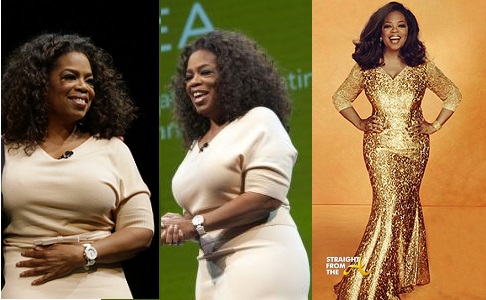
l, c: O yesterday; r: Cover O.

l, c: O yesterday; r: Cover O.

By purest coincidence, I was looking through a magazine rack at CVS yesterday and taking notice of how well Oprah Winfrey has been keeping the pounds off lately. Then, this morning, I saw footage of her walking across a stage to announce her latest venture, something to do with chai tea. Mama mia! The woman I saw smiling and waving, presumably the real Oprah, was easily 50 pounds heavier than the look-alike who has been gracing the cover of recent O’s, though I will say, as mitigation, that the strategically shot March cover has a graphic over OW’s gut.

I could not care less how much Oprah weighs or what she looks like. However, an ethical narcissistic—and what else can you call a woman who publishes a magazine named after herself that has her as the cover model for every single issue?—has limited choices:

  • Keep yourself in fabulous shape, so you are fit to be a cover girl (by your own standards)
  • Don’t put yourself on the cover when you don’t feel cover-worthy
  • Use cartoons, or
  • Let it all hang out.

Not an ethical option: showing your loyal, trusting readers that you look one way, when in fact you look a whole lot fatter.

Yes, yes, I know—photoshopping, airbrushing, make-up, glamor photos, “it’s done all the time.” This is Oprah’s magazine, her image and her body, and pictures communicate. Her covers say “This is what I look like, be like me.” If she doesn’t look like her covers or even close, that’s an outright, calculated lie. It’s really as simple as that.



Schindler’s Tweets And The Monster In The Mirror

Shrek in the mirror

John Schindler is a former NSA officer, a professor at the Naval War College and a PhD who periodically holds forth on his various areas of expertise on the web. He also specializes in particularly obnoxious tweets in which he both insults anyone who questions or disagrees with him, and does so by referring to his own innate superiority as a scholar and an intellect. If he isn’t a complete jerk, he sure plays one convincingly.

Some wag noticed the trend, and created a website that contains nothing but Schindler’s most snotty tweets. Here is the puzzling part: Schindler, in yet another tweet, referred to it as “an ugly new defamation site against me.” Forget the complete lack of comprehension of what defamation is (Ken White at Popehat, an expert in that field of law, invoked Inigo Montoya of “The Princess Bride” in a tweet to the Professor saying “‘Defamation.’ You keep using that word. I do not think it means what you think it means.”). My question is this: if Schindler thinks the website is ugly, and it contains only what he has written to others, why doesn’t that promote self-awareness, regret, remorse, and altered conduct? That is how it is supposed to work; I would think that is how it has to work. The idea behind the Golden Rule is to look at your conduct from another’s perspective, and if it strikes you as ugly and wrong, then you have learned something. So you change. Not this guy. Continue reading

The Fundamental Attribution Error And The Gender Pay Gap: When We Say “Women Need To Learn To Negotiate,” We Meant “Learn To Negotiate WELL”

GenderGapIt isn’t 23 cents less than every dollar earned by men in the same jobs, as the President dishonestly claimed in the State of the Union address, but women’s compensation is not yet equal to what men earn. Part of the reason is the choices women make regarding child-bearing and career timing; part is indeed bias. Some of it is also attributable to the fact that women are less aggressive and perhaps less skilled in negotiation. They often get lower salaries because, unlike their male counterparts, they don’t ask for higher ones.

Now comes “W,” who writes into an academic blog to show that women are penalized for daring to negotiate. She claims she was offered a tenure-track philosophy position at Nazareth College, a liberal arts school in Rochester, N.Y.  She replied, she says, by emailing the selection committee:

“As you know, I am very enthusiastic about the possibility of coming to Nazareth. Granting some of the following provisions would make my decision easier: 1) An increase of my starting salary to $65,000, which is more in line with what assistant professors in philosophy have been getting in the last few years. 2) An official semester of maternity leave. 3) A pre-tenure sabbatical at some point during the bottom half of my tenure clock. 4) No more than three new class preps per year for the first three years. 5) A start date of academic year 2015 so I can complete my postdoc.

I know that some of these might be easier to grant than others. Let me know what you think.”

Let me pause here to point out that this is a terrible response, incompetent negotiation, and career self-sabotage. First, you do not negotiate in a potential employer-employee setting through e-mail. You talk. Then you can gauge how you are being received. She should have asked for an appointment. Continue reading

All Right, I Can’t Let This Pass: Reading Comprehension At The Chicago Tribune, Or Why Do We Rely On People Like This?

THINK, Jack---if the best of the breed was a biased dimwit, why do you still want to trust these people?

THINK, Jack—if the best of the breed was a biased dimwit, why do you still want to trust these people?

I am grateful for the Chicago Tribune website readers who have followed blogger Eric Zorn’s link to the Ethics Alarms Noah post, but is it too much to expect a major newspaper’s  columnist to read and comprehend the plain meaning of a post before criticizing it? Zorn, who authors the Trib’s Change of Subject blog, was cheering on Bill Maher’s atheistic take on God, the Bible and the Noah story, and then quoted me, writing…

I found this refutation of Maher particularly unconvincing and circular:

“God makes the rules, he is literally incapable of being immoral; it is a contradiction in terms. If God kills, it is by definition right and good, because God himself defines right and good. Does Bill really not get this? … If you don’t believe that God “works in mysterious ways” and that everything he does in the Old Testament is justifiable as part of some greater plan, Maher is indisputably right. God is a mass murderer.”

How more wrong could Zorn be?

1. I wasn’t refuting Maher, but defending his anti-God statement as completely accurate from his narrow and biased point of view, which includes a basic misunderstanding of what morality is and what it means to believe in an infallible deity. Continue reading

Why Are American Liberals Espousing Censorship And Mind-Control?

zipper on mouth

I say “suddenly” because I always thought of censorship and mind-control as Big Brother, “1984” stuff, the tools of fascism and totalitarian dictators. Yet for several years, the primary calls for impeding open debate and limiting the tools that facilitate it have been coming from the left. No labels. No “eliminationist rhetoric.” Ban “retarded.” Ban “nigger.” Now a best-selling feminist, Facebook COO Sheryl Sandberg, has launched a fatuous campaign to ban the word “bossy,’ on the theory that it is wielded against incipient female leaders and crushes their spirits and aspirations. (I would counter that any girl who can’t stand up to a word isn’t a very promising leader to begin with.) Unable to mold human nature to its liking with reason, facts and persuasion, the increasingly popular tactic seems to be removing the ability to engage in the kinds of thinking and conduct that liberals, with varying justification, find repugnant. Linguists have shown that ideas that can’t be expressed are difficult to form, much less argue for. Eliminate bigotry, bias, inequality, and social injustice by making them impossible to articulate, and then even conceive! Brilliant!

Now Lawrence Torcello, an American philosophy professor with a Ph.D. from the University at Buffalo, has published  an essay in the academic website The Conversation arguing that dissent about climate change and the human role in it is so sinister that it “ought to be considered criminally negligent.” Continue reading

Self-Promotion Alert: Army Magazine on Candor and Honesty

COVER_March2014Rick Maze, a reporter for Army Magazine, was kind enough to quote me extensively in his article, “Candor: Can the Army Handle the Truth?” which is available here. He also includes an extensive reference to the Rationalizations List.

Ethics Quote of the Day: Composer Mitch Leigh, 1928-2014

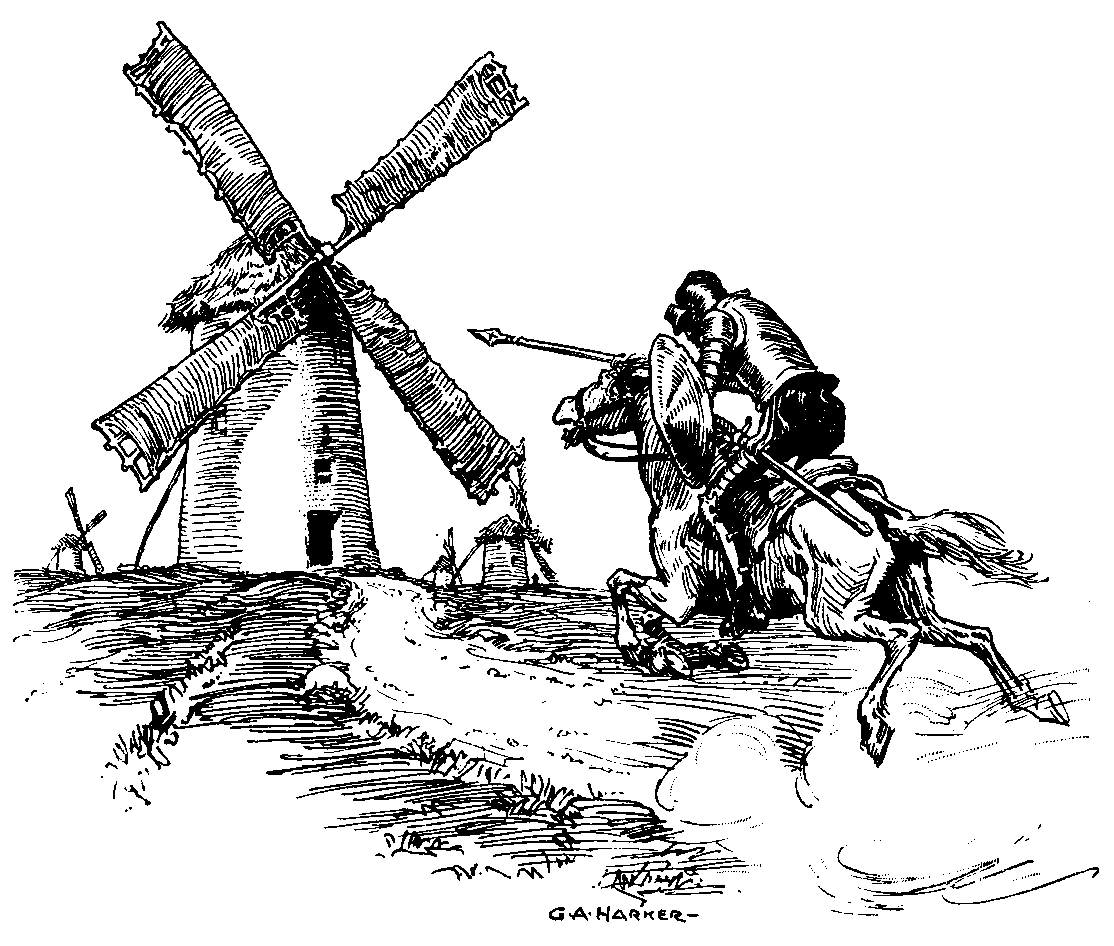
DQWindmill

“I think if you see that no one is going to laugh at you for it, I think the concept of living nicely will be infectious. I believe there is room for the absence of cynicism. This is my final dream before I take the last cab.”

Mitch Leigh, Broadway composer best knows for the music of “Man of La Mancha”-–and “The Impossible Dream,” of course,  in an interview with the New York Times last year, quoted by the Washington Post in the obituary today for Leigh, who finally caught that cab.

The context of the quote was Leigh’s ad for a residential community he tried to launch on land he had bought in New Jersey. His ads seeking businesses and suburbanites requested that only nice people move in.

Leigh didn’t write the famous lyrics of “The Impossible Dream”—-Joe Darion did. He was clearly influenced by the song, however, beyond the fact that it made him rich. Maybe a society with less cynicism where people put a premium on being nice is an impossible dream; certainly the United States has been treavelling in the opposite direction. As an “unreachable star” to reach for, however, it’s not a bad one at all. In the Sixties, people were inspired by “The Impossible Dream.” Now pretty much everyone snickers at them.

You can’t convince me that’s progress.

Dana Milbank’s Weird and Un-American Concept of Loyalty

blind followers

This happens now and then—I consider posting on a topic, decide, “Nah, I must be the only one who sees it this way,” and then another commentator—one people actually pay attention to—flags exactly the same issue I decided nobody would notice or care about. This time it was James Taranto, one of my favorites, who saw the same disturbing sensibilities that I did in Washington Post columnist Dana Milbank’s bizarre column today.

Titled “Why millennials have abandoned Obama,” the Post’s flakiest liberal accuses young voters of disloyalty to their hero because they don’t want to sacrifice their own autonomy and well-being to help the President’s misbegotten health care bill succeed. It is well-known that a sufficient number of young Americans must sign up for health care insurance—which, for them, is over-priced under the law—to make the rest of the numbers add up. So far, they aren’t doing it. Milbank:

“The administration announced last week that only 1.08 million people ages 18 to 34 had signed up for Obamacare by the end of February, or about 25 percent of total enrollees. If the proportion doesn’t improve significantly, the result likely will be fatal for the Affordable Care Act.”

Milbank then makes the jaw-dropping argument that Obama should take this personally, that it is a betrayal by his troops in his hour of need. After all, Milbank tells us, these were the same voters who elected Obama, seeing him as a transformative candidate. Shouldn’t they be willing to sacrifice now and make their health insurance decisions according what will be best for him?

What??? Of course not! Oh, I have no question that the President thinks this way. It was Obama, after all, whose solution to the depressing unemployment numbers has been to tell business leaders to hire more people, because he said so, and because it would make his policies look more successful. Businesses would be happy to hire more employees, of course, if the stuttering administration didn’t keep changing the rules, laws and assumptions, wasn’t feeding global uncertainty by inept foreign policy, threatening to make energy costs skyrocket, and generally be the least business-friendly government in recent memory. Businesses don’t change their behavior because it helps a President politically, they do it because it will help them make money. The same is true of individuals, young and old. “This will make my life easier and more secure” is a reason to buy health care. “This will help a President I voted for rescue his grand plan that he lied about, managed incompetently and that isn’t working right” is not.

Why does Milbank think it is? Continue reading

Comment of the Day: “Noah” Ethics

noahs-beaver-problem

Patrice, the Ethics Alarms resident Catholic theologian (and a dear friend), weighs in on the “Noah” controversy, in the this Comment of the Day on the post, “Noah” Ethics:

My undergraduate theology degree is indisputably from a Catholic perspective, although many of the scholars we studied were not Catholic, nor even Christian. I was required to take only 4 semesters of biblical literature, but even those few academic hours of biblical studies taught me enough about biblical analysis to understand how “The Bible” (which, as I’m sure you know, is just a mutually-agreed upon canon of literature which omits as much as it includes) came to be. I often think that it is a shame that true knowledge about biblical literature mostly seems to reside only in academia. Unfortunately, most of the zealots out there would and probably do regard biblical scholarship as an attack on God. The battles over the centuries over biblical inerrancy/infallibility/literalism are merely unread footnotes to most people. Continue reading

“Noah” Ethics

God

There is nothing unethical about “Noah,” the biblical spectacular that harkens back to the grand old days when Cecil B. DeMille reigned supreme. I haven’t seen the movie, and yet I can say that with absolute certainty. The reason I can say it that there is no way on earth that a movie about Noah and the Ark, in this day and age, could possibly be unethical. Even if the Old Testament were literal fact, which it is not, cannot be and in all likelihood was never intended to be, “Noah” couldn’t possibly be unethical, because it is a movie.

Never mind that of all the Biblical fables, with the possible exception of Adam and Eve, the tale of Noah is perhaps the most obviously impossible. The movie is art—of one kind or another—and does not represent itself as a documentary or make any factual assertions whatsoever. Thus it can be distinguished from a truly unethical film like Oliver Stone’s “JFK,” which intentionally misrepresented recent historical facts to “prove” a theory of the Kennedy assassination that was irresponsible and almost certainly false. Is “Noah” dishonest? It is impossible to be dishonest about a presumptively non-historical event about which there is no direct evidence whatsoever, and when there is no intention to deceive. Is it disrespectful? Art has no duty to be respectful. Is it fair? Fair to who? An artist’s stakeholders are those who appreciate his or her art. Does it do harm, or intend to? No. Continue reading