Election Ethics Catch 22: The Necessary And Destructive Lie

Unrecorded Custer quote that he probably said: "Don't worry, men! I believe we will win!"

Unrecorded Custer quote that he probably said: “Don’t worry, men! I believe we will win!”

In the last 48 hours, both Joe Biden and Democratic Committee Chair Debbie Wasserman Schultz told interviewer on national television, and thus the American public, that the Democrats would hold the Senate in tomorrow’s elections. Literally nobody believes this. News reports abound that Democratic pollsters and consultants don’t believe this. Polls show that Democrats are in for an epic clobbering that will give Republicans control of both Houses of Congress. Is there a chance this won’t come to pass? Sure there is: that why we cast real votes. But there is a big difference between “I hope our party holds the Senate” or “I think if everyone gets out and votes, we can hold the Senate,” and “We will hold the Senate.” The latter means “I honestly believe we will hold the Senate.” In context, it is either a statement of ignorance and delusion, or a lie.

Now with the track record of Biden and Schultz, one can never be certain that they aren’t delusional, but I’m going to give them the benefit of the doubt and assume they are lying. (They have track records in that area as well.) They are lying because they don’t really believe what they are saying, but feel they have no choice. This is the Underdog’s Dilemma. If anyone is going to care about a contest, neither competitor can concede or admit that it’s a hopeless mismatch. This is especially true for the leaders of  a team facing near certain defeat, and perhaps more true even in politics than in sports. Even when defeat seems inevitable, a candidate or his or her party’s leaders can’t admit it. Why would anyone bother to come out and vote when the object of the vote admits it’s a waste of time? The integrity of the system demands that the myth that anything can happen is kept alive until the final vote is counted. Sometimes, as we all know, the impossible upset happens. Truman defeats Dewey. Eric Cantor, a Republican heavyweight whose polls show him waltzing to re-election, gets beaten in the primary by some guy nobody ever heard of. Continue reading
So Soon? The Bill Maher Ethical Condundrum Strikes Again…In Ferguson!

It's baaaack!

It’s baaaack!

No sooner did I announce the Bill Maher Ethical Conundrum than a perfect example of it—not involving Bill Maher—hit the news…and joined the Ferguson Ethics Train Wreck.

In August, the Federal Aviation Administration agreed to a request by the St. Louis County police to restrict about 37 square miles of airspace over Ferguson, Missouri, then engulfed in the most violent of the protests and rioting sparked by the shooting of Michael Brown. The restriction lasted for 12 days, and the reason given for it was safety concerns. Shots had been fired at a helicopter at one point during the violence in the city.

Safety is surely a valid concern, and since there were legitimate reasons to believe that the no-flight restrictions were prudent in the interests of safety, the measure was ethical. Or was it? The Bill Maher Ethical Conundrum, for those who missed the recent post:

Is the ethical nature of an act defined by its intent, or by an objective assessment of the act alone without reference to motive?

The Associated Press obtained tapes of the FAA’s air traffic managers discussing how to redefine the flight ban to allow commercial flights to operate at nearby Lambert-St. Louis International Airport and to permit police helicopters to fly through the area while meeting the goals of the ban. On the ban, they heard an administration manager say, about the St. Louis County Police Department, “They finally admitted it really was to keep the media out. But they were a little concerned of, obviously, anything else that could be going on.” A manager at the administration’s center in Kansas City said the police “did not care if you ran commercial traffic through this T.F.R. all day long. They didn’t want media in there.” Acknowledging that a ban that said “…you know, ‘OK, everybody but the media is OK,’ ”  the FAA managers then developed wording that they felt would keep news helicopters out of the controlled zone but not impede other air traffic.

Bingo! A flight ban in the interest of safety, serving the interests of safety, but motivated primarily by the illegal, unconstitutional, unstated motive of interfering with the public’s right to know through exercise of the Freedom of the Press.

Ethical or unethical?

The Bill Maher Ethical Conundrum strikes again!

___________________

Facts: New York Times

Pre-Election Ethics Quiz: The Campaign Fortune Cookie

I have not authored the usual number of unethical campaign tactics indictments this time around. One reason is that their desperation while facing an almost certain GOP wipe-out has led Democratic Party candidates into far more questionable devices than the confident Republicans as the Blues have increasingly defaulted to race-baiting, Koch brothers attacks, scare-mongering on everything from guns to contraception, and the “war on women” chorus. Combine that with the popular integrity breach of  Democratic incumbants virtually pretending that they never heard of the Democratic President in the White House, and I was faced with giving more ammunition to those who accuse me of partisan bias. Looking at the poll projections, it appears that the worst offenders—Wendy Davis, Allison Grimes, Mark Udall, and Mary Landrieu among them—will get their just desserts from voters without additional alarms from me.

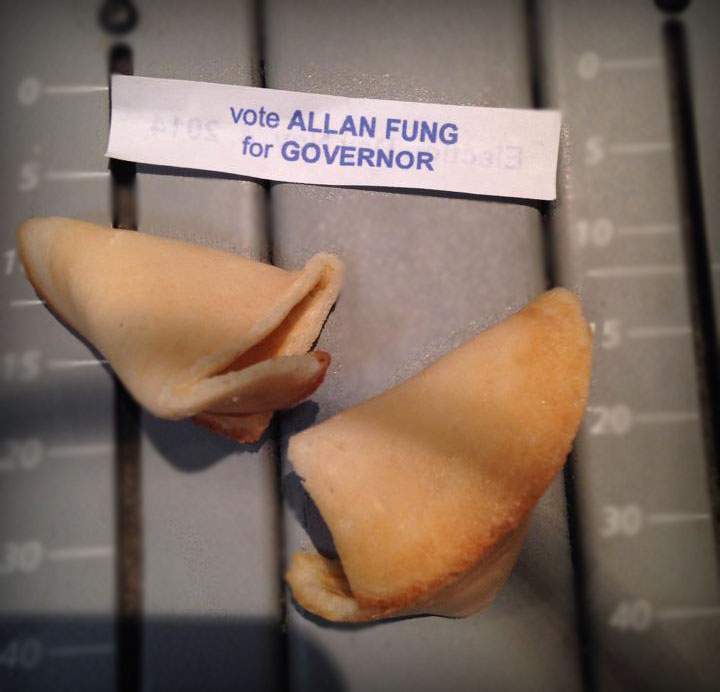
Speaking of desserts: this campaign tactic is worthy of note. A loyal Rhode Island reader inquires if I have any ethical problems with the campaign of Allen Fung, the Chinese-American GOP candidate in the closely contested Rhode Island governor’s race, delivering thousands of fortune cookies to Rhode Island Chinese restaurants that look like this when you open them

fortune-cookie-fung

So your Ethics Alarms Pre-Election Ethics Quiz is the question asked of me:

Is there anything unethical about this?

Continue reading

When Ethical Causes Are Pursued By Unethical Means: The Anthony Porter-Alstory Simon Mess

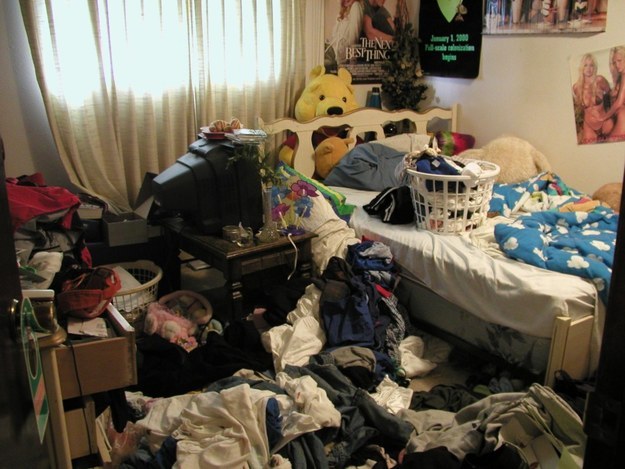
What does this picture have in common with the Alstory Simon case and the Illinois criminal justice system? Read on...

What does this picture have in common with the Alstory Simon case and the Illinois criminal justice system? Read on…

All Americans owe a debt to the many non-profit organizations across the country dedicated to freeing innocent prisoners, some of them sentenced to die, who were wrongly prosecuted and convicted as a result of breakdowns in the justice system or prosecutorial corruption. Their work has served as an invaluable fail-safe, it has focused attention on needed reforms, and it has rescued innocent lives before they were completely destroyed. As a reminder of the corruptive power of good intentions, however, the recent release of a convicted murderer put in prison by one of these organizations serves as an ethics cautionary tale. Apparently one such “innocence project” believed that it was worth sending an innocent man to prison for a murder he did not commit in order to save the man originally convicted of the crime from execution.

In 1998,* Illinois death row inmate Anthony Porter, convicted in the 1982 murders of Marilyn Green and Jerry Hillard, was apparently proven innocent 48 hours before his scheduled execution. A Northwestern University professor and his students working with the Medill Innocence Project had obtained a videotaped confession by a man named Alstory Simon, admitting that he, not Porter, was the real killer. Porter was ultimately released, in 1999.

The governor of Illinois at the time, George Ryan, a longtime supporter of the death penalty, claimed that he was so shocked by the near fatal miscarriage of justice that he halted all executions less than a year after Porter’s exoneration. Eventually he commuted the sentences of every prisoner on death row, saying the state’s capital punishment system  could not be trusted. The Simon confession leading to Porter’s exoneration drove the shift in public opinion that caused the Illinois death penalty’s demise in 2011.

Happy ending? Not exactly. In 2005, witnesses who implicated Simon announced that they had fabricated their stories in exchange for money and a promise by the Northwestern professor, David Protess, that he would work to free two incarcerated relatives of one of the witnesses. Then Alstory Simon recanted his confession, saying that he had been persuaded by a faked videotape of witnesses implicating him in the crime, and promises of a short prison sentence and a movie deal if he confessed to a crime he didn’t commit. Last week, an Illinois judge ordered Simon released from prison after  prosecutors agreed that he was probably not guilty. He had spent almost 15 years in prison. Continue reading

Comment of the Day on… Oh, Never Mind, It Had Nothing To Do With The Original Post Anyway

Make Believe sign

This mind-blowing comment by the one-hit wonder “bubbabru” struck me as uniquely appropriate as we head into next week’s elections. I apparently set him off by my response to a commenter expressing wonderment at the defenses being offered by supporters of an animal abusing and crooked veterinarian. She wrote, ” I can’t even figure out the kind of mindset that requires pooh-poohing such overwhelming evidence of someone who is, at the very least, a depraved and wicked person.” I responded,

“Why do people still claim Michael Jackson was pure as the driven snow? Why do people still say Nixon was hounded from office, or that Clinton was a victim? Why does anyone say that JFK was a great man? Why is anyone fooled by Hillary? Why do people still insist that Obama is a brilliant, honest, skilled leader? Why do people still think the Rosenbergs were innocent? It’s self-delusion, because people fight to hold on to their illusions, and resent those who try to point out the horrible truth, especially when it makes them feel like dupes.

This relatively bi-partisan list of delusions unwittingly triggered the vomiting up of the Angry Left talking points, lies and mythology that follow. Is this what the “base” of a major party is like? (I assume that there is a polar version, equally unhinged, fact-resistant and hateful,  for Republicans.) If so, one can only diagnose being part of a base as akin to being a member of a cult. For any responsible politician to intentionally nurture and try to profit from this kind of disability is not only antidemocratic, it approaches evil. How many American are mired in the hyper-partisan hate fantasies illustrated by this Comment of the Day? Can they be saved?

I worry about the answers to those questions, and a third: how can we stop this crippling contagion from spreading? Here is the Comment of the Day. Res ipsa loquitur: Continue reading

The Free Range Mom, Bias, and the Perils Of Blind Loyalty

About  the blind leading the blind---not only is it dangerous, it looks ridiculous to those who can see.

About the blind leading the blind—not only is it dangerous, it looks ridiculous to those who can see.

One of my favorite bloggers just fell into the blind loyalty trap. I’m sympathetic, but this is something that those who accept the responsibility of  teaching us important lessons and clarifying difficult issues must avoid at all costs. Bias makes us stupid, and blind loyalty breeds bias like carrion breeds maggots. It pains me to see Lenore Skenazy, author of the Free Range Kids blog, undermine her credibility like this.

She titled her post Horrible Editorial Chides Mom for Not Predicting Unpredictable Crime. In it, she takes the side of a mother who left her four-year-old son in an unlocked, running van while she picked up her daughter at a northeast school. Someone was drove her van off with her son in it, and subsequently crashed. The boy was unhurt. Under the circumstances, there is nothing horrible about the editorial, which uses the incident—even Skenazy agrees that the mother’s conduct was “dumb”—to caution parents about leaving children in cars. This is the editorial that aroused Skenazy to defend the indefensible:

“A Calgary mom has no doubt learned her lesson. The woman recently left her four-year-old son in her unlocked, running van while she picked up her daughter at a northeast school. The mother said she was gone about six minutes, and when she came out, someone was stealing her van with her son in it.

Fortunately, the incident ended well, with the child unhurt after the thief crashed the van, and the suspect was taken into custody.…charges of child endangerment need to be pressed to set an example, because no matter how often these types of things occur, other parents continue to leave their kids in similar situations. It takes just a few minutes to get your child out of a vehicle and bring him or her along with you on whatever errand needs running. Sure, it’s more convenient just to leave a child in the car and do the errand, unencumbered. However, child safety should trump inconvenience every time. Better a few extra minutes lost bundling a little one in and out of a vehicle than a lifetime of regret and what-ifs.”

The rationalizations in Skenazy’s defense begin with the title of her post, which is dishonest and in her own words, “dumb.” She is using moral luck as a defense, arguing that the sequence of events as they unfolded were merely unfortunate, and the mother just as easily could have returned to her van and car with nothing amiss. The odds favor nothing bad happening in six minutes; on the other hand, the odds of nothing bad happening are much better if a child isn’t in an unlocked vehicle with the engine running at all. Continue reading

The Bill Maher Ethical Conundrum

Wits

“One of these things is not like the other…”


The Bill Maher Ethics Conundrum is not what you probably think it is.

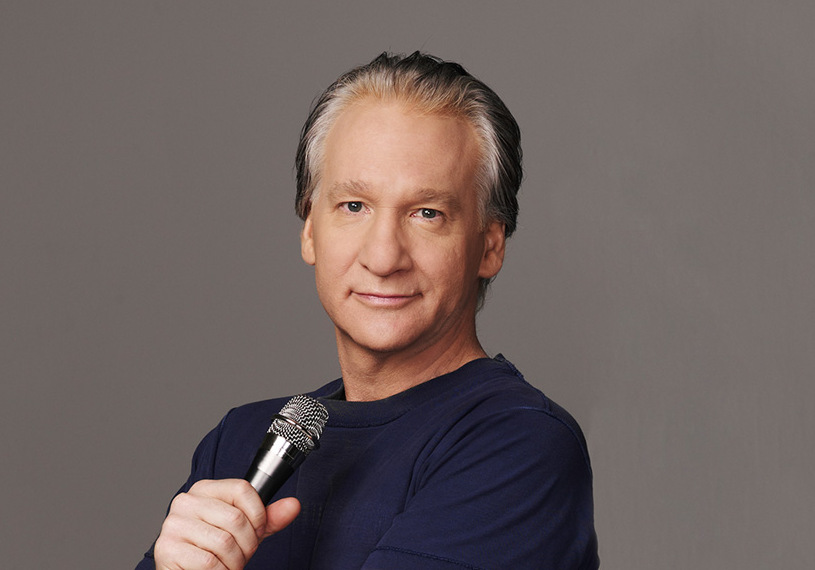
Maher, the alleged comic and anti-conservative scold who hosts an HBO program, was chosen by a student committee to be the  commencement speaker for the University of California-Berkeley’s December graduation. This was a lazy, embarrassingly juvenile and politically-loaded selection, but Maher had also just recently used his show to join fellow atheist and neuroscientist Sam Harris in a condemnation of Islam, calling it  “the only religion that acts like the mafia that will fucking kill you if you say the wrong thing, draw the wrong picture or write the wrong book.” Later on Maher nodded approvingly  as Harris also called Islam”the mother lode of bad ideas.”

This caused Muslim students at Berkeley to prove Maher correct about their religion’s entrenched intolerance of opposition, and they have been joined by other political correctness censors in the student body—there are a lot of them—to demand that the university rescind Maher’s invitation because of his “hate speech.”A  Change.org petition—-now THAT site is the real mother lode of bad ideas—now urges students to boycott the decision and asks the campus to stop him from speaking. It has gathered more than 1,400 signatures. The committee that chose Maher, naturally, backed down, but the University, so far at least, is sticking to its decision to invite him.

Yes, yes, universities ought to be marketplaces of ideas where all views are welcome, and yes, it is hypocritical and offends the traditions of liberal education to stop Maher from stating his views on Islam, or re-telling “The Aristocrats,” or making a fool of himself, or whatever he’s going to do because some students or all students disagree with him, just as it was for Rutgers students to force Condolezza Rice into withdrawing after she was invited to speak at Rutgers. The dilemma illustrated by this flap is a classic ethics problem, which I will henceforth call the Bill Maher Conundrum, which has been long debated and never decisively settled:

Is the ethical nature of an act defined by its intent, or by an objective assessment of the act alone without reference to motive? Continue reading

Bravo To Windypundit’s Takedown Of Salon’s Proposed Anti-Democratic “Constitution”

Shredding-the-Constitution

This is a belated salute to an excellent post by the 2014 Ethics Alarms Blogger of the Year, Mark Draughn. I saw the same Salon post he so neatly and ethically eviscerated, and was too busy and too nauseated to flag it here as the piece of progressive fascism that it is. Fortunately. Mark did his duty, and well.

Andrew Burstein is a leftist professors of history at Louisiana State University, and gave Salon a slovenly-written and thought-out essay about what a new U.S. Constitution should look like. He doesn’t approach the topic seriously, but rather engages, as Mark perceptively puts it, in a long ““If I ruled the world” screed that asserts the need for a U.S. Constitution that includes policy micromanagement provisions like teaching foreign languages in first or second grade, eliminating SAT scores, adding counselors and school psychologists to school systems, and closing tax loopholes. His objective is to make progressive policies unalterable by edict. Either Burstein doesn’t know what a Constitution is supposed to do, or he doesn’t care: do NOT send your child to LSU. Continue reading

The GOP’s Favorite Unethical Tactic: Deceptive Mailers

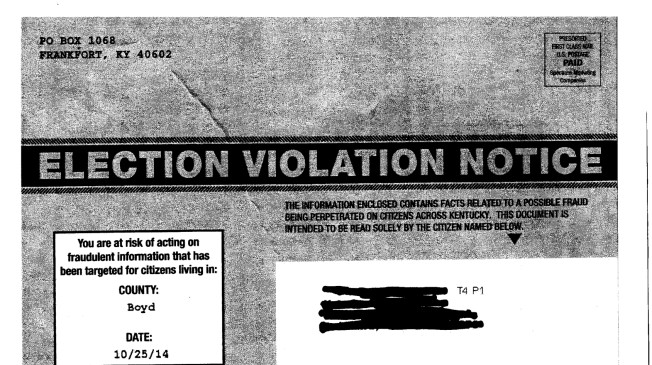
McConnell mailerIt’s not sufficient, apparently, that Senator Mitch McConnell’s (R-Ky) Democratic opponent Allison Grimes has thoroughly disgraced herself (See here and here, and that’s not all, but I didn’t want to pick on her with so many other unethical candidates running under the banner of either political party) and probably squandered any chance she had of unseating the GOP Minority Leader. So  the Republican campaign geniuses decided to attack this not-ready-for-prime-time politician using a tactic out of former Republican Chairman Michael Steele’s playbook. That means unethical, for those of you who didn’t follow Steele’s slimy reign.

In 2010, Steele approved the GOP sending out mailers disguised as official U.S. Census documents twice, the second time after the House of Representatives had rebuked the despicable tactic and voted unanimously to make them illegal. Since then, the GOP has hectored those citizens foolish enough to contribute to a Republican candidate with mailings deceptively designed as renewal notices, as if something would expire if you didn’t send in another check. This is a sleazy method of inducing someone to open junk mail, and it shows how thoroughly mass mailing is dependent on influencing the dim, timid and too forgiving that such dishonestly packaged appeals work. Continue reading

“The Firm” Ethics: Mitch Should Have Known What He Was Getting Into

I was just watching “The Firm” again after many years—my old friend and the terrific actor, the late Bart Whiteman, played “Dutch”—to get the ick of “Cabin Fever 3” out of my head. (It was part of last night’s Halloween triple feature at my house.)

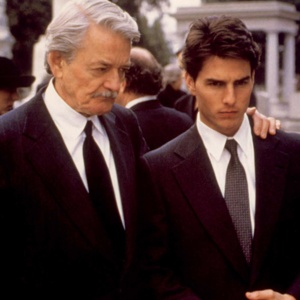
Pay attention, Tom...

Pay attention, Tom…

In an early scene in the film, Harvard Law student Mitch McDeere (Tom Cruise) is being courted by big law firms offering perks and cash. Then a small Memphis firm he never heard of —later, he learns that it is run by the Mob— blows him away with an offer he can’t refuse. The firms partners tell him that they wanted him so much, they bribed the clerk at Harvard’s placement office to learn what salaries the other firms had offered Mitch, then matched it plus 20% more. Tom is impressed, and flattered, and greedy, and takes the offer, even though the firm had openly revealed itself as unethical and proud of it.

He should have seen this as signature significance of a dangerously unethical culture in a profession with high ethical obligations, and walked out the door. A young lawyer with well-maintained ethics alarms would have. Who knows? Maybe this was a test the corrupt firm used to weed out ethical associates.

I always thought Mitch was just unlucky, but in the film, at least, he ended up in a bad firm because an ethics alarm wasn’t working.