On Peter Pan, Pippi Longstocking, And Ethics Of Applying Political Correctness To Art And Literature

Cultural events earlier this month brought to light, on two continents, the problem of maintaining the integrity of art and literature under the onslaught of political correctness.

In Sweden, a controversy has erupted over the re-broadcast of a 1969 television adaptation of the Pippi Longstocking books, the children’s classics authored by Astrid Lindgren. The Swedish national TV station, SVT, announced that it is revising a scene from the 1969 television series about Pippi  which she says her father is “king of the Negroes,”a direct quote from one of the stories. Believe it or not, this has set off a contentious national debate.

The family has approved the station’s  desire to change the TV version, but is keeping the term in future editions of the books. In 2006, the family added a preface explaining that today, the word is considered “offensive,” but that when the books first appeared, “Negro was a common expression for people with black skin who lived in other parts of the world than ours.” That’s a sensible solution. Period and context is important in art and literature: the urge by some to constantly purge the world of any reference, word or attitude in past creations that seem out of place now leads to a form of cultural self-lobotomy. Erik Helmerson, a columnist at Dagens Nyheter, an influential Stockholm newspaper, called the changes a form of censorship. “I’m very sensitive to the fact that people are offended by the N word,” he said in an interview. “I’d never use it myself.” He even called revising the TV series  “a huge interference into freedom of speech.”  “Where do we draw the line? What do we cut and what do we keep? Who should decide? Who needs to be offended before we cut a word?” Continue reading

Here’s A First: Kansas Suspends A Lawyer For Facebook Bullying

It's unethical for a lawyer to play a sad violin over Facebook??? Why yes, it is!

It’s unethical for a lawyer to play a sad violin over Facebook???  Why yes, it is!

Eric Michael Gamble was representing a biological father opposed to the adoption of his daughter, which had been approved by the 18-year-old mother.

After Gamble deposed the young woman, he messaged her on Facebook in a shamelessly manipulative fashion, saying…

‘I wish to offer you some reasons why you should stand up and fight for your daughter. As you know, I am the attorney for [the biological father]. We held your deposition in my office. I wanted to give you the chance to make things right. This may be your last opportunity to be a mom for [the baby]. As I told you after your deposition in my office, it is not too late. You still have a wonderful opportunity to have a real relationship with your daughter if you so choose. I have attached a document for you to consider signing and bringing to court or to my office. It is a revocation of your consent to adopt. If you sign this document there is a very good chance that you will be able to call [the baby] your own and [the baby] will call you her mom. I can’t begin to explain how beautiful and wonderful parenthood is. I have a little girl myself and she is my world just like you are your dad’s world. [The baby] deserves to know her parents. She deserves to know that you love her and care for her as well. Do not let this opportunity pass you by because you will live with this decision the rest of your life and [the baby] will know someday what happened. [The adoptive parents] do not legally have to ever let you see her again after court (although they are probably trying to convince you otherwise with the idea of an ‘open adoption’). The reason why you don’t know about the trial was because they don’t want you there because that doesn’t help [the adoptive parents] case. This is your time to get rid of the guilt and standup and do what is right and what [the baby] deserves. She deserves to have her parents love and care for her. She deserves to know her grandparents and extended family. If she’s adopted, she won’t have that chance. [The biological father] wants to be her dad and to love her. She deserves that. I urge you to print, sign, and notarize this document and bring it to my office before court. Trial is June 27, 2013, at 9:00 a.m. at the Johnson County Courthouse, Division 15. I hope to see you and your father there.’

What’s wrong with this? The legal ethics rules protect unrepresented parties in a matter from exactly this sort of pressure. Rule 4.3, in Kansas and elsewhere, prohibits a lawyer from giving advice to adversaries of his or her client, which statements like “This is your time to get rid of the guilt and standup and do what is right and what [the baby] deserves” clearly are. The rules also require lawyers to treat all participants in the justice system with fairness and respect. That message constitutes neither. Rule 4.4 says that “In representing a client, a lawyer shall not use means that have no substantial purpose other than to embarrass, delay, or burden a third person.” Gamble has a defense, of course: his substantial purpose was to have the adoption dropped like his client wanted, but since he wasn’t supposed to be talking to her anyway (other than to advise her to get a lawyer), that wasn’t going to fly. Rule 8.4, meanwhile, says that a lawyer must not “engage in conduct that is prejudicial to the administration of justice.”

After he lost the case, Gamble reported himself for the Rule 4.3 violation. This is usually a good tactic to encourage lenient treatment, but in this case, it didn’t work. In suspending Gamble for six months, the Kansas Supreme Court seemed to invoke all three of the violated rules, as it wrote,

“…As the hearing panel noted, respondent “attempted to manipulate the biological mother and, as a result, interfered with justice.” Respondent’s conduct “amounted to emotional blackmail” of an unrepresented 18-year-old who was dealing with a process that was already “’emotionally exhausting.'” His “electronic message was designed to embarrass, burden, and create guilt in the mind of the biological mother.” These “bullying tactics directly reflect on [respondent’s] fitness to practice law as an attorney.” Consequently, we hold that the respondent should be suspended for a period of 6 months. A minority of the court would impose a longer period of suspension. We unanimously order a reinstatement hearing under Rule 219.”

And the social media claims another victim.

Addendum: I was remiss, in posting this, not noting that the underlying issue in the lawsuit is a far more serious and complex ethical and legal one than the topic of this post: the matter of unwed mothers putting their new borns up for adoption without the father’s consent or participation. That has been a battle royale on Ethics Alarms twice, and you can review it here.

_________________________

Pointer: ABA Journal

Facts: Legal Profession Blog

Smith College President Kathleen McCartney’s Apologizes For Saying “All Lives Matter”: Is There A Problem?

Damned if you do, damned if you don't.

Damned if she does, damned if she doesn’t.

There is a problem, all right, but not the one you might think—at least not this time.

Smith College President Kathleen McCartney attempted to  show support for her students  protesting racism and police brutality by sending a campus-wide email titled, “All Lives Matter.” But the official slogan of such protests is “black lives matter.” McCartney immediately came under fire from black students and others, accusing her of minimizing the specific nature of her concerns. “No, Kathy. Please do not send out an email saying ‘All lives matter.’ This isn’t about everyone, this is about black lives,” Sophia Buchanan, a Smith student, in a typical critique.

The college President apologized several hours later, saying that she hadn’t thought about the fact that “all lives matter” was being used by some as a rebuttal to “black lives matter”:

“I regret that I was unaware the phrase/hashtag ‘all lives matter’ has been used by some to draw attention away from the focus on institutional violence against Black people…. “It minimizes the anti-blackness of this the current situation; yes, all lives matter, but not all lives are being targeted for police brutality. The black students at this school deserve to have their specific struggles and pain recognized, not dissolved into the larger student body.”

That statement put her in the cross-hairs of the “conservative media” and others, who treated it as a full-fledged “gotcha!” What??? Saying that all lives matter is offensive now? What next Orwellian proposition will political correctness bullies demand from spineless college administrators? Continue reading

Ethics Hero: Sen. John McCain

waterboard1

While other Republicans are attacking the Senate report on torture as a political hit piece by Democrats—which, in part, it is, but that doesn’t diminish its significance—the one Senator who has experienced torture is supporting the report’s conclusions and criticism, saying…

I know from personal experience that the abuse of prisoners will produce more bad than good. Most of all, I know the use of torture compromises that which most distinguished us from our enemies.”

Exactly.

My position on this topic is unchanged from what I wrote in 2006, which you can read here.

Ethics Quiz: The Harvard Prof and The Erroneous Chinese Restaurant Menu

Perfect! Just what you need to handle that pesky flea, Professor!

Perfect! Just what you need to handle that pesky flea, Professor!

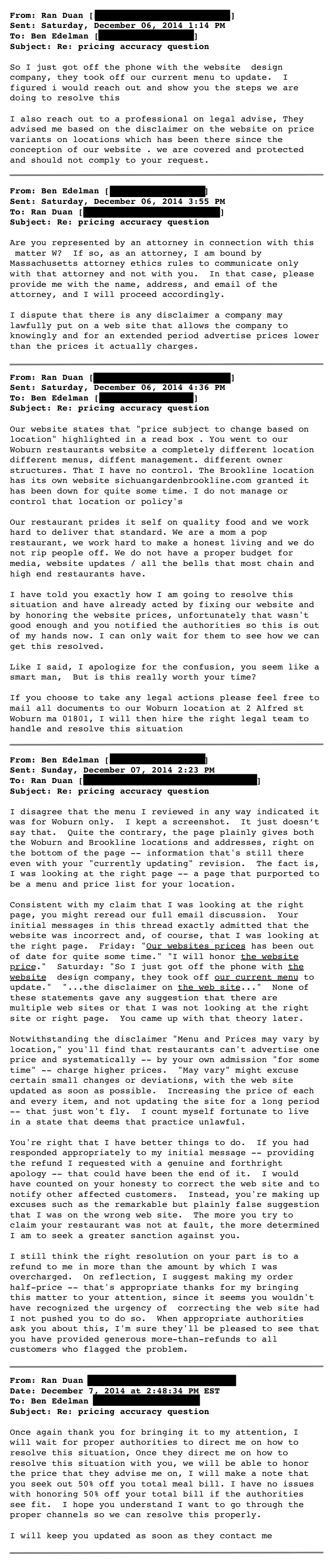
Ben Edelman, a rather well-noted Harvard Business School professor, had this fascinating exchange with a local Szechuan restaurant:

Edelman 1Edelman 2Your Ethics Alarms Ethics Quiz:

“Is Prof. Edelman’s conduct ethical?”

Continue reading

Getting Eaten Alive By A Really Big Snake Ethics: The Rest Of The Story

My guess: Paul tastes like chicken...

My guess: Paul tastes like chicken…

When we left naturalist and filmmaker Paul Rosolie, we were told that he journeyed  to the Amazon, donned a special suit, slathered himself in pigs’ blood, and allowed himself to be swallowed whole by an anaconda on “Eaten Alive,” in a two-hour special produced by  the Discovery Channel that would air December 7.  Rosolie would be removed from the snake by a cord attached to his suit, presumably before he was digested. Animal rights groups and zoologists objected, quite accurately, that this was cruelty to animals for sport.

What did viewers see on December 7? (I’m sorry: my sock drawer desperately needed organizing that day. I’m basing this on published accounts.) Rosolie found an appropriately large and hungry  snake and attracted its attention in the water. The 20-feet long reptile attacked, wrapped around him and then began to constrict. Then the snake started to try to eat the naturalist head first:  Rosolie’s helmet camera provided a lovely shot of  the anaconda’s gaping throat.

At that point, Rosolie did a terrific imitation of Gene Wilder as “Young Frankenstein” after he had himself locked in a room with the Monster with instructions that nobody should let him out no matter how much he begged. (“Let me out! Let me OUT OF HERE!!! GET ME THE HELL OUT OF HERE!!!….Mommy!” ) Rosalie’s team rushed in and pulled him away, disappointing the snake. Continue reading

Signature Significance Verdict: Lena Dunham Is An Awful Human Being

 UPDATED!

Yechh.

Yechh.

If her boasting about abusing her little sister in her memoir wasn’t enough, Lena Dunham’s revealed conduct regarding “Barry” in the same tome rings the signature significance bell. No human being with a sufficient amount of decency would do something like this, even once.

In case you have not followed the latest ethics scandal involving the over-praised creator and star of HBO’s “Girls,” what occurred is this:

In one chapter of Dunham’s memoir “Not That Kind of Girl,” the feminist actress describes as factual an episode of sexual assault or rape that she says she experienced while an undergraduate at Oberlin. Her assailant was a well-known campus “Republican,” she says, a conservative whom she refers to as Barry—without the conventional quotes that would indicate a pseudonym.

There was, as it happens,  a real Oberlin college graduate from the same period named Barry, then well-known as a conservative, which then as now, is a species about as common at Oberlin as velociraptors. Besides his name and campus reputation, Barry fit some of the other details given by Dunham, such as wearing cowboy boots and sporting a flamboyant mustache. Now the 28-year-old man (the same age as Dunham)  is being tarred as a rapist, and has been forced to take down his social media accounts. He has hired a lawyer named Aaron Minc, with the help of donations from GoFundMe to help pay his legal fees, and has promised that any money he receives from the suit exceeding legal fees will go to charities assisting survivors of rape and sexual assault.

Dunham has not had the courage or decency to say anything, to or about Barry. But yesterday Random House did, in an extraordinary statement and admission: Continue reading

Ethics Dunce: George Stevens, Jr.

Abuse of power, abuse of position, disrespect, unfairness and old-fashioned pettiness—these are just some of the ethics fouls the Kennedy Center’s George Stevens, Jr. committed during the 37th Kennedy Center Honors program last night in Washington, D.C.

“Take this job and shove it” is a pleasing anthem of the abused and disaffected in the workforce, but acting on the sentiment is usually a bad idea, and in some cases, like this one, a terrible idea. The Kennedy Center Honors program was Stevens’ baby from its inception nearly two decades ago, a gala honoring the greats of American culture with a star-studded stage show attended by the glitterati of Washington and Hollywood. Through his skill and showmanship—it runs in his family: he is the son of the great Hollywood director George Stevens, who directed “Shane,” among other classics–he had made the annual event an institution. The awards were considered the official confirmation of icon status, and the program was one of the few culture-related presentations remaining that was deemed worthy of a yearly network telecast. Apparently, Stevens felt that he made the Honors what they were, so he had the right to warp it to his own selfish ends.

Kennedy Center Chairman David Rubenstein thanked the audience for its support, and then, in a gesture unchanged from past years, thanked producers George Stevens Jr. This time, however, instead of waving from the audience as in past years, Stevens came on stage and announced that Rubenstein was forcing him out as producer after 37 years. “We accept that this will be our last Honors,” Stevens said. “This is our good night.” It was hardly a spontaneous show of pique, for he had programmed his comments into the teleprompter.

The sour note interrupted the flow of the evening, and cast a pall over the tributes to honorees Lily Tomlin and Sting, which had not yet begun. (The celebrations of the careers of Tom Hanks, ballerina Patricia McBride and soul singer Al Green had been completed.)

Stevens had been engaged in contentious talks with Kennedy Center management, which wanted to move the Honors show in a new direction and sought a fresh creative vision. In a messy split redolent of Jerry Lewis’s divorce from the Annual MS Labor Day Telethon, an aging creator of a cherished tradition was being retired against his will, and felt betrayed.

Jerry Lewis, however, did not crash the telethon to announce his departure.

This kind of petulant and vindictive exit may feel good in the doing, but is always destructive. The victims included the honorees, the audience, and Steven’s own good will and reputation, as well the event itself.  Can this be justified by the momentary satisfaction of telling his foes at the Kennedy Center off, and holding them up for brief, unwanted criticism? Of course not. All this act accomplishes is to make it clear why the leadership of the Kennedy Center concluded that it was time for Stevens to go. This was not the act of a professional nor the act of a gentlemen. It is the act of an egotist, or perhaps that of someone who has stayed too long and through age or complacency forgotten that maxim of both the theater and life, that you always want to leave your audience wanting more.

Comment of the Day on “Comment of the Day on ‘The Perils Of Over-Regulating The Police: A Case Study'”

Robocop

Stephen Mark Pilling contributes the second consecutive Comment of the Day providing perspective on the issue of police militarization, in response to the first. Here is his Comment of the Day to the post (by dragin_dragon, which you should read first if you haven’t yet), Comment of the Day on “The Perils Of Over-Regulating The Police: A Case Study”

When critics speak of the “militarization” of the police, not all are looking at it from the same viewpoint. Some are, of course, sociopathic or are conspiracy theorists. Some have swallowed the loudly flaunted concept that policemen are evil racists, corrupt ward healers in uniform or just about anything heinous, as they represent law as an absolute, not a relative.

There is a rational based distrust, however. Many of us grew up in a time where the police still walked a beat or patrolled his neighborhood in a squad car, armed with nothing more than a revolver. We’re also the product of an old tradition of law enforcement that stems from the British mold. Unlike the continental European system of paramilitary gendarmes, we adapted a system of localized lawmen, run by an elected county sheriff. The metropolitan police department is still a relatively new phenomenon, started in late 19th Century London.

To many citizens, police who are unaccountable to a directly elected chief and who sport automatic weapons strike a sour note. But recently, people have been seeing them acquiring armored vehicles, military assault training and a tendency to wearing black uniforms. They’ve also noted an increased likelihood of these tactics and weapons being utilized and the increased incidence of “no knock entries”. Likewise, citizens have been imaging police making arrogant idiots out of themselves and caused other cops to become ever more touchy about cell phones, whether they’re right or wrong.

These and other factors have been serving to create a gap between the citizens and the police. That’s never a good thing, of course, because that trust is vital in a free society. Citizen distrust only deepens when they perceive policemen in whom this sense of civil mastery is full blown. As a former military cop, as a private citizen and as a friend or relative of a lot of civilian cops, I’ve seen all this from different angles. I’ve also seen the divide deepen in recent days.

One small note. The funding of police units on all levels directly from federal sources coincides with the worry by many that state and local police units may be more or less within the pocket of federal departments. The actual militarization of once innocuous federal police units and the memory of Obama’s projected National Civilian Defense Force has resulted in fear that this is an intentional part of a program to create an instrument of oppression. For myself, I highly doubt that any street cops would lend themselves to some “martial law” based takeover of the homeland of America. What I’m not sure of, though, is how many in higher authority have not conceived of the notion and would execute it if they could.

Again; it’s vital that the bonds of trust be strengthened between the police departments and those law abiding citizens whom they “serve and protect”. They must never- ever- be heard to make disparaging remarks about “civilians”, as that only deepens the gulf. In the Army Military Police Corps, the official motto is “Of the troops and for the troops”. It’s a good motto. It should also carry over to every local police or sheriff’s department in America. “Of the citizens and for the citizens”. Policemen who embrace that attitude will seldom go wrong. Both they and the communities they serve will benefit.

Continue reading

Comment of the Day on “The Perils Of Over-Regulating The Police: A Case Study”

militarization

ABC News Political Analyst and former Bush advisor Matthew Dowd said on ABC’s This Week  that the recent cases of police violence involving unarmed African Americans were as much due to the militarization of police forces as race.

“We basically dress up officers as if they’re machines,” Dowd said. “And then we expect them to act like human beings. So what happens is, they confuse power with force. Most of the officers in this country do a great job. But when we militarize our police force and dress them up like machines, they act like machines.”

Technically, he was right: there is no evidence that those tragedies were caused by race or militarization. He had exactly no evidence or documentation that the “militarization of police” caused these deaths, or that alleged militarization has caused any deaths. This appears to be emerging conventional wisdom, just one of those things someone says and everyone nods in agreement with no real thought. Why is the so-called “militarization” of police forces such a threat or cause to distrust police? If police are not trustworthy, that’s a reason not to give them fire-power, but having more fire-power doesn’t make them less trustworthy. It simply makes it more important than ever that police be well trained and responsible.

I was preparing a post about this emerging theme as an example of bias, in this case, pre-existing anti-police bias, being translated into false and discourse-warping assumptions by activists and the police when stalwart commenter dragin_dragon delivered this, the Comment of the Day, on the post The Perils of Over-Regulating the Police: A Case Study:

Police departments have been quasi-military for many years, and it has not seemed to hurt their ability to enforce the law. As early as 1974, Austin, Texas P.D. referred to it’s officers on patrol as “the troops”. S.W.A.T. units have traditionally used what they thought of as “Military” weapons, tactics and mode of dress; never mind that a properly trained infantry squad could and would wipe them out in minutes. Note, also, that most states and/or cities ban the mounting of weapons on the surplus (obsolete) armored and tracked vehicles or helicopters. They do NOT ban a man carrying a weapon being mounted on those vehicles. I also point out that many police officers are ex-military so are bringing to the job an environment with which they are already familiar. Rank structures are similar, and the police in the United States, at least, carry weapons, perhaps as a holdover from the Old West, perhaps not.

Given the rise in crime rates (see Chicago, Detroit), many of these escalations of Police equipment and training are needed. This became evident a number of years ago when a Los Angeles bank robbery went south and the robbers began shooting at the converging police with automatic (not the semi-automatic versions described as automatic, but rock-and-roll full automatic) assault weapons. The out-gunned police (9 MM pistols and shotguns) did the best they could and, like Israel, vowed “Never again”. Strangely enough, many in the National Media agreed, at the time. So, what we are referring to as the “Militarization” of the Police is being undertaken for 2 reasons: 1) to provide a higher likelihood that the officers will get to, at the end of the day, go home to family, and 2) so that the public, which they are sworn to protect and defend, will also, at the end of the day, get to go home and family.

Does this increase the likelihood that a perpetrator may not make it to trial? Quite likely. Do I care? Not so much. As I am sure will be pointed out repeatedly, death tends to be relatively final, with no appeal. And, after all, the most dangerous criminal has the right to due process. Unfortunately, crime, violent crime, is not something one does accidentally. It requires a conscious decision, often along with a misplaced almost arrogant sense of invincibility. Getting shot, and probably killed is the most natural consequence in the world of that attitude. Ask Michael Brown. Like it or not he jeopardized the well-being of an armed police officer, apparently arrogantly disregarding the consequences of his behavior and, quite probably putting the officer’s life at risk. I am assuming that Wilson, like many police officers these days, was wearing a very militaristic bullet-proof vest under his shirt, but, since Ferguson is a fairly poor community (and rapidly becoming poorer) possibly not, so he might have been better off if Brown had shot him, first. At least he would still have a job.

All this is by way of saying that militarization of departments is not necessarily a bad thing. The use to which the training and equipment is put may be a bad thing, but I have not seen, in any report, any attempt to oppress or exert Nazi-like control over the citizenry. So, am I in favor of the “Militarization”? You bet. I am in favor of anything that makes it more likely that they will be able to survive the work day. And make no mistake, that is always a question for a police officer, just like it is for the combat soldier. Am I also in favor of more and better training? Also, you bet. Need I repeat? And the management, or “command” element of the police need to be taught How and When to use the equipment and training.

Continue reading