KABOOM! A Teacher Sexually Molests A Middle School Student In Class (And The Daily Caller Thinks It’s Funny)

Well, there goes THAT suit...

Well, there goes THAT suit…

The latest KABOOM occurred when I read this report about Felicia Smith, a Houston 40-something middle school sexual predator masquerading as a teacher, who gave a a male student a lap dance in class, in front of his classmates, for his birthday.

I’m not going to reprint the details here; there are not levels of inappropriate lap dances for pre-teens. The teacher is under arrest; that’s not enough. A school that vets its teachers this negligently is a menace; a profession that allows a practitioner with such wretched judgement and such vile proclivities in its ranks is innately untrustworthy and an ugly sham. And a society that entrusts its vulnerable young to a system so corrupt and inept that this could occur is irresponsible.

One young  maniac attacks a school in New Town, and a national movement of fear is launched to remove a Constitutional right. Teachers sexually assault students nearly every day. What are schools doing about it? What are teacher unions and the education profession doing to protect potential victims? Where is the oversight? Does anyone believe that until she turned into a middle school stripper, Smith never demonstrated any suspicious tendencies? She just awoke one morning and decided that this was the day to give a child a lap dance? I don’t. Continue reading

Comment of the Day: “Ethics Quiz: Peeps Ethics”

Peeps Last Supper by Leonardo DiPeepchi

Peeps Last Supper by Leonardo DiPeepchi

Extradimensional Cephalopod’s thoughtful answer to today’s ethics quiz was instantly recognizable as a Comment of the Day, so here it is, EC’s musings on the ethical limits on peeps art, as posed by the post, Ethics Quiz: Peeps Ethics:

Full disclosure: I identify as a freethinker, which in my case means my opinions are informed by this idea: “It is the mark of an educated mind to be able to entertain a thought without accepting it.” –Aristotle (or so the Internet tells me)

With that in mind, offhand I’d say anyone who can’t handle the juxtaposition of a serious scene with a cutesy or comical medium is not emotionally mature enough to be trusted to react appropriately in today’s complex and nuanced culture, and their reverence is likely to be taken to unhealthy levels. I think it is not only ethical, but a requirement for intellectual health to be able to entertain different perspectives and styles of presenting even the most serious subjects. Before someone asks, yes, that includes depictions of the prophet Muhammad, along with all other historical figures on pedestals. I think taboos are unhealthy for a society because they limit critical thinking and creative free thought, both of which are necessary (yet seldom employed) to resolve social issues and differences in perspective.

Bad taste is still a valid concept, but it is context-dependent. It is possible that a subject is not appropriate for most contexts because it leads people to feel bad, but it is imperative that there be some place where it can be discussed, even if it is only under the Jester’s Privilege. My subjective judgment rules that depicting the Civil Rights Movement with marshmallows in this case is not intended with disrespect: the contest stipulated that the medium be marshmallows, and the artist chose a powerful scene without regard for the medium, as is the artist’s prerogative. I personally think the marshmallow scene is quite dignified, but then I am a bit out of sync with humanity as to what I take at face value and what I don’t. I form opinions of peeps by their actions, not by their countenance. It’s unethical for an artist to deliberately spread misconceptions about history, and it may be unethical for an artist to deliberately show disrespect to powerful agents of good. Disrespect is usually unethical because it causes so many problems. However, I’m not sure a sincerely respectful artist can be unethical in their art, unless they simply fail to do the research on the facts they depict and the cultural context for showing respect.

If depicting scenes from the Civil Rights Movement with marshmallows (and putting a good deal of effort into it) is wrong, though, what else is wrong? Crayon drawings by kids? Macaroni? Charcoal? Embroidery? Spray paint? Etch-A-Sketch? Is anything that looks insufficiently grandiose for depicting humanity’s legendary heroes an affront upon their memories? Are scenes of historical importance off-limits to mediocre artists, for fear the general public will lose respect for heroes drawn with funny expressions and ridiculous poses? What if an artist is deliberately depicting a heroic person comically, but without telling lies? Why can’t we be mature, and tell the history with respect while artists do their best in sincerity or spite? Why not simply say, “Well, it’s nice, but it really doesn’t do it justice,” and walk away?

Continue reading

Strict Liability For Biases and the Racist NBA Team Owner Principle

Keep the lock secure, and all the bad stuff inside might not matter...

Keep the lock secure, and all the bad stuff inside might not matter…

I had an unusual  roommate in law school, a former Marine, smart, handsome and charismatic. Let’s call him “Carl.”

He was also a racist, and unapologetic about it. He was an anti-Semite too. After Carl died at the age of 27 in a freak accident, his funeral was attended by several Jewish and African-American law students who considered my roommate a good friend. They had no idea that he was prejudiced, because my friend treated everyone with fairness and respect, at least in my experience. I would ask Carl about this, and he would express surprise that I would be confused at his behavior. “I would never treat anyone with disrespect, no matter who he or she was, or unfairly either,” he said. “That would be wrong, and not Christian.” (He was a Roman Catholic.) Carl also gave annual contributions to the United Negro College Fund, and he was far from wealthy.

That was my introduction to the truth, and it is a comforting one, that biases can be overcome if someone has the character and the strength to recognize them as biases. Racism is just a bias, you know; a particularly harmful and strong one, but still a bias. Having a bias, even a strong one, is not unethical, just as thoughts themselves, without more, are not unethical. A bias is an ethics impediment, a condition that makes being ethical more difficult, and for many of us, impossible. My friend was one of the most honorable and ethical people in his conduct that I ever knew. He had a bias, knew that to be an ethical human being he had to overcome it daily, and did.

If, however, his black and Jewish friends had learned about his private arguments with me, they would have been hurt, and could not have remained friends with him. It would simply be a matter of trust….although, in fact, Carl was completely worthy of trust no matter what race or creed you were. But it is impossible, I think to continue to trust anyone once you know that he is prejudiced against your race.

This brings us to the ugly tale of Donald Sterling, owner of the NBA’s Los Angeles Clippers. His girlfriend, who is black, recorded an argument between the two of them in which he reprimanded her for posting photographs of African-American companions. Continue reading

Ethics Quiz: Peeps Ethics

peeps winner

I collect sentences that can safely be said to have never been uttered before in the history of mankind, and encountered one this morning in a letter of complaint to the Washington Post. It read…

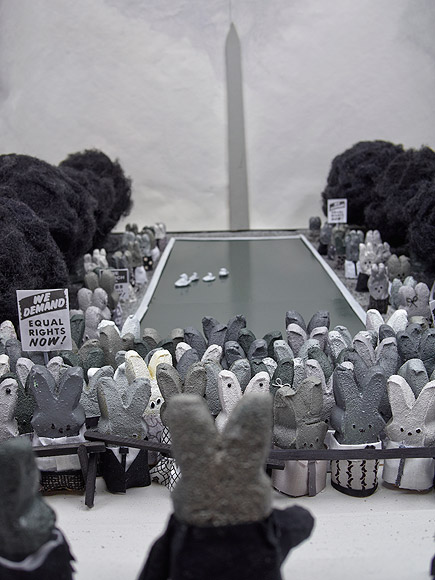
“To take a sacred and historic event in our nation’s history and depict it using marshmallow candy is highly insulting and offensive to the legacy of the Rev. Martin Luther King Jr. and to all those who worked, and continue to work, for racial justice in this country.”

Like all of the sentences in my collection, my favorite being my sister’s immortal, “That fish looks so good, from now on I think I’ll wear my bra on my head,” this one requires some context. The Post holds an annual contest for its readers around Easter, challenging them to submit the best diorama of a scene, using marshmallow peeps. This year’s winner was created by Matthew McFeeley, Mary Clare Peate, and Alex Baker, and involved meticulously painting the colorful bunny stand-ins for King and his throng  at the 1963 March on Washingtonian eight shades of gray to evoke the black-and-white photographs of the event.

Your Ethics Alarms Ethics Quiz, in the sadly neglected field of peeps ethics, is…

Is it unethical to use marshmallow candy as a medium to portray serious, solemn, or other events that many feel deserve respect and reverence?

I know my answer, but this time, I’ll hold my fire until I hear from readers. I’d also be interested in whether any events—Gettysburg…JFK’s assassination…the Lindbergh baby kidnapping…the Crucifixion…Pearl Harbor…9-11…  are ethically off-limits for peeps creativity as inherently offensive, or if this is just  an unappetizing mixture of “ick,” art, humor, and candy.

Ethics Dunce: Justice Sonia Sotamayor

We shouldn't need one of these at the Supreme Court.

We shouldn’t need one of these at the Supreme Court.

Supporters of Justice Sotamayor’s embarrassingly anti-judicial dissent in Schuette v. Coalition to Defend Affirmative, Integration and Immigration and Fight for Equality by Any Means Necessary betray their ignorance of law and worse, their endorsement of double-talk from the one place in our government where it should never be tolerated, the Supreme Court.

It’s not even debatable.

“The way to stop discrimination on the basis of race is to speak openly and candidly on the subject of race,” she wrote,  “and to apply the Constitution with eyes open to the unfortunate effects of centuries of racial discrimination.”  “Speak openly and candidly…”

How does Sotamayor speak openly and candidly?  Like this, from footnote 2 of her dissent…

“Although the term “affirmative action” is commonly used to describe colleges’ and universities’ use of race in crafting admissions policies, I instead use the term “race-sensitive admissions policies.” Some comprehend the term “affirmative action” as connoting intentional preferential treatment based on race alone—for example, the use of a quota system, whereby a certain proportion of seats in an institution’s incoming class must be set aside for racial minorities; the use of a “points” system, whereby an institution accords a fixed numerical advantage to an applicant because of her race; or the admission of otherwise unqualified students to an institution solely on account of their race. None of this is an accurate description of the practices that public universities are permitted to adopt after this Court’s decision in Grutter v. Bollinger, 539 U. S. 306 (2003) . There, we instructed that institutions of higher education could consider race in admissions in only a very limited way in an effort to create a diverse student body. To comport with Grutter, colleges and universities must use race flexibly, id., at 334, and must not maintain a quota, ibid. And even this limited sensitivity to race must be limited in time, id., at 341–343, and must be employed only after “serious, good faith consideration of workable race-neutral alternatives,” id., at 339. Grutter-compliant admissions plans, like the ones in place at Michigan’s institutions, are thus a far cry from affirmative action plans that confer preferential treatment intentionally and solely on the basis of race.”

Oh, look! A new euphemism, which is how partisans, activists, advocates and pols muddy public policy discussions by using carefully crafted words and phrases designed to mislead the public and hide what is going on!

Continue reading

No “Affluenza” Defense Here: A Judge Lowers The Boom On A Teen Predator

"Well, maybe she can be rehabilitated..."

“Well, maybe she can be rehabilitated…”

Perhaps you have read about the horrific bullying case in Southern Maryland, where two teenaged girls victimized an autistic boy who attended their school who thought—indeed still thinks, apparently—that they were his friends. A recent Slate story gives you the flavor of it:

“A teenage boy identified as Michael and described as autistic started writing love letters to a pretty girl at his Southern Maryland high school. They became friends and started hanging out with the girl’s older friend, 17-year-old Lauren Bush, who was a cheerleader. On days when their parents weren’t around—mostly snow days—the girls began to toy with Michael. Bush put a knife to his throat and scared him, kicked him in the groin, dragged him by his hair, and tried to get him to have sex with the family dog. His younger “girlfriend” took video of the incidents on her cellphone. Once they got Michael to walk on a half-frozen pond. He fell through the ice, and they didn’t help him. Then, Sunday’s Post story revealed they didn’t let him ride in the warm car because he’d get the seats wet. Instead, they made him ride in the trunk.”

Nice girls! Continue reading

Wait…WHAT? Something Is Missing From This Ethics Story….

please-move-along-theres-nothing-to-see-here-1

From the Washington Post:

“Homeland Security Secretary Jeh Johnson put the agency’s former inspector general on administrative leave late Thursday, the same day The Washington Post revealed a congressional investigation’s finding that the former watchdog had tailored reports to the liking of senior Obama administration officials. A Senate investigative report concluded that Charles K. Edwards, who served as acting inspector general at the agency from 2011 until this past December, had directed altering and delaying critical investigative reports and audits at the request of top political appointees in the department”

In that story, we learned that  Edwards, who served as acting DHS inspector general from 2011 through 2013, routinely socialized with department leaders and gave them inside information about the timing and findings of investigations.  The objective, which staff members said that Edwards was confident he had in the bag, was White House support for his position to be made permanent. A year-long bipartisan investigation also concluded that Edwards improperly consulted with top political advisers to then-Homeland Security Secretary Janet Napolitano and acquiesced to their suggestions about the wording and timing of his supposedly objective reports. Whistleblowers told the panel that Edwards ordered them to remove derogatory information about the Secret Service in the findings regarding the Service’s prostitution scandal, and also evidence implicating a White House staff member. Other whistleblowers alleged deletions and alterations in other reports by Edwards. Investigators told the Post they were able to confirm the improper deletions and delays in several reports, but did not reach a conclusion on the Secret Service-related allegations because the DHS, which is, as we all know, part of the most transparent administration ever. declined to provide Edwards’s e-mails about the Secret Service incident. Continue reading

Eric Holder Scores A Jumbo

Charging Elephant

Elephant? What Elephant?

I was going to let this pass—I pass up a Holder or Obama ethics topic approximately twice a day, just for, you know, diversity—but it is such a blatant Jumbo, and such an insulting one, that it has to be noted. When it occurred last week, I called up my two Hill contacts who have worked with Holder, and asked how they could square this with their “Trust me, he’s a good guy and a decent lawyer who is just over his head” assessments. Now that assessment is “He’s a good guy who is just over his head, the nasty politics is getting to him, and he’s not thinking straight any more.”

Speaking to Al Sharpton’s National Action Network,  on April 10, Attorney General Holder went off script to say this, in the context of his remarks about civil rights progress during the Obama administration:

“The last five years have been defined by significant strides and by lasting reforms even in the face, even in the face of unprecedented, unwarranted, ugly and divisive adversity. If you don’t believe that, you look at the way — forget about me, forget about me. You look at the way the attorney general of the United States was treated yesterday by a House committee — has nothing to do with me, forget that. What attorney general has ever had to deal with that kind of treatment? What president has ever had to deal with that kind of treatment?”

The comments were widely and correctly interpreted as an accusation of racial bias, which is exactly what they were: Continue reading

Pineda-Pine Tar, Part II: Baseball Clarifies Its Bizarro Ethics Culture

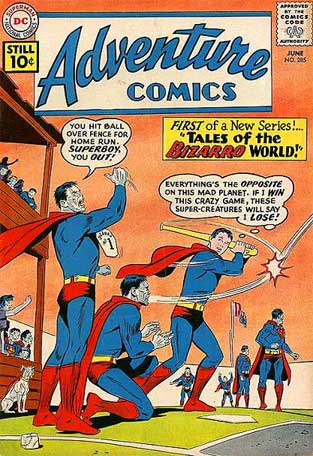
bizarro_world-baseballYou shouldn’t have to appreciate, care about or even understand baseball to find illumination in its latest ethics controversy, which shows how cultures can go horribly wrong, precluding exactly the values that any functioning entity must embrace to remain viable and healthy. For someone like me, to whom Baseball is Life, the whole thing just makes me want to jump out the window.

You will recall that a couple weeks ago, the sport embarrassed itself by making excuses and accepting lies regarding New York Yankees pitcher Michael Pineda being allowed to break the game’s rules against pitchers applying foreign substances (in this case, pine tar) on the baseball while pitching to the Boston Red Sox. I wrote about it here. I interpreted the post-incident consensus of the game and its pundits as “everybody does it, so let’s not make a big deal over a little infraction on a night when it was abnormally cold and hard to grip the ball.”  That’s unethical enough, but the truth, as revealed in Part II, is far worse.

Last night, fate had Pineda on the mound against the Red Sox again. Baseball’s ethics had already begun falling apart in chunks when Sox manager John Farrell, asked about whether he expected Pineda to cheat again (for that is what using pine tar on baseballs is—cheating. Official Rule 8.02 states: “The pitcher shall not apply a foreign substance of any kind to the ball.” ) answered that hopefully, if he did, he would be more discreet about it. Huh?

But Pineda was not discrete; in fact, he could not have been more obvious, or ridiculously so. After a rough first inning in which he gave up two runs, Pineda emerged from the dugout with a large, brown, greasy gob of pine tar on his neck. On TV. In nationally broadcast game. Against the same team that he was caught using pine tar against before. In that team’s home park.

In the Red Sox dugout, Manager Farrell and the team were laughing and rolling their eyes. Farrell finally shrugged, and walked out to complain to the home plate umpire, for it is an automatic ejection for a pitcher to be caught doctoring the ball. The umpire dutifully walked out to the mound—he had to have seen the offending gob before Farrell complained—and to add to the foolishness, checked Pineda’s glove, cap and jock strap before looking at the huge brown smear on his neck. Finally he did so, said, “That’s pine tar!” (in the previous game, Pineda told the press it was “dirt”) and threw him out of the game.

In subsequent interviews with Farrell and others, the explanation that emerged was this gibberish: “everybody” uses something to grip the ball better when it is cold (and often when it isn’t); hitters don’t mind because they don’t want to get hit. Pineda’s offense wasn’t that he used pine tar, but that, as Farrell suggested before the game, that he was “blatant” about it. That gave Farrell no choice, you see….even though his own pitchers also use foreign substances to grip the ball (in unequivocal violation of a baseball rule), and this sets his team up for “retaliation.”

I feel like I’m going crazy. Continue reading

Comment of the Day: “Ethics Quote of the Week: Justice Sonia Sotamayor”

Here is Chris Marchener’s Comment of the Day on the post, “Ethics Quote of the Week: Justice Sonia Sotamayor”: and the ongoing debate it has sparked here:

I am not a lawyer. do not play one on TV, nor did I spend the night in a Holiday Inn Express last night. BUT, my understanding of the decision was that the SCOTUS would not overrule the will of the electorate, who, after reasoned debate on the issue, voted to amend its state constitution to state unequivocally that no person shall be granted a preference based on some genetic characteristic, belief, religion, etc. Isn’t that what we are striving toward? They did not strike down nor address the merits of affirmative action.

I get Jack’s point that Justice Sotamayor’s dissent was not based on Constitutional law and was reflecting her own biases regarding race and gender.

Outside of this decision, there is no doubt that some people in this country have a cultural aversion to people of other races, nationalities, genders, lifestyles, Such aversions apply equally to all genders, races, nationalities etc. on a global scale. In the US. such personal aversions must not be a criterion for employment decisions, educational, or other economic opportunities.

To Mr. Green’s assertion, “You mean racists are the ones who talk about racism? How is that not like blaming the victim? This is a pernicious, evil lie – that the victims of racism are in fact the cause of racism because they have this nasty habit of pointing out the unpleasant fact of racism’s existence” : The evil lie is that racism and gender discrimination remains an institution perpetrated by white males such that all benefits inure to them within the economy of the US. Therefore, such institutional racism must continue to be addressed through the very means that created unequal opportunities in the first place. I have stated in earlier posts that any group that demands perpetual preferential treatment by virtue of race, ethnicity, gender or some other factor is guilty of the same institutional bias that we seek to overcome.

In Justice Sotamayor’s words  “Race also matters because of persistent racial inequality in society…” What does this mean? Does it mean that every race be identical in population size? Does it mean that income distribution within the racial sub-segment reflect the income distribution in the majority demographic? Or, does it mean that everyone has an equal chance based on persistence, education and intellect?

This is same Justice that said, “I would hope that a wise Latina woman with the richness of her experiences would more often than not reach a better conclusion than a white male who hasn’t lived that life,”

Blatant racism if we switched the nouns, And why just white men?

Later she said, “Whether born from experience or inherent physiological or cultural differences,” she said, for jurists who are women and non white, “our gender and national origins may and will make a difference in our judging.” To this I do not disagree. However, the difference does not mean that better decisions will be made just different decisions. If we accept the premise that physiological or cultural differences are acceptable biases in judicial rulings then no culture, race, or national origin is inherently racist. She cannot say that white European physiology or culture is inferior for is she does then the logical conclusion is that all others are cultures and genders are superior to the white European culture which is a racist statement.

She continues, “And race matters for reasons that really are only skin deep, that cannot be discussed any other way, and that cannot be wished away. Race matters to a young man’s view of society when he spends his teenage years watching others tense up as he passes, no matter the neighborhood where he grew up.”

To that I say, Why can’t they be discussed in any other way? I cannot wish away what others think, I can only think for myself. Why do you feel the need to tell me how I think and feel? Why does the young man sense the tension of others when he walks by? Are the passerby’s truly in a state of tension or has such hypersensitivity been planted within him through the rhetoric of those “leaders” who amass great wealth and power rationalizing every perceived slight as evidence of racism. We need to tell children that they can be anything they want provided they work hard in school and apply themselves. If we continually tell them the majority is against them and they have no chance without government protections then they will simply fail to strive for greatness, reinforcing within them the sense that majority society is against them. This is exactly what the self-described champions of racially equality seem to want. If it is not then I challenge them to try alternative tactics to get my support.

However, because there has been past injustice and we feel that we must compensate those affected by such injustice, we must ask who should pay the price for past injustice and for how long. Is evidence of economic disparity the only means to determine evidence of racism; I think not. It takes individual effort and if that effort is not forthcoming then failure to achieve is not evidence of racism. For those that advocate for affirmative action, should only the sons of whites who had the misfortune of being born into lower and middle-income American families bear the burden of reparations? I don’t think that the sons of well-connected whites suffer from being denied employment in favor of a greater, equally, or lesser qualified women or minority candidate as a result of ensuring affirmative action plan goals. Nor do I think that the daughters of many well to do citizens have ever faced any form of discrimination in their lives.

Continue reading