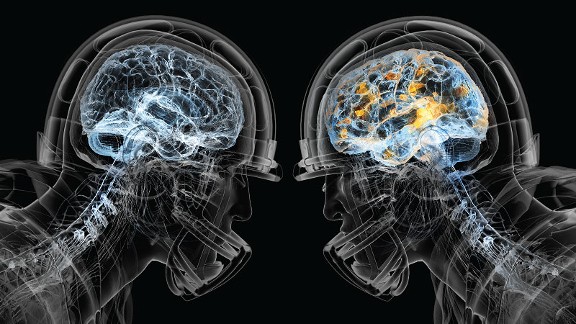
It is indeed strange to call someone an ethics hero for taking reasonable steps to save his own life. In the case of Chris Borland, however, it is appropriate.
Borland, one of the NFL’s top rookies in 2014, announced that he is retiring after just one season he does not want to risk the long-term effects of repetitive head trauma.
Borland, 24, said he made his decision after consulting with concussion researchers, and current and former teammates, as well as researching the relationship between football and neurodegenerative disease.
“I just honestly want to do what’s best for my health,” Borland told ESPN. “From what I’ve researched and what I’ve experienced, I don’t think it’s worth the risk.”
Borland’s a smart man, and thinks to this decision is likely to remain one. He is giving up stardom, celebrity, the game he obviously loves and the promise of millions for his family and his future. Yes, it sounds like an obvious choice. But it is an obvious choice that almost none of the athletes in a position to make it have made, until now. His unexpected decision is sending shock waves around the sports world and especially the National Football League, which should know that it is finally losing ground in its effort to pretend that its sport is all-American fun, and not greed-driven destruction of young lives for profit.
Tom Boswell is not a sportswriter whom I admire or trust, but he has been relentless and accurate on this topic. He writes,
When will the first college with a noticeable football tradition cancel its program as a simple, common-sense concession to medical decency? It’ll happen.
When will the first high school league, perhaps after a spinal cord or concussion-related tragedy, decide that a dozen others sports are enough variety and say, “Football is banned here.” That will happen, too.
Once I would have thought such landmarks were 20 years in the future. But as momentum builds and they’re met more rapidly, how will parents across the United States explain to their friends, their neighbors and even to their own parents that they are allowing their sons to play tackle football?
I think Boswell is right, and that Borland represents a tipping point. I wrote about the unavoidable conclusion that supporting football was unethical when the concussion data first came out, and frequently since. Yes, it’s an exciting game, but it kills people. It kills people. Somehow this has not been sinking in, but when a young man leaves his game, its millions and its glory while he still can play it and excel, attention must be paid, and will.
Borland may have begun footballs long, painful journey along boxing’s road to infamy; he may also have saved the brains of a thousands of children….by saving his own.
 Ethics Alarms
Can they not just design better helmets or something?
No, the best helmet in the world could only prevent your skull from being fractured, it couldn’t prevent your brain from colliding with the inside of your skull (which is what causes concussions).
Along those lines, I’ve wondered whether making guys play without helmets might solve the problem. Back to the future. It would make football more like rugby but guys would be more careful of their heads and noses and teeth, it seems to me. I’m guessing the problem began sometime after WWII with the introduction of hard plastic helmets and face masks which quickly became battering rams. But a friend who played linebacker in HS football and tried to walk on at Stanford said it wouldn’t work because so many football players are macho nuts to begin with. In any event, it would so dramatically change the game and slow it down that it would be no more popular in the US than rugby is. But rugby is terribly popular in most of rest of the world.
But American football has a real problem. I find it hard to watch any more. Dave Duerson was a Notre Dame guy when I was in law school there. Awful to think he was sacrificed for ND’s economic benefit.
might be another instance of risk compensation. I suspect moving to flag football is more likely than completely abandoning the game though.
A nice side effect might be an end to “jock culture” and the looking the other way on bullying it produces. No more would schools be afraid to discipline the football hero who is also a stone cold jerk.
We recently switched our kids to new private schools for the upcoming school year — schools where they will remain for many years. We were lucky and had options We eliminated the most prestigious school to which we were accepted in large part because of its fierce dedication to a very rigorous competitive sports program. Lacrosse, soccer, and football are huge at this school. I didn’t want my kids heading into college with brain injuries. I will note that when I mentioned this criterion to my friends, I was mostly met with blank uncomprehending stares. We have a long way to go I think.
All three sports with serious concussion issues. Good move Beth. Rush Limbaugh has mocked any efforts to make sports safer as “chickification.” This is one of many areas where chickification is an asset.
I’m going to play devil’s advocate. People don’t watch organized chess matches, and the only reason people watch cars drive in circles for hours is the relative likelihood of a crash. We as a species like risk, danger and conflict, and the reason the NFL is as successful as it is is because of the violence. Following that logic it hits me that if the NFL brought in the safety protocols we’re talking about, it is possible that the NFL would become less popular and profitable.
Maybe we’re looking at this the wrong way… The average NFL salary is 1.9 million dollars, and the average tenure is 3.5 years. What would you do for 6.6 million? Maybe “I’m going to increase my likelihood of cranial trauma, and permanently move three rungs up the social ladder.” Is a legitimate life choice, so long as everyone walks in eyes wide open. And maybe there’s room in that business model for the Chris Borlands in that business model… People who like the idea of the money, but are more risk adverse than the person who hangs out longer, wanting to make some quick cash and get out of dodge.
People who work often take their lives into their own hands. Look at the police, the military, crab fishermen, snow road drivers and construction workers. As the risk of injury increases, so does the average salary, and what an NFL player gets paid blows those arguably more dangerous jobs out of the water.
“[W]hat an NFL player gets paid blows those arguably more dangerous jobs out of the water.”
Maybe so, but not what the owners and broadcasters are making.
Is your argument called “The Gladiator Equivalency?” Do we really want to be so much like ancient Rome? Let’s just legalize dog fighting and cock fighting while we’re at it. Would be good for our diversity score. Mexicans love dog and cock fighting. Brilliant. It will add another spice to our culture.
You would be surprised, after expenses, the largest of which is salaries by a mile, some organizations actually lose money. Take the 49ers though, because that’s pertinent. Revenue: $226 mil, Operating Income: $21.0 mil, Player Expenses: $136 mil. So the two owners shared 21 million. That 21 million is a ROI of 2.1% of the initial investment of 995 million that the team is valued at. That’s actually a pretty shit return.
http://www.forbes.com/lists/2010/30/football-valuations-10_San-Francisco-49ers_307075.html
Check my other articles on the issue. The fact that we can pay people to make them ruin their lives doesn’t make it ethical to do so. That’s where the public’s complicity comes in. Society would not—presumably–tolerate professional gladiator games to the death even if the participants were voluntary and handsomely paid. That’s essentially what the NFL is, except that the participants are also gambling that they will not be one of those who actually dies.
What about these other, more necessary dangerous jobs? Cops, firemen, rescue swimmers and copter pilots, test pilots, salvage divers, hazmat techs, all a lot more dangerous than the occasional bon on the head, what is the ethics of doing them. Presumably necessity v. risk?
Those are dangerous jobs that have to be done by somebody for society to survive. Football is not a necessity.
About what I thought, although some folks in my neighborhood might disagree that football isn’t a necessity.
I see that as apples to oranges. We aren’t paying them to kill each other, we’re paying them to play a game, and in the process of playing that game, they sometimes get hurt. Getting hurt is not the win scenario.
Baloney, HP. The cheer for the players to hurt each other, and if death is inevitable as a result of the game, it is disingenuous to argue that they aren’t paying them to kill each other. We are paying the to take a deadly risk that we wouldn’t take our selfe, for our enjoyment. It’s is no different from paying a drunk to fall down the stairs so we can put it on Youtube.
The following 20 sports/recreational activities represent the categories contributing to the highest number of estimated head injuries treated in U.S. hospital emergency rooms in 2009.
Cycling: 85,389
Football: 46,948
Baseball and Softball: 38,394
Basketball: 34,692
Water Sports (Diving, Scuba Diving, Surfing, Swimming, Water Polo, Water Skiing, Water Tubing): 28,716
Powered Recreational Vehicles (ATVs, Dune Buggies, Go-Carts, Mini bikes, Off-road): 26,606
Soccer: 24,184
Skateboards/Scooters: 23,114
Fitness/Exercise/Health Club: 18,012
Winter Sports (Skiing, Sledding, Snowboarding, Snowmobiling): 16,948
Horseback Riding: 14,466
Gymnastics/Dance/Cheerleading: 10,223
Golf: 10,035
Hockey: 8,145
Other Ball Sports and Balls, Unspecified: 6,883
Trampolines: 5,919
Rugby/Lacrosse: 5,794
Roller and Inline Skating: 3,320
Ice Skating: 4,608
I was amused by the golf line.
But my point is: I don’t ascribe that level of malice to the average NFL watcher. Arguing that these head injuries are fatal and that the participants are actively murdering each other while the masses cheer is hyperbole, and you know it.
Source: http://www.aans.org/%20Patient%20Information/Conditionsnd%20Treatments/Sports-Related%20Head%20Injury.aspx
As an aside, you’ve used HP a couple of times before, and I assumed they were typos, but third time has me wondering.
Interesting stats, but useless if not a ratio of “head injuries” to “total number of practitioners of the sport from which the head injuries stat was pulled”.
If Activity X has 100 injuries and Activity Y has 20, you might say, AHA, Activity X is more dangerous….except it turns out Activity X has 10,000 practitioners and Activity Y has 40….
But does the rate really matter? My stance is that as risk increases, compensation should increase to cover that risk, at a rate decided by the risk taker. Jack’s said a few times that these are risks the average person wouldn’t take, and to that I say: Baloney. The reason people aren’t lining up for millions of dollars isn’t because of the risk of concussion, it’s because they don’t have the skill.
Unofficial poll: 6.6 million dollars for brain damage that causes you to lose balance, you probably won’t be able to walk, would you do it?
Given that risk is a two part formula, the first part of which is a measure of probability of occurrence, I would submit that yes, rate does matter in determining risk…
Fair.
Your unofficial poll lacks nuance… How old is the person being offered the money?
What other skills does this person have?
As for analogy, the brain damage does far more than just balance issues…
The person is you. I don’t know if I would. I might. 6.6 million? No student loans, pay off the mortgage? Take an annual trip? For the risk of brain damage? 10 year ago me definitely would have done it.
And I know that brain damage does more than just effect balance, but it’s also a risk as opposed to a certainty.
A younger you? Not my perspective… An older me would dive on the deal much more quickly than a younger me…
I assumed that the proposition was a definite trade off, I assumed imbalance was the only hazard and was guaranteed for the scenario…
If there are still hidden risks in your hypothetical bargain then that changes the calculus.
I’m much better set up now than I was when I was young, and I couldn’t have known at the time that I would end up as blessed as I’ve been. Honestly… for 6.6 mil, I might still do something stupid. But point taken.
And I think you’ve hit my point right on the head. The math is important. The risk reward paradigm is important. And individual tastes will vary. I don’t ascribe the level of malice Jack does to the average viewer, and I don’t think the entertainment industry is so unimportant that we can call it unnecessary.
Which still doesn’t address Jack’s central issue which he has resolved in his mind but is still in debate amongst hyper-libertarians:
How much does willingness to destroy yourself make certain self-destructive conduct ethical?
Is self destructive conduct unethical? Real question. Is smoking unethical?
If we are discussing a truly clean and pure definition of “self destructive” then I don’t know the answer for sure.
If we are discussing self-destructive without actually taking into account what indirect victims there are that make the conduct not exclusively *self* destructive, then yes, plenty of conduct that we currently call “self”destructive is unethical.
Does that include all other revenues? Concessions? Parking? Jersey and hat sales? Tax losses used to apply against other non-football income? So the owners are idiots and their bankers are as well? And they fully disclose their incomes even though they’re private?
“The initial investment the team is valued at?” The DeBartolos paid a billion for the 49ers thirty years ago? I think teams are currently a capital gains play. See, eg., Clippers and Bucks sales.
I haven’t brushed up on my “football economics”, but I know the licensed merchandise category for all 32 teams is a line item that goes to the central “NFL Trade Org” and then is cut evenly 32 ways for each team. So, each team contributes *something* to the pie, and each team walks away with an equal share of the pie. As a non-profit, the central NFL Trade Org has to spend all the money they take in or distribute to the for-profit teams they serve.
The rest of your questions I haven’t a clue.
I don’t completely disagree with you, and would very much like to see some more clear and unbiased data before I make up my mind one way or the other. I do note, however, that you speak as though signing a contract for the NFL=automatic and unavoidable brain injury=death.
I also see potential loss with the disappearance of the game. Loss of opportunity for those who love the sport, and for those who are skilled enough to make money at it. Loss of the chance for active youngsters to learn teamwork, strategy, and that fraternal bond. Loss of an outlet for physical competition. Boxing was a violent, gladiator-like sport as well, and its’ fading from the spotlight may have been a boon to society. At the same time, however, the practice and discipline which surrounded the sport being lost as well is not such a boon, I think. Even the gladiators well back in the day – they were not all slaves. Many were quite wealthy and famous, and I imagine there were likely those who reveled in the risk of combat.
In these times where recess is being cut from schools (so that children might better learn to fill in the little bubbles correctly, but I digress) and society grows ever more risk-averse; where the need to protect people from just one more hazard grows and grows; It may be that the money is too good, the NFL too big, the dangers too hidden and secretive – that it needs to be talked about and the rugs pulled back that we may see what has been swept beneath them. But there’s a lot in play here, and I wonder.