Announcement: The Winner Of The “Take Down Monica Brennan!” Contest Is…

With a third of the vote, texagg04 lapped the tough competition. He will receive an ethics movie classic of my choosing as his prize.

Congratulations to Tex, and to all the competitors. I hope Monica was following closely, and that she learned something. I doubt it: I’m sure she is cheering the news that there is agreement on the basic terms of a deal to keep Iran from getting a nuclear bomb and wiping Israel off the face of the earth, which, according to Monica and Christiane Amanpour, is all a bluff anyway. Besides, Iran knows what happened to Assad when he crossed Obama’s “red line,” so it as absurd for Israel or anyone else to think that it doesn’t intend to keep its word.

This was certainly encouraging: hours after the administration announced the good news about the deal, Iran accused the U.S. of lying about it.

But I digress. Thanks to everyone who voted.


First Lady Ethics: Sorry, Michelle Obama Fans, But This Is Way Over The Line

I was silent the first time this happened, because I was trying to provide the benefit of the doubt with an assumption that the First Lady would realize why it was inappropriate. I was wrong.

I can predict the “Get off my lawn!” retorts, the “Things have changed!” excuses and the “Lighten up!” deflections already, but this has to be said. The leadership of the free world and the office of the Presidency of the United States demands the assumption and maintenance of a basic measure of dignity, decorum, prudence and restraint. I realize the erosion of these qualities, not just in the White House but in society generally, is ongoing and that this will trigger the usual rationalizations.

Nevertheless, the First Lady represents her husband and his office. She is not a clown, an entertainer, a red carpet celebrity or a comedian’s sidekick, and every time she acts like any of these, no matter how pleasantly or charmingly she does so, it diminishes the prestige of the office and the nation. I don’t want to hear about how a majority of a public that wears tank tops on airplanes and flip-flops to the theater think it’s just wonderful for the First Lady to cavort with Jimmy Fallon in a manner indistinguishable from what we would expect from the latest flavor-of-the-month pop-tart.  Part of her job is modelling conduct for the clueless and unmannerly, and not sinking to their warped conduct of dignified professional conduct.

I am well-aware that this ethics verdict will be mocked. Never mind. I’m right.

Back to rationalizations: I’m expecting at least 17 of them from the Ethics Alarms list. None justify Michelle’s televised antics: Continue reading

Tales of the Indiana State Legislature: “Your Baby Is A Racist!”

Indiana State Rep. Vanessa Summers. (All right, not really, but I couldn't resist. Read the story and you'll get it.)

Indiana State Rep. Vanessa Summers. (All right, not really, but I couldn’t resist. Read the story and you’ll get it.)

Can it get worse than this? During the debate  in the Indiana House  over the Religious Freedom and Restoration Act,  state Rep. Vanessa Summers, (D-Indianapolis) rose to set a new record in outrageous race-baiting.

“I told [Republican colleague] Jud McMillin I love his son, but he’s scared of me because of my color.”

Responding to a rumble of protest from her assembled colleagues, Summers insisted, “It’s true.” When challenged on the assertion later. she defended her accusation, saying:

“He (the eighteen-month-old child) looked at me like I was a monster and turned around and cried. And I told him (McMillin) you need to introduce your child to some people that are dark-skinned so he will not be scared.”

There are so many take-aways from this episode that it’s difficult to know where to begin, or where to stop.

Continue reading

Ethics Over Compliance: The Dutch Banker’s Oath

bankers oath

“Professional ethics” is a never-ending battle between compliance and ethics, between rules and penalties on one side, and principles and values on the other. Compliance is easier: all you do is tell people with rules and regulations what they must or can’t do, and promise that there will be consequences if those rules are violated. For ethics to work, people actually have to understand ethical values and be committed to living by them in a professional context.

Compliance has little to do with ethics. Jack the Ripper will follow rules if they are clear, if he knows he’ll get caught if he violates them, and if the punishment when he does will be  harsh enough. That won’t make him ethical. In fact, compliance–rules-based professional conduct control—is often antithetical to ethics. Rules and laws are merely a challenge to the type that Oliver Wendell Holmes called “The Bad Man”-–which includes bad women—to find ways to do things that are wrong but that avoid violating rules sufficiently to justify punishment.  This is why most compliance codes have language in their introductions noting that it’s impossible to make a code that will cover every wrong someone can think of, so ethics are important too.

Pure compliance-based systems don’t improve ethical conduct. The financial collapse in 2008 was largely caused by financial manipulators operating in the grey areas of the rules and laws—that’s why so few of them could be prosecuted. In politics, The compliance mindset is extremely convenient for clever liars and cheats like the Clintons, which is why Hillary could try to explain her e-mail shenanigans by saying that “I fully complied with every rule I was governed by (heh-heh-heh!).” Unethical people will always find ways to get around rules. Ethical people, in contrast, barely need rules at all.

Another benefit of ethics over compliance is that ethics rules–compliance codes—have to be long and detailed, otherwise it’s too easy for Clinton-types to find loopholes, though they usually will find some anyway. Ethical values, on the other hand, can be stated very simply. An ethical employer thinks, “Hmm, that intern is cute, but I am married and have duties of loyalty and honesty to my wife and family, and it would be an abuse of power and influence as well as irresponsible for me as a leader to have an affair with someone under my supervision in the organization.” The Bad Man thinks, “Wow, she’s hot; my wife won’t care as long as I’m not caught; getting a hummer isn’t considered sex where I come from, and there’s nothing that says a President can’t fool around!” For the former, “A leader should not have sex with subordinates” is clear as a bell; his values tell him why. The latter, though, is thinking, “Hmmm. How can I get around this? That rule says “should” but not “shall”— that’s good. No punishment is specified. Sounds like more of a guideline than a rule. “Sex”—that must mean sexual intercourse: great! Lots of wiggle room there. And “subordinate”—is an intern really a subordinate? And I bet I could argue that this is personal, not official conduct. All good…now where’s that cigar?

Invoking ethics rather than compliance is a new oath required by the Dutch Bankers Association. It could be printed on a postcard, and if a banker is ethical, it is all he or she needs:

I swear within the boundaries of the position that I hold in the banking sector…

…that I will perform my duties with integrity and care;

…that I will carefully balance all the interests involved in the enterprise, namely those of customers, shareholders, employees and the society in which the bank operates;

…that in this balancing, I will put the interests of the customer first;

…that I will behave in accordance with the laws, regulations and codes of conduct that apply to me;

…that I will keep the secrets entrusted to me;

…that I will make no misuse of my banking knowledge;

…that I will be open and transparent, and am aware of my responsibility to society;

…that I will endeavor to maintain and promote confidence in the banking system.

So truly help me God.

And if a banker isn’t ethical,

it won’t matter anyway.

__________________________

Pointer: Legal Ethics Forum

Sources: Bloomberg, The Conglomerate

Graphic: Bloomberg

Ethics Dunce: Tucker Carlson (No, I Mean Seriously, This Guy Is Really, REALLY An Ethics Dunce!!!)

Oh NO!!! Tucker Carlson is trapped by a conflict of interest! I'm coming, Tucker...just hold on! I'M COMING!!!!

Oh NO!!! Tucker Carlson is trapped by a conflict of interest! I’m coming, Tucker…just hold on! I’M COMING!!!!

Tucker Carlson is the founder and publisher of the conservative commentary and news site, The Daily Caller. In this post, I recently discussed Carlson’s ethical obtuseness in pulling a column by a Daily Caller contributor because it criticized Fox News, where Carlson has a gig as a weekend host of the network’s embarrassing happy conservative talk morning news show. I wrote,

The conflicts of interest on display here, the insensitivity to them, and the lack of any pretense of journalistic fairness or integrity is staggering. Carlson has placed The Daily Caller in the same, discredited ethics no-man’s land of Media Matters, Move-on.org, the Daily Kos and other sites that blatantly distort the news and their commentary on it for specific, ideological and personal agendas, and a personal agenda is the most unethical and cynical conflict of all. Carlson likes his Fox paycheck, apparently. Well, then, his ethical obligation is to have an independent journalist edit his website. In the alternative, he needs to refuse to work for Fox unless the network agrees to allow him full reign to say and write what he believes on his website, and to allow others to do so as well.

Apparently Carlson doesn’t read Ethics Alarms—I am shocked and disappointed—and moreover, has the imagination and ethics problem-solving skills of a banana slug.  Mediaite reports that he was discussing his ethics problem with RealClearPolitics, and admitted that he was totally flummoxed about what to do, poor dear:

“I have two rules,” Carlson said, “One is you can’t criticize the families of the people who work here, and the other is you can’t go after Fox” because he works there. Sigh. “Yes, it’s a conflict, for sure…but I don’t know what to do about it.” Continue reading

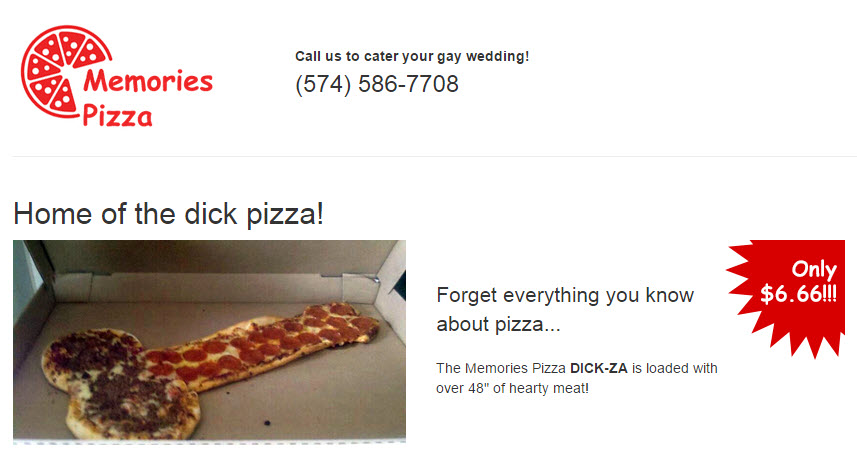
Well-Earned But Wrong: The Parody Website And The Attack On Memories Pizza

Memoriespizza

It is difficult to work up much sympathy for Memories Pizza, the Indiana pizza place that rushed to be known as the first business to announce that it plans on refusing to serve gay customers under the cover of Indiana’s new and poorly thought-out religious freedom law.  Oh, I agree that it was thoughtful of the owners to help show that the law, regardless of the neutral words used, was intended to be a rallying point for anti-gay advocates who want to fight back against what they see as a frightening cultural shift that they don’t understand and can’t accept, but the owners are still, to be blunt, morons.

Announcing that the law would allow them to refuse to cater a gay wedding, they injected their biases into a debate they were neither legally, ethically, morally or intellectually equipped to participate in. Crystal O’Connor, whose family owns the small-town pizzeria, spouted off  that “If a gay couple came in and wanted us to provide pizzas for their wedding, we would have to say no,”  as the national debate over the law was heating up. Well, no, Crystal, you wouldn’t have to, and the law probably wouldn’t protect you if you did. Baking pizza is not the exercise of religion, and nothing in the Bible says “Thou shalt not send pizza to the reception of a wedding you disapprove of.

I just heard one of the law’s supporters from a “family values” group that spends much of its time, words and money attacking homosexuality swear to Chris Cuomo on CNN that the law has nothing whatsoever to do with Indiana embracing anti-gay bigots (and tricking them into thinking that stunts like Crystal’s are acceptable). “It’s about conscience, ” he intoned, without giggling. But the law says nothing about conscience either.It prevents the government from  substantially burdening the exercise of religion. Catering an event, religious or not, is not a religious act, nor is a wedding reception a religious ceremony. It is no more legitimate to say that your conscience forbids you from selling pizza to strangers than it is to say that your conscience forbids you from letting a transsexual into your cab. O’Connor, not surprisingly, doesn’t comprehend the law. Continue reading

A Remorseful Prosecutor Apologizes

Above: Glenn Ford Today. L-Ford in 1983 R-The apologetic prosecutor

Above: Glenn Ford Today. L-Ford in 1983 R-The apologetic prosecutor

Now THIS is a #1 Level apology on the Ethics Alarms Apology Scale.

It’s more than an apology, really: it approaches self-flagellation. The tragic aspect of the confession and apology of former prosecutor  A.M. “Marty” Stroud III,  is that no one can really apologize for what he did, not after 30 years. For Stroud was the lead prosecutor in the December 1984 first-degree murder trial of Glenn Ford, who was convicted and sentenced to death for murdering Isadore Rozeman. Ford was innocent, and was finally released a year ago. His is a classic, horror story of justice derailed. Continue reading

Wasting A Heart

Heart transplant patient

I don’t have a solution to an ethics fiasco like this or know how it could be avoided, but there have to be some lessons buried here somewhere.

In 2013, 15-year-old Anthony Stokes was denied a place on the waiting list for a life-saving heart transplant  at Children’s Healthcare of Atlanta at Egleston because, the hospital explained, he had “a history of noncompliance, which is one of our center’s contraindications to listing for heart transplant.”

This means that doctors doubted that Anthony would take his medicine or go to follow-up appointments. In other words, he was too unreliable and irresponsible to be entrusted with a heart that could save the life of someone else more likely to make good use of it. When a doctor told the family that Anthony’s low grades and time spent in juvenile detention factored into the assessment, however, that gave the family an opening to save the boy’s life. They played the race card. Anthony was being sentenced to death because he was poor and black, and a white patient would naturally be a better risk. The media ran with the narrative, and there was national outrage. Fearing a public relations disaster, the hospital reversed its decision, and Stokes got his heart.

From the Washington Post today:

Tuesday afternoon, [Anthony] Stokes died after a vehicle he was driving jumped a curb, hit a pedestrian and collided with a pole in a car chase with police, according to WSBTV. The pedestrian was hospitalized for her injuries, but Stokes’s car was nearly split in half by the sign, according to the Atlanta Journal-Constitution.

Police said he had to be cut out of the Honda by first responders and rushed to a hospital where he later died…Stokes was driving a car that matched the description of one used by a person suspected of breaking into an elderly woman’s home. The chase began after officers responding to her 911 call attempted to pull Stokes over, according to WXIA.

Pensive and Rueful Observations: Continue reading

The Phenom, The Agent And The Cubbies: 2015’s First Baseball Ethics Controversy

No, I don’t count Pete Rose.

Kris Bryant, whose day will come.

Kris Bryant, whose day will come.

The lesson of the Kris Bryant dispute is that sometimes the result that seems the least fair is also the right one. Bryant, in case you don’t follow baseball or do not live in Chicago, is the hot Chicago Cubs minor leaguer—what used to be called a “phenom” in the old days—who will not be playing third base for the Cubs when the season opens despite everyone’s agreement that he is not just ready for National League, but ready to star in it. Last week, the young man was assigned  to  the Cubs’ Triple-A Iowa farm team.  Cubs fans are upset. Sports pundits are outraged. Bryant’s agent is furious.

What’s going on here?

A lot.

The MLB  collective bargaining agreement, negotiated and signed by both baseball management and the players union, gives teams control over players for six years before a player can enter free agency and sell his talents to the highest bidder. Thus most young players earn a small percentage of their true market value initially, and, if they are good, hit the jackpot after that. (The average salary in Major League Baseball is $4 million a year). There is a catch, however—and an unavoidable loophole. A full season is defined as 172 days, though the season is 180 days. If a young player is left off the roster until there are fewer than 172 days remaining in the regular season, that season doesn’t count as one of the six years; a player can’t become a free agent mid-season six years later. Before the demise of the reserve system that bound a player to one team until the team released or traded him, there was no reason not to promote a promising minor league star to the big team the second it looked like he was ready. Now, there is a big reason: delaying those few games will give the team an extra year of control, since under the rule, 6 years and 171 games is still just six years. That means an extra year of the player at bargain compensation, and possibly an extra year of the player, since he can fly the coop once the clock has run.

This is not a new issue: players and agents have been complaining about teams doing this for years, but the rules allow it. Since the rules allow it, and since the monetary and competitive benefits of waiting those extra nine days can be huge, there is nothing unfair or unethical about a team taking advantage of the provision. Indeed, it would be irresponsible and a breach of management’s fiduciary duties not to save millions and ensure the extra year of a star’s services. What, then, has made Bryant’s case so contentious?

It’s the Cubs, that’s what. Continue reading

Ethical! Funny! But Stupid: Kentucky’s Risible Same-Sex Marriage Ban Defense.

laughing Scotus

Supreme Court justices deserve to have a good laugh now and then.

Michigan, Ohio, Kentucky, and Tennessee are all defending their legislative bans on gay marriage in briefs before the U. S. Supreme Court. Only one of their legal teams came up with—-or had the guts to include—the novel argument contained in the Bluegrass State’s brief, which explains why a ban on gay marriage does not “discriminate on the basis of sexual orientation”:

Kentucky’s marriage laws treat homosexuals and heterosexuals the same and are facially neutral. Men and women, whether heterosexual or homosexual, are free to marry persons of the opposite sex under Kentucky law, and men and women, whether heterosexual or homosexual, cannot marry persons of the same sex under Kentucky law.

This is in the amusing category of arguments that make technical sense in legal terms—well yes, come to think of it, if you look at it that way, you’ve defined discrimination right out of the case!— but no sense whatever in the real world. Gays can’t marry their intended life partner but heterosexuals can; that’s obviously unequal treatment and constitutes discrimination. The defense deceitfully pretends that the whole reason for the emotional controversy doesn’t exist: “Love? What’s that? We know nothing of this thing you call love!”

These come up all the time when legal teams are brainstorming which theories to pursue in an appellate brief, and are virtually always discarded after some general amusement and admiration for the Clintonian who devised it. There is nothing unethical about including a dubious argument along with better ones in a brief, even a Supreme Court brief: consider the position that carried the day in the Obamacare case, when Chief Justice Roberts adopted a rationale for the individual mandate that the Obama Administration had repeatedly rejected and denied. The problem is that such an off-the-wall argument is risky:

1. It pulls time, attention and consideration from more promising arguments.

2. It makes the client look foolish or unserious to the public.

3.  Worse, it might make the client look foolish to the justices.

4. Some justice might react to it as an insult to his or her intelligence.

More than all of that, however,the argument is not going to work. Can you imagine what the reaction would be if the Supreme Court endorsed gay marriage bans relying on that logic? The argument is a non-starter, so including it in the brief sends a loud and clear message that no appellate lawyer ever wants a judge to hear:

“We got nothin’.”