Unbelievable!
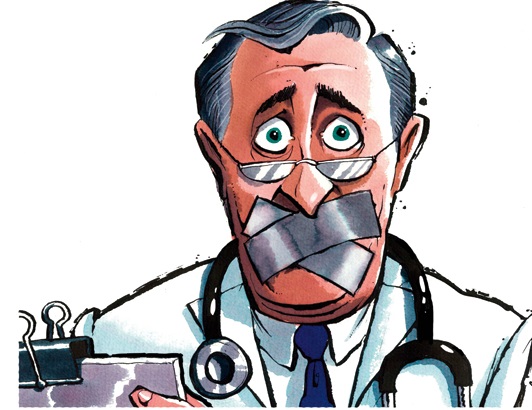
“See doc? That’s what you get for shooting your mouth off! Get it?”
A federal appeals court this week upheld an NRA-crafted Florida law making it illegal for doctors to ask questions and record information about a patient’s gun ownership. Medical groups had challenged the law, arguing that it infringed on doctors’ First Amendment rights.
Which it does. The law is an outrageous incursion on free speech in order to protect gun owners from unwelcome anti-gun lobbying by their physicians.
Among other restrictions, the law says doctors must refrain from asking about gun ownership by patients or family members unless the they believe in “good faith” that the information is relevant to medical care or safety. It also prevent doctors from discriminating against patients or “harassing” them because of owning firearms, which presumably means that it is illegal for a doctor to tell a patient, “You’re too clumsy to own a gun, and if you blow your damn face off, don’t come crying to me.”
“The purpose of the act, as we read it, is not to protect patient privacy by shielding patients from any and all discussion about firearms with their physicians; the act merely requires physicians to refrain from broaching a concededly sensitive topic when they lack any good-faith belief that such information is relevant to the medical care or safety of their patients or others,” said the 2-1 majority opinion, written by Judge Gerald Tjoflat and joined by Judge L. Scott Coogler.
Dissenting Judge Charles Wilson argued that the law violates the First Amendment rights of physicians:
“Simply put, the act is a gag order that prevents doctors from even asking the first question in a conversation about firearms. The act prohibits or significantly chills doctors from expressing their views and providing information to patients about one topic and one topic only, firearms.”
I don’t see how anyone can dispute that analysis. I especially don’t see how the other two judges dispute it.
Doctors shouldn’t use their position of influence to try to impose their political, social and life-style views on patients. If the American Medical Association wants to declare that to be an unethical abuse of a doctor’s status and a patient’s trust, I wouldn’t complain. The law, however, has no more business telling doctors that they can’t advise their patients that owning guns may be bad for their health or their neighbor’s health than it has making it illegal for doctors to tell patients that Donald Trump is just what this country needs in the White House. What’s next, telling dentists that they can’t tell you about their brilliant kids while they’re poking around your mouth?
The state doesn’t have to get involved in what patients and doctors talk about, shouldn’t, and mustn’t. This is a job for ethics, not law. If a doctor won’t stop telling you that the Second Amendment should be repealed, the remedy is easy: tell him to shut up, or you’ll find a new doctor.
Or just shoot him.
Kidding.
_____________________
Pointer: Legal Ethics Forum
 Ethics Alarms
I hate this law (and I’m pro gun-rights) but I heard one remarkable argument for it:
Given the way health information is stored and shared, allowing your doctor to ask about gun ownership would end up in your chart, and then it becomes a de facto gun registry. It sounds a little too conspiracy theorish for my tastes and if that was the case, why not just pass a law preventing that information from going into the health system?
Incursions on free speech have to be as limited as possible. The gun ownership question could easily be prohibited, plus who says you have to answer?
I have been asked about this every time I go to the doctor for the past several years. I assumed it was part of the Obama care protocol. If it isn’t why are they suddenly asking? I spent the first 55 years of my life never having the doctor ask and now I suddenly look like I’ve got a home arsenal?
I note that the ruling cites Piuckup v. Brown, 740 F.3d 1208, 1227–28 (9th Cir. 2013) and King v. Governor of N.J., 767 F.3d 216, 236–37 (3d
Cir. 2014)
I think the issue of the separation between law and ethics is both important and fascinating, and I encourage you to write more about it – you, Jack, are uniquely situated to address it.
With the advent of EMR(electronic medical records) there has already been an unprecedented incursion into the doctor-patient relationship by the government and regulatory agencies. Monthly there are new questions and data points that need to be entered before a provider can proceed to the next task while rooming, rounding on or otherwise caring for a patient. Laws such as Florida’s are likely an anticipatory move to keep the feared, future “mandatory” CMS requirements from forcing doctors/nurses into being accomplices in violating their patients’ second amendment rights. As Alex referred to above, once any bit of information about you is in the EMR it is available for data mining by any and all parties with the tools to search it. A brief perusal of the last few months shows that no database is safe. Unless, of course, we could somehow store our data on Lois Lerner or Hillary Clinton’s servers, then that data, apparently, is irretrievable.
Gunter will be here all week, folks.
I think it’s also worth noting that owning a gun is an inherently risky activity. Taking into account accidents and suicide, the person most likely to shoot you is… you. How can we justify taking away our doctors’ freedom to ask patients if they’re endangering themselves?
I do not wish to speak against the Second Amendment (I fully support the right to bear arms, even big and scary ones) but there’s a reason I don’t own a gun: like so many other people, I am my own worst enemy, and I don’t wish to arm my enemies.
So who appointed the two judges that voted to infringe the first amandment?
What difference does it make?
Maybe ideology plays a part in the decisions that judges make at that level.
Sure. But who appointed them doesn’t determine their ideology.
I am sure that the appointing authority reviews their ideology. I agree that the appointing authority doesn’t determine their ideology but their ideology may determine their suitability to the appointing and confirming authority.
Sure. But judges aren’t supposed to make decisions based on their ideologies, but on the law’s ideologies. And most of the time, the good judges don’t.
I agree that most of the time they don’t. This case might be one of the exceptions.
“If the American Medical Association wants to declare that to be an unethical abuse of a doctor’s status and a patient’s trust, I wouldn’t complain.”
Is AMA is, unfortunately, the likely culprit here. They’ve declared that gun violence “has reached epidemic proportions”:
http://www.ama-assn.org/ama/pub/advocacy/topics/violence-prevention.page
at a time when gun violence has clearly declined either by rates or absolute numbers (depending on the year you begin with). Do we really have to wait for the unethically obtained undercover video that shows med students being indoctrinated in how to scare people into not having guns?
The full text of the law (taken from the court’s opinion):
“3 The full text of the challenged provisions is as follows:
“(1) A health care practitioner licensed under chapter 456 [of the Florida
Statutes] or a health care facility licensed under chapter 395 [of the Florida Statutes] may not intentionally enter any disclosed information concerning firearm ownership into the patient’s medical record if the practitioner knows that such information is not relevant to the patient’s medical care or safety, or the safety of others.
“(2) A health care practitioner licensed under chapter 456 or a health care
facility licensed under chapter 395 shall respect a patient’s right to privacy and should refrain from making a written inquiry or asking questions concerning the ownership of a firearm or ammunition by the patient or by a family member of the patient, or the presence of a firearm in a private home or other domicile of the patient or a family member of the patient. Notwithstanding this provision, a health care practitioner or health care facility that in good faith believes that this information is relevant to the patient’s medical care or safety, or the safety of others, may make such a verbal or written inquiry. . . .”
Keep 1 and strike 2.
The AMA is just like the American Bar Association in this regard. They can’t resist taking political positions that exceed their expertise and charter. It is one reason why I won’t join the ABA.
There are at least five different possibilities for discretion in the quoted sections: “intentionally,” “knows,” “not relevant,” “relevant,” and “in good faith.” A doctor who wants to ask about gun ownership can do so and claim a good faith belief. It could well be that the main impact of the law is to give doctors who don’t want to raise the gun question support against harassment from the medical establishment.
Chills speech. There’s no excuse for it.
I’ve been following this case, mostly from idle curiosity and because I have relatives in Florida. I’ve actually had a physician ask me that question, once. My response, “Why do you need to know?” He said “No reason.” and we went from there.
Same here, except I said, “that’s none of your Goddamn business”. That question really pisses me off, and I do suspect that the wrong answer to that will be used against people some day. The NY SAFE act has already been used as the basis for confiscation, and California is confiscating based on a very loose definition of “mentally ill”, including episodic clinical depression. I’m personally FAR less worried about doctors’ 1st amendment rights in this situation, because once some hapless, unsuspecting patient gives the wrong answer to that, thinking “I’ve got nothing to hide”, there’s no taking it back. He or she loses their 2nd amendment rights, and will likely not get them back.
I should emphasize “less worried”. I’m not saying that protecting the 1st amendment is ever unimportant, but I definitely see a sinister ulterior motive at work here. It’s common knowledge that if you start running your mouth in the presence of a policeman, what you say constitutes a legal statement. This seems like entrapment; a data-mining opportunity, to be used once the anti-gun pricks get their way. Basically, an end-run around not having mandatory registration yet.
Nope. Unless the Doctor is performing this as a free service, then he doesn’t get to ask me questions that I find uncomfortable or that violate my personal privacy. He doesn’t get to record answers to questions that I find objectionable and then share those with Governmental Organizations.
As long as this is a Fee service, I get to set the limits to which I will participate. Government cannot force me to to answer those questions by inserting itself into the Medical equation. He is free to ask me any question he wants, but I’m just as free not to answer. Saying “Government Requires I ask this” is just as unethical as masking that this may be a Government program to identify gun owners.
He is free to ask me any question he wants, but I’m just as free not to answer. Or to tell him to go to Hell. Or to find a new doctor.
Precisely my point. And yours…thank you.
Through Obamacare the Left has successfully politicized medicine, now every trip to the doctor will have to be viewed through a political lens. This isn’t an unintended consequence, this is exactly the outcome the Left wanted.
Now people need to wonder if their Doctor is an agent of the State and whose interests they are really serving. At its most basic elements politics is about patronage and power. What could give politicians more power than control over healthcare. Just wait until politicians start breaking patients into voting blocks. We already have free birth-control voters, I’m sure they will be followed by, hip replacement and diabetes voters.
Yup, exactly.
This is not required by the Affordable Care Act. It is not required by the government. As Jack has stated, you don’t have to answer if your doctor asks you this question. It could be that he is genuinely concerned about your well-being.
Bwahahahaha! Just kidding!
At my pediatrician’s office, information on gun safety is included along with poison info, car seat safety, etc. in a large packet of written materials. I don’t read the poison info as an attack on Clorox bleach — just a gentle reminder to keep it in a locket cabinet. Same is true with guns. People need to get a grip.
No, actually; people DON’T need to “get a grip”. There aren’t vast, concerted, politicized efforts to do away with citizens’ constitutional right to own bleach and poorly-constructed car seats.
Yep.
I love the false comparisons…
Like when someone uses the “We license driving cars and maintain records of drivers, why not guns?” argument…. because there isn’t an entire HALF of the political arena that quietly and passively supports the removal of the right to drive…
But, remember, to Leftists like Beth, gun owners are just idiotic rubes who need an education and to let go of their psycho love of guns.
You’re an idiot. I come from a pro-gun family. I am not anti-gun.
“You’re an idiot.”
Nope.
“I come from a pro-gun family.”
Logically irrelevant.
“I am not anti-gun.”
So says 99% of Leftists I’ve discussed with. Usually followed by the comment, “I just believe in reasonable gun regulations”.
Usually followed by a long list of “reasonable” regulations that are tantamount to banning guns, and when pressed, turns out they really are pretty well anti-gun…
I wonder if gun opponents all realize that there really isn’t a lot of middle ground. If law abiding citizens have access to guns, then there won’t be any way to stop criminals, crazy people and law abiding citizens who suddenly go crazy from getting guns. The only way to stop the conduct that the anti-gun zealots want to stop is to confiscate guns and try prohibition, only with guns. And it will work about as well, because guns are as imbedded in the culture of this country as alcohol was. And the US isn’t England, Sweden or Switzerland. I KNOW gun opponents don’t understand THAT.
I think that many do understand just that, and that with some careful prodding, most will reveal that that is what they would like to see. Remember; “if it can save one child….”
You say that analogy as though guns are a kind of problem equitable to alcohol.
Only in the sense that guns are interwoven with American tradition and cultural norms like alcohol, and thus essentially impossible to extract.
The balance between deficits and benefits is much closer with guns than alcohol. Nothing positive about alcohol use is within miles of the havoc it wreaks on society. Guns are useful and valuable, essential even.
Fair enough.
You are the one with the sweeping generalized statement about me and my gun beliefs — which are incorrect. That makes you an idiot.
Uh-huh. I bet.
Guns kill children. Doctors are just telling us to keep our kids safe — like poison control, vaccine safety, etc. It was one of a million pamphlets I received — and all it said was keep guns out of the reach of children. Are you against that? Do you know how many kids get shot each day because they get their hands on guns?
Not as many as they’d have us believe, unless you count 19-year old “gangstas” as children. They comprise the bulk of these cases.
Joed68,
Here’s some actual data
Click to access innocents-lost.pdf
FROM DECEMBER 2012 TO DECEMBER 2013, AT LEAST
100 CHILDREN WERE KILLED IN UNINTENTIONAL
SHOOTINGS — ALMOST TWO EACH WEEK, 61 PERCENT
HIGHER THAN FEDERAL DATA REFLECT. And even
this larger number reflects just a fraction
of the total number of children injured
or killed with guns in the U.S. each year,
regardless of the intent.
ABOUT TWO-THIRDS OF THESE UNINTENDED DEATHS
— 65 PERCENT — TOOK PLACE IN A HOME OR VEHICLE
THAT BELONGED TO THE VICTIM’S FAMILY, MOST
OFTEN WITH GUNS THAT WERE LEGALLY OWNED BUT
NOT SECURED. Another 19 percent took place in
the home of a relative or friend of the victim.
MORE THAN TWO-THIRDS OF THESE TRAGEDIES COULD
BE AVOIDED IF GUN OWNERS STORED THEIR GUNS
RESPONSIBLY AND PREVENTED CHILDREN FROM
ACCESSING THEM. Of the child shooting deaths
in which there was sufficient information
available to make the determination,
70 percent (62 of 89 cases) could have been
prevented if the firearm had been stored
locked and unloaded. By contrast, incidents
in which an authorized user mishandled
a gun — such as target practice or hunting
accidents — constituted less than thirty
percent of the incidents.
Only in America could we have a constitutional debate about the legality of doctors advising patients on keeping their kids from getting killed.
And to save you the trouble, I too was raised with guns, taught by my grandfathers about responsible gun use; I can’t imagine they would have rejected the added support of the family physician when it came to gun safety – they took it way seriously.
I probably don’t have to tell you that 100 deaths in a year isn’t even a statistical blip, nor do I have to quote hammer-related deaths, and certainly not the 100,000 car deaths, or this:
Over 540,000 Slip-Fall injuries, requiring hospital care, occur in North America each year.
◦ Slip-Falls account for over 300,000 disabling injuries per year in North America.
◦ One in three serious bone breaks for seniors result in death, within one year of the accident.
◦ Slip-Falls account for over 20,000 fatalities per year in North America i.e. 55 persons per day.
◦ It is the second leading cause of accidental death and disability after automobile accidents.
◦ Slips and falls are the number one cause of accidents in the home and workplace 30% of all reported injuries.
◦ Slip-Falls kill more workers than all other combined forms of workplace accidents.
◦ Slip-Falls are the number one cause of accidents in Hotels, Restaurants and Public Buildings; 70% occur in flat and level surfaces.
◦ Slip-Falls are the leading cause of death in the workplace and the source of more than 57% of all disabling injuries.
◦ Slip-Fall accidents account for 30% of all reported injuries.
◦ There are social burdens related to this problem, including Worker’s Compensation claims over $1.8 Billion year – i.e. 40% of all accidents claims paid out. Worker’s Compensation and Liability Insurance Rates are increasing on the average of 30% per year.
◦ The focus should be on prevention, not compensation.
◦ The total expense resulting from slip-fall injuries alone is a $100 million per day problem.
◦ Insurance rates are increasing on average of 30% per year.
◦ Slip falls account for forty per cent of general-liability claims relate to slip and fall.
How many of them do you think were banana-peel related? When will the banana insanity stop? As far as the non-accidental killings; almost all of them are occurring in the inner-cities, and even an outright ban isn’t going to stop that. Here’s the thing: Nobody with a lick of common sense needs to be told to secure firearms in a way that makes it difficult for their kids to kill themselves with them, and if they do, their stupidity is going to do them and their progeny in sooner or later anyway. You’re a concerned physician? Hand out a pamphlet. Otherwise, don’t be sticking your proboscis there. Definitely not there.
Or to be briefer: doctors can’t possibly question patients about all of their hobbies, life-style choices and activities. Do they buckle their seatbelts? Do they wear bicycle helmets? Do they climb on ladders? Do they wear white while jogging? Do they give the finger to drivers who cut them of? Is their husband abusive? Do they drive drunk? Stoned? Tired? Do they speed?
Choosing guns as an area for meddling is political, and an abuse of trust and position.
But they have a constitutional right to do it.
I can’t argue about it being constitutional. It just makes my skin crawl and my hairs stand on end.
I agree with you both by the way about the relative infrequency of the problem (though that kind of death is high on the ‘yuck’ meter). There are indeed much bigger issues; I was mainly commenting on the unique-to-the-US issue of constitutionality of the discussion. That said, you make a good point about the motives.
I should make it clear that I don’t consider the lives of a hundred children a ‘blip’; I hope you get where I’m coming from with that.
I do get where you’re coming from, and agree with your point.
Actually — I do get a lot of questions about seat belt safety, alcohol use in the home, the use of blinds, bumpers in cribs, balloons (yes, balloons — major choking hazard apparently) and helmets. Every year at the annual check-up. The vast majority of these questions are annoying to me because I am a responsible parent, but doctors ask for a reason. There are a lot of stupid parents out there.
Are you asked these questions at your children’s annual check ups or at yours?
Yeah, I hear you, but regardless of good intentions, I bristle when someone starts asking me about what goes on in my home. It smacks of big brotherism, and there’s way too much of that being snuck in under our noses, pretty much everywhere. We’ve got this health insurance last that keeps calling, wanting to come INTO our house to talk about health. I have yet to get an explanation as to why it has to happen in our home.
Under traditional notions of freedom, yes.
But new dimensions of freedom can become apparent to new generations.
That’s what the Constitution is for, though. To limit those “new dimensions’ a.k.a popular censorship.
So the Glucksberg analysis should be restored?
Or to be briefer: doctors can’t possibly question patients about all of their hobbies, life-style choices and activities. Do they buckle their seatbelts? Do they wear bicycle helmets? Do they climb on ladders? Do they wear white while jogging? Do they give the finger to drivers who cut them of? Is their husband abusive? Do they drive drunk? Stoned? Tired? Do they speed?
Choosing guns as an area for meddling is political, and an abuse of trust and position.
But they have a constitutional right to do it.
Now, the American Association of Pediatrics recommends asking children about firearms in their home, At one point, they recommended separating the child from the parents to ask the questions. The pediatrician can then call child services if they don’t like the answer. Half of the members of the AAP feel that all firearms should be removed from a home that has a child in it. The AAP belongs to anti-firearms groups, distorts figures to make firearms seem like a major threat to children. About 100 ‘children’ every year are killed by firearms in the US, so why is this of overriding importance? I put children in quotes because the CDC considers everyone 19 years of age and under to be ‘children’ for this statistic but for drowning (about 700 per year) children are people 14 and under. For some reason, though, the AAP doesn’t suggest asking about pools despite the fact that drowning in pools is the number one cause of death in children aged 0-4. For children 5-14 drowning is the second leading cause of death, after car accident. Oh, the AAP considers everyone 25 and under to be ‘children’ for their gun injury statistics. I assume this includes most of our soldiers wounded in combat. It doesn’t appear that the AAP is really interested in actual hazards to children, they are just against guns.
I see this as an unethical law passed to combat an unethical professional society. I see no way around it as long as we give a monopoly on medicine to groups controlled by organizations like the AMA and the AAP. Oh, the AMA has stating that they are fighting to end firearms ownership in the US. Why should these people be allowed to ask about my legal firearms ownership and then have my children taken away over it. The medical community has a legal monopoly on an essential service. If they are harassing people based on their ideological views and this interferes with this essential service, I don’t see a better option.
Now, if physicians disapproved of same sex relationships and were asking children if their parents were in same sex relationships, would it be OK? If they were harassing the children and parents in such a relationship because they didn’t feel it was a ‘healthy’ environment for the children, would that be OK? If they said it was just informational and they had pamphlets that talked about the ‘damage’ that such relationships did to children, would it be OK? Would you be against a law telling them to ‘knock it off’?
In short, the medical community is not asking this information for any valid medical reason. The medical community is in a position to use this information to harass and damage the families of these children based solely on their choice to own firearms. The pediatrician’s professional society is prodding their members to do this, and this practice may lead to children not receiving medical care because the parents are worried about being reported to child services ( where you are guilty even if you can prove your innocence). It isn’t the best law in the world, but what is the alternative, have ethical physicians?
It isn’t the best law in the world=Rationalization #22.
Congress can’t pass laws against unethical speech. You don’t want to open that Pandora’s Box.
Times can blind. New dimensions of freedom become apparent to new generations,often through perspectives that begin in pleas or protests and then are considered in the political sphere and the judicial process. The nature of injustice is that we may not always see it in our own times. The generations that wrote and ratified the Bill of Rights and the Fourteenth Amendment did not presume to know the extent of freedom in all of its dimensions,and so they entrusted to future generations a charter protecting the right of all persons to enjoy liberty as we learn its meaning.
Under traditional First Amendment analysis, this law would be unconstitutional. But we are no linger bound by historical notions of freedom. This law was passed to address an injustice that we did not see until now.
Sure we did. That injustice is called “people saying things they shouldn’t.”
Amen!
Like!
I was previously unaware of this Florida law. However, I generally agree that the law serves a legitimate purpose. I also agree with the Federal Appeals Court ruling on the law. I do not agree that the doctor’s 1st Amendment rights are infringed in any way by the law or even has anything to do with this law.
I am somewhat surprised at the negative attitude towards this law and the court ruling expressed in this Ethics Alarms post. The First Amendment argument is in my opinion specious… and totally irrelevant. Of course doctors have an unfettered 1st Amendment right to freedom of speech… on their own time and own dime. But not while delivering professional services that I am paying for.
I am guessing that if you were more familiar with the history of certain political and governmental factions trying to contrive the false narrative that “gun ownership is like a disease” or that “guns in society is a national health crisis,” you would not be so cynical towards this law or this Federal Appeals Court ruling. There is a real threat of inappropriate government intrusion and harassment and it should not be taken lightly. The court clearly recognizes this threat.
Having said this, of course, doctors in some cases… mental illness, extreme depression, and injuries due to domestic violence, for examples… have legitimately professional justification to explore with the patient and in certain instances others, the availability of guns to the patient or others who may pose a threat to the patient. Those lines of inquiry, however, have to be a clearly relevant to a specific medical situation being examined, and not the result of some arbitrary blanket policy.
And too, I acknowledge that there is gun violence in America. But it is not a “national health crisis” as some continue to suggested. Gun violence is a result of social dysfunction and criminality. (If guns caused crime, we would see thousands of people killed EVERY DAY and rivers of blood flowing down the streets of every community in America. That is not what is happening.)
Bottom line: No… I do not buy the idea that my doctor or any doctor has a 1st Amendment right to harass a patient about gun ownership or to keep gun related records in the patient’s medical file unless they are clearly relevant to a specific medical situation and especially if those records can somehow be accessed by the government or be hacked from poorly secured computers (which includes most of them).
Thanks.
“Of course doctors have an unfettered 1st Amendment right to freedom of speech… on their own time and own dime. But not while delivering professional services that I am paying for.”
That’s just factually false. How do you find an exception for professional communication in the First Amendment? “Congress shall make no law… abridging the freedom of speech.” Not “private speech”…speech. The reasonable exception you are claiming simply does not exist, nor does any controlling Supreme Court decision hold so. Your position would prohibit an auto mechanic from “harassing” you about the Iran deal.
What about all of the laws that punish employers who ask applicants their age, ethnicity, familial status, or plans to have a family?
Do you consider such laws equally unethical?
-Jut
My view is that a doctor, or auto mechanic for that matter, is not doing his or her job if they are engaged in wasting my time and money talking about things that are irrelevant to the services I seek and need. They are acting unprofessionally, unethically, and in some cases incompetently. The Bill of Rights 1st Amendment, of course does not limit when or under what circumstances an individual may express their opinions… no matter how stupid or irrelevant or even harmful to the interests of others. But in the circumstances we are speaking of, 1st Amendment issue is, in my opinion, specious, irrelevant and subordinate to the bigger concern for privacy (The 4th Amendment), and the fundamental need for professionalism and competency in the delivery of services whether it be medical services or auto mechanic services.
Suppressing speech has nothing to do with privacy, and no one has a reasonable expectation of privacy from the person one is speaking to. The doctor has a right to decide that anything he or she thinks is relevant to health—anything—is worth mentioning. And the right to be completely wrong to do so without the government issuing commands and punishment.
Holy fuck, Jack.
Did you just say no one has a reasonable expectation of privacy from someone you speak with (rhetorical question, as I read your comment)?
Have you heard of the doctor-patient privilege? Attorney-Client? Priest-Penitent? (Those should not be rhetorical questions, but you statement was far too broad.)
-Jut
The commenter was claiming that privacy rights guard you from having doctors inquire about your guns. I wrote, “no one has a reasonable expectation of privacy from the person one is speaking to” That means if you are right goddamn in front of me, I have allowed you to invade my privacy for that time, at least to the extent of seeing want you can see and saying or asking what you say.
I tried to make that clear, obviously failed.Sharing proprietary information is not free speech, any more than sharing classified information is.
Wait. Back-up. Should a patient be able to dictate to a doctor what goes into the EMR? Is that a restriction on speech? (That may be a little different from your question.?
-Jut
It is. Reporting and relaying information is conduct, not speech. Sometimes the lines are thin ones.