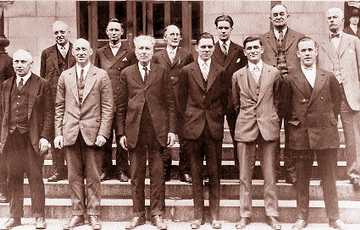
Clarence Darrow, in 1926, On Why Black Lives Matter

The all white Detroit jury that acquitted Dr. Sweet.

The all white Detroit jury that acquitted Dr. Sweet.

When I referred to Clarence Darrow’s support for terrorist John Brown in the previous post, I reviewed other references to the great trial lawyer that have appeared here. (As you may know, I authored a one-man play about Darrow, still performed to legal groups by actor (and my friend) Paul Morella, and with historian Ed Larson compiled selections from Darrow’s writings, court appearances and speeches, The Essential Words and Writings of Clarence Darrow.) I have also posted on his famous Leopold and Loeb argument against capital punishment, but I was shocked to find out that I never posted any part of his closing argument in the murder trial of Dr. Sweet.  I need to remedy that omission now. That courtroom oratory is not only the best of Darrow’s closing arguments, but also the most relevant to current events. It is a masterpiece, and  also astonishingly prescient and wise.

In 1925, Dr. Henry Ossian Sweet, a black man, moved his family into a house in a previously segregated section of Detroit. Mobs of whites gathered outside the house with torches, clubs and guns the first two nights of their residence, as police stood by passively. On the second night, a gunshot coming from the house killed one of the demonstrators, and all 11 residents of the home, including Dr. Sweet, were charged with murder. The National Association for the Advancement of Colored People hired Clarence Darrow to handle the defense.

There were two trials, the first ending in a hung jury. In the second, Darrow performed a seven hour closing argument, aspects of which have inspired homages in “To Kill A Mockingbird” and “A Time to Kill.” Despite the all-white jury, Dr. Sweet was acquitted, and the charges against the others were dropped. Darrow isn’t a legend for nothing.

I have left out the parts of the closing argument that recount the testimony and the facts of the case: you can read about the trials on Doug Linder’s excellent website, and you can read Darrow’s whole closing here. This redacted version focuses on Darrow comments about race and race relations. It is longer than the version we used in the play, but this is the version I would have used if audiences could tolerate a three hour one man show.

I continue to believe that this was the high point of Darrow’s incredible career, and also one of the most impressive—and gutsy—speeches in our history. Only Clarence Darrow would challenge an all-white jury like this in 1925. It is also unbearably moving. Paul, when he performs the selection, ends with tears streaming down his face, as Darrow did. You might too. Try reading it aloud to your kid. Or to yourself.

This post also relates to another recent post, the one about jury nullification. That is really what Darrow is arguing here, in the context of confronting racial injustice and bigotry for the survival of the nation and society. The white victim of the shooting was shot in the back. Darrow, at one point, calls it murder himself. Nonetheless, he argues that acquitting Sweet and his family is the right thing to do, whatever the law says.


Here is my abridged version of the epic closing argument made by Clarence Darrow, May 11, 1926, in defense of Dr. Sweet and his family.

Continue reading

Ethics Hero, Maybe For The Ages: The Center for Medical Progress

As I said with the release of the first surreptitious “sting video” of Planned Parenthood released under auspices of the anti-abortion group, the Center for Medical Progress, such videos are, in principle, unethical. However, while the unethical should be used in pursuit of a greater good only with great reluctance, moral certainty and a minimum of harm, there are instances when utilitarianism must apply.

This is one of them.

In the case of abortion, the prospect of saving the lives of millions of unborn is certainly worth the incursion on the ethical values of honesty and respect for privacy implicated by these videos. Indeed, it is worth a great deal more. With the seventh video, released yesterday, the conclusion is unavoidable that we, the public, the nation, and humanity, owe a debt of gratitude to the Center for taking radical action to force  confrontation with the reality of abortion so that there can be a real, open and honest debate  that doesn’t duck the central issue. That issue  is not women’s control over their lives, but the ethics of killing innocent human beings to achieve it.

The latest video, like the earlier ones, compels any fair, emotionally functioning and rational observer to accept the brutality and near complete callousness towards human life that the abortion machine creates and requires. In this respect the seven videos—with more to come— are abortion’s equivalent of “Uncle Tom’s Cabin,” forcing genteel, moral, good people by their own confident assessment to confront the horrors that have been occurring under their noses with their passive approval. Because they chose not to think about what abortion really involved, just as so many Americans had no idea what  slavery was like until Harriet Beecher Stowe forced them to consider it as more than an abstraction, abortion advocates, passive and active, have an ethical obligation to watch these videos. Those who refuse are admitting that they are incapable of letting facts disturb their ideologies. Continue reading

Ethics Quiz: Good Samaritan Drug Overdose Laws

heroinoverdoseI know how this one will break down, but it’s an interesting issue nonetheless. And it doesn’t involve Hillary, Donald Trump of Bill Cosby!

Many states have addressed drug-related deaths by allowing junkies using illegal drugs to call 911 for a fellow shooter or snorter in life-threatening distress and be immune from prosecution.   New Mexico passed a “Good Samaritan law” in 2007 that granted limited immunity from prosecution on simple possession charges for people who used 911 to report a drug overdose going on in front of them. The Drug Policy Alliance reports that 28 states and the District of Columbia have passed laws differing in exact provisions but providing limited freedom from prosecution in exchange for saving lives.

There is an explosion of heroin use nationwide, and therefore heroin deaths, right now. (The government abandoning its vital statements via law that drug use is wrong has a lot to do with causing this, but that is for another day.) As always, the first proposals to address a drug crisis involve loosening enforcement. Slate writes,

“In the end, of course, it doesn’t much matter how or why states pass these laws, as long as they pass them. A University of Washington study evaluating the initial results of Washington state’s Good Samaritan policy found in a survey that drug users who were aware of the law were 88 percent more likely to call 911 in the event of an overdose than before. “Despite lingering concerns about possible negative consequences of the new law, such as prosecutions being impeded, no evidence of negative consequences has been found to date,” the study concluded. Good Samaritan laws are humane and sensible. There are no compelling reasons to oppose them.”

Your Ethics Alarms Ethics Quiz of the Day:

Are there really “no compelling” ethical reasons to oppose such laws?

Continue reading

Bad News For Hillary: Someone At CNN Told Carol Costello To Stop Helping Her, And Clinton’s Talking Points Are Wearing Thin…OK, THINNER

This was fascinating. I was trying to decide whether to post today about the latest spin tactics by Hillary’s minions and her dwindling but still formidable media allies  in light of Clinton’s awkward press conference where she insisted that she didn’t do anything “wrong” regarding the mishandled State e-mails. Earlier in the day the Washington Post’s Chris Cillizza, a usually decent journalist whom it is sad to see succumbing to the  Clinton Corruption Virus (you would think there would be a vaccine by now!), had used this same talking point—and it is a campaign talking point. In a column that could be used in a public service announcement, Cillizza seriously wondered why Hillary was in trouble. Gee, he mused, maybe Hillary just isn’t very good at campaigning! What else could possibly explain why she isn’t cruising to the nomination?

In other words, the fact that she has lied constantly, used her foundation to profit from influence-seeking foreign powers, was a flop as a Secretary of State, put U.S. security at risk and destroyed potential evidence so she could avoid getting caught in her complex political/financial machinations—Allegedly! Allegedly!—wouldn’t matter at all to Democrats, voters or Chris if she was just better at fooling the public. Darn!

“This is Chris, and this is the tragedy of Clinton Corruption Syndrome. Won’t you help?”

Then he wrote, “The appearance here — even if Clinton did nothing wrong (and there is no proof she did at this point) — is terrible.”

What? WHAT? Of course she did things that were wrong. Isn’t lying like crazy wrong, Chris? Isn’t paying people to throw the media off the track and confuse the public using deceit and misrepresentations wrong, Chris?  Isn’t the tactic of smearing the messengers wrong, and sending out statements like the infamous “nonsense” letter wrong? Is intentionally breaking your own Department’s policies wrong? Is sending and receiving sensitive information in a manner that makes it vulnerable to hacking by foriegn governments wrong, Chris? Do you even know what wrong means any more, Chris?

That’s when it hit me, and that’s why I decided I had to post, again, on the Hillary Clinton E-mail Ethics Train Wreck, which is really just part of the The Hillary Clinton Presidential Candidacy Ethics Train Wreck. The Clinton campaign’s current strategy is now to make the public understand right and wrong the way the Clintons do. If it isn’t illegal, it isn’t wrong. (This is on the Ethics Alarms Rationalization list, incidentally: #4. Marion Barry’s Misdirection, or “If it isn’t illegal, it’s ethical.” Marion Berry went to jail.)

Talk about waving a red flag in front of an ethicist! Continue reading

The Ethics From U.N.C.L.E.

U_N_C_L_E_-logo-symbol-The-Man-From-UNCLE-TV-show

There’s nothing that can be done about this, but I’m going to complain about it anyway.

When I was a sprout, one of my favorite TV shows, indeed among my top 20 shows of all time, was “The Man From U.N.C.L.E.”  At least for its first few seasons—that balance between satire, intentional silliness, cool and plots worth paying attention to was hard to hold—the show simultaneously kidded the James Bond craze and delivered an hour of thrills and intrigue. It was a period piece, to be sure, of its time as much as “Perry Mason,” which is why, I assumed, that it wasn’t in syndication any more.

When I heard that it was getting the Hollywood reboot treatment, I knew what was in store, and it was. The movie, which came out last week, is an unremarkable meh, and the middling to sneering reviews, by people less than half my age and who never saw the original, are taking cheap shots at Robert Vaughn (the first Napoleon Solo) and David McCallum (the only Illya Kuyakin) and the original as if it were crap too.  As has happened so many times before, a careless and disrespectful movie exploiting all the good will created by an older work of art—yes, art, dammit—is burying its better model and has effectively poisoned it in the culture. Ultimately, the loss is ours. Continue reading

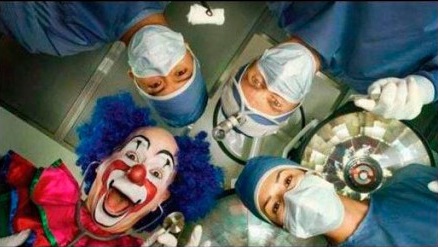
Disrespect And Assault In The Operating Room: Our Nightmares Are Real

clown-in-the-operating-room

“A few moments later, the anesthesiologist walks in the room and asks, ‘What do you got?’ Dr. Canby says, ‘Vaginal delivery. Uterine atony. External massage failed. Give her some ketamine.’”…I look at Mrs. Lopez—her eyes are half-closed and vacant. Dr. Canby instructs me to hold her knee. A fellow medical student holds her other knee….Canby then performs an internal bimanual uterine massage. He places his left hand inside her vagina, makes a fist, and presses it against her uterus. I look down and see only his wrist; his entire hand is inside her. Canby puts his right hand on her abdomen and then massages her uterus between his hands. After a few minutes, he feels the uterus contract and harden. He says something like, ‘Atta girl. That’s what I like. A nice, tight uterus.’ And the bleeding stops. The guy saved her life…But then something happened that I’ll never forget. Dr. Canby raises his right hand into the air. He starts to sing ‘La Cucaracha.’ He sings, ‘La Cucaracha, la cucaracha, dada, dada, dada-daaa.’ It looks like he is dancing with her. He stomps his feet, twists his body, and waves his right arm above his head. All the while, he holds her, his whole hand still inside her vagina. He starts laughing. He keeps dancing. And then he looks at me. I begin to sway to his beat. My feet shuffle. I hum and laugh along with him. Moments later, the anesthesiologist yells, ‘Knock it off, assholes!’ And we stop.”

This is an operating room anecdote related in an anonymously authored article published this week in the Annals of Internal Medicine, a respected medical journal. The publication says that the piece is intended to shine light in a dark corner of the medical profession. Oh-oh. The essay is anonymous, I assume, because the author is afraid that there would be professional repercussions from his revealing this—what? Bad habit? Dirty secret? Crime? Reason for us to go stark, raving mad? Continue reading

Ready or Not Clinton Corruptees: Your “The E-mail Scandal Is Anything But Nonsense” Update For Today

sending email

I care about you all, I really do. Clinton Corruption is not incurable; it can be cured if detected early, slowly, with a steady intake of facts, with the  generous  application of  basic ethical values and the gradual acceptance of the concept that they matter in leadership, because ethics justify trust.

Let us being today’s session with the rantings of a CCS (Clinton Corruption Syndrome) sufferer, Washington Post’s relatively objective columnist Chris Cillizza, who shows the advanced and probably hopeless progression of Clinton corruption with his most recent column. His sad delusion: Hillary’s nomination is inevitable, it’s too late to challenge her, so Democrats, and the nation, should just accept it. This aids Clinton, or course, placing her in Clinton Nirvana, where there is no accountability. Cillizza shows the ravages of Clinton corruption when he says that “Clinton has been under fire” for her private e-mail server and her responses to the unfolding controversy. This plays the Clinton enabling game so popular in the left leaning news media, discussing the politics of the scandal, like it’s a football game, rather than honestly disclosing the obvious conclusions from it.  The episode has already proven that Clinton is unqualified for the Presidency—incompetent, more concerned with personal interests than national welfare, dishonest, arrogant, untrustworthy, and dangerous. It is a great boon to Clinton to convince the public that all of these revelations are to no effect, because there is nothing to be done. “Move on!” was the mantra of the anti-impeachment crowd  when it was shown that Bill Clinton had disgraced the office; now it’s “What difference, at this point, does it make?” Of course Democrats aren’t stuck with Hillary. Would Cillizza make this argument if she were shown to be suffering from dementia? If she were shown to have committed treason? If she killed someone? If she dies, would they put her on the ticket anyway, like El Cid leading his army post-mortem? The only reason anyone is making the Carole King argument (“It’s too late baby”) to bolster Hillary is because they think the public really doesn’t think habitual lying and lack of trustworthiness is disqualifying.

It is, and I’m betting a critical mass of Democrats understand that, or will, because of developments like these… Continue reading

The Cake And The Clerk: If Living In A Pluralistic And Democratic Society Offends You, It May Be Time To Find Another One

Davis Protest

The kicking and screaming of the anti-gay marriage bitter-enders is becoming a national embarrassment, especially since some of the Republican Presidential candidates can’t seem to resist pandering to them. The social contract in a democracy involves accepting where the system decides to go and following along to the extent the law requires. If we don’t like a law, or a war or a government program, we are free to complain and to try to get them changed, or to pay the price for defying the law as part of the contract. We may not unilaterally declare that the law doesn’t apply to us. No, not even if we think God agrees. He’s not a party to the contract.

This is straightforward and clear. The ethics of citizenship requires it. Two current situations that have had significant developments in recent days illustrate the principle in the breach of it.

The Cake.

Jack Phillips, who is yet another Christian cake baker, lost an appeal that asserted that he had a First Amendment right to refuse to provide a cake for a gay couple to celebrate their wedding. Continue reading

Suggested Journalism Ethics Rule For The Washington Post: If You Want To Publish Race Hate, Anti-American Op-Ed Pieces,At Least Insist That They Don’t Misrepresent The Facts.

Is that too much to ask?

Sunday last,  the Washington Posts’s Outlook section included an anti-American diatribe against police and whites by a California public defender named Raha Jorjani. I know there are black racists that see the world, law enforcement and government as he does, and there is nothing wrong or irresponsible in the Post allowing such screeds to see the light of day in its pages—all the better to expose them. I would feel better if the equivilent racist bile from the white side was not treated differently, but I tire of pointing out this double standard, at least right now.

But no editor should allow such a piece to include factual distortions on the scale of the opening paragraph, which begins,

Suppose a client walked into my office and told me that police officers in his country had choked a man to death over a petty crime. Suppose he said police fatally shot another man in the back as he ran away. That they arrested a woman during a traffic stop and placed her in jail, where she died three days later. That a 12-year-old boy in his country was shot and killed by the police as he played in the park.

Suppose he told me that all of those victims were from the same ethnic community — a community whose members fear being harmed, tortured or killed by police or prison guards. And that this is true in cities and towns across his nation. At that point, as an immigration lawyer, I’d tell him he had a strong claim for asylum protection under U.S. law.

What if, next, he told me he was from America? Black people in the United States face such racial violence that they could qualify as refugees.

The short and well-earned response to his last sentence is “Bullshit.” Before one can even get to his offensive and absurd (and paranoia-seeding: the lawyer must regard it as good for business) thesis, the utter dishonesty of his premises disqualify the op-ed for serious consideration, as well as raise question about the way this guy would practice law. If that is how he represents facts in court, he won’t be a lawyer long: Continue reading

Unethical Quote of the Week: Rosie O’Donnell

rosie-odonnell

“I’d like to take my period blood I no longer have and write, ‘you’re all assholes.’ I’d like to smear it all over some people’s faces.”

—-Former actress, occasional comic and former talk show host  Rosie O’Donnell, extemporizing on her hatred of anti-abortion advocates and conservatives on Jenny Hutt on SiriusXM’s radio program “Just Jenny.”

This kind of vituperative and hate-infected comment poisons public discourse, polarizes society  and harms the nation by not only making a functioning democracy nearly impossible but making living in one ugly. Continue reading