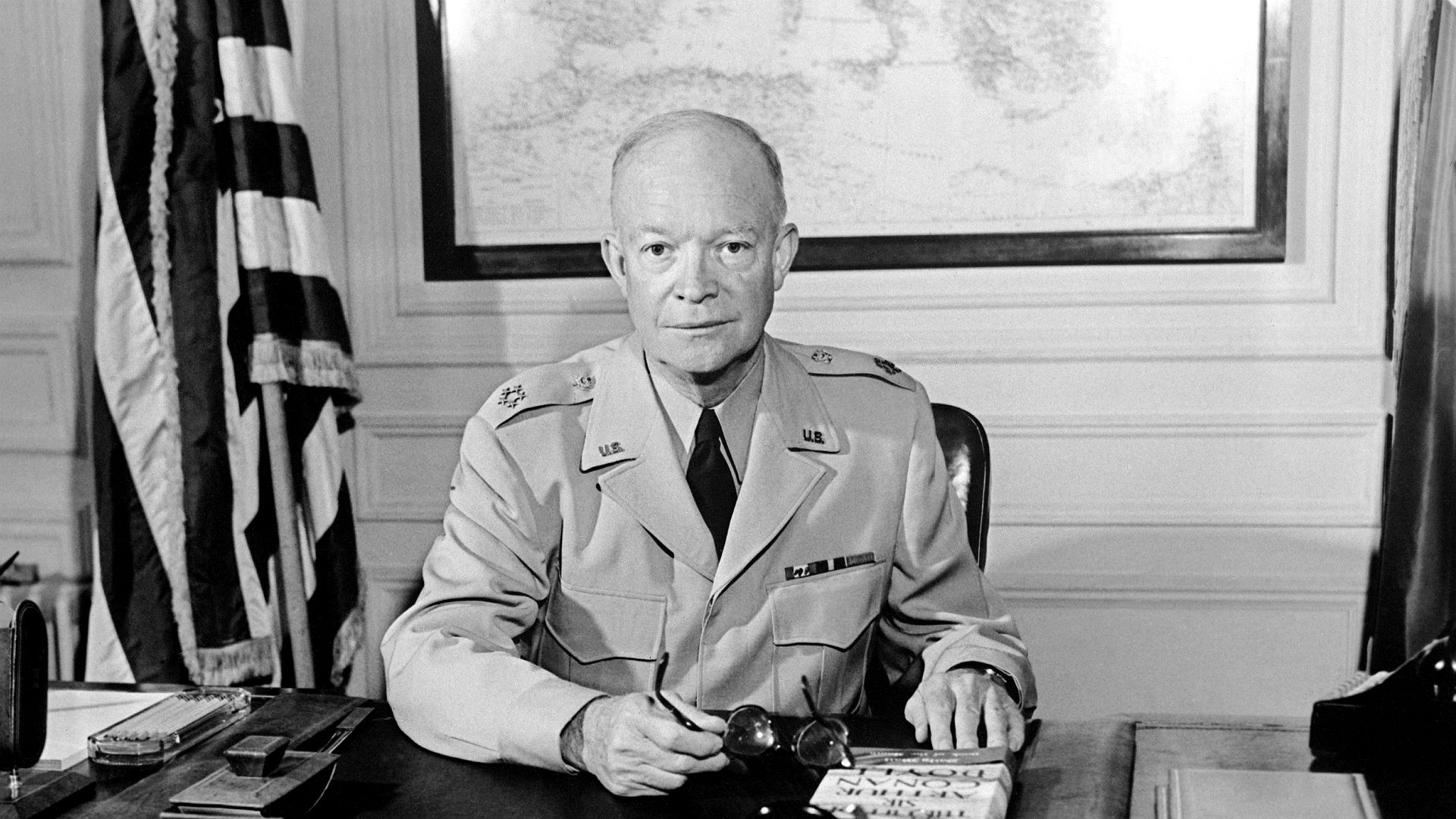
Dwight D. Eisenhower lied in a signed pledge in order to play football as a West Point student. Had the false assertion been discovered, the Allied Forces would have had a different commander, and the Cold War would have been fought on the U.S. side by a …Adlai Stevenson, if not Herman Goering. Ike never mentioned his ethical and very uncharacteristic breach of military conduct in his memoirs, but the incident seems to have haunted him all his life.
President Eisenhower played the outfield for Class D Junction City, a professional minor league team, in 1911. Ike used a false name—“Wilson”— to maintain eligibility for collegiate athletics. He was 20 years old and hit .355, but he wasn’t aiming for the big leagues. “I wanted to go to college that fall and we didn’t have much money,” General Eisenhower told the Associated Press in 1945. “I took any job that offered me more money, because I needed money.”
When Eisenhower joined the Army’s football program at West Point, he had to sign a form saying he was never compensated for playing a professional sport. The assumption is that Ike signed, but the document has never been found. Had his lie been discovered whgile he was at West Point, he would have been kicked out of the Academy. Had the falsely signed document surfaced while he was President, it would have been a serious embarrassment for both Ike and the military.
My guess is that it was “lost.”
Eisenhower mentioned the pro baseball excursion several times. While visiting the NY Giants and the Boston Braves at the Polo Grounds in June of 1945, he confided in Giants manager Mel Ott and Braves manager Bob Coleman. Ott asked the general if he had played professional baseball. “The general admitted he had done so, under the assumed name of Wilson,” the New York Times reported.
He called it ‘the one secret of my life,’ ” the Times wrote. The book My Three Years with Eisenhower: The Personal Diary of Captain Harry C. Butcher also included a first-person account of hearing Eisenhower discuss a brief and incognito minor league baseball career.
After leaving the White House, Eisenhower refused to discuss his secret life as a professional baseball player and the honor breach that must have followed. In 1961, Ike sent a memo (on file at the Eisenhower Presidential Library in Kansas) to his staff, directing them to avoid answering questions about this chapter of his life because “it gets too complicated.”
Now there’s a rationalization!
And that’s how moral luck made the difference between Dwight D. Eisenhower being remembered as a man who saved the world from Adolf Hitler and navigated the U.S. through the early years of the Cold War, and forgotten as a failed West Point cadet.
Young Ike was wrong. He lied and cheated, and we should all be grateful that nobody found out until he had a chance to show he was better than that.
A lot better.
_______________________________
Facts and Graphics: The Sporting News
 Ethics Alarms
I’m over here in Amsterdam, not far from Arnhem and Antwerp. I keep hearing about all of Montgomery’s horrific blunders.
“Eisenhower was the best clerk I ever had.”
―Douglas MacArthur
“MacArthur is the most dangerous man in America.”
—-Franklin Delano Roosevelt
You wont get any argument out of me on that. Ive never worshipped at the alter of MacArthur. I think he should have been relieved of his command after the Philippines.
Dunno about worship, but I don’t think Trevor DuPuy would have designated him “the last great captain” without merit. That said, being a master strategist does not make you righteous or ethical, and the man had an ego the size of Gaul.
Didn’t expect one. But I always liked the idea that FDR said that while comparing Mac to Huey Long.
Hahaha, that’s good. Your thoughts on the Kingfish vis-à-vis Hilary? I think there are some parallels to be drawn.
Yeah, but Hillary’s small beer compared to Huey. And he had genuine charisma. No contest.
She might have married brother Earl, though.
Had he come to be at a different time, and not fallen to an assassin’s bullet, he might well have been president.
If I can find the insurance report I’ll post it. The detective who did the insurance investigation reported that Weiss was unarmed that Long had been shot and killed by his own body guards.
There’s good evidence to suggest that the round that killed Long was a ricochet from one of his numerous bodyguards’ pistol. As for Eisenhower’s lie; this is just one of those incidents where things worked out for the best of all concerned. As for MacArthur getting caught as he did in the Philippines, that is an easy criticism to make long after the fact. A far better case could be made about the state of preparedness on the highest levels when the war came. That, however, would require a lot of in-depth analysis!
Id like to have seen a debate between Mac and Long. lol
It would be a great play.
Uh, you mean UNethical breach, right? More than a few heroes have benefitted from moral luck, and I am never sure which to shrug at and which to say should have brought someone down. John Sidney McCain, a consistently poor student and discipline case, but for WWII giving him a chance to show his natural wartime leadership abilities, would have been pushed out of the navy probably with the rank of Lt. Commander, just enough to let him finish out his 20. Instead he rose to command the Pacific Fleet. Joseph Stillwell acted consistently like a jerk in high school and should have been expelled, not sent to West Point, nonetheless he got in through connections, and you know the rest.
What are your thoughts regarding historical figures who did objectively VERY bad things, like Ataturk (fighting on the wrong side, turning a blind eye to genocide), Michael Collins (terrorism), or Moshe Dayan (disloyalty in the field), but ultimately succeeded and are hailed as heroes by those loyal to the side they fought on? Are they still heroes because of their success, or are their successes, and the nations that came to be from them, “tainted” as a result?
I think this is a fair question, given the recent historical revisionism and tendency to try to take traditional heroes off their pedestals due to either actual wrongdoing (Andrew Jackson) or presentism (Jefferson, Washington, Columbus, et al. ).
1. Breach of ethics=ethical breach. Or ethics breach. A breach of ethics is by definition unethical.
2. Or John Brown. Or Mark Felt, aka “Deep Throat.”
Gotcha. I think the phrase “ethical and very uncharacteristic breach” made me think it might be a typo. And yes, what about John Brown (a murderer and a kook) or Mark Felt (a whistleblower who hid until 30 years after the fact)? Does it really all come down to what Sea Shepherd founder Paul Watson said: It’s all right to be a terrorist as long as you win, because then you write the history?
Shame on all of us. We should have known better. We had all the smoking gun about Ike’s corruption we needed, with Ike’s pick of Nixon for his Veep. No true Army General would pick a poker-playing Navy man like that. Shoulda let Adlai invite those Russian missiles into Cuba sooner. That way, he could spare himself waiting till hell froze over.
I don’t think Ike was irreplaceable during WW2. MacArthur could have handled the Normandy Landing, as he proved at Inchon and Patton was already to go. Eisenhower was a superb commander and his planning skills for D Day were meticulous. Still, I don’t think he was irreplaceable. Playing minor league D baseball and claiming otherwise was unethical but Ike might have gone on to the majors.
His great talent that neither Mac nor—-GOD—Patton had was political acumen. Maneuvering among the Russians and egomaniacs like Monty and Patton was the under-rated part of his job.
Yes, but Ike gave in to Montgomery and allowed the disastrous Market-Garden operation to go ahead which resulted in enormous British, American and Polish casualties. MacArthur was used to getting his way and I question that he would have allowed Allied harmony considerations to rule the day. I don’t think Eisenhower’s decision to allow the Russians to enter Berlin before Patton was so great either.
All good points, but remember: we know what happened with Ike, we have no idea what would have happened without him. That’s one time-machine trip I would recommend not risking.
Don’t forget MacArthur also had the disastrous Operation Tailboard so he wasn’t immune to making mistakes.
Blaming Eisenhower for the failure of Market-Garden is consequentialism. First off, the Germans had been in full retreat — they were losing faster than the Allies could win, up until mid-September. This was changing even as Market-Garden was being planned, but the Allies missed and minimized the signs.
Secondly, Eisenhower had been earnestly looking for two things. For weeks he’d been trying to find a mission for the Allied Airborne Corps, which was three elite divisions being held in England seeking an opportunity. He was also seeking a bridgehead across the Rhine. Montgomery’s plan offered a solution to both of these and Eisenhower jumped on it with both feet.
With hindsight we can see that his plan was fatally flawed . . . and yet . . . they darn near pulled it off. It was not the first or the last time the Allies underestimated the Germans and they paid for it.
Eisenhower had to make his decision on the spot when he met with Montgomery but, from all I’ve seen, he had no trouble standing up to Montgomery or Bradley or Patton. They both knew that any opportunity would be fleeting. I think also that Eisenhower was employing the American system of command. He gave Montgomery the talk, gave him the tools and support, and left it to Montgomery to run the battle. It certainly wasn’t Montgomery’s best hour.