I can’t blame the airport officials who voted 8 to 1 last month to eliminate Bob Hope’s name and change the airfield’s label to “Hollywood Burbank Airport.” It was a business decision based on hard data. Hope’s name wasn’t resonating with passengers outside of Southern California, especially those east of the Colorado Rockies.
The airfield had been rechristened to honor Hope in 2003, not long after his death at the age of 100. Yet just a bit more than a decade later, the entertainment icon whose theme song was “Thanks for the Memory” is fading from ours at record speed. The comments on various news reports on the airport’s decision range from stunningly ignorant to disrespectful. Bob Hope deserves better. The culture will be stronger if it remembers him, and so will the nation.
I must admit, I didn’t see this coming, but I should have. The survival or disappearance of once famous figures from our cultural memory fascinates and often horrifies me. One of the definitions of culture is what a society chooses to remember and chooses to forget: these seemingly random decisions have significant long-term consequences. Occasionally there is a last-minute rescue: just as the Treasury was preparing to remove Alexander Hamilton from the ten-dollar bill, a Broadway musical, of all things, rescued his image and re-established his cultural presence. Usually, however, once a figure drops down the memory hole, he and the public appreciation of his importance is gone, gone, gone. Forever.
The mechanics of this process are chaotic. A single movie that enters classic territory and is featured regularly on television can rescue the memory of a whole career for generations. Ray Bolger, an eccentric dancer who was never regarded as close to Fred Astaire or Gene Kelly in the hierarchy of Hollywood hoofers nonetheless remains a recognizable figure today purely on the basis of “The Wizard of Oz.” Edward G. Robinson was a famous and respected actor mostly on the strength of his gangster films, but his memory survives almost entirely due to his strange ( and strangely miscast) role as the Hebrew villain in “The Ten Commandments.” Meanwhile, who remembers George Raft?
Hope, I now realize, despite one of the longest and most successful careers in show business history and epic stardom on radio, films, theater and T, despite being the most frequent and most successful MC for the Oscars telecast and while he was alive and regarded for 50 years as the undisputed champion of stand-up comics, has no such marker to keep his image and memory alive. Humor is famously dependent on the times and culture, and Hope’s humor and style were more so than most. He was not a physical or slapstick comedian, and his movies, with the exception of the best of his “Road” movies with Bing Crosby, were at best mildly funny. The later ones, like his films with Phyllis Diller and Lucille Ball, weren’t even that. By the 1960’s, Bob Hope’s reputation as an entertainment icon was so well-established that he didn’t really need to be funny; the fact that he was Bob Hope was enough. He was a living relic of vaudeville, radio comedy and traditional TV skits who never changed his delivery or mildly self-deprecatory yet cocky demeanor. But what was special about him? There’s little available on TV or elsewhere to let new generations in on the secret.
The honors should be a clue. The list is overwhelming.
Bob Hope was awarded over two thousand honors and awards, including 54 honorary doctorates. Providing him endless material for jokes, Hope was never nominated for an acting Oscar (he was one of the exceptions to the rule that great comedians tend to be good dramatic actors), but he was awarded a record five honorary awards by the Academy of Motion Picture Arts and Sciences.
In 1963 President John F. Kennedy awarded him the Congressional Gold Medal for service to his country. President Lyndon Johnson bestowed the Presidential Medal of Freedom on Hope in 1969. In 1982, he received the S. Roger Horchow Award for Greatest Public Service by a Private Citizen. He was presented with the National Medal of Arts in 1995, and the Ronald Reagan Freedom Award in 1997. On June 10, 1980, he became the 64th and only civilian recipient of the United States Air Force Order of the Sword.
In addition to the now removed honor with the airport, buildings and facilities dedicated to Hope include the historic Fox Theater in downtown Stockton, California, the Bob Hope Gallery at the Library of Congress, and the USNS Bob Hope (T-AKR-300) of the U.S. Military Sealift Command, which was named after him in 1997. The United States Air Force named a C-17 Globemaster III transport aircraft the Spirit of Bob Hope.
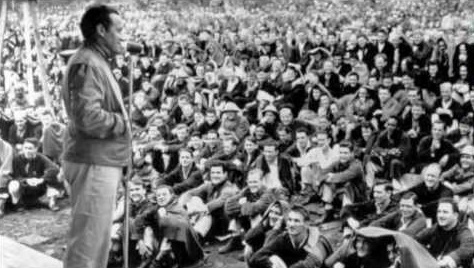
Hope was awarded the Sylvanus Thayer Award by the United States Military Academy at West Point in 1968. President Bill Clinton signed an act of Congress in 1997 naming him an “Honorary Veteran,” a unique honor no one had received before. You may notice that a lot of these honors relate to the military, and there is a reason for that. For nearly six decades, Hope traveled the globe to entertain America’s service men and women.
This dedication to the troops began in May, 1941 when Hope and a group of performers went to March Field, California, to do a radio show for airmen stationed there. Throughout World War II, with only two exceptions, all of his radio shows were performed and aired from military bases and installations either in the United States or combat areas in Europe and the South Pacific. Beginning in 1948, Hope spent every Christmas entertaining the troops abroad. He went to Germany at the request of then Secretary of the Air Force, Stuart Symington, to entertain the troops involved in the Berlin Airlift. He repeatedly entertained the troops in Vietnam. With the end of the Vietnam war nearing, Hope described his 1972 trip as his “last Christmas show”; after all, he was 69. It wasn’t. Each Christmas after that for decades, he was somewhere in the country doing a show at a military base or veterans hospital. In 1983, when Hope was 80, he brought his USO show to Beirut.
Four years later, Hope flew around the world to entertain servicemen and women in the Pacific, Atlantic, the Indian Ocean and in the Persian Gulf. When Bob Hope was 87, he embarked on a 1990 goodwill tour to entertain military personnel stationed in England, Russia, and Germany. Hope and his wife spent Christmas that year in Saudi Arabia entertaining the men and women of “Operation Desert Storm.”
Hope made many of these appearances at great personal risk, but never let that prevent him from bringing some home memories and levity to men and woman who might find themselves under fire the next day. My father, an officer during the war, testified to how much Hope’s visits boosted morale.
Writer John Steinbeck wrote of Hope’s USO shows in World War II —the author of “Of Mice and Men” was working as a war correspondent at the time (1943):
When the time for recognition of service to the nation in wartime comes to be considered, Bob Hope should be high on the list. This man drives himself and is driven. It is impossible to see how he can do so much, can cover so much ground, can work so hard, and can be so effective. He works month after month at a pace that would kill most people.
So, sure, Bob’s movies seem dated and his topical jokes are mild by today’s standards. His delivery was stiff compared to modern comics, and his humor was pretty corny. No entertainer, however, before or since, gave more back to the nation that made him rich and famous.
Bob Hope was a genuine hero, and when I see those comments from 25-year olds who would never dream of braving enemy fire themselves mocking this brave and patriotic man as a forgettable and irrelevant footnote of an earlier time, I feel that this culture is in trouble. America needs to remember and honor Bob Hope. It needs to permanently express its gratitude and respect.
He earned it.
____________________
Sources: Wikipedia, Bobhope.com, Library of Congress
 Ethics Alarms
Bravo.
It’s hard to believe, but I expect that Bob is not the last entertainment icon to be forgotten in a generation. Very sad, considering all he did for us.
Thanks, Jack, for THESE memories. Someone on Facebook recently shared a video of Hope tap-dancing on a table with, and verbally sparring with, James Cagney. What a delight to watch! I did not grow up fast enough to appreciate what Hope did for the troops with his USO shows. I hope some tract of land will be named after him instead – something more permanent than an airport or other building that can just be blown up anytime. Heck, if I was President, I’d push for commissioning another granite mountainside somewhere, to name after him even after his face is sculpted on it and later blasted away by whoever.
“. . . granite mountainside somewhere, to name after him even after his face is sculpted on it and later blasted away . . .”
As long as the nose remains, we shall remember the face.
Bob Hope = A historical icon of the entertainment industry!
Without people like Bob Hope blazing the trail, the entertainment industry would have failed miserably. Years ago “neato” got some people in the door but it could only sell so many tickets; to keep the public coming back for more there had to be QUALITY; Bob Hope was part of that quality!!
I agree with the lamentation however the only entertainer from the 19th century anyone remembers is John Wilkes Booth. They’re memory just doesn’t last. Entertainers almost always have trendy appeal even if they manage to cleave a longer time span of value than most trends.
Don’t forget Sarah Bernhardt!
But, yes, I do understand your point. 🙂
Caruso?
I’d also note that before mass media, the means of preserving fame was severely limited. Most Americans in the 19th Century never saw Edwin Booth, for example, or Kean, or Joseph Jefferson. Now anyone can see Bob Hope within seconds on YouTube, or any of his movies, with a little searching. So the 19th Century is not really a good comp for today.
There is some truth in what you write. But I daresay that few if any of those forgotten entertainers were also heroes and patriots.
The number of USO tours he made to entertain the troops is staggering. He was always willing to go where they were with his troupe which gave the guys a much needed break from the grim realities of war. He really put it on the line and it’s truly sad that the corporate types at Hollywood-Burbank Airport would made this decision.
Hope not only gave tirelessly to the US military, but sought to help Jewish refugees in flight from Nazi Germany.
“In an all-star show at Madison Square Garden to benefit the Emergency Committee to Save the Jewish People of Europe” Hope used his entertainment connections and friendships to save lives.
http://www.jewishpress.com/indepth/opinions/bob-hope-and-the-holocaust-no-laughing-matter/2003/07/26/0/?print
Jack,
Kind correction: In the first sentence of the last paragraph you spelled his name incorrectly.
Great article. Cheers!
The v is right next to the b.
Bob was called “Bov” by his closest friend–Delores, Jerry Cologna, Bing of course.
No, I’m not going to be able to brass this one out. I hate it when I have to run out after a post and someone has flagged a typo that just sits there making me look stupid.
Fixed.
Unfortunately, to a large extent, Bob Hope was already an anachronism by the time the baby boom came along. He was way too “establishment.” He wasn’t Lenny Bruce or Richard Pryor or even George Carlin. He was definitely of the WWII generation and Sinatra and John Wayne and, frankly, Nixon.
But man he was funny. And classy in that old school way. He was stand up comedy and comedians incarnate. A living monument or museum. But, as you say, that was almost three or four generations ago already. I doubt there will be a Bob Hope revival. He wasn’t sufficiently NYC. He was too West Coast and Southern California, Palm Springs, even.
And by the way, another thing that’s lost Hope’s name is the annual mid-winter golf tournament in Palm Springs, The Bob Hope Classic. (Great name, by the way.) Which is now known, unfortunately, as [some corporation that actually pays money as sponsor rather than free loading] and the Bill Clinton Foundation golf tournament. Depressing. Hope (and Crosby) probably did as much for tournament professional golf as Arnold Palmer but is now essentially forgotten by golf as well.
Frankly, I see this trend as another example of the dumbing down of the American collective mind, especially in the area of historical milieu. Bob Hope wasn’t just an entertainer. He rose above most in his generation for many reasons and deserves to be remembered as part of the historical experience of America. But as has been proven by many talk show hosts by “person-in-the-street” interviews, Americans often don’t have a clue about events and people from last week let alone last century. I don’t think that Americans have become dumber, but I do think that their education has become a sham. Education. The root of and answer to so many of our problems.
Hope was, of course, an immigrant, born in London and moved to America as a small boy with his family.
My favorite memory of Bob Hope is of him introducing the college football All-Americans on his Christmas show every year. As each kid came out he would tell one of three jokes about big or fast the guy was, or how much he could eat. It went on for years and the kids, including increasing numbers of huge black kids, would give good – natured but ever more quizzical looks about who this old man was and why was he telling these corny jokes?
“…Raft?”
Loved him in Lifeboat.
Terrible pun.
And parodying himself in “Some Like It Hot”
Well what do you expect, its not like he is Eddie Foy.
Or Eddie Foy Jr.
I’m going to try to get my dad to write up his story about getting to see Bob Hope live when he was in Vietnam in the Army.
Do it!!!
It’s short, but this was his time seeing Bob and the crew in late ’71…