Ethics Dunce: Anyone Who Ran This Story

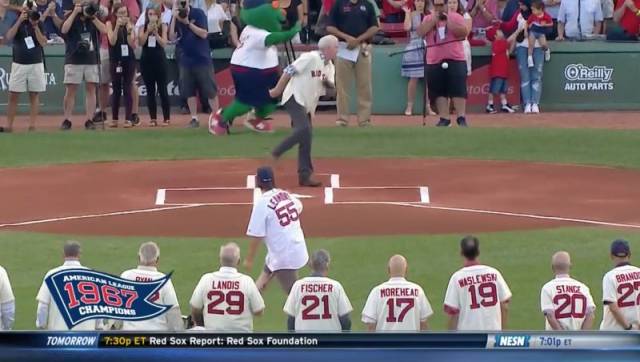
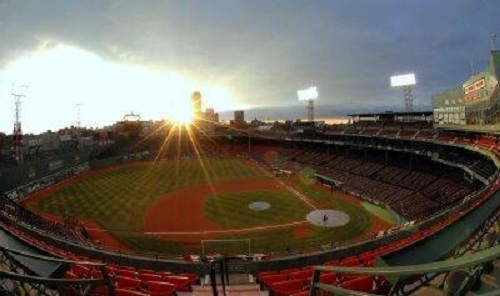
On my way home from my seminar today, I saw that my cab’s in-ride video featured, along with three Jeopardy! questions from Alex Trebek, a Jimmy Kimmel feature (his “Pedestrian Belly-Flop” competition) and the weather, and a video from the ceremonies I had just returned from witnessing in person at Boston’s Fenway Park. The headline was-HAHAHAHA!—“First Pitch Goes Horribly Wrong!” and showed Mike Andrews, the ex-Red Sox second baseman from the 1967 “Impossible Dream Team,” receiving a pitch from the ceremonial first pitch tosser, who then heaved the ball far beyond Mike’s reach into a group of photographers, hitting one of them—it’s important to note that he is male–right in the crotch. The clip was attached to an ad for the local ABC affiliate here.

I thought that the mocking video was an ABC product, and it might be, since other ABC affiliates have distributed it. But the same video with similar mockery of the pitch in the commentary is elsewhere, and on its way to going viral. Here is the attached story used by ABC Channel 15 in Arizona:

A photographer and University of Arizona alum was the unfortunate victim of one of the worst first pitches in MLB history on Wednesday night.

Before the Boston Red Sox hosted the St. Louis Cardinals at Fenway Park, the gentleman who tossed out the first pitch threw it juuuuuust a bit outside — and right into a sensitive spot for Tony Capobianco, a photographer and page designer for The Eagle-Tribune who graduated from UA in 2013.

Fortunately, Tony reported he’s OK. Way to Bear Down, sir.

That “sir” is a triumphant cancer survival and success story by The Jimmy Fund, the Dana-Farber Cancer Institute’s ‘s research drive to cure cancer in children that the Red Sox  made the organization’s affiliated charity since Ted Williams became passionate involved with the project in the late 1940s. His pitch was the climax of the ceremonies honoring the 50th anniversary of  the storied pennant winning team, in part because that team became the first to ever award a full World Series share to cancer research, and in part because Andrews had followed his playing days with 25 years as the Jimmy Fund’s executive director. Continue reading

Morning Ethics Warm-up: 8/17/17

Good Morning!

1. I got back late last night from my pilgrimage to say thanks to the Impossible Dream team, and now I’m on my way out to teach an ethics seminar for D.C. government attorneys. I haven’t caught up with the comments yet; I’m sorry. Things should be back to normal hear by this afternoon. Here are the surviving members of that 1967 Red Sox team that changed my life:

Incredibly, the Red Sox barely promoted the event, and had no memorabilia, not even a T-shirt, available at the souvenir stands. I asked one of the sales people, who said the team had given them nothing, figuring that the typical fan was too young to remember or care.

And people wonder why I object to tearing down statues…

2. …which the unethical Mayor of Baltimore ordered to be done yesterday in the dead of night. From the Times:

It was “in the best interest of my city,” Mayor Catherine Pugh said Wednesday, as she explained why she ordered Confederate monuments removed under the cover of darkness, days after violence broke out during a rally against the removal of a similar monument in neighboring Virginia.

“I said with the climate of this nation,” Ms. Pugh said later, “that I think it’s very important that we move quickly and quietly.”

With no immediate public notice, no fund-raising, and no plan for a permanent location for the monuments once they had been excised — all things city officials once believed they would need — the mayor watched in the wee hours on Wednesday as contractors with cranes protected by a contingent of police officers lifted the monuments from their pedestals and rolled them away on flatbed trucks…

David Goldfield, a professor of history who studies Confederate symbols at the University of North Carolina at Charlotte, said the removal of the monuments in Baltimore was likely to be part of a “rolling cascade” of cities and states ridding themselves of, or at least relocating, similar statues.

”You’re going to see another wave of these removals.” Mr. Goldfield said. “The fact that it’s done fairly expeditiously is not surprising because if you do it quickly the opposition can’t build up, and the confrontations that we’ve had, not only in Charlottesville but elsewhere, will not materialize.”

By all means, move quickly and without notice or due process so lawful protests and expressions of public opinion “can’t build up.” “It was in the best interests” is such a versatile rationalization for unilateral government action.

Democracies don’t undertake controversial actions in the night. Dictatorships do. Pugh and others nascent fascist of the left are as responsible for “the climate of this nation” as much or more than anyone else, and now want to exploit the dangers of that climate to stifle dissent.

Perfect. Continue reading

Morning Ethics Warm-up: 8/16/17

GOOD MORNING!

1. I’m heading to Boston and Fenway Park in a few hours to meet with two of my high school classmates and together pay our respects to the 1967 Boston Red Sox, the spiritual beginning of Red Sox Nation, and a group of men, then barely more than boys, who had as profound an effect on my life and view of it as anything I have ever experienced.

It’s the 50th Anniversary of that amazing team and the heart-stopping pennant race it won against all odds, in a four team race that came down to the final game of the regular season. I mean heart-stopping literally: the team wasn’t called “The Cardiac Kids” for nothing. TWO of my father’s colleagues at the Boston Five Savings Bank died of heart attacks while attending Red Sox games, during one of the 9th inning desperation rallies for which the team was famous. The only reason I didn’t perish in like fashion is because I was just 16 years old.

Why was this team, and that summer 50 years ago, so important to me? I don’t have time or space to answer that question well, and you’d probably wonder what I was babbling on about anyway. A 2017 film by Major League Baseball called “The Impossible Dream” does a fair job of explaining it, but it’s too short to do the job right.

I had listened to, watched or attended every Boston Red Sox game for five years, as the team lost and lost. From those bad teams, followed weakly by the city in those days, in a crumbling old park that seemed destined to be abandoned and torn down, I learned that winning wasn’t everything, that loyalty wasn’t easy, that Hemingway was right, and that baseball was about courage, humility, perseverance, doing your job every day, sacrifice, and hope, as well as usually losing at the end. That summer of 1967 taught me that hope is worth the effort even though hope is usually dashed by the ice water of reality, that you should never give up, that miracles do happen, and that nothing is as wonderful as when a community is united in a single, inspirational goal, no matter what that goal might be…and that you should never be afraid to give everything you have in pursuit of a mission, even when it is likely that you will fail.

I learned difficult, discouraging lessons, too. When an errant pitch hit Red Sox right-fielder Tony Conigliaro in the face on August 18, 1967, it was the beginning of a lesson that revealed its tragic last chapter 23 years later. That one taught me that life is horribly, frightening unpredictable, and that we envy others at our peril. It taught me that we need to do what we can to accomplish as much good as we can as quickly as we can, because we may lose our chance forever at any moment.

Tony C, as he was and is known as, was a beautiful, charismatic, local kid, the idol of Boston’s huge Italian-American community,  in his fourth season with his home town team at the age of 22. He dated movie stars; he recorded pop songs; he had a natural flair of the dramatic, and was destined for the Hall of Fame. One pitch took it all away. Although he had two comebacks and played two full seasons facing major league fastballs with a hole in his retina and his field of vision, Tony was never the same. After his final attempt to keep playing failed at the age of 30, he became a broadcaster, and at 37 was seemingly on the way to stardom again in 1982 when he suffered a massive, inexplicable heart attack—Tony  did not smoke, and had no family history of heart problems– that left him brain damaged until his death in 1990.

As Henry Wiggin, the star pitcher protagonist of the novel, play and movie “Bang the Drum Slowly” observes as he  reflects on the death of his catcher and roommate, everyone is dying, and we have to remember to be good to each other. But it’s so hard. Ethics is hard. The ethics alarms ring faintly when we are about the task of living, or not at all…

At the end of the story, the narrator, the best friend of the catcher (but not really that close a friend) recalls how quickly everyone on the baseball team went back to their selfish ways after their teammate went home to die Even the narrator, who was the leader of the effort to make the catcher feel loved and appreciated in his last days, ruefully recalls his own failing. The catcher had asked him a favor, just to send him a World Series program (the team won the pennant after he had become too ill to play), and he had forgotten to mail it until it was too late. How hard would it have been, the narrator rebukes himself, to just put it in an envelope and mail it? Why are we like that, he wonders?

1967 was the beginning of my exploration of that mystery too.

So I am going to Boston for the 30 minute ceremony. I can’t even stay for the game; I have a seminar to teach tomorrow morning, and the last flight out of Logan is at 9 PM. There will probably be just a small contingent from the Cardiac Kids: most of them are dead now, or too infirm even to walk onto the field. But Yaz will be there, and Gentleman Jim Lonborg; Rico Petrocelli, Mike Andrews, and maybe even Hawk Harrelson  and Reggie Smith. I will be there to say thank-you, that’s all.

And to show that I remember. Continue reading

From The “I Told You So Files”: First They Came For General Lee…[UPDATED]

UPDATE: Because the first two news sources I had were in error, I originally posted that the event described occurred this week. It did not: it occurred in October of last year.

Just a few hours ago, I was explaining to a usually wise and rational commenter why her willingness to allow periodic purges of statues and memorials honoring those individuals who past members of our society determined were worthy of continuing honor. The figure in question was Robert E. Lee, not one of my personal favorites, but a generally recognized military genius and easily a man whose life and accomplishments included several justifications for permanent memorials. My favorite: Lee personally vetoed the Confederacy’s fallback plan of taking the war to a guerilla stage, extending the conflict indefinitely. It might well have worked, but Lee refused. I’ll happily grant him some perpetual statuary for that. But the self-righteously intolerant practitioners of presentism want Lee cast as a an irredeemable villain, and his statues toppled.  There are many reasons why this kind of self-imposed cultural amnesia is offensive, harmful and stupid, but in my exchange with that usually wise and rational commenter, I focused on the slippery slope, writing,

You cannot articulate what the stop is on that slippery slope that doesn’t end with blowing up Mount Rushmore.

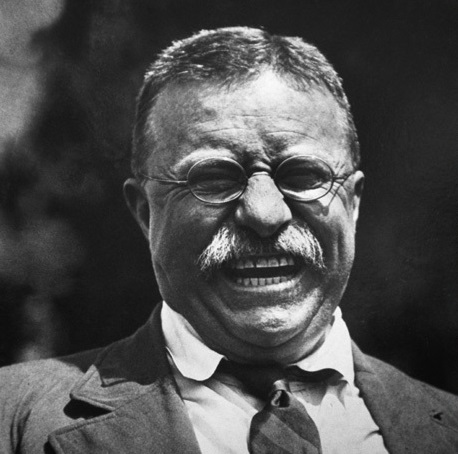
Imagine my surprise, not to be proven right, for that occurs often, but to be proven right so quickly by a news report I just read concerning a protest  by more than 200 political correctness  maniacs inside the American Museum of Natural History in New York City. Their goal: take down the statue of former of Theodore Roosevelt—historian, author, scholar, orator,  political philosopher, war hero, patriot, cowboy, explorer, public servant, the father of conservationism, the creator of the National Parks system, President and one of progressivism’s founding pioneers—and, of course, one of the Mount Rushmore Four. The protest’s organizers, NYC Stands with Standing Rock and Decolonize This Place, called the statue of the former New York City police commissioner and former New York governor  a “stark embodiment of the white supremacy that Roosevelt himself espoused and promoted,” adding in a statement that “The statue is seen as an affront to all who pass it on entering the museum, but especially to African and Native Americans.” The protesters carried signs that read “BLACK LIVES MATTER,” “DECOLONIZE THIS MUSEUM,” and “ABOLISH WHITE SUPREMACY.”

Of course they did.

Continue reading

Ethics Quiz: The Nicely-Dressed Factor

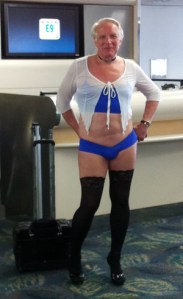
(NPR says this was an actual passenger.)

When I fly, I always wear a sports jacket. No tie, often a sports shirt. Usually dress shoes, though not since I got mt neato-keen Boston Red Sox canvas deck shoes. Why do I do this? Apparently because I’m old, but also because of that old, archaic value, respect. If I’m in public, and especially if I’m going to be in close quarters with someone, I want the experience for them to be as pleasant as possible.

The airlines exercise very little dominion over what its passengers wear. Bare feet will keep you grounded; a T-shirt  with profanity or a lewd message may get you barred from a flight, but not much else. However, the airlines do notice what you wear, and what you wear may have benefits:

George Hobica, founder of the travel fare advice site Airfare Watchdog, said that “everyone believes no one gets upgraded anymore based on how they look.” But, he added, “It does happen.”… [Hobica] then relayed tales of friends who had been upgraded while wearing clothes they considered nicer than what they might wear to the gym or the grocery store, and a conversation he once had with a gate agent friend at Lufthansa.

“She told me she would upgrade people based on how good-looking they are, how pregnant they are, or how nicely they’re dressed,” he said. “She said: ‘Look, we oversell flights and, of course, we go down the status list first. Absolutely, we look at your miles.’” But if no one on the flight warrants special privileges, the absence of ripped jeans or tattered sneakers can help, Mr. Hobica said.

The Times got uniform denials that attire was rewarded when it contacted various airlines, but a flight attendant vaguely confirmed Hobica’s account.

“I will say that when I see someone come on the plane and they’re dressed nicely and their children are dressed nicely, I do take notice,” said …a United flight attendant since 1978. “When someone is a little dressed up and looking like they made an effort, it’s almost like they’re showing respect for themselves and for everybody else on the plane…My personal opinion is that when you take pride in how you look, you take pride in how you act,” she said.

Hmmmm.

The Ethics Alarms Ethics Quiz of the day is…

It is ethical for polite attire to confer benefits for flyers over passengers who dress in flip-flops, tank-tops and torn jeans?

Continue reading

Yes, Virginia, There Is A White Supremicist Teacher Principle

“Oops! Sorry.”


A commenter yesterday inquired about the Ethics Alarms position regarding efforts to punish participants at white nationalist rallies by publishing their photos on Facebook and other social media, presumably to help get them fired.

I’ll begin the analysis with the Naked Teacher Principle, explored in its many variations on Ethics Alarms, which states,

“A secondary school teacher or administrator (or other role model for children) who allows pictures of himself or herself to be widely publicized, as on the web, showing the teacher naked or engaging in sexually provocative poses, cannot complain when he or she is dismissed by the school as a result.”

The same general reasoning would apply to a secondary school teacher or administrator (or other role model for children) who placed videos or photos of himself or herself demonstrating in favor of racist causes, or giving the “Sieg Heil!” salute, on social media. Even a superb teacher, and one who never exhibited any racial bias at all, would be rendered untrustworthy by such photographs. A neo-Nazi has a right to his or her political views, but those views cannot interfere with the individual’s ability to do a job.

No, I wouldn’t trust a Klan member, a neo-Nazi or a white nationalist to teach my child.

The same would apply to social media posts, and the exact analogy are the college professors who have recently found themselves enmeshed in controversies by declaring on Twitter or Facebook that white people should be killed, that males are a social contagion, or similar bigoted sentiments. These teachers should be separated from their students, and many, though not all, have been. They are, however, publicizing themselves, as well as their bigoted views. Like the naked teachers who posed on-line, they are accountable for the images they project and publish, and how those images affect present and future employees.

However, this is different:

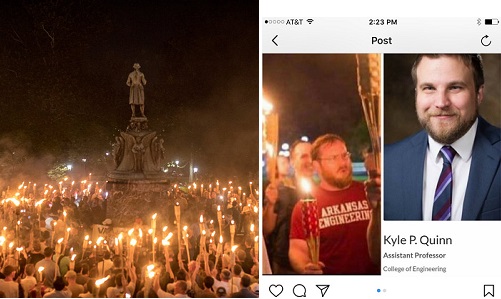
Thousands of strangers across the country had been working together to share photographs of the men bearing Tiki torches on the University of Virginia campus. They wanted to name and shame them to their employers, friends and neighbors. In a few cases, they succeeded.

The activity described is a direct effort to punish people for  their opinions expressed through legal means. It is in the same unethical category as sending private e-mails that reflect badly on former lovers through social media, or using a questionable tweet to destroy the life and career of the tweeter. This kind of  “amateur sleuthing”  as the Times whitewashes the practice, is vicious, destructive, reckless, unfair, and a Golden Rule breach.

I have already pointed out that I might be tempted  join a demonstration against the unethical airbrushing of history that taking down Robert E. Lee’s statue in his home state represents. If I were an idiot (but not a bigot), and didn’t recognize that the white nationalists were just exploiting the General’s memory for their own agenda, I might have been in that group of Tiki torch marchers. A photograph of me marching with a bunch of Klansman and neo-Nazis would hardly be good for my ethics business, though I would be completely innocent of racist views.

The “amateur sleuths” also are not always correct (being amateurs, after all) , as well as being self-righteous, vicious, and opponents of free speech. The Times describes that fate of a professor, Kyle Quinn, who runs a laboratory dedicated to wound-healing research, and who resembled another man caught in a photo marching with the racists. Quinn was attacked on Twitter and Instagram, and social media demanded that he be fired, accused him of racism, and posted his home address online.

Nice.

Be proud, you vicious social justice warriors! Continue reading

Morning Ethics Warm-Up: 8/15/2017

Gooood Morning, Ethics Alarms!

1. And the grandstanding goes on. CNN’s HLN repeatedly played the Tonight Show’s Jimmy Fallon’s undoubtedly heartfelt and gratuitous “very special episode” where he condemned racism and bigotry and saluted the victim of the vehicle attack by James Fields, saying that she was standing up for “what was right.” I’m sure she thought she was. She was, however, in a group that stood for the suppression of free speech and political views they have decided don’t deserve First Amendment protection. That is NOT “right.”

Shut up and be funny, Jimmy. You haven’t been given that show to make half-baked and ignorant political pronouncements, That’s Stephen Colbert’s job.

2. The President came out yesterday with an unequivocal condemnation of racism, bigotry, violence and white nationalism. The Times headline today notes this, but that “some say it was too late.” Of course “some” do.  And besides, says my allegedly rational liberal former Democratic Congressman staffer Facebook friend, it is obvious what he really believes. And besides, even if his statement hadn’t been too late, there were “dog whistles” in it, and his body language was suspicious.

I have to keep reminding myself that these people are ill, in the grip of a powerful mob mentality  and to “hate the sin, never the sinner,” as Clarence Darrow said (but probably didn’t believe).

3. Related: from Investor News Daily, via Instapundit:

“Obama never mentioned the anti-cop sentiment fomented by Black Lives Matter — with an assist from Obama himself — in his brief statement after five police officers were assassinated in Dallas. Obama did find room in those remarks to mention racist cops. Did anyone on the left complain?”

Wait—is it too late for Obama to condemn anti-white racism now? Continue reading

More Perspective On Charlottesville, The Left, And The First Amendment

I’ve been spending the day pointing out the bias and hypocrisy of various Facebook friends who posted emotional, warped, virtue-signaling junk assuming they would be greeted with the sounds of a thousand well-trained seals clapping. I’m not sure why I bother: it gets close to the cartoon about the guy who tells his wife, “Someone is wrong on the internet!” I feel like the alternative is to  just let a brain virus run amuck. These once intelligent people just know the President is secretly a white supremacist. He’s obligated to specifically condemn the white nationalist group, because they were “emboldened” by his election. And, they say, their “side’s” violence is “less disgusting” than the violence of the bad people….because, though they don’t say this, the ends justify the means.

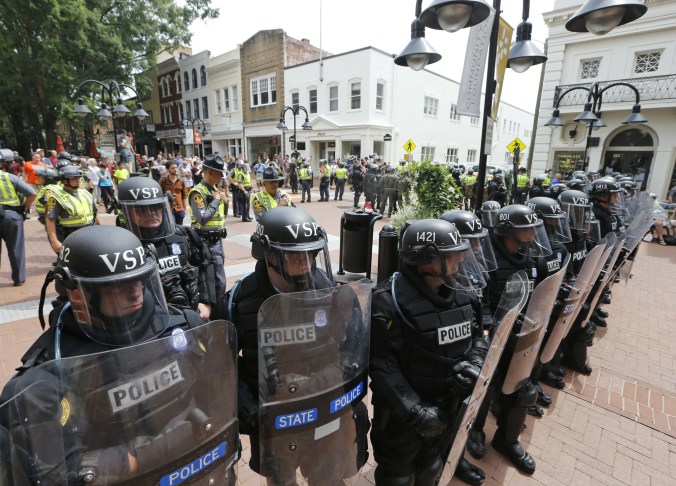
I think the reason I subject myself to the sneers and abuse—did you know I must be a Donald Trump supporter and a white nationalist?—is that the Left’s assault on free speech, which is the cornerstone of democracy,  has to be opposed, called out and condemned every single time, until they either embrace the Constitution, move to Canada, or haul us off to re-education camps. White supremacists aren’t a danger to the nation, because that kind of prejudice is antithetical to core American values, and no credible, respectable institutions and individuals support them, or ever will. Fascism of the Left is a real danger, because it is seductive and misleading, and it is infecting the most powerful and influential institutions we have. We saw it in Charlottesville. In a college town indoctrinated in the progressive cant that the wrong opinions don’t deserve to be heard because they constitute harm and violence by spoken word, the state and local government  combined to use violence to stifle political speech.

One of the best and most objective political, government and ethics websites around is City Journal; I really should cite it more often. Today Bob McManus posted an excellent essay which began with this… Continue reading

Morning Ethics Warm-Up, Charlottesville Aftermath Edition: 8/14/2017

Charlottesville, Virginia.

Good Morning?

1. Just a side note before the serious stuff: WordPress spell-check thinks “Charlottesville” is misspelled. It says the correct spelling is “Chancellorsville.”

And you wonder why I have so many typos…

2. Either one believes in, supports and will fight for freedom of speech, expression and assembly, or one does not. Those who do not also do not genuinely believe in democracy, the Constitution, civil rights or the core principles of the United States of America. This group, which has been slowly—not so slowly, really—taking over the progressive movement and the Democratic Party, and with them that party’s institutional allies, the U.S. education system and journalism, is far, far more dangerous than the alt-right, racist fools who tried to exercise their own rights over the weekend.

At the center of the implicit rejection of the freedom to say, express, demonstrate for and hold whatever wise, creative, idiotic or hateful opinions and ideas a U.S. citizen chooses were the despicable and anti-American comments of Virginia Governor Terry McAuliffe, ( WordPress thinks I should spell his name “Cauliflower”) who told a group of U.S. citizens that they were not welcome in his state, and that there was no place for them in the United States of America—you know, like the German Nazis told the Jews. Pathetically and dispiritingly, knee-jerk defenders of McAuliffe have spun this as mere “opprobrium,” a deflection that we technically refer to as “baloney.” When the leader of a government points to any group and says, “Get out!” based solely on what the group says and believes, that’s totalitarian oppression. It also paints a bullseye on the backs of every member of that group. Continue reading

Ethics Hero: World War II Veteran Marvin Strombo

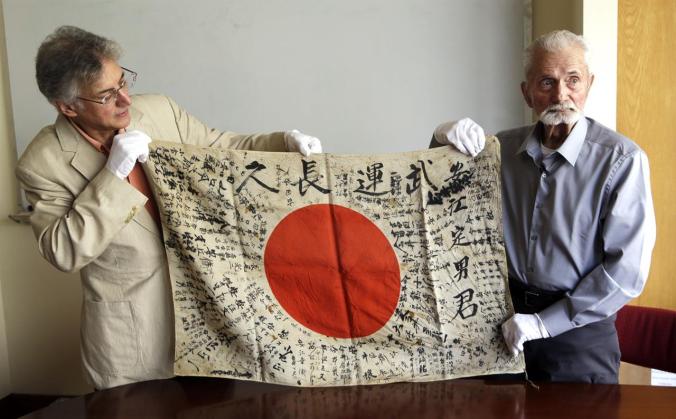
Many Japanese soldiers during World War II went into battle carrying small “Rising sun” flags, the red sphere on the field of white, with the white field decorated by hundreds of classmates, family members and friends. The flags were for good luck, and to link soldiers to their loved ones while they fought for the Emperor.  I had never heard of this practice until today; my father served in the European theater, so he would not have known that many American soldiers took these personal talismans from the bodies of fallen Japanese soldiers as war trophies.

U.S. Marine Marvin Strombo was such a soldier. A member of  an elite sniper platoon during the bloody battle for the Pacific island of Saipan in 1944, he had taken a flag from a dead Japanese soldier lying on his left side—he remembered that the young man looked like he was  asleep—after he noticed something white sticking out from his jacket.

The flag with all the inscriptions on it hung behind glass in Strombo’s gun cabinet in his home in Montana for decades until 2012, when the son of his former commanding officer contacted him for assistance with a book he was writing about the exploits of his father’s platoon. (ARGHHH! I just remembered that I haven’t gotten back to a member of my Dad’s unit who wrote me a couple of months ago!) Working with the author,  Strombo learned about  the Obon Society, a nonprofit organization in Oregon that works to locate and return the personal Japanese flags to the families of the fallen soldiers who carried them. Researchers determined that the dead soldier Marvin’s flag had belonged to was named Yasue Sadao. What Strumbo thought was calligraphy were really the signatures of 180 friends and neighbors, including 42 relatives, who saw Yasue off to war from Higashi Shirakawa, a small village of about 2,400 people in the mountains roughly 200 miles west of Tokyo. Continue reading