My Verizon WiFi Ethics Dilemma

ProEthics (and our home, where it resides) is in Alexandria City, in Northern Virginia. We are dependent on the internet, but cannot get the high-speed variety, Fios, from Verizon, our provider. This has significant business and personal consequences: for one thing, it means that I can’t load video commentary on Ethics Alarms as I have wanted to do for years. For another, Verizon’s DSL service, at least mine, sucks. Lately it has been kicking out many times every day, sometimes after only being up for a few minutes.

We have called Verizon many, many times, in various states for fury,  to ask when  Fios will be available. The answers are scripted and vague, made to sound like the service will be available imminently. Nothing changes, however. Alexandria isn’t Hooterville: there are many businesses, and the residents would be a prime market for high-speed internet.

What’s going on here? Continue reading

Morning Ethics Update: 8/10/17

Good Morning!

1. Less than two weeks after social justice bullies on social media chastised actor Mandy Patinkin for agreeing to take the place of a black actor in Broadway’s “Natasha, Pierre & The Great Comet of 1812,”  causing the politically impeccable Mandy to withdraw with humble mea culpas, and the “woke” creator of the  the Tony winning musical to humbly kowtow to the new show business principle that it is better for a show to close entirely, putting everyone out of work, than for a white actor to take over a role from a black actor who took over the role from a white actor in the first place, “The Great Comet’s” producers announced that the show will close in September.

Good job, everybody!

Morons.

2. First Amendment incursions are creeping in from all sides and all angles so fast it’s hard to slap them down. Cowboy Joe West, the major leagues’ longest-serving umpire,was just suspended for three days for comments he made a in an interview with USA Today published on June 20, to mark   the umpire’s 5,000th regular-season game. Asked which player beefed most frequently about his calls, West said “it’s got to be Adrian Beltre.” Beltre, who recently punched his own ticket into the Hall of Fame by getting his 3000th hit, is apparently something of a human Bermuda Triangle for ethics controversies.

“Every pitch you call that’s a strike, he says, ‘Whoa! Whoa! Whoa!,'” West was quoted as saying.  “I had a game with him recently and the pitch was right down the middle. He tells me, ”That ball is outside.’ I told him, ‘You may be a great ballplayer, but you’re the worst umpire in the league. You stink.'”

MLB suspended West for three days, telling the umpires union in a letter that the discipline was in response to an “appearance of lack of impartiality.” Beltre has said that he never assumed West was being anything but facetious. The umpires union is livid, and West is likely to file a grievance.

There are two theories about this strange episode in the Marshall household. I think it’s more evidence of slippage on the societal slope to speech suppression. My wife thinks baseball is laying the groundwork for replacing umpires on balls and strikes with robo-calls. After all, robots aren’t biased.

I hope she’s right, but I doubt it.

3. Why don’t Democrats want to clean up eligible voter rolls?the Justice Department filed a Supreme Court amicus brief  supporting the state of Ohio as it fights to defend its law that purges names from voter rolls if  those names aren’t attached to votes for a significant period. This reverses the Obama Administration’s position, which backed a lower court decision  that it ran afoul of the 1993 National Voter Registration Act.

Why does Ohio want to de-register voters who don’t vote for two years, then are sent notices asking that they confirm their voter registration, don’t respond to the notices ,and continue to not vote for another four years? I assume it is because the state doesn’t want dead people on the voter rolls. Why do Democrats want the names of dead people listed as eligible voters?

I’ll leave that to your imagination… Continue reading

Unethical Quote Of The Month: An NFL Wife, On The Private Facebook Fearful Spouses Of Future CTE Victims Support Group Page

“It’s scary to think about the future and the ‘what ifs’ … if it’s what he loves, I have to support it.”

What? No, you don’t!

The above anonymous quote from a feature about how 2,000 wives of past and current NFL players share their fears and console each other as the evidence mounts that their husbands are likely to spend their final years as tortured, brain-damaged victims of their sport and burdens on their families illustrates how delusional supporters of the NFL money machine have become.

It also shows, to depressing degree, how people will rationalize and justify conduct that cannot be rationally defended.

If an unmarried NFL player without family responsibilities chooses to shorten his life and cripple himself in exchange for a brief career in the limelight and a lot of money, that’s his stupid choice to make. Then the only other responsible parties are the cynical and corrupt sport that knowingly pays him to make that choice, the amoral and greedy corporations that make such cruelty worth the NFL’s while, and the ethics alarms deficient football fans who get their Sunday thrills watching young men slowly disable themselves. Continue reading

Comment Of The Day: “The Viral Google Diversity Memo”

The perspective Ethics Alarms readers often add to topics based on their personal experiences is a often great enhancement to the discussions here. This Comment of the Day by Alex is a perfect example, as he clarifies the context of the Google diversity memo through his own observations as an employee of another large tech company.

Here is his Comment of the Day on the post, “The Viral Google Diversity Memo”:

Rather than rehash the memo or analyze it or say what is right or wrong with its reasoning, I’ll instead add my experience dealing with internal policies and “requests for comment” at a large tech (software) company – this is a direct competitor of Google, based in the Pacific NW and employing ~100,000 people (you can figure out who they are with that). My background is in Electrical Engineering with a strong focus on Computer Science, and I was hired by my previous employer just out of college after spending a summer internship with them. I worked there for 12 years, until the summer of 2016 (actually today is my one year anniversary at my new job). In my time there I can only describe diversity and HR policies around race and gender are schizophrenic, even if well-intentioned. These are my stories [insert Law and Order opening notes].

The official harassment/discrimination policy as stated in the employee handbook (which was updated every year) is incredibly vague, and this is intentional (although no one will come out and accept it publicly). We are in an at-will state, so you can be easily dismissed based on that one vague rule; and it has been used as a negotiation tactic on borderline performance dismissals to settle for a lower severance package. (“Do you really want us to state that you’re leaving for violations of the harassment policy? No? Ok, how about you settle for 2 weeks instead of 4?”) But I also have to state that the cases where I saw this section being arguably misused can be counted with the fingers of one hand. Also, I am certain that there are good intentions behind this policy, but as is the case with many well-intentioned rules, it is when the rubber meets the road that things get messy.

Every year we had to take Standards of Conduct training. Every year we had a new edition, and every year there was at least one case study dealing with gender or racial discrimination. Some years were better than others, but in general the training was terrible. If you had the cognitive abilities of a 7-year-old you could figure out what were the right responses without watching the videos or reading the policies. (The Saturday morning cartoons I watched in the 80s – G.I. Joe, He-Man, Transformers – had more complex moral dilemmas). I remember one year around the middle of my tenure when the videos and cases were actually interesting and engaging. A case that I still remember from that time is about an ambiguous situation between a male manager and a female engineer not in the same chain of command. There was a big internal debate about that one, and the next year we had the blandest possible training to avoid controversies.

The above two points are to set the stage: corporate policies are clear, you should toe the line, do not do anything that might be misconstrued, you can be dismissed for very small transgressions.

And then… well… tech companies are rebels, they thrive in chaos, and you’re expected to rock the boat. In many (may be even all) groups you can only grow so much by being a technical expert, you are expected to influence larger and larger teams as you get promoted to keep getting good performance reviews. You can be the only expert on a certain software component, but unless other people know about you and have been “influenced” by you, you are not considered good enough. This has the effect of incentivizing “visibility”. Other people and other teams should know you exist and be willing to state that you’ve had a positive impact for the company. Continue reading

Morning Ethics Warm-Up: 8/9/2017

Good Morning!

1. On the matter of whether James Demore’s Google memo was unethical in its distribution, which some commenters here dispute, apparently he took the precaution of hiring an employment lawyer before he sent the memo. This strongly suggests that he was not merely opening up an internal discussion, but intentionally provoking a confrontation. If he just wanted to alert management to a problem, the ethical approach was to speak directly to management, not put out an e-mail that he had to know someone would leak to the internet.

Meanwhile, Google’s firing Demore for politely raising legitimate culture issues belies its “Don’t Be Evil” motto. It also may be illegal: Federal labor law bars union AND non-union employers alike from punishing an employee for communicating with fellow employees about improving working conditions. California also has a very strong anti-political discrimination law which “prohibits employers from threatening to fire employees to get them to adopt or refrain from adopting a particular political course of action.”

2. I noted this in yesterday’s post, but it’s worse than I thought: the left-wing news media, which is to say the news-media, has displayed neither discipline, common sense (you can’t keep signalling how biased you are, guys—eventually people will notice) nor ethical journalism by outrageously misrepresenting the message and the tone of the memo. CNN’s Brooke Baldwin, for example, described the memo as saying  “I don’t really like women anywhere near a computer.” That’s false reporting. Do these people understand that anyone can read the memo and see that either they are lying, or haven’t read the memo?

3. The memo’s allegedly “controversial” statement that men and women have some innate physiological, emotional and psychological differences that make their genders (in general, not in specific cases) better or less-well-suited for certain jobs, tasks or fields takes me back to my multiple battles with feminists who insisted that I cast female actors in “Twelve Angry Men.” They simply put their fingers in their ears and hummed when I pointed out that the play was about the group dynamics when twelve disparate male strangers are locked in a room. Do women in such a situation keep threatening each other physically? I think not. Actually, the play is an advertisement for diversity: having women in that largely dysfunctional fictional jury would have probably solved many of its problems, but because women are different from men, not because they are exactly the same, as the Georgetown feminists insisted. Women really need to decide what their stand is: are they different in ways that can be advantageous, or not different at all? They can’t have it both ways. On Instapundit, Glenn Reynolds recalled “The Althouse Rule of Gender Research”, which is, : “Scientists: remember to portray whatever you find to be true of women as superior.”

This goes for commentators, pundits, journalists, educators and, of course, Presidential candidates. ‘We need a woman in the White House (because men screw things up)’ is wise and true, and not sexist at all. Continue reading

That Viral Google Diversity Memo

I’m going to vary a bit from typical Ethics Alarms practice, and ask for comments on the long, viral, controversial memo by a Google  software engineer named James Demore regarding the company’s diversity initiatives before I do a thorough analysis of it.  The author has been fired, of course. He had to know he would be.

The essay covers a lot more than diversity—gender stereotypes, the radioactive question on innate differences between men and women, ideology over reality, fairness, oppressive cultures, and much more. It is courageous; it’s also unethical. Ambushing an employer like this—it is fair to say that the essay has caused a PR crisis for Google—is never fair. He would argue, I suspect, that this was a form of whistleblowing, as well as taking a stand for other employees who feel as he does but who fear making their opinions known.

I have taught diversity seminars, often in conjunction with sexual harassment and bias training. The area is inherently dishonest. Of course all races, genders and creeds, ages and types should be welcome in a work environment. The claim that diversity is inherently valuable for its own sake, however, is nonsense, a phony “fact” declared to bootstrap other initiatives, such as affirmative action. The alleged innate value of diversity is cited to justify the and out-balance the inherent disadvantages and injustice of not hiring the best applicants for a job or position based on their demonstrated abilities and experience. This is a myth, and pretty obviously so. Diversity is not a virtue when it leads to incompetence, bias, resentment, and staffing that is less talented and effective than it might be. Diversity should never take priority over getting a job done as well as possible.

The bias in the news media’s coverage of the memo has been palpable, and would be very revealing regarding how ideological bias warps coverage, if so much evidence didn’t already exist. This particular biased reporting is likely to mislead more than it should, because the memo is long, and most readers will accept on faith (why? WHY???) the false characterizations of it. It is not a “screed” (The Atlantic), a “tirade” (TIME), or “sexist.” (Recode). The memo does not say that women are inferior,  or “genetically unsuited” for tech jobs. (Washington Post). Nor does he write that women are “biologically unfit” for tech jobs. (CNN). The memo isn’t even “anti-diversity” (Vanity Fair, Forbes). This is how ideological propaganda works: slap labels on inconvenient arguments that will pre-bias an objective or open-minded readers.

You should read the whole thing, which is below. As you read it, think about the fact that Google has stated that the content of the memo violated aspects of Google’s Code of Conduct. I find that incredible, and a greater indictment of Google than the memo itself.

The highlights in blue are mine, and reserved for what I regard as ethically significant sections. Continue reading

Ten Further Thoughts On The “The Taunting Girls Softball Team”

Well! I returned from my seminar to find an excellent discussion underway regarding this Morning’s Ethics Warm-up, wholly devoted to the Virginia girls softball team that was hammered mercilessly for the raised middle fingers of six teammates to send off their vanquished foes in the semi-finals. Here are some further thoughts after reading the comments:

1. There is no question that the conduct of the girls concerned the game, the sport, and the League. They were in uniform. The message directed the “up yours” gesture to the other team. This is not a case where personal expression via social media was punished by an outside authority. Ethics Alarms has been profuse in its rejections of efforts by schools to punish students for their language, ideas or other expression on platforms like Facebook and Snapchat. Those are clearly, in my view, abuses of power, parental authority and free expression. This is not like such cases in any way. If a cheerleader squad, wearing the uniforms, colors and emblems of a school, behaved like these girls, punishment by the school would be appropriate, right up to the “death sentence” of dissolving the squad.

2. Would the reaction to the photo be different if it were a boy’s team? I just don’t think so.

3. The comparison has been made to the earlier post about Matt Joyce, a major league player, being suspended by the league for a comment made to one fan during a game in a heated exchange. For the life of me, I cannot figure out what anyone would think is similar about the two episodes, the primary difference being the fact that in one case, an adult was disciplined for professional misconduct on the field of play, and in the other, children were disciplined for breaching conduct their sport and organization exists in part to teach, reinforce and convey. The punishment of the player was $60,000 in lost income for a single word, not broadcast via social media. The team was not punished except to have to play without his services for two games, but then it was not colorably a team offense by any stretch of the imagination. I don’t even want to think about what an MLB team would do to six players who, in uniform, made the same gesture the girls did to “our fans.” They might all get released. Continue reading

Morning Ethics Warm-Up: 8/8/2017: The Taunting Girl’s Softball Team

Good Morning!

I’m squeezed today like fresh orange juice!

I have an early morning ethics seminar in about 90 minutes, so one topic is all I have time for. But it is a good warm-up, reaching an ethics issue—the proper level of punishment for civility breaches in sports— recently discussed here, but with very different factors and ethical considerations involved.

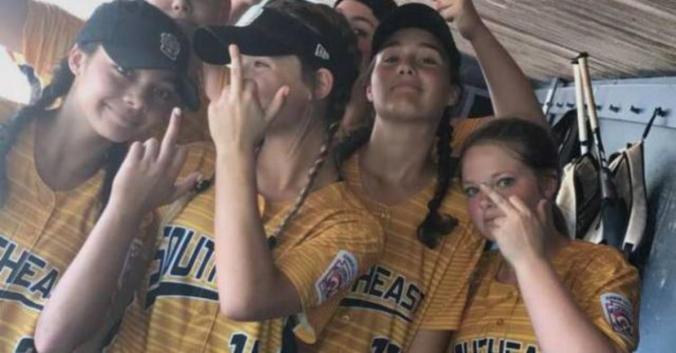
Here and Virginia, many are steaming over the harsh punishment handed down to the victorious Atlee Little League girls’ softball team, which was kicked out of  the Junior League World Series,  featuring the best 12-to-15-year-old girls teams in the world, only hours before its players were about to take the field on national television. The team’s offense: an unsportsmanlike social media post, taunting its last opponent.

Atlee prevailed in a week long tournament in Kirkland, Washington, culminating in tense 1-0 victory in the semifinal game against the host team. Apparently resentment between the teams ran high, and the game featured a controversy over the Kirkland team stealing signs. (Stealing signs in a girls’ softball game? Wow. I didn’t even think there were signs in girls’ softball!)

After the victory, the carptain of the Atlee team used Snapchat to post a photo of showing six members of the team flipping the Fuck You Finger at the Kirkland team.

The Atlee manager Scott Currie heard about the post and had it deleted. Then he arranged for his team to deliver a formal apology in person  to the Kirkland players the same evening. Nonetheless, it was too little, too late. The next morning the head office of the Little League World Series disqualified Atlee from the tournament, and awarded Kirkland the berth in the title game.

The Junior League  issued the following statement:

“After discovering a recent inappropriate social media post involving members of Atlee Little League’s Junior League Softball tournament team, the Little League® International Tournament Committee has removed the Southeast Region from the 2017 Junior League Softball World Series for violation of Little League’s policies regarding unsportsmanlike conduct, inappropriate use of social media, and the high standard that Little League International holds for all its participants.”

Not surprisingly, supporters of the Atlee team, and the team itself, feel that the punishment is excessive.

Observations: Continue reading

Ethics Quiz: “13 Reasons Why”

“13 Reasons Why” is a Netflix  television series based on the 2007 novel “Thirteen Reasons Why” by Jay Asher. A high school student receives a box containing 13 cassette tapes recorded by his friend Hannah Baker, before she committed  suicide. The show has been a critical and popular success (although the Times didn’t like it much) , and a second season is planned.

But Researcher John Ayers of San Diego State University has studied the results of the show on the culture by monitoring discussions of suicide on the internet following the debut of “13 Reasons Why.” The phrases “how to commit suicide” and “commit suicide”  have experienced a 26% and 18% increase in searches. Ayers sees no other explanation for this other than the show.  Searches for the phrase “suicide hotline number” also jumped, by 21%

Ayers now says, “Our worst fears were confirmed That is, thousands of people, thousands more, are searching online about ways to kill themselves.”

Ayers wants the first season to be re-edited to discourage suicidal behavior, and argues that the second season should be postponed. “Psychiatrists have expressed grave concerns because the show ignores the World Health Organization’s validated media guidelines for preventing suicide. The show’s staff instead continue to prefer their gut instincts,” Ayers says.

Your Ethics Alarms Ethics Quiz of the Day is this head-scratcher…

Is it ethical for Netflix to continue running the series in light of Ayers’ research and recommendations?

Continue reading

More Speech Policing In The Service Of Political Correctness: The Matt Joyce Affair

“GET HIM! He used a bad word!!!”

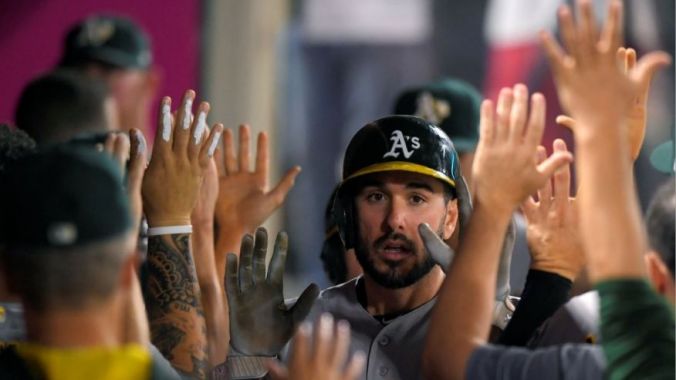
An obnoxious fan was verbally abusing Oakland A’s player Matt Joyce during 8-6 loss to the Los Angeles Angels, and he responded in kind, or perhaps worse than in-kind, since what the fan was saying has not been reported. In his angry exchange with the fan, however, Joyce used what is only described as an “anti-gay slur,” which I assume to be “fag” or faggot.” If it was “cocksucker,” which I don’t believe is an anti-gay slur as used by athletes and others, then the description is misleading.

I have no problem with the fact that Joyce was disciplined for this. He’s a professional, and major league players have to put up with fans, even those who behave despicably. (Harassing a player with abusive verbiage is unethical, and the fan should have been ejected.) However, the player’s offense was a single word, and the punishment was two games suspension, which in Joyce’s case is about a $60,000 fine. $60,000 for a single word hurled in the midst of an argument is cruel and unusual punishment. Worse, Major League Baseball required that Joyce now participate in an outreach program with PFLAG, a “family and ally organization” supporting the LGBTQ community. That’s indoctrination, and an abuse of authority. The issue is incivility, not insufficient sensitivity to a minority group.

Joyce grovelled and apologized all over the place on Twitter, as if he had condemned the entire LGBT community. He needed to apologize to the fan he used the word on. That’s all. As we discussed in the case of a previous ballplayer, Kevin Pillar, disciplined this year for using the same term during play, this appears to be virtue-signalling by MLB, and unfair. Would Joyce have been suspended for, say, calling the fan “fuckhead”? Would he have to go to Fuckhead Sensitivity Training?

I wrote, Continue reading