…and James Cagney. And Kirk Douglas. And Bette Davis. And Rita Hayworth.
Seeing Kirk Douglas at the Golden Globes revived the concern that every Christmas season intensifies for me, when I realize that it is only Christmas that keeps such giants of entertainment past as Gene Autry, Bing Crosby and Dean Martin from fading into permanent obscurity. The cultural figures who we remember are mostly the beneficiaries of moral luck, not a fair merit-based calculation. It is a random process, and culture, which is significantly defined by who and what we remember and who and what we forget, should not be shaped by coincidence, chance, and random amnesia.
It should not be, but it is. A classic example outside the realm of entertainment is the strange case of Col. Joshua Lawrence Chamberlain, the hero of Little Round Top in the Battle of Gettysburg, and by some assessments the savior of the Union itself. When the story of Gettysburg was assembled by the battlefield commission, plaques erected and statues placed. Chamberlain’s desperate stand protecting the Union army’s flanks on Day Two of the battle didn’t make the cut. Despite as remarkable a career as anyone from Maine could have, and more than one shining moment of distinction during the Civil War, he was forgotten for more than a century. Then a brilliant, best-selling historical novel, “The Killer Angels,” recounted his heroics leading the 20th Maine so vividly that Chamberlain memory was re-animated, and began receiving the attention from historians that it deserved from the start.
In popular culture, whether a performer’s unique talents and contributions are remembered after more than a generation is now almost entirely dependent on whether there is a film featuring them that is regularly presented on television. Only a handful of performers who have permanently entered iconic status avoid that standard: I’d include Charlie Chaplin, Marilyn Monroe, Fred Astaire, Judy Garland, Shirley Temple and John Wayne in this category, with a few debatable others. (And even the Little Tramp, MM, Fred, Judy and The Duke aren’t necessarily safe: once Rudolf Valentino, Laurel and Hardy, Lon Cheney, Greta Garbo, Boris Karloff and James Dean could be safely called icons. I doubt one Millennial in a hundred could identify any of them. Marlene Dietrich has a thumb-hold on her iconic status only because of Madeline Kahn’s film-long send-up of her in “Blazing Saddles.”) Continue reading →
1 The ancient Greeks in my family were pleased. Yesterday could be used in public schools to teach the concept of hubris. I doubt that public schools teach concepts like hubris, unfortunately. (I doubt that most public school teachers could explain hubris.) For in a single day..
We saw Steve Bannon dismissed from his kingdom, right-wing propaganda organ Breitbart.
We learned that Joe Arpaaio, who is only not facing prison time because of a generous pardon frm President Trump, and who lost his latest election for sheriff, and who is 85-years-old, announced his candidacy for the U.S. Senate in Arizona.
NJ Governor Chris Christie gave his farewell address, celebrating himself. Earlier this week he said that he would be President today if not for Donald Trump.
2. “What’s done is done.” Yesterday, a Democratic mouthpiece who sounded like Kristin Chenoweth on speed (looked like her too) was confronted with videotapes of the last two Democratic Presidents swearing that they were committed to strengthening the borders and enforcing immigration laws. “We are a nation of immigrants,” intoned Bill Clinton. “We are also a nation of laws.”
“What’s done is done,” blathered ‘Kristin.’
This is the unethical rationalization known on the Ethics Alarms list as #51 . The Underwood Maneuver, or “That’s in the past”:Continue reading →
Regular readers here know I’m a sucker for Presidential history, even when I’m not the one expounding on it. I’m also a sucker for posts that I would otherwise have to write myself., and I was outlining a very similar post to this when Steve-O-in-NJ kindly produced this Comment of the Day. For of there is one thing my life-time love affair with the Presidency and the men who have had the audacity to try, always with mixed success, to fulfill its crushing challenges, has taught me, it is that these were all weird men, each in their own unique ways. You have to be weird to seek this job, or survive it. The argument that Donald Trump’s undeniable weirdness is somehow deserving of less tolerance than any of the other Presidents is bigotry mixed with ignorance. Leadership is itself abnormal, and has infinite guises.
Washington was an inch away from leading an army personally to put down the Whiskey Rebellion. Andrew Jackson had a notorious temper (all his life), fought duels (though not while in office), and said he was going to hang the first South Carolinian who defied Federal law to the first tree he could find if bloodshed resulted from that defiance. LBJ gave interviews while on the toilet, more than once. Jimmy Carter talked about having consulted with his young daughter regarding policy matters and claimed to have seen a UFO. Calvin Coolidge brushed off a reporter who had made a bet that she could get more than two words out o him by saying “you lose.” Grover Cleveland had half his jaw cut out due to cancer and told the press he had two bad teeth extracted. He also married a woman who was young enough to be his daughter. Lincoln of course battled what we’d probably now recognize as clinical depression.
The two biggest offenders for presidential disability were Woodrow Wilson, who was actually completely disabled by a stroke and hid it, in effect making the nation an oligarchy ruled by his wife and closest advisors, and JFK, who hid the fact that he had Addison’s disease (why that didn’t keep him out of the Navy I don’t know), probably PTSD, and crippling back pain that sometimes left him unable to stand without drugs. I also wonder if it would be out of line to diagnose Clinton with satyriasis, given his behavior.
My main point is that some of the arguably best presidents like Washington and Jackson, others who were at least popular like Cleveland and Clinton, and some that official history is reluctant to examine too closely like JFK (although that is starting to change) all had issues of risky or extreme actions, bizarre behavior, or concealing disability from the public, and no one now calls any of them unfit for office, nor was that charge ever leveled to my knowledge at any of them with any level of seriousness. As far as I know no Republican leader has ever leveled the charge of mental or other unfitness at any Democratic president with any seriousness, although Clinton’s sexcapades, Carter’s incompetence and errors, LBJ’s open crudeness and weirdness, and JFK’s litany of problems presented the opportunity several times. Continue reading →
I am drowning, once again, in deserving Comments of the Day. This is a good thing in many respects, including the special circumstances that I am sick and have the energy of a spent battery. It is perplexing because it threatens to transform EA into an ethics version of Medium and put me out of a job.
One benefit of having such a diverse and erudite crowd here is that people who actually know what they are talking about have a tendency to interject when the discussion gets sloppy. John Billingsley just did this on the topic of dementia, which was much on everyone’s mind as a result of the embarrassing outbreak of the anti-Trump coup plot known here as Plan E in the news media and among “the resistance.” (Here’s an especially revolting effort from yesterday by old Cross-Fire from the Left veteran Bill Press. When a opinion piece begins by calling a professor of psychiatry who has been rebuked by her own association “a leading psychiatrist” and asserts convincing authority in her announcing that the President’s mental health is “unraveling” based on a substantially debunked book, objective people can tell what’s going on, and it isn’t fair, dispassionate analysis.)
The word “dementia” is being tossed about here with little regard to what it actually means. It is a word that has a specific technical meaning and is not something that can be diagnosed by simply watching someone on TV or reading their tweets. There is no specific, single identifying symptom of dementia. Statements someone doesn’t like, decisions someone thinks are bad, slips of the tongue, lapses of memory, spelling or grammatical errors, calling another national leader “Rocket Man” and comparing your button to his, cutting off aid to Pakistan, enforcing the law as written, not believing in global warming, referring to yourself as a stable genius, acting like an idiot at times, doing inexplicable things, being unethical, etc. are not specific symptoms of dementia. Taken all together they do not make the diagnosis of dementia. To make a diagnosis in this manner is no more valid than diagnosing Hillary as having seizures based on a few movements seen on video.
Dementia is a syndrome, a group of symptoms that occur together, not a specific disease. There are many diseases that may result in dementia such as Alzheimer’s disease, Lewy body disease, and vascular disease to name only a few. The DSM V actually eliminated the term “dementia” and replaced it with the term “major neurocognitive disorder” but the diagnostic criteria are essentially unchanged and they are (taken from the DSM V):
Evidence of significant cognitive decline from a previous level of performance in one or more cognitive domains (complex attention, executive function, learning and memory, language, perceptual-motor, or social cognition) based on:
Concern of the individual, a knowledgeable informant, or the clinician that there has been a significant decline in cognitive function; and
A substantial impairment in cognitive performance, preferably documented by standardized neuropsychological testing or, in its absence, another quantified clinical assessment.
The cognitive deficits interfere with independence in everyday activities (i.e., at a minimum, requiring assistance with complex instrumental activities of daily living such as paying bills or managing medications).
There are a couple of other technical requirements that are not pertinent to this discussion.
As you can see the first criteria requires a “significant cognitive decline” in one or more areas of functioning. I don’t believe anyone can give specific examples from available sources to conclusively show there has been a significant decline. I don’t think there is any available evidence that even strongly suggests there has been a significant decline.
Has Trump himself, a knowledgeable informant (not an anonymous source), or a clinician who has actually examined him expressed concern that he has experienced a significant cognitive decline? Both Theresa May and Mike Pompeo, though not clinicians, have at least interacted with him in circumstances that would be likely to reveal significant cognitive impairment, and they say no. Has there been standardized testing or other quantified clinical assessment? If there is, it certainly isn’t public knowledge. Does he require assistance with taking his medications and paying his bills? I don’t know but I rather doubt it.
For anyone other than a qualified professional who has actually examined him to diagnose that he is demented is simply name calling and should be given the weight it deserves. Absolutely none. Now if you want to call him demented, a moron, an idiot, or anything else in the slang rather than technical sense of those terms, have at it, but don’t then try to pretend that you made a real diagnosis carrying any weight or satisfying the requirements of the 25th Amendment.
…I agree with you that this stuff is as mission-critical as anything.
As you know, my life’s work is studying trust, and while I focus on interpersonal trust, you can’t ignore the systemic institutional issues either. In fact, they are connected.
In fact, I agree with your fundamental point that the cure for what ails our institutions must lie in personal behaviors, personal relationships, personal ethics.
Without taking anything away from that fundamental and massive agreement, let me suggest two tweaks to the issue as you have presented it.
The first is that this is NOT simply a US phenomenon. I recommend even more sobering reading from the Edelman Trust Barometer, a study that has been ongoing for over a decade. See the 2017 version here: https://www.edelman.com/global-results/
That survey covers about 18 western countries: fully half of them report the level of distrust in institutions – business, communications, NGOs, CEOs, etc. – not materially different from what we see in the US. Continue reading →
1 Golden Globes hangover I. Following up on a point made in yesterday’s Golden Globes post, presenter Natalie Portman’s much-praised but unfair innuendo that the directors nominated in the “best director” category were there because of gender bias rather than the quality of their work was an example of shooting the bystander rather than the villain. The fact that women don’t get the opportunities to direct major films that men do–as a result of many factors, none of which relate to the relative directing abilities of the two pools–is not the fault of the male directors who get the jobs, nor does the fact of discrimination make the films that women do get to direct inherently better and more award-worthy than they are.
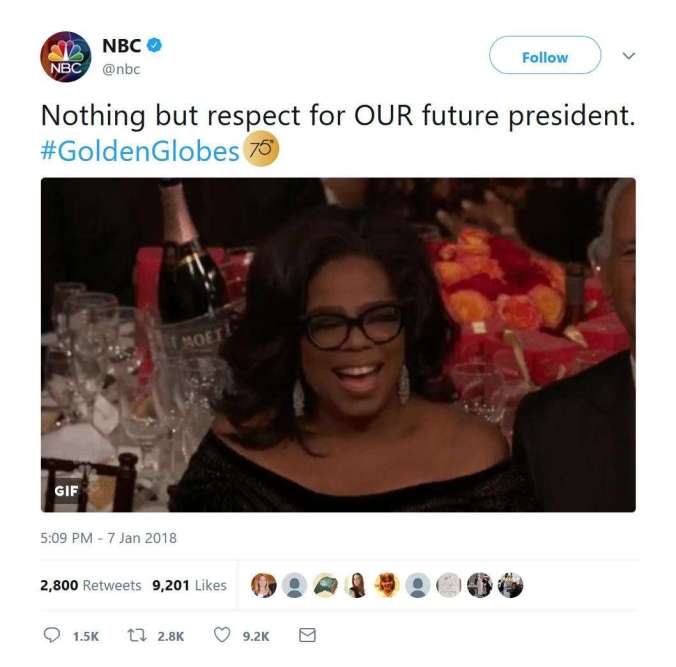
2. A Nation of Silly People. I warned that electing Donald Trump as President would eventually turn us into a Nation of Assholes, and that has come to pass with unexpected rapidity. I did not see the development resulting in the US becoming a nation of silly people, though that process was well underway already. The rush to anoint Oprah Winfrey as the savior of the Republic based on a speech at an entertainment awards show, however, is new evidence of the damage done to the nation’s values by the Trump trauma. Oprah is a cult, pop culture figure; a democracy deteriorating into a society where celebrities and cult leaders become political leaders was one of the fears expressed by our Founders. For the Left to embrace Oprah is stunning hypocrisy, after more than a year of (correctly) accusing Republicans of nominating a Presidential candidate with none of the qualifications traditionally required to be taken seriously as a contender for the office. Many unhealthy trends of long standing pointed to this eventuality,it is true: celebrity obsession, poor civic education, ignorance of history, and new age gibberish, plus the stunning absence of legitimate leaders in both political parties. Having followed O for a long time, since her days in Baltimore as a rising life-style reporter, I recognize a lot of warning signs regarding her ethical instincts, such as her addiction to talking about “personal truths,” which is just a sneaky way of endorsing “alternate facts,” her troubling anti-vaxx statements, her promotion of fake experts like Dr. Oz and Dr. Phil, her race-baiting, and more. There will be plenty of time to elaborate on these if and when her candidacy becomes more than a twinkle in E!’s eye. I doubt that we’ll get there, but as President Trump proved, you never know in the United States of America.
3. A “Nah, there’s no media bias against Trump” note: During the Golden Globes broadcast, NBC, that paragon of journalism integrity, tweeted this:
4. Fake news in irresponsible punditry. I have been meaning to write about this op-ed by New York Times “contributing opinion writer” Kashana Cauley for more than a week now, and the task has seemed so odious that I have avoided it. It is as bad an op-ed as I have ever seen, full of false assertions, misrepresentations , rationalizations and racial hate. I wonder when the New York Times editors reached the point where they would regard such trash as fit to be published under its banner. Rather than dissect the ugly thing as I originally intended, I’ll let you do the work, with me just pointing out some, but far from all, of the features that make this such unethical op-ed page content. Continue reading →
I worked very hard to qualify as an ‘xyzist’ (initially in the UK finance industry in the 1970s) and the profession has served me very well, across much of the world. Part of the reason why I could earn big bucks was that I was trusted. My employer needed my sign off. The head regulator was generally a qualified ‘xyzist’ too. No Board would dare go far without support from a qualified ‘xyzist’.
The professional body (The Institute of ….) was strong, controlling entry (with hard exams), and policing behaviour with professional standards, codes of conduct and a disciplinary system. The profession largely wrote the rules and regulations for the industry. We always maintained we were acting in the ‘public interest’. At least superficially, we took our version of ‘noblesse oblige’ very seriously.
We, of course, weren’t the only elite and cosy profession, and in times of stress we could join together with others (lawyers, accountants, elite civil servants etc.) to present a united front against ‘unsound’ proposals.
That cosy world has now largely disintegrated, and perhaps it deserved to. Margaret Thatcher viewed the professions with particular suspicion as being self serving and in restraint of trade. The tide in academia has been towards open competition and ‘freedom with disclosure’, and quite unsupportive of unaccountable elites (largely male and similarly educated) setting the rules. Continue reading →
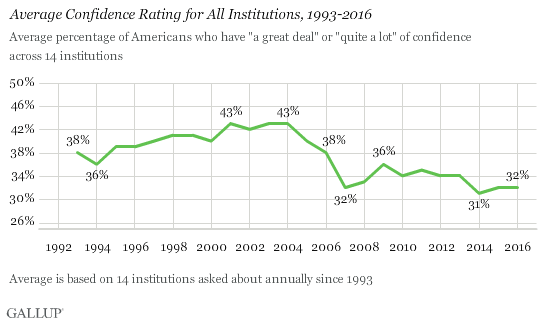
In Part 1, we looked at the implications of Gallup’s 2017 polling on Americans’ beliefs in the trustworthiness and honesty of various occupations. This post looks at institutions, and what Gallup’s research shows us when those polled answer the question, “Now I am going to read you a list of institutions in American society. Please tell me how much confidence you, yourself, have in each one — a great deal, quite a lot, some or very little?”
As with the occupations poll results, what is most interesting—or depressing— is how the public’s attitude has changed over time. Gallup has been taking this poll at the end of every year since 1993, and in some years, for some institutions, before that.
The most important finding is that Americans have less trust and confidence in our institutions than ever before, and have been in this state for three straight years. (See chart above.) The 32% average confidence level in all institutions measured was one point above 2016, which came in at a record low 31%, but that difference is not statistically significant. This is the third straight year that the number has been under 33%. That has never happened before.
I have written about this issue in the past (and discussed it with professional groups, like newly elected state legislators, in ethics seminars), with the same alarm. For a democracy to lack confidence and trust in its institutions portends disaster, and the danger cannot be understated. Of all forms of government, it is democracy that is most built on a foundation of public trust. This erosion in public trust—the average level of trust has fallen about 26% in just ten years—is collectively frightening. Look at the first line and the last in many of these charts: Continue reading →
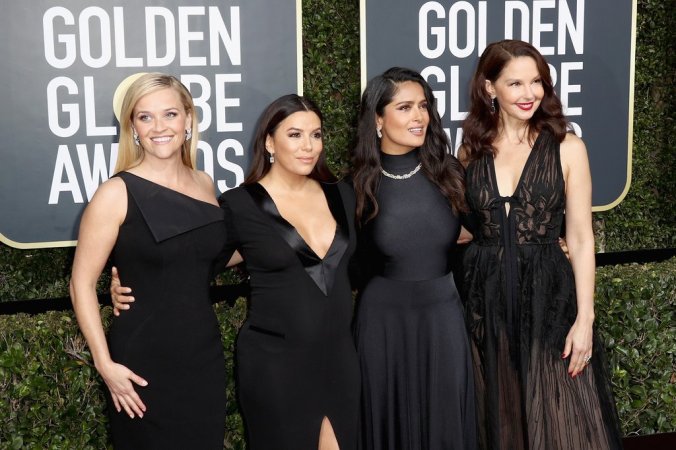
It is not surprising that last night’s Golden Globes award, pre-hyped as some kind of virtuous purging of the old, bad Hollywood culture where men used their power to sexually abuse women, and women submitted–and stayed silent—to achieve power and wealth of their own, was self-contradictory, hypocritical and incoherent.
What, for example, did the all-black outfits mean? Here is B-list actress Amber Tamblyn trying to explain in the New York Times:
“We actresses are not just modeling clothing when we walk a red carpet on award show night. We are modeling a kind of behavior. We are speaking in a coded language to other women — even young girls — that says: The way I look and what I wear and how I wear it is the standard for women. What is being worn is not an exception. It is the rule. You must dress a certain way and look a certain way if you want to be valued as a woman, no matter what you do for a living or who you are. We never intend for this to be the message we are sending with what we wear, but often it is the perceived one, whether we like it or not…Tonight, you will see just such an experiment as myself and hundreds of women from the Time’s Up movement will reject colorful gowns for black ones on the Golden Globes’ red carpet and at related events across the country. Wearing black is not all we will be doing. We will be doing away with the old spoken codes in favor of communicating boldly and directly: What we are wearing is not a statement of fashion. It is a statement of action. It is a direct message of resistance. Black because we are powerful when we stand together with all women across industry lines. Black because we’re starting over, resetting the standard. Black because we’re done being silenced and we’re done with the silencers. Tonight is not a mourning. Tonight is an awakening.”
Oh. What? This is Authentic Frontier Gibberish. I sincerely doubt that what actresses wear on the red carpet has as much influence, or even close to it, on young women as what the actresses wear in films and TV. The black is a statement of action? What action? Resistance to what? Anyone who thinks that now, suddenly, a hundred years of a corrupt culture has been erased, and that if a message is sent by a male director, producer or star that an ambitious young actress can prevail over her competition by acceding to a date, a grope, or a night of sex, that won’t get essentially the same results it always has is naive. Tamblyn doesn’t think that, and I guarantee that Meryl Streep doesn’t think that. This means that the all-black stunt was just grandstanding, and a mass deception upon the public.
If this was genuinely turning the page, why didn’t any of the actors—not one–mention Harvey Weinstein? They didn’t because they are afraid that he might come back, that’s why. Mel Gibson came back. David Begelman came back. Hollywood has a cruel, venal, ethics free,culture, and all of these women and actors know it. They won’t burn bridges, not completely. This is why Rose McGowan, who was the most vocal and audacious of the abused actresses, one who took grave personal risks to accuse Weinstein of raping her and then paying her off, as well as Ashley Judd and Salma Hayek, who both went public with the abuse before other stars felt secure enough to come forward–Hayek wrote that Weinstein threatened to have her killed —were completely ignored during the ceremony. Nobody saluted them. Nobody thanked them. Harvey might take it personally.
When host Seth Meyers, in his opening monologue, mentioned Weinstein, it was with this jibe “Harvey Weinstein can’t be here tonight because, well, I’ve heard rumors that he’s crazy and difficult to work with.” (That was an anti-Trump shot, of course) “But don’t worry — he’ll be back in 20 years when he becomes the first person ever booed during the ‘In Memoriam’ segment.”
The crowd, supposedly there explicitly rejecting the Weinstein culture, moaned and booed. What bad taste for Myers! Imagine, being mean to a rapist! (“See Harvey? I didn’t laugh! Can I read for that part?”) Continue reading →
1 On the other hand, “Bite me!” I find myself feeling bad about a Facebook retort yesterday laying out an old friend, also a former Democratic official’s staff member, for taking a snide shot at my “bias” after my answer to a query about anti-Trump legal ethicist Richard Painter. Painter has been on the “remove Trump by any means possible” bandwagon since the 2016 election, and because he was an ethics advisor to the Bush White House, he has been a favorite go-to source for CNN and MSNBC while authoring bizarre op-eds that distort the Constitution. My response about Painter was that he has apparently been driven mad by the whole Trump experience, and is now in the process of wrecking a very fine reputation as his colleagues in the field, like me, roll their eyes and weep. (Painter is a Bush family loyalist, and the guessing is that he is following the lead of the two Georges, who hate Trump to pieces.) Yes, Richard was among the first to advocate Plan E, removing Trump because he is “unable” to do the job, so he’s especially hot right now.
I feel bad because I’m a nice guy, but I’ll be damned if I will put up with being called “biased” for correctly pointing out what is dishonest and wrong about the various plots to circumvent the election. It’s not a “bias” to believe that an entire party attempting to undermine an elected President is wrong, and that lawyers and ethicists who pander to that mob have slipped a professional cog. I sent my friend to this website to find any evidence that I am a Trump fan, other than being the apparently rare critic who will give the President credit when he deserves it, and who will defend him against fake news and dishonest accusations. I’m a passionate supporter of U.S. values, the system, our institutions, the Presidency itself and elections. That’s not bias. That’s called being an ethical citizen.
2. Signature significance for a weasel. Five days after his reported quotes in “Fire and Fury” including one accusing Don Jr. of “treason” caused President Trump to slam him on Twitter, former White House aide and Breitbart power Steve Bannon sent an “apology” to Axios, of all places. This is known as ” crawling back.” Bannon, while at the White House, leaked to reporters and played both ends against the middle to further his own agenda, and betrayed the President’s trust and confidence by aiding and abetting sleazy political gossip-monger Michael Wolff. Now, after Bannon’s split with Trump has obviously cost him support, influence and credibility, the man who chomped on the hand that fed him wants a do-over. Only the worst species of unethical and unprincipled weasel would try something like this. If he genuinely regretted the quotes, he would have immediately said that they misrepresent him, and repudiated them. Waiting five days makes it clear that Bannon was waiting to see how the episode was playing in the media and public to decide whether to stand by his own words or not. The short version of this is: “Integrity? What’s that?”
Moreover, the text of the “apology” shows that Bannon isn’t very bright. Why bother looking pathetic and weak if you aren’t even going to do it effectively? He doesn’t even apologize: he says that he regrets his “delay in responding to the inaccurate reporting regarding Don Jr has diverted attention from the president’s historical accomplishments in the first year of his presidency.”
An insincere and dishonest apology designed to allow the wrongdoer to escape accountability cheaply, and to deceive his or her victims into forgiveness and trust, so they are vulnerable to future wrongdoing.
3. Is expressing “regret” the same as an apology? Let’s look closely at which mainstream media outlets call Bannon’s statement an “apology.” Axios does. When President Obama was making his so-called “apology tour,” as it was dubbed by the Right, journalists rushed to his defense, arguing that saying in multiple nations that he “regretted” the policies of his predecessors and the past actions of the United States was not the same as apologizing for them.
4. Somewhere, Dan Rather is smiling...I’m putting this in the Warm-Up because, as you may have noticed, yesterday’s posts were dominated by “the resistance’s” Plan E and the news media’s dutiful assist by hyping “Fire and Fury.” Incredibly—yes, I’m an idiot: the degree to which the news media will abandon core journalism ethics if it means bringing Trump down still surprises me–there was little effort on the news shows yesterday to hide the fact that much of Wolff’s book is unreliable, and that the author admits it. Nonetheless, they reported on the salacious quotes and accounts, debated in panels whether it “proved” the President is disabled, and generally presented the book to the public as fact, not fiction.
How can journalists possibly justify this? It can’t be justified, but the news media’s anti-Trump bias has made them stupid and incompetent.
For example, CNN MEDIA ETHICIST—I have to place both hands over my head to prevent an explosion when I type that, which means I have to type with my nose—Brian Stelter tweeted,
Big picture point: Wolff’s errors are sloppy, but many Trump experts say the book “rings true” overall.






I am drowning, once again, in deserving Comments of the Day. This is a good thing in many respects, including the special circumstances that I am sick and have the energy of a spent battery. It is perplexing because it threatens to transform EA into an ethics version of Medium and put me out of a job.
One benefit of having such a diverse and erudite crowd here is that people who actually know what they are talking about have a tendency to interject when the discussion gets sloppy. John Billingsley just did this on the topic of dementia, which was much on everyone’s mind as a result of the embarrassing outbreak of the anti-Trump coup plot known here as Plan E in the news media and among “the resistance.” (Here’s an especially revolting effort from yesterday by old Cross-Fire from the Left veteran Bill Press. When a opinion piece begins by calling a professor of psychiatry who has been rebuked by her own association “a leading psychiatrist” and asserts convincing authority in her announcing that the President’s mental health is “unraveling” based on a substantially debunked book, objective people can tell what’s going on, and it isn’t fair, dispassionate analysis.)
This is John’s Comment of the Day on the post, Morning Ethics Warm-Up, 1/7/2018: Lies, Dunces, Fools, Villains, Hypocrites And Big Liars In The Resistance’s Plan E, “The President Is Disabled!” [Part I]: