Public Confidence And Trust (2): Observations On Gallup’s Confidence In Institutions Poll

In Part 1, we looked at the implications of Gallup’s 2017 polling on Americans’ beliefs in the trustworthiness and honesty of various occupations.  This post looks at institutions, and what Gallup’s research shows us when those polled answer the question, “Now I am going to read you a list of institutions in American society. Please tell me how much confidence you, yourself, have in each one — a great deal, quite a lot, some or very little?”

As with the occupations poll results, what is most interesting—or depressing— is how the public’s attitude has changed over time. Gallup has been taking this poll at the end of every year since 1993, and in some years, for some institutions, before that.

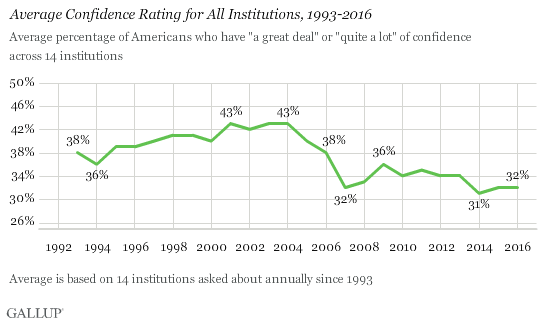
The most important finding is that Americans have less trust and confidence in our institutions than ever before, and have been in this state for three straight years. (See chart above.) The 32% average confidence level in all institutions measured was one point above 2016, which came in at a record low 31%, but that difference is not statistically significant. This is the third straight year that the number has been under 33%. That has never happened before.

I have written about this issue in the past (and discussed it with professional groups, like newly elected state legislators, in ethics seminars), with the same alarm. For a democracy to lack confidence and trust in its institutions portends disaster, and the danger cannot be understated. Of all forms of government, it is democracy that is most built on a foundation of public trust. This erosion in public trust—the average level of trust has fallen about 26% in just ten years—is collectively frightening. Look at the first line and the last in many of these charts: Continue reading

As Expected, The Golden Globes Were Ethically Incoherent

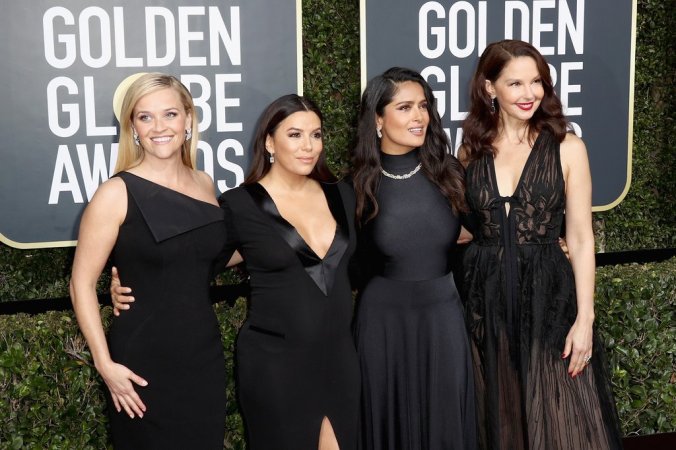
It is not surprising that last night’s Golden Globes award, pre-hyped as some kind of virtuous purging of the old, bad Hollywood culture where men used their power to sexually abuse women, and women submitted–and stayed silent—to achieve power and wealth of their own, was self-contradictory, hypocritical and incoherent.

What, for example, did the all-black outfits mean? Here is B-list actress Amber Tamblyn trying to explain in the New York Times:

“We actresses are not just modeling clothing when we walk a red carpet on award show night. We are modeling a kind of behavior. We are speaking in a coded language to other women — even young girls — that says: The way I look and what I wear and how I wear it is the standard for women. What is being worn is not an exception. It is the rule. You must dress a certain way and look a certain way if you want to be valued as a woman, no matter what you do for a living or who you are. We never intend for this to be the message we are sending with what we wear, but often it is the perceived one, whether we like it or not…Tonight, you will see just such an experiment as myself and hundreds of women from the Time’s Up movement will reject colorful gowns for black ones on the Golden Globes’ red carpet and at related events across the country. Wearing black is not all we will be doing. We will be doing away with the old spoken codes in favor of communicating boldly and directly: What we are wearing is not a statement of fashion. It is a statement of action. It is a direct message of resistance. Black because we are powerful when we stand together with all women across industry lines. Black because we’re starting over, resetting the standard. Black because we’re done being silenced and we’re done with the silencers. Tonight is not a mourning. Tonight is an awakening.”

Oh. What? This is Authentic Frontier Gibberish. I sincerely doubt that what actresses wear on the red carpet has as much influence, or even close to it, on young women as what the actresses wear in films and TV. The black is a statement of action? What action? Resistance to what? Anyone who thinks that now, suddenly, a hundred years of a corrupt culture has been erased, and that if a message is sent by a male director, producer or star that an ambitious young actress can prevail over her competition by acceding to a date, a grope, or a night of sex, that won’t get essentially the same results it always has is naive. Tamblyn doesn’t think that, and I guarantee that  Meryl Streep doesn’t think that. This means that the all-black stunt was just grandstanding, and a mass deception upon the public.

If this was genuinely turning the page, why didn’t any of the actors—not one–mention Harvey Weinstein? They didn’t because they are afraid that he might come back, that’s why. Mel Gibson came back. David Begelman came back. Hollywood has a cruel, venal, ethics free,culture, and all of these women and actors know it. They won’t burn bridges, not completely. This is why Rose McGowan, who was the most vocal and audacious of the abused actresses, one who took grave personal risks to accuse Weinstein of raping her and then paying her off, as well as Ashley Judd and Salma Hayek, who both went public with the abuse before other stars felt secure enough to come forward–Hayek wrote that Weinstein threatened to have her killed —were completely ignored during the ceremony. Nobody saluted them. Nobody thanked them. Harvey might take it personally.

When host Seth Meyers, in his opening monologue, mentioned Weinstein, it was with this  jibe “Harvey Weinstein can’t be here tonight because, well, I’ve heard rumors that he’s crazy and difficult to work with.”  (That was an anti-Trump shot, of course) “But don’t worry — he’ll be back in 20 years when he becomes the first person ever booed during the ‘In Memoriam’ segment.”

The crowd, supposedly there explicitly rejecting the Weinstein culture,  moaned and booed. What bad taste for Myers! Imagine, being mean to a rapist! (“See Harvey? I didn’t laugh! Can I read for that part?”) Continue reading

Morning Ethics Warm-Up, 1/8/2018: Regrets, “It Rings True,” Bannon The Weasel, And “But It Would Be Wrong…”

Good Morning, everyone!

1 On the other hand, “Bite me!” I find myself feeling bad about a Facebook retort yesterday laying out an old friend, also a former Democratic official’s staff member, for taking a snide shot at my “bias” after my answer to a query about anti-Trump legal ethicist Richard Painter. Painter has been on the “remove Trump by any means possible” bandwagon since the 2016 election, and because he was an ethics advisor to the Bush White House, he has been a favorite go-to source for CNN and MSNBC while authoring bizarre op-eds that distort the Constitution.  My response about Painter was that he has apparently been driven mad by the whole Trump experience, and is now in the process of wrecking a very fine reputation as his colleagues in the field, like me, roll their eyes and weep. (Painter is a Bush family loyalist, and the guessing is that he is following the lead of the two Georges, who hate Trump to pieces.) Yes, Richard was among the first to advocate Plan E, removing Trump because he is “unable” to do the job, so he’s especially hot right now.

I feel bad because I’m a nice guy, but I’ll be damned if I will put up with being called “biased” for correctly pointing out what is dishonest and wrong about the various plots to circumvent the election. It’s not a “bias” to believe that an entire party attempting to undermine an elected President is wrong, and that lawyers and ethicists who pander to that mob have slipped a professional cog. I sent my friend to this website to find any evidence that I am a Trump fan, other than being the apparently rare critic who will give the President credit when he deserves it, and who will defend him against fake news and dishonest accusations. I’m a passionate supporter of U.S. values, the system, our institutions, the Presidency itself and elections. That’s not bias. That’s called being an ethical citizen.

2. Signature significance for a weasel. Five days after his reported quotes in “Fire and Fury” including one accusing Don Jr. of “treason” caused President Trump to slam him on Twitter, former White House aide and Breitbart power Steve Bannon sent an “apology” to Axios, of all places. This is known as ” crawling back.” Bannon, while at the White House, leaked to reporters and played both ends against the middle to further his own agenda, and betrayed the President’s trust and confidence by aiding and abetting sleazy political gossip-monger Michael Wolff.  Now, after Bannon’s split with Trump has obviously cost him support, influence and credibility, the man who chomped on the hand that fed him wants a do-over. Only the worst species of unethical and unprincipled weasel would try something like this. If he genuinely regretted the quotes, he would have  immediately said that they misrepresent him, and repudiated them. Waiting five days makes it clear that Bannon was waiting to see how the episode was playing in the media and public to decide whether to stand by his own words or not. The short version of this is: “Integrity? What’s that?”

Moreover, the text of the “apology” shows that Bannon isn’t very bright. Why bother looking pathetic and weak if you aren’t even going to do it effectively? He doesn’t even apologize:  he says that he regrets his “delay in responding to the inaccurate reporting regarding Don Jr has diverted attention from the president’s historical accomplishments in the first year of his presidency.”

Ha! I bet he does. But this is a Level 10 apology on the Apology Scale:

An insincere and dishonest apology designed to allow the wrongdoer to escape accountability cheaply, and to deceive his or her victims into forgiveness and trust, so they are vulnerable to future wrongdoing.

3. Is expressing “regret” the same as an apology? Let’s look closely at which mainstream media outlets call Bannon’s statement an “apology.” Axios does. When President Obama was making his so-called “apology tour,” as it was dubbed by the Right, journalists rushed to his defense, arguing that saying in multiple nations that he “regretted” the policies of his predecessors and the past actions of the United States was not the same as apologizing for them.

4. Somewhere, Dan Rather is smiling...I’m putting this in the Warm-Up because, as you may have noticed, yesterday’s posts were dominated by “the resistance’s” Plan E and the news media’s dutiful assist by hyping “Fire and Fury.” Incredibly—yes, I’m an idiot: the degree to which the news media will abandon core journalism ethics if it means bringing Trump down still surprises me–there was little effort on the news shows yesterday to hide the fact that much of Wolff’s book is unreliable,  and that the author admits it. Nonetheless, they reported on the salacious quotes and accounts, debated in panels whether it “proved” the President is disabled, and generally presented the book to the public as fact, not fiction.

How can journalists possibly justify this? It can’t be justified, but the news media’s anti-Trump bias has made them stupid and incompetent.

For example, CNN MEDIA ETHICIST—I have to place both hands over my head to prevent an explosion when I type that, which means I have to type with my noseBrian Stelter tweeted,

Big picture point: Wolff’s errors are sloppy, but many Trump experts say the book “rings true” overall.

Continue reading

Lies, Dunces, Fools, Villains, Hypocrites And Big Liars In The Resistance’s Plan E, “The President Is Disabled!” [Part 3]

This topic started out as a morning warm-up and has stretched into three posts. I’m sorry: the more I look at it, the more infuriating Plan E appears.

Let’s briefly recap, shall we?

…The news media, using the dubious claims of Michael Wolff as its catalysts, and following the dictates of the anti-Trump resistance, is trying panic the public into believing that the President is mentally incompetent, and that the provisions of the 25th Amendment might have to be activated, removing him from office.

…That this claim is legitimate, justified, or based on anything but the same view of the President the news media, progressives and Democrats had and loudly publicized through the 2016 campaign is a lie.

…Because it is an audacious, unconscionable lie devoid of evidence or justification being repeated for the purpose of making its targets deny it and discuss it, thus giving it more publicity and legitimacy (“Did the Holocaust really happen?” “Did Trump make a deal to have Russia take down Hillary?”), it fits the description of Hitler’s Big Lie propaganda technique.

…The foundation of this disgusting plot is Bandy Lee, Yale professor of psychiatry who has been condemned by her profession, who is hawking a book, who relies on rationalizations, and whose statements betray a political rather than a professional agenda.

Now we continue…

7.  Ethics Dunces: Everyone who accepts, supports or furthers Plan E, the “Trump is disabled” lie. Ethics Dunce is too mild a name here. We have the mainstream news media proclaiming to the world that the President of the United States is mentally deficient based on tweets, gossip, leaks, unethical diagnoses by discredited professionals, an author who has admitted making things up and lying to the White House to get access, and Steve Bannon. Those who enable Plan E are deliberately risking Constitutional disaster and permanent weakening of our institutions. Jonathan Turley properly called this out as the nonsense that  it was in October, only then the supposed crippling malady being claimed was narcissism. That wasn’t flying—Turley: “If we started removing public servants because they were narcissists, the nation’s Capital might become a virtual ghost town. In D.C., the question isn’t who fits that definition? but, who doesn’t?”—so Lee et al. switched to “dementia.”

That’s equally weak and dishonest, and obviously so to anyone who is objective. In the Washington Examiner, Eddy Scarry asks,  “Why hasn’t Michael Wolff’s dementia-Trump ever been seen in public?” We have seen public figures and elected officials show signs of mental problems, like Nancy Pelosi, who has frequently mixed up names, forgotten where she was, sounded disoriented and confused, and talked gibberish in public appearances, or John McCain, who had a disturbing episode in a Senate hearing before his brain tumor was discovered. Trump has had nothing like that occur, either before or after being elected. Scarry: Continue reading

Comment Of The Day: “Wait, WHAT? NOW They Tell There Are “Two Big Flaws” in Every Computer?”

The comments on this post about the sudden discovery that every computer extant was vulnerable to hacking thanks to two 20-year-old “flaws” were so detailed, informative and excellent that I had the unenviable choice of posting one representative Comment of the Day, or eight. Having just posted eight COTDs on another post last weekend, I opted for one, but anyone interested in the topic—or in need of education about the issues involved— should go to the original post and read all the comments. Forget the post itself—the comments are better.

Here is Extradimensional Cephalopod‘s Comment of the Day on the post, Wait, WHAT? NOW They Tell There Are “Two Big Flaws” in Every Computer?

This is not likely to be a popular opinion among professional programmers, but I feel it needs to be said.

The excuse that computers are complex and that testing to remove all of these flaws would take a prohibitive amount of time just doesn’t hold water. I understand that security vulnerabilities are different from outright bugs: security vulnerabilities are only problems because people deliberately manipulate the system in unanticipated ways. Bugs happen when people inadvertently manipulate the system in unanticipated ways. Some of these ways are incredibly sophisticated and may be infeasible to anticipate. However, having supported computers for the past few years, I’ve seen bugs that should have been anticipated, and zero testing would be required in order to do so.

The problem with testing is that the people testing usually understand the software well enough to know how it is supposed to work, or they are given a few basic things to try, but they don’t have time to test a program with heavy use. Luckily, testing is not the problem.

The problem is that in many cases I’ve seen (and I’ve come to suspect most cases across the software industry) the input and output footprints of code modules are not documented (and if your code contains comments laying out the pseudocode structure, I consider you very lucky). From an engineering standpoint, the input footprint of a system or subsystem describes the conditions the system assumes to be true in order to work effectively. The output footprint describes what effects (including side-effects) the system has or could have on its environment, including if the input footprint is not fulfilled. Those aren’t the official names; I’ve just been calling them that. Continue reading

Lies, Dunces, Fools, Villains, Hypocrites And Big Liars In The Resistance’s Plan E, “The President Is Disabled!” [Part 2]

As their purely, non-partisan, unbiased,professional opinion. of course–just like Prof. Lee today.

[Part I was the Morning Warm-up for 1/7/18, which can be found here.]

4. The Big Lie’s smoking gun. CNN, Politico, MSNBC, Newsweek, The Hill, and many other news sources had headlines this week that were some variation of this one, from CNN:

“Lawmakers consulted psychiatrist about Trump”

The obvious message being conveyed: lawmakers—not just Democrats, but Republicans too!—are worried enough about the President’s mental health that they called in an expert to “brief” them. (“Lawmakers briefed by Yale psychiatrist on Trump’s mental health: report”—The Hill.) This is misleading, dishonest, and factually false—truly fake news. The Weekly Standard, hardly a reflex pro-Trump publication, revealed how false it all was. The story began…

On Wednesday night, before Washington was completely consumed by Michael Wolff’s West Wing tell-all, Politico published a piece feeding into a different frenzy: the notion that Congress was concerned President Trump might be mentally unfit for office. The article, titled “Washington’s growing obsession: The 25th amendment,” claims that more than a dozen lawmakers—all Democrats, with the exception of one nameless Republican senator—attended private briefings in early December with a Yale psychiatry professor to discuss Trump’s mental health. The most interesting detail of the story, of course, was that one rebellious Republican senator had met with Dr. Bandy Lee to discuss her belief that Trump is unfit to serve as commander-in-chief. Politico reported that Lee refused to name the GOP lawmaker she claimed to have had a meeting with.

The reporter, Haley Bird, investigated and…

  • …”was unable to confirm that any Republican Senator actually met with the Yale professor.”
  •  “In an on-the-record phone call with TWS Saturday afternoon, Lee admitted her “meeting” with a Republican senator was not actually scheduled and that it was, in her own words, “accidental.” “The meeting happened—it wasn’t arranged in advance,” she said. “It was accidental. It was incidental, I will say. It was incidental.”

That means that she was not summoned  to “brief” worried Republican lawmakers. It was not a “meeting” is the way the word is routinely used by the news media in political matters. The word is not generally construed to mean “the bumped into each other and had a chat.” Nor is “consulted”  used to describe spontaneous questions in a chance encounter.

The media reporting here was pure hype, blowing an informal. chance meeting—in the hall?–with the unethical psychiatrist who has been unethically diagnosing Trump from afar all year long–into news. That’s propaganda in service of the Big Lie. This was not a bipartisan inquiry into a matter of state. Lee was invited to a partisan meeting of Democrats to determine if she could assist with Plan E, removing the President because of an inability to perform his duties.

5. Let’s meet the primary Ethics Dunce in the Big Lie plot,Yale psychiatry professor Bandy Lee.  She has been claiming for over a year  that Trump is mentally impaired and unfit to serve. Her primary evidence are his tweets. This is because she has never examined him, met him, or had first hand knowledge about any aspect of his conduct or behavior. Because so many Democratic and progressive professionals were moved to violate their ethics codes out of animus to Trump and fealty to the Democratic Party, the head of the American Psychiatric Association handed down this edict in August of 2016:

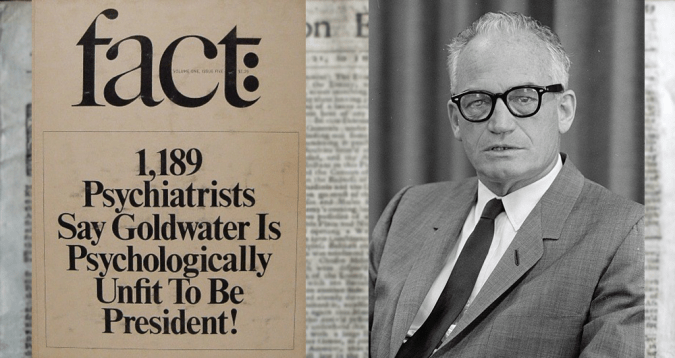
“Since 1973, the American Psychiatric Association and its members have abided by a principle commonly known as “the Goldwater Rule,” which prohibits psychiatrists from offering opinions on someone they have not personally evaluated. The rule is so named because of its association with an incident that took place during the 1964 presidential election. During that election, Fact magazine published a survey in which they queried some 12,356 psychiatrists on whether candidate Sen. Barry Goldwater, the GOP nominee, was psychologically fit to be president. A total of 2,417 of those queried responded, with 1,189 saying that Goldwater was unfit to assume the presidency.

While there was no formal policy in place at the time that survey was published, the ethical implications of the Goldwater survey, in which some responding doctors even issued specific diagnoses without ever having examined him personally, became immediately clear. This large, very public ethical misstep by a significant number of psychiatrists violated the spirit of the ethical code that we live by as physicians, and could very well have eroded public confidence in psychiatry… I can understand the desire to get inside the mind of a Presidential candidate. I can also understand how a patient might feel if they saw their doctor offering an uninformed medical opinion on someone they have never examined. A patient who sees that might lose confidence in their doctor, and would likely feel stigmatized by language painting a candidate with a mental disorder (real or perceived) as “unfit” or “unworthy” to assume the Presidency.

Simply put, breaking the Goldwater Rule is irresponsible, potentially stigmatizing, and definitely unethical.”

Got that? Lee just defied her profession’s standards. During the campaign, she continued to diagnose Trump without his consent or an in-person examination. She justified doing so on the grounds that she is “obligated to break them in times of emergency.” Do I really have to recite all of the rationalizations this transparently disingenuous  excuse employs? Oh, all right…

8A. The Dead Horse-Beater’s Dodge, or “This can’t make things any worse”
13. The Saint’s Excuse: “It’s for a good cause”
24. Juror 3’s Stand (“It’s My Right!”)
25. The Coercion Myth: “I have no choice!”
28. The Revolutionary’s Excuse: “These are not ordinary times.”
30. The Prospective Repeal: “It’s a bad law/stupid rule”
31. The Troublesome Luxury: “Ethics is a luxury we can’t afford right now”
40. The Desperation Dodge or “I’ll do anything!”
45. The Abuser’s License: “It’s Complicated”
58. The Golden Rule Mutation, or “I’m all right with it!”
59. The Ironic Rationalization, or “It’s The Right Thing To Do”

She continued to breach professional ethics standards after the election,  earning a book deal that spawned  “The Dangerous Case of Donald Trump: 27 Psychiatrists and Mental Health Experts Assess a President.” So much for objective, unconflicted, professional analysis. She saw a niche and an audience, and grabbed it.

Lee herself said in an interview that she was a “pariah” at her department  Lee’s book, which came out October 3, expanded on her rationalizations by arguing that psychiatrists have a “duty to warn” the country about President Trump. In response to the book, the APA issued another statement reaffirming the importance of the Goldwater Rule standard “not to provide professional opinions in the media about the mental health of someone they have not personally examined and without patient consent or other legal authority.” It also debunked Lee’s “duty to warn” argument, saying,

 “The APA would also like to dispel a common misconception about the so-called ‘Duty to Warn.’ The duty to warn is a legal concept which varies from state to state, but which generally requires psychiatrists to breach the confidentiality of the therapeutic session when a risk of danger to others becomes known during treatment of the patient. It does not apply if there is no physician-patient relationship.”

She is an unethical professional by her own profession’s standards.

6. The Ethics Dunce’s Unethical Quotes Of The Month. In a jaw-dropping interview with Vox that is  signature significance for Anti-Trump Derangement, Lee says, among other things:

“It would be hard to find a single psychiatrist, no matter of what political affiliation, who could confidently say Trump is not dangerous.”

Yes, and that would be because they couldn’t confidently or ethically make any assertions without actually examining him. Moreover, “dangerous” is not a term of art, and in a political context, which is how Lee is speaking, it is subjective and ambiguous. The Left thinks Trump is dangerous because he chooses to be tough with North Korea.

“On the other hand, in the book we have as authors Phil Zimbardo, Judith Herman, and Robert Jay Lifton, who are notable not only for their contributions to mental health but for their amazing ethical record. These are living legends who have also stood on the right side of history, even when it was difficult, and they stand as beacons for me. No one matches their moral and professional authority, in my mind.”

She defends her unethical conduct because others have breached the same standards. (#1 Everybody Does it, #32. The Unethical Role Model)!

I’m a fan of Philip Zimbardo’s writings, but to say that the man who engineered the infamous Stanford Prison Experiment has an “amazing ethical record” shows selective attention. Zimbardo himself declared that his experiment was unethical! Then, as a blatant tell,  Lee uses “the right side of history,”  Rationalization 1B:

1B. The Psychic Historian, or “I’m On The Right Side Of History”

This especially arrogant and annoying rationalization is essentially “Everybody’s going to do it.”  It is an intellectually dishonest argument, indeed no argument at all. Every movement, every dictator, Nazis, Communists, ISIS, the Klan, activists for every conceivable policy across the ideological spectrum, think their position will be vindicated eventually. In truth, they have no idea whether it will or not, or if it is, for how long. If history teaches anything, it is that we have no idea what will happen and what ideas and movements will prevail. “I’m on the right side of history is nothing but the secular version of “God is on our side,” and exactly as unprovable.

We have heard this rationalization a lot during the escalating culture wars. It is a device to sanctify one’s own beliefs while mocking opposing views, evoking an imaginary future that can neither be proven or relied upon. Nor is there any support for the assertion that where history goes is intrinsically and unequivocally good or desirable. Are millions of aborted babies a year “right”? Is the constantly increasing percentage of children born to unmarried couples “right”?

Those who resort to “I’m on the right side of history” (or “You’re on the wrong side”) are telling us that they have run out of honest arguments.

With this she he also proves that hers is a political position, not an honest, objective professional one.

Those who most require an evaluation are the least likely to submit to one. That is the reason why in all 50 states we have not only the legal authority, but often the legal obligation, to contain someone even against their will when it’s an emergency. So in an emergency, neither consent nor confidentiality requirements hold. Safety comes first. What we do in the case of danger is we contain the person, we remove them from access to weapons, and we do an urgent evaluation. This is what we have been calling for with the president based on basic medical standards of care.

Surprisingly, many lawyer groups have actually volunteered, on their own, to file for a court paper to ensure that the security staff will cooperate with us. But we have declined, since this will really look like a coup, and while we are trying to prevent violence, we don’t wish to incite it through, say, an insurrection.

Gee, you certainly wouldn’t want it to LOOK like a coup….

KABOOM!

That this astoundingly unethical and unprofessional, hyper-partisan academic radical can be the cornerstone of an effort by Democrats and the news media to overthrow a President just exploded my head, and my office looks like an abattoir. I have to take a break. Look for Part 3.

__________________________

Sources: Daily Caller, Vox
Morning Ethics Warm-Up, 1/7/2018: Lies, Dunces, Fools, Villains, Hypocrites And Big Liars In The Resistance’s Plan E, “The President Is Disabled!” [Part I]

I won’t lie to you…

It’s not a good morning,

(until Americas and journalists condemn this for what it is.)

1 The Big Lie Let us begin by calling the pile of news stories spreading the slander, libel and fake news that President Donald J. Trump is mentally disabled what it really is. It is part of a Big Lie strategy by Democrats, “the resistance”, and the mainstream news media to bring down the Trump Administration without having to win an election.

Because the term”Big Lie”  itself was coined by  Adolf Hitler, in his 1925 book Mein Kampf, and because the Nazis were themselves so fond of the tactic, many hesitate to use the phrase when that is exactly what is being done for fear that to do so will be attacked as comparing the Big Lie wielder to Hitler, Goebbels, or fascists. People are free to make whatever comparisons they like. Using a technique the Nazis mastered doesn’t make a group Nazis, but using a sinister, powerful propaganda weapon that honest and fair people recognize as vile and dangerous is unforgivable.

The claim that President Trump is suffering from dementia or some other form of mental disability is a big lie” by definition. Hitler called it a lie so “colossal” that no one would believe that someone “could have the impudence to distort the truth so infamously.” The idea, of course, is to make it impossible for the victim of the attack to ignore the lie, and require the victim and others to deny it. The lie is given currency by the denials, and then the Big Lie propagandists can focus on the denials rather than the substance of the lie itself, of which there is none. Brilliant!

An essential element for a Big Lie to work is extreme bias and bigotry. The absence of these in sufficient measure is why other recent Big Lie attempts, such as the theory that the Bush administration bombed the Twin Towers and the Pentagon, and the Birther claims, failed. The past year has demonstrated that, thanks in part to the unAmerican efforts by Democratic leadership to undermine the legitimacy and acceptance of President Trump’s election, and a non-stop negative tone and attitude in the reporting of the news regarding his administration, a very large component of the electorate is steeped in irrational fear and hate of the President that is emotional rather than rational. That’s bigotry, and it is the fertile solid where big lies flourish.

2. Why Plan E now? Plan E is one of the rotating plans (reviewed in #5 here) embraced at various times in the past year by “the resistance” to justify overturning the 2016 election.I touched on this yesterday. Plan J, the effort to force Trump to resign in the midst of the Terror-like, Harvey Weinstein sparked witch hunt to drive from positions of power make any man who ever allegedly engaged in any sexual misconduct ranging from a gross proposition to an impulsive kiss to rape, never came close to working, even though Democrats sacrificed an iconic Congressman and a rising Senator in the effort. The death knell of Plan J was when it was revealed that Democratic supporters, including the shameless Media Matters, were paying women, through lawyers or otherwise, to make accusations and bring law suits. The decision to re-animate Plan E was the furor and media feeding frenzy surrounding Michael Wolff’s latest book of whispered gossip, pay-back, rumors and spin, “Fire and Fury.” Wolff is a muckraking entrepreneur whose past books and articles have been frequently criticized for including speculation and outright falsehoods. Never mind: the timing of a sensational best seller purporting to dish the real dirt about the chaotic early day of the Trump White House as it struggled to find its footing and the man at its center, Donald Trump was too good to pass up. Wolff is no Bob Woodward, but as they say, any port in a storm. The new narrative is that Trump is nuts, or senile, or something. He’s not right in the head. Lots of people who work with him say so (anonymously), and lots of people who would have said or done anything to stop him from being President have been saying so all along.

3. This Big Lie’s essential smaller lies.

  • Prime among them is that anything new has occurred, or that there is evidence of the President’s mental/emotional unfitness that the public was not fully aware of long before they elected him. There isn’t. The re-emergence of the Plan E narrative is nothing more than a re-litigation of the campaign.

Trump critics (like me, as I variously described him during the campaign—and before–as unstable, narcissistic, infantile, stupid, deranged and worse, based on specific statements and incidents) always believed that he did not have the appropriate intellect, instincts, emotional make-up or character to lead the country, but the electorate did not agree, and that’s all that matters. Conservatives, Republicans and those just sick of the arrogance and divisiveness of the Obama administration adopted  the long-accepted Democratic position, specially reinforced to get Bill Clinton (and, hopefully, his equally ethics-challenged wife) elected and keep him in office, that only results matter, not character. This coalition  elected Trump despite his obvious flaws, and to some extent, because of them.

  • The second attendant lie to Plan E—maybe it should be #1– is that the 25th Amendment’s Section 4 allows the Cabinet to remove any President who isn’t literally unable to function. Section 4 states,

“Whenever the Vice President and a majority of either the principal officers of the executive departments or of such other body as Congress may by law provide, transmit to the President pro tempore of the Senate and the Speaker of the House of Representatives their written declaration that the President is unable to discharge the powers and duties of his office, the Vice President shall immediately assume the powers and duties of the office as Acting President.”

Until the Democrats began pretending otherwise, no one, not legal scholars, not Constitutional experts, not people who can read English, ever interpreted “unable” to mean anything but completely disabled: a major stroke, a coma, debilitating illness. A disabled President can’t sign documents, can’t make decisions, can’t delegate, can’t hold meetings, can’t even tweet. If the definition of “unable” bleeds into “doesn’t make decisions or express himself in ways others think are wise or prudent,” then the 25th Amendment becomes an open-ended means to achieve a coup….which is the real purpose of distorting it now. Underestimating the seriousness of this effort, or its existential danger for the nation, would be mistake.

  • Even if Trump were handicapped by a new mental or emotional problem, and there is no evidence that he is, Presidents battling such problems are practically the natural state of the office.  Too many Presidents have suffered through various health issues, physical and mental, in the course of their terms in office to count. The 25th Amendment was not put in place to allow a coup any time a President was temporarily diminished or not in top form. Several Presidents, including Lincoln and Teddy Roosevelt, suffered from clinical depression. They dealt with it. Others dealt with alcoholism, drug addiction, serious illness, narcissism, old age, and often many of these at once. FDR was dying during his entire last term, until he did in fact die.

Most of our leaders have been mentally and emotionally abnormal in one way or the other, because normal people don’t become President.

  • Finally, contrary to what “the resistance” and the media are peddling, the evidence indicates that the President has been doing his job surprisingly well. Those who hate him and his policies can’t accept or admit that, but it is a matter of record. There is no legitimate, objective evidence to support Plan E. That is why this is, in reality, a Big Lie.

Exposing a Big Lie takes a Big Post. I’ll get into the fools, dunces, villains and liars next.


Comment Of The Day (1): “Public Confidence And Trust (1): Observations On Gallup’s Trust In Occupations Poll”

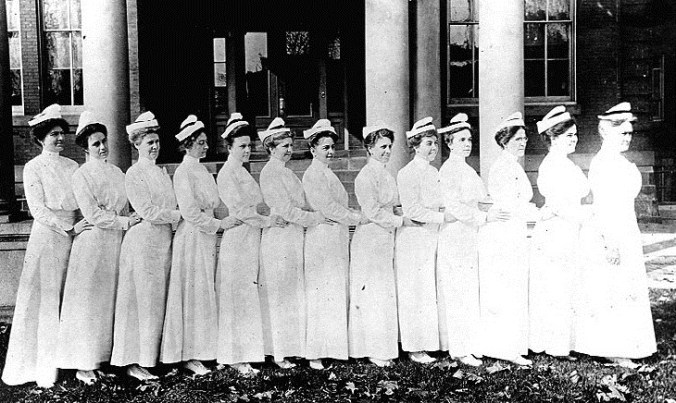
My post on the Gallup poll on public trust in various occupations and professions strayed into Charles Green’s wheelhouse, and the resulting home run comment enlightened us regarding why nurses keep “winning” the poll as the most trusted year after year after year.

Here is Charlie’s Comment of the Day on the post, Public Confidence And Trust (1): Observations On Gallup’s Trust In Occupations Poll:

Speaking just to the nursing angle: my work on trust has involved a diagnostic tool, the TQ (Trust Quotient), a self-assessment of the four components of trustworthiness in the Trust Equation:
(Credibilty + Reliability + Intimacy) / Self-Orientation.

70,000 people have taken it, and three results stand out above all others.

First, women are more trustworthy than men – a finding confirmed by informal polls in 397 out of 400 groups I’ve presented in front of.

Second, the most powerful factor of the four (defined as the highest coefficient in a regression equation) is Intimacy.

Third, the bulk of women’s outscoring men is their higher score on the Intimacy factor (again, intuitively true to the vast majority of groups I ask).

It’s in this context that I note the Gallup work (and other pollsters) finding of nursing at the top of the heap every year but 2002 (which was, not coincidentally, the year after 9/11 – and a year in which firemen, if only for that one year, took over the top spot.

Nursing is an 89% female profession. I ask my audiences, “Which of the four trustworthiness factors do you think nurses most embody: credibility, reliability, intimacy, or low self-orientation?” Most pick intimacy (with low self-orientation a frequent second).

Add ’em up: female, Intimacy, nursing – it’s a trifecta. Continue reading

Public Confidence And Trust (1): Observations On Gallup’s Trust In Occupations Poll

I’ve been following the Gallup organization’s yearly polls on public attitudes toward institutions and occupations for a long time. The results are in for 2017. I’ll discuss the ethics implication of the Gallup occupations poll first; Part 2 will cover the institutions.

The occupations poll tends to fluctuate more year to year, and is most interesting as viewed a competition. Who are most trusted and regarded as most honest? Who are least trusted? Nurses have been ranked #1 in public trust for 16 straight years. I guess this means not too many people watch “Nurse Jackie.” I assume the consistently high rating is because we tend to trust people we have to trust, thus confirmation bias, and because there haven’t been any major nursing scandals or “Angels of Death” in the news. As you will see from the chart, medical doctors are trusted much less. I think that’s the result of an illusion.

Only six professions rate as more than 50% “high” or “very high” for honesty and ethical standards: nurses, military officers, grade school teachers, medical doctors, police officers and pharmacists. The honesty rating of pharmacists dropped five points since 2016, however, and it an occupation that has sometimes finished right behind the nurses. Gallup guesses that the opioid crisis is to blame, and maybe that’s right, though I would think the doctors who prescribe the drugs are more to blame then the druggists who sell them.

Public views of the clergy have fallen like a Chinese space station. Before the Catholic Church child molesting scandal in 2001, the clergy was very trusted at the high 60% level. Now it is all the way down to 42%, though the total of high trust and average trust is still 85%. I think the film “Spotlight” hurt, as it should have.

Occupations that I would regard as having positive public trust include those whose high trust+average scores are higher than their low trust+average scores. That group, in addition to the occupations already named above, includes day care providers, judges, auto mechanics, nursing home operators and bankers. I think in all of these cases, the public has no real idea about how trustworthy these occupations really are. We just hope they are trustworthy, so again, we have a result that is polluted by wishful thinking. These people are entrusted with the welfare of our children, our cars, our parents and our money, plus the justice system. They better be trustworthy. Ignorance is bliss.

I confess amazement that Wells Fargo scandal didn’t result in lowered trust for bankers. Continue reading

Morning Ethics Warm-Up, 1/6/2018: The “Too Sick To Come Up With A Good Headline” Edition

He’s lucky: he has hair...

Good Morning!

1 A solution to a perpetual problem. I do the mandatory introduction to legal ethics for two jurisdictions. Both are early in the morning,and both have courts monitoring them, insisting that to get credit, attendees must be present for every second of the course. The problem: late arrivals. One of my jurisdictions had a tendency to let late-comers in if it’s just a few minutes, but sometimes it gets ridiculous. Once the line is blurred, when does it get hard again? I have sen the administrators tell a lawyer that she is absolutely the last one who will get a break, only to see another late comer burst through the door panicked, upset, and with a doozy of an excuse…and then another, and another. This is especially ironic because lawyers are ethically required to be on time to court, or else.

In my other jurisdiction, they deal with the problem by absolute enforcement. 30 seconds late, and you have to come back next month. It doesn’t matter why, it doesn’t matter where the lawyer came from (one had flown in from Seoul and was two minutes late). If you arrive after the doors are closed at 9 am sharp, you can’t get credit. This, as you might imagine, often sparks tantrums, tears, threats, and “Do you know who I am?” One furious attendee actually cast a curse on every bar employee in sight. I’m talking about a real curse, right out of the movies, pointing and chanting. Some months we have had more than ten latecomers in the lobby, acting like an angry mob, and threatening a riot.

This jurisdiction has solved the problem by recently telling all who need the course on the bar website and  in email messages that the program begins at 8:30 am, when it really doesn’t. In other words, the solution is a lie: if someone arrives at 8:59, there’s no problem.

Is this ethical?

2. Oh, this was obviously going to be an ethics rain wreck long ago. AG Sessions announced that the Justice Department would not be following the Obama Administration’s policy regarding federal anti-pot laws—which is to say, it would not signal that it wouldn’t enforce the law. As a result,  Corey Gardner, Republican Senator from happily stoned Colorado, announced that he would block any appointments to Justice until the Department charged with enforcing laws agrees to stop enforcing laws. What Sessions did is not the draconian reversal it has been represented as by the Angry Trump Hate Mob, Stoner Chapter. Read the order from Sessions here.

Never mind. Following the lead of California, which has officially announced that it will encourage breaches of the immigration laws, now Colorado wants to impede the functioning of national law enforcement to force the federal government to let another state veto drug laws. This is what we call “a dangerous and irresponsible trend.”

3.  The Tragedy of Joanie Cunnningham. The New York Times Magazine ended the year with biographical sketches, including the sad story of Erin Moran, aka Joanie Cunningham on “Happy Days,” who died of cancer in 2017. It’s an all-too-typical story of a child star with a dysfunctional family who grew up on a set without ever receiving the parenting and support she needed to be able to become a functioning adult. I knew about Moran’s problems after the show ended; I did not know that her bitterness about her fellow cast members stemmed from her feelings as a child that her TV family was a substitute her real family, and that they failed her. Of course, the Cunninghams, Fonzie, Ralph and Potsie had no duty to become Moran’s surrogate family, but I am not surprised that a child actor would feel this way, especially one who was  being neglected and mistreated at home the way Erin Moran apparently was. Interestingly, child actor advocate Paul Petersen has said that his TV mom and dad, Donna Reed and Carl Betz, did act as his surrogate parents in important and beneficial ways.

I continue to believe that using child performers before the age of informed consent is unethical. Continue reading