Now THIS Is An Unprofessional Lawyer!

And juuuuust a bit uncivil, I’d say. I  may be wrong…

In a motion to dismiss an insurance law suit, Allstate’s lawyers revealed this remarkable conduct on the part of plaintiff’s attorney Christopher Hook in his communications during the case. According to the declaration of those attorneys in their motion, Hook said or wrote…

  • “Fuck you crooks. Eat a bowl of dicks.” (Declaration of Peter H. Klee, Ex. 1, p. 5)
  • “I’m going to let the long dick of the law fuck Allstate for all of us.” (Id., p. 7)
  • “Hey Klee you Cumstain the demand is now 302 million. Pay up fuckface.” (Id., p. 8)
  • “Peter when you are done felating your copy boy tell Allstate the demand is now 305 million.” (Id., p. 9)
  • “[Other Sheppard Mullin attorneys] may not be too smart but at least they have some fucking dignity and honor unlike you two limp dick mother fuckers.” (Id., p. 10)
  • “What is Wright going to do when he finds out Allstate is using people who are borderline retarded to adjust complex claims. That’s what I’m going to do. Demand increases tomorrow.” (Klee Decl., Ex. 1, p. 11)
  • “Anytime now faggot.” (Id., p. 13)
  • “I want my clients’ money gay boys.”

Continue reading

The Pro-Impeachment Experts, Making the Public Dumber

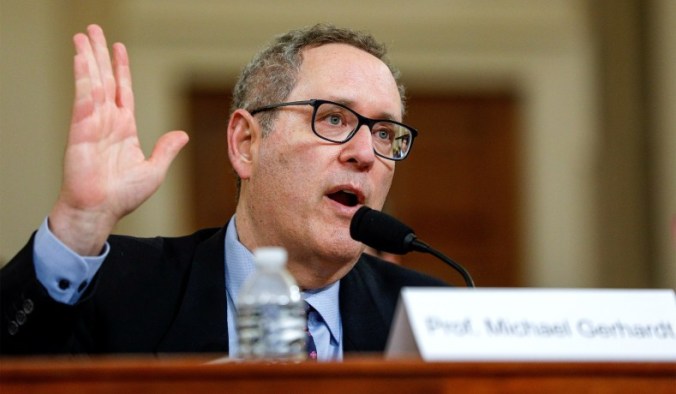
Prof. Gerhardt, making you dumber.

An ongoing theme of Ethics Alarms, not merely related to politics and the news media, is the unethical conduct of intentionally misinforming the public for partisan or ideological agendas. For professionals and those holding themselves out as experts, this is especially unethical conduct, and damaging. Academics, professionals and experts are obligated to use their knowledge to enlighten the public. Using their authority and credentials to deceive them, thus betraying the public trust, is unconscionable. Particularly since the elites in academia decided to help remove Donald Trump, this has become epidemic.

A signal of what was to come revealed itself on election night, when CNN produced once respectable historian Douglas Brinkley, now a shameless partisan hack of the worst sort, to explain to America that Hillary Clinton’s loss was really because Americans seldom vote for the same party to be in the White House three elections in a row. As I wrote in one of my posts about this lie, which no CNN talking head had the knowledge or integrity to challenge,

…esteemed Presidential historian Doug Brinkley, for reasons known only to himself, went on the air live on CNN and concocted a new alibi for Hillary Clinton and the Democrats. using fake history to do it. He said that there were powerful historical patterns at work in Hillary’s defeat, and that it is always hard for any one party to hold the White House for three consecutive terms. Then, as exceptions to the rule and to show how rare the exceptions were, Brinkley cited Reagan successfully pushing George H.W. Bush on the nation as his “third term,” and then went all the way back to 1836 for his other exception, when popular Democrat President Andrew Jackson got his acolyte Martin Van Buren elected to succeed him.

For days after this, I kept hearing Brinkley’s observation cited by talking heads and my disappointed Democratic friends, yet what he had said was wildly, unforgivably untrue. On election night, I ticked off the instances where one party has held the Presidency for more than two terms on the spot, right after Brinkley’s fiction (much to the annoyance of my wife):

After Van Buren, there were a bunch of one term Whigs and Democrats, but Lincoln’s two terms (the last finished by Andrew Johnson) was followed by Grant for two more, Hayes for one, and Garfield/Arthur for four more years. That 6 straight Republican terms, Doug. Then, three terms later, McKinley was elected to two, Teddy Roosevelt for one on top of the McKinley term he finished out, and Teddy anointed Taft as his successor just as Jackson had with Van Buren. That’s four straight Republican terms, or as we call it around my house, “More than two.”

But wait! There’s more! After Wilson and Mrs, Wilson served out two Democratic terms, we got Harding, Coolidge, and Hoover, another three Republicans in a row. Then the Democrats made up for those consecutive runs with five straight of their own, courtesy of FDR’s four and Truman beating Dewey. In short, Brinkley gave the nation fake history, which then became fake news.

And he made Americans ignorant. Spinning for Hillary, for example, Whoopie Goldberg told her audience, “You know, there have been very few eight years of one party and eight years of the same party. It doesn’t generally go back to back. The last time I think was Nixon and whoever came in after him was the last. Ford….That was the last time we had a long stretch. When it wasn’t Democrat, Republican, Democrat Republican. So given all the crap that Obama had to eat from his own party, I don’t think Bernie was going to — I don’t think any Democrat was going to–people were going to vote –”

This was regurgitated Brinkley—Hillary also cited him during her endless “It’s not my fault I lost!” tour–and not even accurately regurgitated.  And it’s dead wrong. Imagine: an “expert” whose specialty is American Presidential history was paid to go on national television and used his authority to give out false information about American Presidential history.

The phenomenon has become frighteningly common as the Democratic Party/”resistance”/mainstream media collective has tried to trick, bully and incite the public into supporting its undemocratic cause. The academics recruited by the Democrats for the latest impeachment push have continued to assert outright falsehoods, adopting former Senate Majority Leader Harry Reid’s theory that a lie is virtuous if “it works.” Continue reading

Saturday Ethics Warm-Up, Pearl Harbor Day, 2019: Actual Crimes, Misdemeanors And Other Despicable Acts Edition

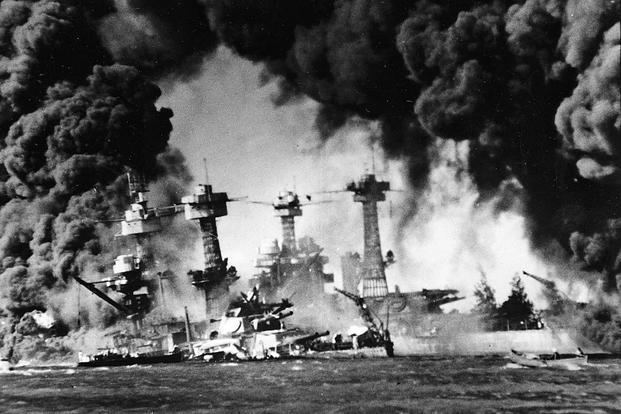
Remember.

1. The Bad Guys. This email message was received by George Washington Law School administrators urging it to punish Prof. Johnathan Turley for presenting a factual analysis of the Democrats’ contrived case against Donald Trump:

“I am writing you all after listening to Jonathan Turley’s disgraceful statement defending the corrupt and impeachable actions of President Trump at the House Judiciary impeachment hearing today. I know you all cringe inside knowing that you are affiliated in some way with Turley and have to work or study at the same institution in which he is employed. He is defending the indefensible and I hope that all of the Deans at GWU Law and the students will recognize that he is not serving in the best interest of our country and is a detriment to the success of your school’s future reputation. His actions today were spineless and shameful. He is clearly a lackey for the Trump Administration I trust you will act appropriately and reprimand this sad excuse of a man.”

The email was unsigned, but the school says it did not come from a student. Meanwhile, on his blog, Turley has stated that his “office and home have been inundated with threats from people irate over the fact that I would question the sufficiency of this record for impeachment.” He also has felt it necessary to respond to intentionally false arguments against his positions. That Turley’s employers would be told by anyone that the public courage and erudition of Prof. Turley could possibly be “a detriment to the success” of the “school’s future reputation” show how completely the  mass determination to “get” President Trump has entered the realm of Bizarro World ethics, or perhaps for younger fans of “Stranger Things,” the Upside Down.

A commenter on the post about the email at Legal Insurrection writes,

In The Coming of the Third Reich (2003), historian Richard J. Evans explains how, in the early days of National Socialist Germany, Stormtroopers (Brownshirts) “organized campaigns against unwanted professors in the local newspapers [and] staged mass disruptions of their lectures.” To express dissent from Nazi positions became a matter of taking one’s life into one’s hands. The idea of people of opposing viewpoints airing their disagreements in a civil and mutually respectful manner was gone. One was a Nazi, or one was silent (and fearful).

Today’s fascists call themselves “anti-fascists.” Just like the Nazis, they are totalitarian: they are determined not to allow their opponents to murmur the slightest whisper of dissent. Forcibly suppressing the speech of someone with whom one disagrees is a quintessentially fascist act.

Exactly.

2. The Legacy of Marion Barry.  Usually crooked D.C. politicians who are caught stealing money or passing it along to cronies —and there have been oh-so-many of them, resign, long-time member D.C. City Council member Jack Evans, however, became the first local scam artist to be kicked off the body, which voted this week that he  be expelled after a series of investigations found Evans, the city’s longest-serving lawmaker, used his public office to benefit private clients and employers who paid him hundreds of thousands of dollars.

“He has betrayed each and every one of us,” said council member Mary M. Cheh (D-Ward 3), who is leading the internal investigation of Evans. “You would speak to him about council things, but he was speaking for the people who were buying him.”

This time, for a change, the elected crook is white, so there will be no demonstrations by D.C. residents claiming racism. Whew! Continue reading

Conclusion To The Written Statement of Prof. Jonathan Turley: “The Impeachment Inquiry Into President Donald J. Trump: The Constitutional Basis For Presidential Impeachment”

Jonathan Turley ended his epic testimony before the House Judiciary Committee with a flourish. His whole statement was remarkable, leaving no reasonable argument for impeachment standing—but then the now-insatiable desire to undo the 2016 election has never been rational, and it has relied, despicably, on the historical and legal ignorance of the vast majority of the American people. Turley provided an opportunity for responsible citizens to educate themselves: his language was easy and clear, and there were no pompous or especially academic turns of phrase. Nonetheless, few will read or watch the whole thing, allowing the news media, which has exceeded all previous villainy in this three-year long fiasco, to distort and minimize his patriotic achievement. To the degree that they succeed, it is do the detriment of the nation, and its future. Somehow, Turley makes this clear as well, yet does so without the kind of alienating condemnation that I, in his position, would be unable to resist.

No doubt about it, the professor is a far better scholar and advocate than I am, and a brilliantly talented teacher as well. Still, he made me feel good about the analysis I have been presenting here since 2016. I have studied Presidential history for a shockingly long time; I know my impeachment history well, and observed two of the three previous inquiries up close, live and carefully. I have been certain, certain, from the beginning that what we have seen here is an unprecedented crypto-coup, for virtually all the reasons Professor Turley explains. I’m glad to have the legal authority and the meticulous tracking of where the inquisition ran off the rails, but Turley validated the analysis I have  given readers here. That came as a relief and a confirmation.

It was naturally a special pleasure that the professor ended his testimony by referencing the scene in the video above, from “A Man for All Seasons,” my favorite ethics moment in any movie, and the clip most often used on Ethics Alarms. He also referenced the story of the Republican Senators who turned on their party and voted to acquit President Andrew Johnson, for me the most memorable chapter of “Profiles in Courage,” the book that introduced me to the topic of ethics when I was 12 years old. Turley quotes one of the Senators who was only slightly mentioned by credited author John Fitzgerald Kennedy, but it’s a stirring quote, and damn any politician or citizen who ignores its message.

Lyman Trumbull (R- Ill.) explained fateful decision to vote against Johnson’s impeachment this way:

“Once set the example of impeaching a President for what, when the excitement of the hour shall have subsided, will be regarded as insufficient causes … no future President will be safe who happens to differ with the majority of the House and two-thirds of the Senate …I tremble for the future of my country. I cannot be an instrument to produce such a result; and at the hazard of the ties even of friendship and affection, till calmer times shall do justice to my motives, no alternative is left me…”

Those who endanger the future of my country because of their unrestained anger, hate, confirmation bias, partisan loyalty, prejudice, need to conform, and yes, ignorance and their lack of education, are contemptible. Those who lead them in pursuit of power are worse.

[Turley’s entire statement, with footnotes, is here. The Ethics Alarms edited version is here (Part I); here (PartII); here (Part III); here (Part IV), and here (Part V.) The video is here.]

***

V. CONCLUSION

Allow me to be candid in my closing remarks. I get it. You are mad. The President is mad. My Democratic friends are mad. My Republican friends are mad. My wife is mad. My kids are mad. Even my dog is mad . . . and Luna is a golden doodle and they are never mad. We are all mad and where has it taken us? Will a slipshod impeachment make us less mad or will it only give an invitation for the madness to follow in every future administration?

That is why this is wrong. It is not wrong because President Trump is right. His call was anything but “perfect” and his reference to the Bidens was highly inappropriate. It is not wrong because the House has no legitimate reason to investigate the Ukrainian controversy. The use of military aid for a quid pro quo to investigate one’s political opponent, if proven, can be an impeachable offense.

It is not wrong because we are in an election year. There is no good time for an impeachment, but this process concerns the constitutional right to hold office in this term, not the next.

No, it is wrong because this is not how an American president should be impeached. For two years, members of this Committee have declared that criminal and impeachable acts were established for everything from treason to conspiracy to obstruction. However, no action was taken to impeach. Suddenly, just a few weeks ago, the House announced it would begin an impeachment inquiry and push for a final vote in just a matter of weeks. To do so, the House Intelligence Committee declared that it would not subpoena a host of witnesses who have direct knowledge of any quid pro quo. Instead, it will proceed on a record composed of a relatively small number of witnesses with largely second-hand knowledge of the position. The only three direct conversations with President Trump do not contain a statement of a quid pro quo and two expressly deny such a pre-condition. The House has offered compelling arguments why those two calls can be discounted by the fact that President Trump had knowledge of the underlying whistleblower complaint. However, this does not change the fact that it is moving forward based on conjecture, assuming what the evidence would show if there existed the time or inclination to establish it. The military aid was released after a delay that the witnesses described as “not uncommon” for this or prior Administrations. This is not a case of the unknowable. It is a case of the peripheral. The House testimony is replete with references to witnesses like John Bolton, Rudy Giuliani, and Mike Mulvaney who clearly hold material information.

To impeach a president on such a record would be to expose every future president to the same type of inchoate impeachment. Continue reading

End of A Horrible Week Ethics Warm-Up, 12/6/2019…

Ho Ho Ho Crap!

1. “Radical? What radical?” Stanford law professor Pam Karlan, who stood out as a neon beacon highlighting 2019 Democratic Party extremism when she turned her House testimony on impeachment into an unhinged, Trump-hate rant including a cheeap shot at Barron Trump’s name, was apparently too radical for Barack Obama, says Legal Insurrection. He appointed far more moderate Solicitor General Elena Kagan to the Supreme Court, despite Democrats then being in control of both Houses.

“Fast forward to 2019, and this radical Obama SCOTUS reject is a star witness for the Democrat impeachment circus,” the blog notes. “It’s surreal how completely the Democrats have removed themselves from any semblance of rational thought when it comes to their impeachment obsession.”

If we regard the public as the jury and the House Democrats as prosecutors, how can one explain putting such an angry, ugly, biased and partisan fanatic on the metaphorical stand as an “expert witness”? Isn’t that gross incompetence? What’s going on here? In fact, let’s poll it. Who knows, maybe it will draw almost as much interest as the Peloton commercial poll, the second most active in Ethics Alarms history (so far). (But then there were more Google searches on “Peleton” than “impeachment” last week, so we know what American priorities are…)

2. Polls suggest that public opposition to abortion is rising again. Gee, I wonder why?

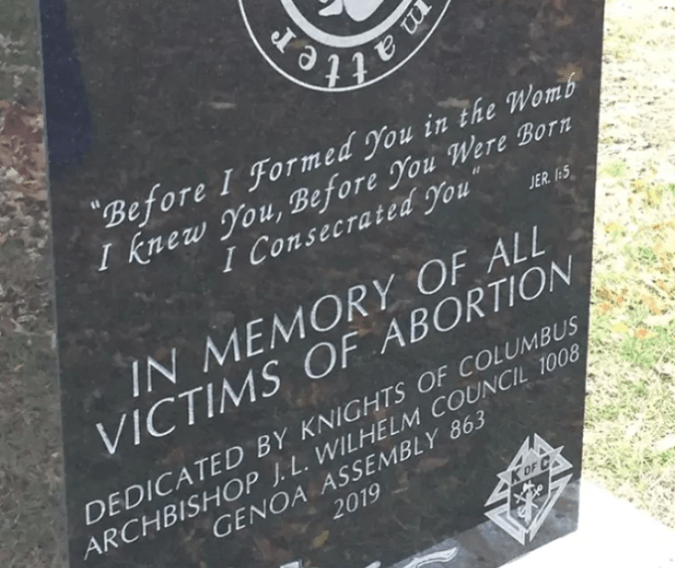
“Can you believe this?” wrote one on Facebook. “Knights of Columbus Belleville  (all men) organized this absolutely shameful act ….and also posted it on their facebook page.” Erecting a the memorial is shameful. Got it.

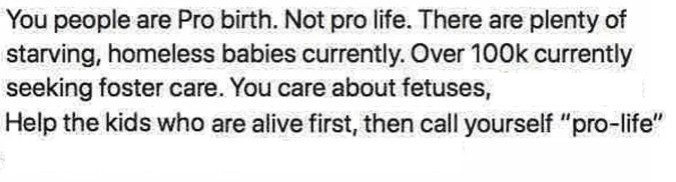
Well, they were just warts and parasites, so she has a point.

The National Post reported that the coordinator of a protest over the memorial stone, Elissa Robertson, accused the Catholic charity of “attacking a women’s right to choose,” saying,

“It was designed to shame people. I think it was absolutely uncalled for and that money they put into this anti-abortion monument could have done a lot of good somewhere else. It ties into patriarchal values and this idea that women’s bodies are meant to be controlled by men. It’s a broader issue that ties into violence against women, it ties into health care, it ties into safety.”

It ties into climate change! It ties into racism! It ties into tooth decay!

If one has no regrets or shame about snuffing out nascent human lives, then how does the monument shame you? The abortion argument is very difficult to win on a factual or ethical basis, but advocates have learned that “How dare you!” and “Shut up!” are very effective.

Actress Jameela Jamil certainly isn’t ashamed. She’s refreshingly honest…and scary. In a November Harper’s Bazaar interview with Gloria Steinem, she said,

“I’m very outspoken about the fact that I, similarly to you, feel very passionately about a woman’s right to choose I’m someone who’s had an abortion, and I feel like I need to make sure that we prove it’s not always just emergencies. People have abortions, sometimes a woman just wants her liberty, and we have to normalize that it’s okay just to make that choice for yourself, because your life is as important as a newborn life that doesn’t even exist yet.”

Wait, if it’s not living, then why do you have to kill it? Is it really a fair  to compare your avoiding an inconvenient responsibility or life disruption with another human being losing its life? Challenged on this, the actress responded on social media, “I SAID WHAT I FUCKING SAID and you’re clueless if you think I’m going to take it back. My life is more important to me than an unborn fetus’s one. Suck on THAT!”

Wait: I thought you said no life was involved.

This is the approximate level of thought, sensitivity and ethical analysis we hear from almost all pro-abortion activists. Basic competence and responsibility rules: if you can’t discuss a topic more articulately and thoughtfully than this, leave the issue to others. Here’s another one of Jamil’s clever arguments:

Or better yet, why not just kill them too? Continue reading

Written Statement of Prof. Jonathan Turley: “The Impeachment Inquiry Into President Donald J. Trump: The Constitutional Basis For Presidential Impeachment” [PART V]

Note the date…

In his final section before concluding, Professor Turley covers other theories being floated as justification for impeachment, and finds them startlingly weak and contrived.

The Hill has Turley’s lament regarding the  the Alliance of Unethical Conduct’s attacks on his thorough and objective dismantling of their coup efforts. (The AUC—that’s the Ethics Alarm shorthand for the Democratic Party-“resistance”-mainstream media alliance to remove Trump from office by any means possible, not Turley’s.)  He writes,

Despite 52 pages of my detailed testimony, more than twice the length of all the other witnesses combined, on the cases and history of impeachment, [Washington Post columnist Dana Milbank] described it as being “primarily emotional and political.” Milbank claimed that I contradicted my testimony in a 2013 hearing when I presented “exactly the opposite case against President Obama” by saying “it would be ‘very dangerous’ to the balance of powers not to hold Obama accountable for assuming powers ‘very similar’ to the ‘right of the king’ to essentially stand above the law.”

But I was not speaking of an impeachment then. It was a discussion of the separation of powers and the need for Congress to fight against unilateral executive actions, the very issue that Democrats raise against Trump. I did not call for Obama to be impeached….

In my testimony Wednesday, I stated repeatedly [as I stated in my testimony during the Clinton impeachment] that a president can be impeached for noncriminal acts…. My objection is not that you cannot impeach Trump for abuse of power but that this record is comparably thin compared to past impeachments…. … Democrats have argued that they do not actually have to prove the elements of crimes…. In the Clinton impeachment, the crime was clearly established and widely recognized…. [W]e are lowering impeachment standards to fit a paucity of evidence and an abundance of anger…. 

Writes Ann Althouse in a post yesterday, “it seems to me that the real impeachable offense has always been that Donald Trump got himself elected.”

I wish Prof. Turley had dealt with that, the real justification, in their minds, for the House’s impeachment push.

Back to the professor:

C.  Extortion.

 As noted earlier, extortion and bribery cases share a common law lineage. Under laws like the Hobbs Act, prosecutors can allege different forms of extortion. The classic form of extortion is coercive extortion to secure property “by violence, force, or fear.”85 Even if one were to claim the loss of military aid could instill fear in a country, that is obviously not a case of coercive extortion as that crime has previously been defined.

Instead, it would presumably be alleged as extortion “under color of official right.” Clearly, both forms of extortion have a coercive element, but the suggestion is that Trump was “trying to extort” the Ukrainians by withholding aid until they agreed to open investigations. The problem is that this allegation is no closer to the actual crime of extortion than it is to its close cousin bribery. The Hobbs Act defines extortion as “the obtaining of property from another, with his consent, induced by wrongful use of actual or threatened force, violence, or fear or under color of official right.”87

As shown in cases like United States v. Silver, extortion is subject to the same limiting definition as bribery and resulted in a similar overturning of convictions. Another obvious threshold problem is defining an investigation into alleged corruption as “property.” Blackstone described a broad definition of extortion in early English law as “an abuse of public, justice which consists in an officer’s unlawfully taking, by colour of his office, from any man, any money or thing of value, that is not due him, or more than is due, or before it is due.”89 The use of anything “of value” today would be instantly rejected. Extortion cases involve tangible property, not possible political advantage.90 In this case, Trump asked for cooperation with the Justice Department in its investigation into the origins of the FBI investigation on the 2016 election. As noted before, that would make a poor basis for any criminal or impeachment theory. The Biden investigation may have tangible political benefits, but it is not a form of property. Indeed, Trump did not know when such an investigation would be completed or what it might find. Thus, the request was for an investigation that might not even benefit Trump.

The theory advanced for impeachment bears a close similarity to one of the extortion theories in United States v. Blagojevich where the Seventh Circuit overturned an extortion conviction based on the Governor of Illinois, Rod Blagojevich, pressuring then Sen. Barack Obama to make him a cabinet member or help arrange for a high- paying job in exchange for Blagojevich appointing a friend of Obama’s to a vacant Senate seat. The prosecutors argued such a favor was property for the purposes of extortion. The court dismissed the notion, stating “The President-elect did not have aproperty interest in any Cabinet job, so an attempt to get him to appoint a particular person to the Cabinet is not an attempt to secure ‘property’ from the President (or the citizenry at large).” In the recent hearings, witnesses spoke of the desire for “deliverables” sought with the aid. Whatever those “deliverables” may have been, they were not property as defined for the purposes of extortion any more than the “logrolling” rejected in Blagojevich.

There is one other aspect of the Blagojevich opinion worth noting. As I discussed earlier, the fact that the military aid was required to be obligated by the end of September weakens the allegation of bribery. Witnesses called before the House Intelligence Committee testified that delays were common, but that aid had to be released by September 30th. It was released on September 11th. The ability to deny the aid, or to even withhold it past September 30th is questionable and could have been challenged in court. The status of the funds also undermines the expansive claims on what constitutes an “official right” or “property”:

“The indictment charged Blagojevich with the ‘color of official right’ version of extortion, but none of the evidence suggests that Blagojevich claimed to have an ‘official right’ to a job in the Cabinet. He did have an ‘official right’ to appoint a new Senator, but unless a position in the Cabinet is ‘property’ from the President’s perspective, then seeking it does not amount to extortion. Yet a political office belongs to the people, not to the incumbent (or to someone hankering after the position). Cleveland v. United States, 531 U.S. 12 (2000), holds that state and municipal licenses, and similar documents, are not ‘property’ in the hands of a  public  agency. That’s equally true of public positions. The President-elect did not have a property interest in any Cabinet job, so an attempt to get him to appoint a particular person to the Cabinet is not an attempt to secure ‘property’ from the President (or the citizenry at large).”

A request for an investigation in another country or the release of money already authorized for Ukraine are even more far afield from the property concepts addressed by the Seventh Circuit.

The obvious flaws in the extortion theory were also made plain by the Supreme Court in Sekhar v. United States, where the defendant sent emails threatening to reveal embarrassing personal information to the New York State Comptroller’s general counsel in order to secure the investment of pension funds with the defendant. In an argument analogous to the current claims, the prosecutors suggested political or administrative support was a form of intangible property. As in McDonnell, the Court was unanimous in rejecting the “absurd” definition of property. The Court was highly dismissive of such convenient linguistic arguments and noted that “shifting and imprecise characterization of

the alleged property at issue betrays the weakness of its case.”94 It concluded that “[a]dopting the Government’s theory here would not only make nonsense of words; it would collapse the longstanding distinction between extortion and coercion and ignore Congress’s choice to penalize one but not the other. That we cannot do.”95 Nor should Congress. Much like such expansive interpretations would be “absurd” for citizens in criminal cases, it would be equally absurd in impeachment cases.

To define a request of this kind as extortion would again convert much of politics into a criminal enterprise. Indeed, much of politics is the leveraging of aid or subsidies or grants for votes and support. In Blagojevich, the court dismissed such “logrolling” as the basis for extortion since it is “a common exercise.” If anything of political value is now the subject of the Hobbs Act, the challenge in Washington would not be defining what extortion is, but what it is not.

D.  Campaign Finance Violation

Some individuals have claimed that the request for investigations also constitutes a felony violation of the election finance laws. Given the clear language of that law and the controlling case law, there are no good-faith grounds for such an argument. To put it simply, this dog won’t hunt as either a criminal or impeachment matter. U.S.C. section 30121 of Title 52 states: “It shall be unlawful for a foreign national, directly or indirectly, to make a contribution or donation of money or other thing of value, or to make an express or implied promise to make a contribution or donation, in connection with a federal, state, or local election.”

On first blush, federal election laws would seem to offer more flexibility to the House since the Federal Election Commission has adopted a broad interpretation of what can constitute a “thing of value” as a contribution. The Commission states “’Anything of value’ includes all ‘in-kind contributions,’ defined as ‘the provision of any goods or services without charge or at a charge that is less than the usual and normal charge for such goods or services.’” However, the Justice Department already reviewed the call and correctly concluded it was not a federal election violation. This determination was made by the prosecutors who make the decisions on whether to bring such cases. The Justice Department concluded that the call did not involve a request for a “thing of value” under the federal law. Congress would be alleging a crime that has been declared not to be a crime by career prosecutors. Such a decision would highlight the danger of claiming criminal acts, while insisting that impeachment does not require actual crimes. The “close enough for impeachment” argument will only undermine the legitimacy of the impeachment process, particularly if dependent on an election fraud allegation that itself is based on a demonstrably slipshod theory. Continue reading

Cultural And Societal Poison, Pumped Into Our National Bloodstream [Corrected]

When I worked for the U.S. Chamber of Commerce in the 1970s, I was once dispatched to an Amway convention at the Atlanta Omni  to speak to the packed arena about carious Chamber citizen activism projects. Right before I was scheduled, the Amway “Diamond” hosting the thing (it was so strange and cult-like that “thing” is the best I can come up with this early in the morning) rallied the glassy-eyed crowd with a speech the likes of which I had never heard before. Among the crazy assertions he made to cheers and  cries of “Amen!” was that Jimmy Carter, then President, was card-carrying Communist and an agent of the Soviet Union, preparing as he spoke to turn over America to the Russians He also said, Joe McCarthy-like, that he had authentic documents to prove this.

As I sat in the wings, my mind raced to determine what I should do. I did not want to endorse or support what I had just heard in any way, but I also was on an assignment from my boss, who, I was and am quite sure, would have been just as horrified by what I had just heard as I was. Amway’s founders, Jay Van Andel and Rich De Vos were Chamber board members and big contributors to the Chamber’s PAC. Nothing I was promoting there was sinister. Still, I seriously considered leaving immediately, or even using my huge radio mic to denounce what I had just heard as outrageous lies, at least until I was brought down in a hail of bullets, or torn limb from limb by the infuriated mob.

In the end, I gave a shortened version on my planned speech—the crowd was very receptive—and got the hell out of there. When I returned to D.C., I announced that I would not appear at any more Amway conventions, or, for that matter, any John Birch Society meetings or KKK rallies, and my wishes were respected. I remained disturbed by the incident, and especially by the extremist bile that was apparently circulating quietly among the public that was barely hinted at in what was then naively called the “respectable media.”

Sunday, I read a column by Thomas Friedman, a three-time Pulitzer Prize winner and best-selling author who writes for the New York Times. In a column called Iran Is Crushing Freedom One Country at a Time,”  this supposedly mainstream and eminently respectable pundit wrote, Continue reading

Written Statement of Prof. Jonathan Turley: “The Impeachment Inquiry Into President Donald J. Trump: The Constitutional Basis For Presidential Impeachment” [PART IV]

The press wanted Andrew Johnson impeached, too…

This section of Turley’s masterpiece covers the various “obstruction of justice” claims. The conclusion:

“Basing impeachment on this obstruction theory would itself be an abuse of power. . . by Congress. It would be an extremely dangerous precedent to set for future presidents and Congresses in making an appeal to the Judiciary into “high crime and misdemeanor.”

Boy, Turley did a terrific job…

B.  Obstruction of Justice

 Another crime that was sporadically mentioned during the House Intelligence hearings was obstruction of justice or obstruction of Congress. Once again, with only a few days to prepare this testimony and with no public report on the specific allegations, my analysis remains mired in uncertainty as to any plan to bring such a claim to the foundational evidence for the charge. Most of the references to obstruction have been part of a Ukraine-based impeachment plan that does not include any past alleged crimes from the Russian investigation. I will therefore address the possibility of a Ukraine-related obstruction article of impeachment. However, as I have previously written, I believe an obstruction claim based on the Mueller Report would equally at odds with the record and the controlling case law. The use of an obstruction theory from the Mueller Report would be unsupportable in the House and unsustainable in the Senate. Once again, the lack of information (just weeks before an expected impeachment vote) on the grounds for impeachment is both concerning and challenging. It is akin to being asked to diagnose a patient’s survivability without knowing his specific illness.

Obstruction of justice is a more broadly defined crime than bribery and often overlaps with other crimes like witness tampering, subornation, or specific acts designed to obstruct a given proceeding. There are many federal provisions raising forms of obstruction that reference parallel crimes. Thus, influencing a witness is a standalone crime and also a form of obstruction under 18 U.S.C. 1504. In conventional criminal cases, prosecutions can be relatively straightforward, such as cases of witness intimidation under 18 U.S. 1503. Of course, this is no conventional case. The obstruction claims leveled against President Trump in the Ukrainian context have centered on two main allegations. First, there was considerable discussion of the moving of the transcript of the call with President Zelensky to a classified server as a possible premeditated effort to hide evidence. Second, there have been repeated references to the “obstruction” of President Trump by invoking executive privileges or immunities to withhold witnesses and documents from congressional committees. In my view, neither of these general allegations establishes a plausible case of criminal obstruction or a viable impeachable offense.

In the Mueller report, Assistant Attorney General found no cognizable case was presented for an allegation of obstruction of justice. Many members of this Committee heralded the selection of Rosenstein as a consummate and apolitical professional who was responsible for the appointment of the Special Counsel. He reached this conclusion on the record sent by Mueller and, most importantly, the controlling case law. As with the campaign finance allegation discussed in this testimony, an article based on obstruction in the Russian investigation would seek the removal of a President on the basis of an act previously rejected as a crime by the Justice Department. Many of us have criticized the President for his many comments and tweets on the Russian investigation. However, this is a process that must focus on impeachable conduct, not imprudent or even obnoxious conduct. Continue reading

Sackler, Tufts, Cancel Culture And The 100th Rationalization: The Reverse Ruddigore

I have been waiting to find the ideal 100th Rationalization, officially #70 (there are 30 sub-rationalizations on the EA Rationalizations list. It’s “The Reverse Ruddigore,” the equally valid opposite of Rationalization #21. Ethics Accounting, or “I’ve earned this”/ “I made up for that”:

 You cannot earn the right to act unethically by depositing a lot of ethical deeds in the imaginary ethics bank, nor can unethical conduct be erased by doing good for someone else. The illusion that one can balance the ethics books this way is referred to on the Ethics Alarms blog as “the Ruddigore Fallacy.”  Nobody earns the right to be unethical, not even once, no matter how exemplary their conduct. An unethical act is just as unethical, whether it is performed by a saint, a hero, or a villain.

“Ruddigore,” for those of you sadly unaware of the joys of Gilbert and Sullivan, is the unjustly under-rated work by the Victorian geniuses that involved an ancient curse on a family that required a Baronet of Ruddigore to perform a crime a day or die in agony, courtesy of his re-animated ancestors, who otherwise hang around, literally, as portraits in a haunted gallery. One member of the family who has inherited the curse, Sir Despard, believes that he has found a loophole:

“I get my crime over the first thing in the morning, and then, ha! ha! for the rest of the day I do good – I do good – I do good! Two days since, I stole a child and built an orphan asylum. Yesterday I robbed a bank and endowed a bishopric. To-day I carry off Rose Maybud and atone with a cathedral! This is what it is to be the sport and toy of a Picture Gallery!”

Looking back on past posts, I laid the groundwork for #70 when I condemned the decision of Walt Disney World to remove Bill Cosby’s bust from the its Academy of Television Arts and Sciences Hall of Fame of Fame:

[L]ast I heard Bill Cosby was still recognized as a major trailblazer in stand-up, TV comedy, and television integration (remember “I Spy”?), an important positive cultural force for race relations and black community self esteem, and a spectacularly talented comedian with a unique voice and presence. None of that has changed. Those were the achievements that prompted Cosby’s bust’s inclusion in Disney’s Academy of Television Arts and Sciences Hall of Fame Plaza, along with celebrities such as Lucille Ball and Oprah Winfrey who, like the Cos, have been inducted into the Television Academy Hall of Fame. O.J. Simpson is still honored in the College Football Hall of Fame, because he was one of the greatest college stars ever. His post-career hobby as a murderer, like Bill’s extra-curricular activities as a serial rapist, have nothing to do with the honor, just as Cosby earned and still deserves, his honor for what he achieved on stage and screen.

Subsequent bad acts no more cancel out past good ones than Sir Despard’s cathedral would make up for kidnapping sweet Rose Maybud. The current “Cancel Culture,” however, holds otherwise. In the latest episode, Tufts University announced today that it will strip the Sackler name from the buildings and programs on its medical campus, after a report censured the school for its relationship with the family whose drug company made OxyContin, the opioid blamed for hundreds of thousands of deaths nationwide. Continue reading

Written Statement of Prof. Jonathan Turley: “The Impeachment Inquiry Into President Donald J. Trump: The Constitutional Basis For Presidential Impeachment” [PART III]

(Part I is here; Part II, here.)

In this section of his testimony, Turley deals with the Ukraine phone call that is supposedly impeachable. Here is the key paragraph:

“Again, the issue is not whether these comments are correct, but whether they are corrupt. In my view, there is no case law that would support a claim of corrupt intent in such comments to support a bribery charge. There is no question that an investigation of the Bidens would help President Trump politically. However, if President Trump honestly believed that there was a corrupt arrangement with Hunter Biden that was not fully investigated by the Obama Administration, the request for an investigation is not corrupt, notwithstanding its inappropriateness. The Hunter Biden contract has been widely criticized as raw influence peddling. I have joined in that criticism. For many years, I have written about the common practice of companies and lobbyists attempting to curry favor with executive branch officials and members of Congress by giving windfall contracts or jobs to their children. This is a classic example of that corrupt practice.”

IV.   THE CURRENT THEORIES OF IMPEACHABLE CONDUCT AGAINST PRESIDENT DONALD J. TRUMP

 While all three acts in the impeachment standard refer to criminal acts in modern parlance, it is clear that “high crimes and misdemeanors” can encompass non-criminal conduct. It is also true that Congress has always looked to the criminal code in the fashioning of articles of impeachment. The reason is obvious. Criminal allegations not only represent the most serious forms of conduct under our laws, but they also offer an objective source for measuring and proving such conduct. We have never had a presidential impeachment proceed solely or primarily on an abuse of power allegation, though such allegations have been raised in the context of violations of federal or criminal law. Perhaps for that reason, there has been a recent shift away from a pure abuse of power allegation toward direct allegations of criminal conduct. That shift, however, has taken the impeachment process far outside of the relevant definitions and case law on these crimes. It is to those allegations that I would now like to turn.

At the outset, however, two threshold issues are worth noting. First, this hearing is being held before any specific articles have been proposed. During the Clinton impeachment hearing, we were given a clear idea of the expected articles of impeachment and far greater time to prepare analysis of those allegations. The House leadership has repeatedly indicated that they are proceeding on the Ukrainian controversy and not the various alleged violations or crimes alleged during the Russian investigation. Recently, however, Chairman Schiff indicated that there might be additional allegations raised while continuing to reference the end of December as the working date for an impeachment vote. Thus, we are being asked to offer a sincere analysis on the grounds for impeachment while being left in the dark. My testimony is based on the public statements regarding the Ukrainian matter, which contain references to four alleged crimes and, most recently, a possible compromise proposal for censure.

Second, the crimes discussed below were recently raised as part of the House Intelligence Committee hearings as alternatives to the initial framework as an abuse of power. There may be a desire to refashion these facts into crimes with higher resonance with voters, such as bribery. In any case, Chairman Schiff and committee members began to specifically ask witnesses about elements that were pulled from criminal cases. When some of us noted that courts have rejected these broader interpretations or that there are missing elements for these crimes, advocates immediately shifted to a position that it really does not matter because “this is an impeachment.” This allows members to claim criminal acts while dismissing the need to actually support such allegations. If that were the case, members could simply claim any crime from treason to genocide. While impeachment does encompass non-crimes, including abuse of power, past impeachments have largely been structured around criminal definitions. The reason is simple and obvious. The impeachment standard was designed to be a high bar and felonies often were treated as inherently grave and serious. Legal definitions and case law also offer an objective and reliable point of reference for judging the conduct of judicial and executive officers. It is unfair to claim there is a clear case of a crime like bribery and simultaneously dismiss any need to substantiate such a claim under the controlling definitions and meaning of that crime. After all, the common mantra that “no one is above the law” is a reference to the law applied to all citizens, even presidents. If the House does not have the evidence to support a claim of a criminal act, it should either develop such evidence or abandon the claim. As noted below, abandoning such claims would still leave abuse of power as a viable ground for impeachment. It just must be proven.

A.  Bribery

Continue reading