Morning Ethics Warm-Up. 1/3/2020: “Those Who Don’t Understand The Cognitive Dissonance Scale Are Doomed To Behave Like Idiots And Not Know Why”

Who said that?

I did.

1. “This is Rose. Won’t you give to help her and people life her who suffer from crippling hatred of the President of the United States? Just a few dollars a month...”

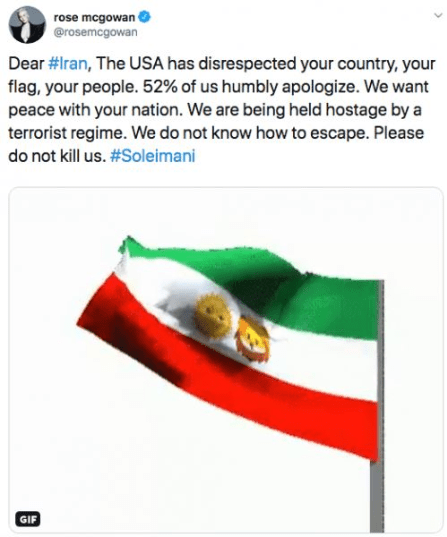
A more vivid example of where anti-Trump hysteria can lead than these two tweets can hardly be found. The author is #MeToo activist Rose McGowan, Harvey Weinstein victim, conventional Hollywood progressive. These were her reactions to the unequivocally welcome news that General Qassim Soleimani, head of Iran’s elite Quds force and the architect of terrorism all over the Middle East, was killed by a U.S. airstrike at Baghdad’s international airport:
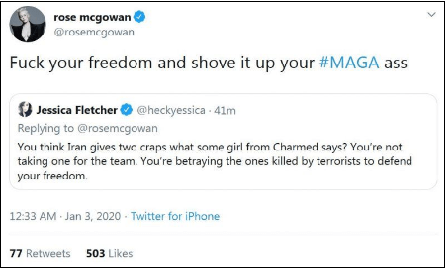
When a social media critic correctly pointed out the lunacy of that one, the former “Charmed” actress responded,
Would it be unfair to say that “Please do not kill us” was the message conveyed by President Obama’s craven and dangerous  nuclear deal with Iran, giving the rogue state billions of dollars in exchange for a (worthless) promise not to pursue nuclear arms capability until later, at which time there would be nothing the U.S. could do about it?

I heard these kinds of sniveling, “Better Red than Dead” protests many times in my youth. They come often from people so young,  inexperienced and ignorant that their confusion can be forgiven—a little–but also from older Americans—more frequently women, unfortunately, and make of that what you will—who have somehow reached maturity without learning that everyone, but especially this unique country, has to be ready to defend their values, and just as important, has to be able to communicate clearly that we will defend those values, with terrible force if necessary.

Over the last couple of decades, a large and influential segment of the progressive community has forgotten that. Fortunately, the majority of Americans have not.

2. How it works: The fact that President Trump is at the dead bottom of the cognitive dissonance scale for most Democrats means that anything he does and any result that would normally and objectively be regarded as positive if another President, especially a Democrat and particularly Barack Obama, were responsible drags that event or decision down below the midpoint into negative territory, unless someone recognizes that their opinion is being warped by psychological forces and biases beyond their control, and adjusts appropriately. Apparently none of the Democrats who have shot off their mouths since Soleimani‘s demise have such wisdom and self-control. Thus they are beginning critical comments with statements like this tweet by Rep. Andy Levin, which was typical:

“There is no question that Qasem Soleimani was an enemy of the United States. I feel no sadness at the news of his death. But I have serious concerns about this President’s execution of a potential act of war without authorization of Congress.”

 “He was a terrible, murderous enemy of our nation and we’re fortunate he’s dead BUT” is just not a smart message.

The President gave the order that resulted in the death of the Quds Force leader after multiple attacks against Americans and American facilities in Iraq that could be traced back to Soleimani.  The Iran-backed Iraqi militia Kata’ib Hezbollah began the exchange  with a rocket attack on a U.S.-led coalition base on December 27. A U.S. contractor was killed andmany Americans and Iraqis were wounded. The Pentagon concluded that  Soleimani ordered the attack. In response, the U.S. launched airstrikes against the militia, killing 25 militiamen. Members of the militiamen stormed the U.S. Embassy in Baghdad, an invasion of  American soil. Again, the Pentagon concluded that Soleimani “approved the attacks on the U.S. Embassy in Baghdad that took place this week.” After U.S. troops forced the attackers to retreat, the President made it clear that there would be harsh consequences for the episode. There was.

Iran’s leader had tweeted that there was “nothing” the U.S. could do. What kind of American does not take satisfaction in what occurred next? My view: only those in the powerful grip of the Cognitive Dissonance Scale.

Here’s Joe Biden: Continue reading
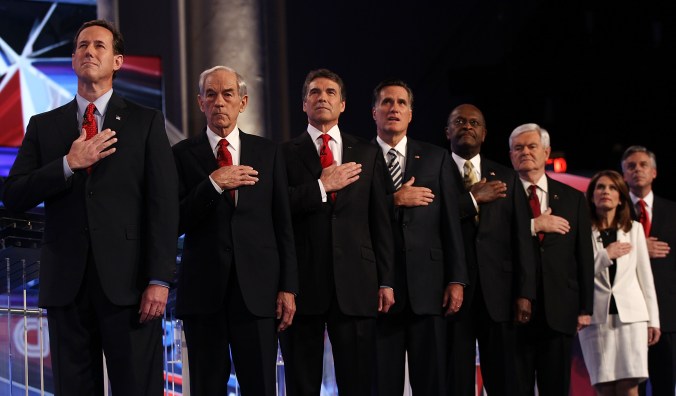
Verdict: Worst Candidates Debate Ever, Part IV: Weak, But Strong On Pandering [Corrected]

You want “a weak presidential field”? I’ll show you a weak presidential field!

[Part 1 is here; Part II is here; Part III is here, and the November debate review is here.]

David Leonhardt, whom I sometimes think is the worst of the horrible stable of New York Times op-ed writers until Michelle Goldberg launches into another fact-free rant or Charles M. Blow authors the latest escalation in his campaign to convince readers that President Trump is the spawn of Satan, wrote an op-ed last week attacking the parties’ nominating processes and asserting that “We have an unnecessarily weak presidential field, especially the incumbent.” Read the article. There is no logic to it, nor consistency; it is yet another “I wonder how gullible and ignorant my readers are?” experiment. Essentially the piece is anti-democratic, as a majority of progressives seem to have soured on democracy once it “failed” by not electing Hillary Clinton President. (I regard the election of Donald Trump over Clinton as one of the most important and exhilarating expressions of democracy in our history, though it was substantially due to moral luck.) Leonhardt’s argument is also historical nonsense, as he claims that the parties were better at picking qualified and electable candidates in the past. They most certainly were not: overage generals like Winfield Scott*, W.H. Harrison and Zachary Taylor, the latter two who, though elected,  promptly died, thus elevating to the White House VPs that nobody ever wanted or envisioned as Presidents…popular generals with no governing experience whatsoever, like U.S. Grant and John C. Fremont…wildly popular outgoing Presidents’ handpicked successors who would never have been nominated otherwise, like Van Buren, Taft, and Bush? Packaged puppets like Warren G. Harding and William McKinley? Doomed losers like Horace Greeley, James Cox, Bob Dole, Walter Mondale, George McGovern, Mike Dukakis  and (yechh) John Kerry? Already once or twice beaten past candidates like Henry Clay, William Jennings Bryan, Thomas Dewey and Adlai Stevenson?  Brilliant!

Leonhardt even offers Abraham Lincoln as an example of the effectiveness of past party nominating systems, ignoring, or, based on his established level of acuity, unaware of the fact that Abe won despite getting only 38% of the vote, or about the same proportion Barry Goldwater and George McGovern received while losing in landslides. That he turned out to be a great President was more moral luck: Lincoln had no executive governing experience at all before being thrust into the most difficult challenge a President had faced since Washington, hadn’t even been a general, and was known mostly for his wit and oratory. With the nation teetering on destruction, the candidates selected by the Democratic and Republican parties in 1860 consisted of Lincoln, John Breckinridge, Buchanan’s inert Vice-President, who had also no executive governing experience, and Stephen Douglas, who also had never run anything and had been a full-time legislator for two decades. In his favor, he had a lot more relevant experience than Lincoln. On the deficit side, he would die in 1861, meaning that if Douglas had been elected the new President would have been the immortal Herschel Vespasian Johnson.

Leonhardt explains why the current field of Democrats is so weak, as if that wasn’t already depressingly obvious, but he never points to a single current non-candidate who would be any more promising, because there aren’t any.  He muses about Democratic governors who might be more promising: Like who, exactly…the ridiculous Andrew Cuomo? How many Democratic governors have distinguished themselves enough to have any national name recognition at all, other than Cuomo and Virginia’s Ralph Northam, of blackface fame?

It’s not the process, obviously, it’s the people. Then Leonhardt ends with “Of course, the biggest sign that the process is broken isn’t any of those seven. It is the man in the Oval Office.” Got it. The op-ed is just more anti-Trump teeth gnashing.

Whatever Donald Trump may be, the fact that he beat a supposed Democratic star overwhelmingly expected to win proves that he was not a weak candidate by definition, and as an incumbent President, he is stronger now. Incumbent Presidents are usually strong candidates because no matter who they are, if the economy is thriving, their foreign policy weaknesses haven’t crippled them, and there’s no prominent third party candidate to siphon votes away, they win, like Obama, Bush, Clinton, Reagan, Nixon, Ike, Truman and FDR (and going back further yet to the beginning of the 20th Century, , Wilson, Teddy, and McKinley).

But I digress. The shocking deficiencies of the current Democratic hopefuls were on full display as the awful awful, awful December debate wound down.

Pete Buttigieg began the worst pander-fest of the evening: Continue reading

Ethics Heroes: The Appeals Court For The Commonwealth Of Massachusetts

I am not honoring the appeals court that just upheld the lower court judgment in my favor in a two-year old (and probably not over yet) frivolous lawsuit against my for defamation by an angry ex-Ethics Alarms commenter. The court’s decision rejecting the plaintiff’s appeal was dictated by precedent and black letter law, as was the decision in the original case. It took no special courage or integrity to hold so, and in fact any other result would have evinced rank incompetence.

No, I am awarding the court Ethics Hero status after receiving today its  published opinion in case n. 18-p-1605, where the judgement of the lower court judge was affirmed. It is officially a summary decision, and thus not binding precedent, since the usual details a full appellate opinion would contain are missing. However, in the eight page opinion affirming the lower court dismissal of the complaint, the judges are impressively restrained, respectful, and thorough. They manage this despite the fact that the lawsuit was doomed from the beginning, without merit or law on its side. The persistence of the plaintiff has wasted taxpayer money (and mine) and occupied time the judges needed to address more serious and legitimate matters.

Nonetheless, the fact that a pro se litigant is able to receive more than perfunctory handling of even a complaint this misbegotten and trivial speaks well for our system, and very well for the judges. Despite all the attacks claiming that our system only caring about ‘justice for the rich,” a pro se litigant seeking justice (as he saw it) and using confused, garbled and outrageously long documents to that end,  cannot deny that his case and arguments were ignored. He lacked the financial resources to hire a lawyer to pursue them (though I wonder if any lawyer would have accepted the representation) and represented himself—rather badly, but still, he took his best shot. Continue reading

Morning Ethics Warm-Up, 1/2/2020: A Rich Assortment Of Jerks And Assholes To Begin The Year.

 It’s finally Getting Back To Normal Day!

I don’t know about you, but I feel like everything’s been one big, holiday/stress/disruption blur since I enlivened Thanksgiving dinner by keeling over. There should be  law preventing Christmas and New Years from falling on Wednesdays, which effectively kills two full weeks. I’m behind on everything, and I don’t know what I could have done to avoid it…

1. Sigh. This is what we have to look forward to in 2020…Ezra Klein, the Left-biased Washington Post journalist who founded Vox, which he then staffed with all Left-biased journalists, tweeted out the link a nine-month-old Post article stating as fact that counties hosting Trump rallies saw massive spikes in hate crimes compared to counties that didn’t host Trump rallies. By Wednesday afternoon, Klein’s tweet had been re-tweeted  more than 7,000 times and had more than 14,000 likes. It also polluted many Facebook feeds.

Klein didn’t tell his 2.5 million followers  that the article relied on a study that had been debunked months ago by  Harvard University researchers Matthew Lilley and Brian Wheaton.  “The study is wrong, and yet journalists ran with it anyway,” they revealed in in Reason magazine four months ago. That’s four. 4. IV. F-O-U-R.

Lilley and Wheaton tried to replicate the original study—if a study is valid, you can do that.  They discovered that “adding a simple statistical control for county population to the original analysis causes the estimated effect of Trump rallies on reported hate crimes to vanish. “Given how little scrutiny was required to reveal the flaws in the thesis that Trump rallies cause hate incidents, one cannot help but wonder whether its viral status was aided by journalists predisposed to believe its message,” the researchers noted.

Ya think?

Klein’s tweet is still up. It’s false and inflammatory, but it advances one of the key Big Lies (that would be #4), so he is running with it anyway. Do you wonder why those on opposite sides of the partisan divide have different views of reality? This kind of thing is a primary reason.

Enemy of the people.

2. The first “I don’t understand this story at ALL” of 2020:

 In July 2018, Michael J. Reynolds. a New York City police officer, was in Nashville for a three-night bachelor-party trip with six other officers. At one point in the festivities,  Reynolds, who is white, kicked in a black woman’s door in a drunken rage, threatening her (“I’ll break every bone in your neck…”) and her sons while calling them “niggers” and showering them with obscenities. He was arrested, tried, and sentenced to 15 days in jail with three years’ probation after pleading no contest to four misdemeanors, court records show. Nevertheless, he remains an employee of the N.Y.P.D. More than 10,000 people signed an online petition demanding his dismissal and supporting the woman whose home he invaded.

Theories? Never mind unions, due process and mandatory investigations: the incident took place a full year and a half ago. There is no excuse for this. Reynolds apologized and said that he was so drunk he doesn’t remember the episode. Oh! Then that’s OK, Officer! Let’s all forget the whole thing!

As it habitually does, the New York Times reached a false analogy, writing,

The case of Officer Reynolds is again focusing scrutiny on the pace of the Police Department’s disciplinary process. In a prominent example of how it can drag on, five years passed before Officer Daniel Pantaleo, whose use of a prohibited chokehold contributed to the 2014 death in police custody of Eric Garner, was fired and stripped of his pension benefits in August.

Ridiculous. There were legitimate issues involved in Pantaleo’s case that made the proper discipline in his case complicated and controversial. There are no reasons for controversy here. Continue reading

Poll: “Unafraid and Unashamed”

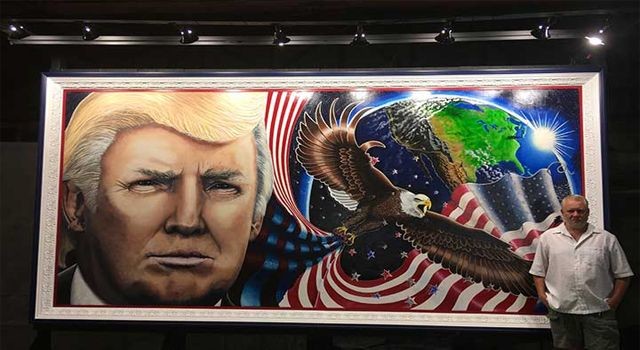
Artist Julian Raven (that’s him on the right above) wants to force the Smithsonian Institution’s National Portrait Gallery to include his “Unafraid and Unashamed,” which you can see above. On the artist’s website  can be found links to his Supreme Court petition and  other documents related to his Free Speech suit “to force the gallery to add a portrait of President Trump to its collection of images of people of remarkable character and achievement.” Raven notes that the gallery has displayed artwork from Barack Obama’s 2008 presidential campaign since 2009, and in his 39-page filing with SCOTUS, argues that gallery’s refusal to hang his portrait is based on an anti-Trump bias.

Raven’s crusade has been treated as an oddball saga and a joke, as in a  profile in the Washingtonian Magazine.

Some conservative writers are taking his cause seriously, however. Here’s Lawrence Jarvik:

Raven’s challenge dramatizes how national cultural institutions established to serve all the American people, such as the Smithsonian, have been hijacked by dangerously partisan factions which seek to exclude, marginalize and erase  “Others.”

As his brief demonstrates, the Smithsonian had accepted campaign posters for Barack Obama and Hillary Clinton, in addition to huge oversized paintings of Bill Clinton, Barack and Michelle Obama. It had a special exhibition for the Obama Inauguration, and maintains a sort of shrine to the Obamas to this day. 

Raven’s case likewise provides evidence that decision-making at the Smithsonian is arbitrary and unfair. He was never provided a written decision on his application. Instead, he received only a phone call from the director, which from his account sounded conclusory, partisan, and unfair.

As he points out, as an American citizen—Raven is entitled to due process. Yet, to this date, he has no idea as to how his work was evaluated, nor what rubric was applied to his submission…versus that used for pictures of Obamas or Clintons.

Although “Unafraid and Unashamed” may not be the most beautiful portrait ever painted, Raven’s legal brief makes clear that the official criterion for display by the National Portrait Gallery is historical significance. No reasonable person could deny that Donald Trump’s election in 2016 had historical significance.

That’s true. It is also likely, certain, even, that the selection criteria used at the Smithsonian, as in every other art museum, is subjective and thus certain to be biased in one respect or another. Since the question involves pro-Trump art, and it would be hard to find an artist or significant arbiter of the arts in Washington, D.C. or anywhere else who doesn’t loathe President Trump, the issue of bias is not an insignificant one. Continue reading

Unethical Quote Of The Month: USA Today Op-Ed Writer Elvia Diaz

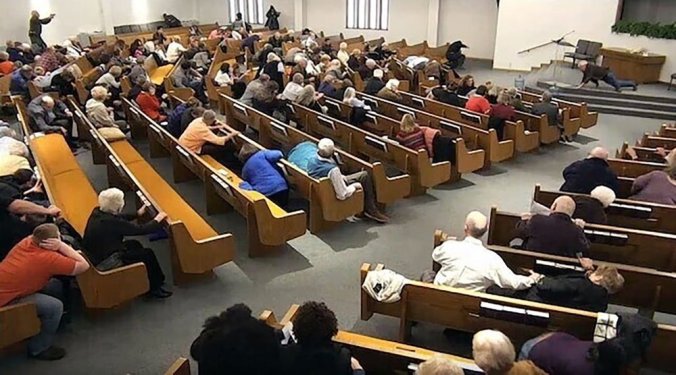
“Jack Wilson is a hero alright. It took him only six seconds to kill a gunman at a Texas church, saving countless lives. Unfortunately, that kind of split-second heroism has been turned into a PR tool by gun advocates…. he’s exactly the kind of man you want around with a firearm. But we know nothing about the at least six other parishioners who also appeared to draw their handguns at West Freeway Church of Christ in White Settlement, Texas. And that’s terrifying.”

Elvia Diaz of the  Arizona Republic, USA Today, in a Jan. 1 , 2020  USA Today op-ed.

The paper, soon to be defunct (thankfully—I would not be shocked if it didn’t last the year), has been furiously flamed on social media for this obnoxious and telling commentary. It doesn’t take much, beyond respect for American citizens and the Second Amendment, to pinpoint the ethics illness on display here.

Every mass shooting instantly is politicized into a repetition of the anti-gun propaganda that has become a reflex on the Left and in the mainstream media since the Sandy Hook school shooting. The disappointment among this group over a shooting being foiled by a lawful gun owner has been nauseating. The right to own guns is the right to self-defense, and not to have to depend solely on  the government for self-preservation.

The result in White Settlement should be used to counter the efforts to strip gun rights from citizens, because there are many benefits to society of private gun ownership.

The op-ed perfectly summarizes the media’s distrust of Americans and personal liberty. It’s so terrifying that those owning guns, and prepared to use them lawfully, haven’t been certified as worthy of self-defense rights by obtrusive government overseers. What an ugly bias.

The social media reactions have been impressively on point… Continue reading

Ethics Observations Upon Watching “Ford v. Ferrari”

My son is an auto tech and car enthusiast as well as a lover of speed (sufficiently to get him in trouble), so when he told me that I should see “Ford v Ferrari” and that he loved it, it was no surprise. I knew nothing about the film other than its title: no reviews, no background. My son said he would eagerly see it again, and was our guide as my wife and I attended a New Year’s Day afternoon showing (which was packed, incidentally.)

To get the basics out of the way up front, “Ford v Ferrari” is a wonderful movie. It immediately takes its place as one of the great sports movies of all time (with “Rocky,” The Natural,” “Hoosiers,” “The Bad News Bears,” “Sea Biscuit,” and a few others we could argue about), but it is also just a great movie. Christian Bale is astonishing, as usual, and the rest of the cast is uniformly excellent, as is the direction, film editing and screenplay. It is the best film I have see this year, easily leaving such critic’s favorites as “The Irishman” and “Once Upon A Time in Hollywood” in the dust.  That, however, is beside the point….

Observations: Continue reading

2020 Ethics Launch, January 1: “The Anti-Benghazi”

Let’s get 2020 off to a great start…

1. Though this story doesn’t qualify: Taking his cue, apparently, from the November incident (which I wrote about here) where a Kiefer, Oklahoma police officer dropped by Starbucks on Thanksgiving Day to buy drinks for his department’s 911 dispatchers and every cup in the order was labeled with the word “PIG,” a police officer in Kansas resigned this week after admitting he had fabricated a story that a McDonald’s employee wrote”PIG” on  his coffee cup.

The fake hate speech (actually it’s not hate speech when someone denigrates a police officer, because, as Black Lives Matter has explained, they deserve it) claim unraveled when McDonald’s produced video footage that proved its employees had not written anything on the cup.  Then the he 23-year-old officer then admitted he had lied about the supposed incident “as a joke.”  Well, at least he has a future in comedy.

I find it refreshing that for once one of these hoaxes was not executed by a minority group or social justice activist. This isn’t going to do much for police-community relations across the country, however. Continue reading

Comment Of The Day: “’Side hustle?’ SIDE HUSTLE?”

Let’s begin the new year with a Comment of the Day.

It’s appropriate.

One of the important things I have learned since beginning this blog in 2009—in addition to the apparent fact that trying to elaborate on the topic of blackface and dark make-up in the arts will get one’s blog banned on Facebook and there is literally nothing one can do about it—is that the commenters enrich, define, and advance the mission of the blog beyond anything I could have anticipated.

Pennagain’s comment on the topic of the so-called “gig economy” and California’s efforts to smother it is an excellent example. (One of the joys of any Pennagain COTD is that I know I won’t have to check for typos, since Pennagain regularly checks MY posts for typos…). Behold the Comment of Day on the post, “Side hustle?” SIDE HUSTLE?”:

I hardly know where to start. It’s the so called “gigs” that people learn most from. It’s those with the widest experience who can not only make the most of their job (main gig), whatever it turns out to be, but who will accommodate to change, go with the flow and roll with the punches, get a kick out of learning new things from different people, be comfortable experimenting with ideas and opinions.

Retirement – grandpa M. was 54 when he found, as the British put it so accurately, to be “redundant” to his own business when one of his sons took it over. He’d been good at his job, learning the trade from his father and practicing it in one form or another since he was a child, bringing his expertise (and, necessarily, a wife) to the New World at the turn of the century. He had never done anything else in his life. Building and running his business was his whole world, full of customers, many of whom had become close friends. The job kept him active, on his feet, reaching, stooping, sorting, lifting, dealing with salesmen and stock deliveries. He appraised and bargained, bought and sold. He had fierce competition that excited him, and he enjoyed every minute of it.

On the day he (was) retired, he sat down in a red plush chair in his living room and spent nearly every day for the rest of his life sitting there, having nothing else to do. No interests, no radio—no hobbies, no friends, not even any acquaintances. He’d never bothered to get to know his neighbors or attend any social functions at his house of worship. He had nothing in common with his family (the son who inherited the business never came to visit; too busy at work). The second-generation Americans who came religiously to visit, at least one group each weekend, didn’t speak either his original or his business language, nor he theirs.

He died just after his 55th birthday. In the red chair. Continue reading