From The Ethics Alarms Archives: “Forgetting What We Know”

This post, one of the very first on Ethics Alarms, was written on Halloween, 2009. The blog had essentially no followers then. I judge it an excellent post (if I do say so myself) but just a handful of people read it. There were four commenters: King Kool, who traveled over from the old Ethics Scoreborad site and who, I am happy to say, still weighs in now and then; “Ethics Bob” Stone, who commented her last year,  and a friend I met through my connection with child star advocate Paul Petersen and with whom I am still in touch.

I found it extremely interesting to review–I wouldn’t change anything substantive in it, though I made three small edits—in light of what has happened since, and the theme of the post, which was how ethics evolves.

The post was written before the #MeToo upheaval. For all I know, Harvey Weinstein was forcing an aspiring starlet to have sex with him and Bill Cosby was drugging a young woman as I was posting it. It references several  rationalizations before the Ethics Alarms Rationalizations list had been launched.

I wonder, though, how much out society has really learned since it was written.  Roman Polanski is still living free and directing films in France. Six women have accused him of sex-related crimes, the most recent last November.

Bill Cosby is in prison for one of his rapes: Harvey Weinstein is standing trial right now. Bill Clinton appears to have finally been reduced to persona non grata status among progressives and his former defenders, but his complicit and unapologetic enabler, Hillary Clinton, is still treated as a feminist icon, and even harbors dreams of running for President again. The Lieutenant Governor of Virginia, Justin Fairfax , has been convincingly accused of rape by one woman and sexual harassment by another, yetremains in office, and the local and national media have stuffed the story in the proverbial memory hole.

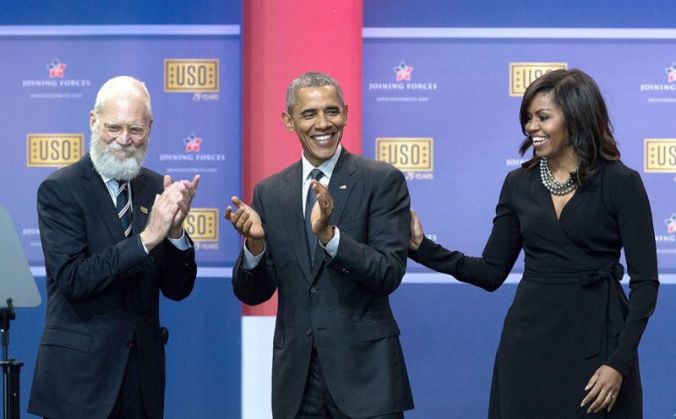
Six years after this post, David Letterman retired from “The Late Show” hailed as comedy legend, with Barack Obama and three former Presidents appearing on his farewell show. He continues to be sought after for interviews and as an MC, as in the USO event pictured above.  In 2016, Letterman joined the climate change documentary show Years of Living Dangerously as one of the show’s celebrity correspondents. In 2017, Letterman gave the induction speech for Pearl Jam when the group was inducted into the  Rock & Roll Hall Of Fame. That same year, 2017, Letterman was feted on Turner Movie Classics with Alec Baldwin—don’t get me started–as he  co-hosted “The Essentials.”  Letterman and Baldwin introduced seven films for the series.

Wisely, “Rosemary’s Baby” was not among them.

In 2018, Letterman began hosting a six-episode monthly series of hour-long programs on Netflix called My Next Guest Needs No Introduction with David Letterman. His old friend, patron, and feminist hero Barack Obama was his first guest.

The second season premiered on May 31, 2019.

This  is “Forgetting What We Know.” Continue reading

After School Ethics Special, 1/6/2020: Stupidity On Parade


“Help?”

A grateful pointer to Althouse for finding this photo, which raises automatic ethics questions. I am viscerally opposed to putting sweater, clothes and costumes on dogs, in part because all of our dogs have hated it, and one, our feisty Jack Russell Dickens, would twist himself like a contortionist to get out of any garb, whereupon he would rip it to shreds. Several of her commenters make a great point, however: it is unethical to force dogs bred for warm and dry climates to live in wet, cold ones. I have dog-lover friends who insist that dogs are humiliated by being dressed up, like Ralphie in his bunny pajamas. That, I think, is a stretch.

1. Don’t blame Disney. Emerson Elementary School in Berkeley, California decided to raise money for the PTA by selling tickets to a screening of  The Lion King. CNN explains,

“One of the dads bought the movie at Best Buy,” PTA president David Rose told CNN. “He owned it. We literally had no idea we were breaking any rules.” While the school doesn’t know how exactly the company discovered the movie was played, Rose said the school’s PTA will “somewhat begrudgingly” cover the cost of the screening. An email sent to the school by Movie Licensing USA informed Emerson faculty that the company had “received an alert” that “The Lion King” was screened during an event on November 15. Movie Licensing USA manages licensing for Disney and other major studios. And since the school does not have a license with the company, it’s been asked to pay $250 for the screening — and $250 per showing of the movie at any future events at the school.”

What? “Somewhat grudgingly”? They had “no idea” charging for tickets to see copyrighted material broke any rules? Those rules are well-displayed on any DVD, and any duty of reasonable intelligence should be able to figure out what’s illegal about doing what they did. There weren’t any lawyers among the organizers and attendees?

In its story about this episode, Boing Boing, an entertaining site with an annoyingly “woke” staff, implies that Disney is being an greedy old meanie, and that the PTA was an innocent victim of another evil corporation.  Wrong, and stupid. If companies don’t protect their copyrights and trademarks, they can lose them. Disney has been overzealous in this area, but not on this occasion.

2. KABOOM! Chris Matthews suggested yesterday that the Democrats should consider nominating Adam Schiff for President. Continue reading

Was Rush Limbaugh A Worthy Recipient Of The Medal Of Freedom Award?…Epilogue

I am doing this for my own sanity. After I researched the post about Rush, I couldn’t stop thinking about the figures who have not received Medals of Freedom. If you think about it, it will drive you crazy too. The honor is now self-defining, like all such honors—the Mark Twain Award and the Kennedy Center Awards come to mind.

The sequence in the post that asked “Why Robert De Niro  and not, say, Al Pacino, Gene Hackman or Dustin Hoffman? Why Loretta Lynn and not Johnny Cash? Why Stephen Sondheim and not Jerry Herman? Why Chita Rivera and not Rita Moreno? Why Vin Scully and not Ernie Harwell?” did it to me. President Trump has entered the realm of post mortem MOF honors, for Elvis (if Elvis, why not Buddy Holly?)and Babe Ruth (If Babe, why not…well, there really isn’t anyone like Babe Ruth). I have no problem with either of them: they are clearly cultural icons who changed America. But once we open the doors to the past, there are thousands of important Americans who haven’t been honored.

Every President from Kennedy on has been awarded a medal (JFK,  LBJ and Bush I posthumously) except Nixon and Bush II.  If dead Presidents are eligible, then where’s Washington? Adams? Jefferson? Madison? Lincoln? FDR? Truman? Ike? Teddy? Trump can make progressives’ heads explode by giving the Medal to Andrew Jackson. He can have a ball with this. Continue reading

Was Rush Limbaugh A Worthy Recipient Of The Medal Of Freedom Award?

What an easy question.

Of course he was. Those who argue otherwise do not appreciate his remarkable influence on the culture, entertainment, and the political landscape. In many cases, they blame him for opening up public discourse and eroding the liberal domination of news commentary and political advocacy. They are the same people who find free speech “problematical,”

I am not a dittohead. Rush Limbaugh’s politics and causes are not mine; I admire his skills, but not always his employment of them.  In the Nineties I  sometimes listened to Rush in the car before I moved permanently to a home office. I have parallel life in theater, acting, comedy, skit writing and stage directing, and I was impressed with Limbaugh as a performer, which is what he is, and has always maintained that he is. His combination of politics, satire and  deft disc jockey patter was unique. It was obvious why he had become, by far, the biggest star in talk radio.

The end of the Fairness Doctrine, which required broadcasters to present all sides of opinion when discussing public issues—(riiiight)—was  repealed in 1987, and  Limbaugh invented a new format, a conservative talk radio show that was dominated by a quick-thinking , quick-tonged, generally jovial ideologue with a sonorous voice. Rush took phone calls from people on all sides of the political spectrum, and unlike so many talkmeisters that followed him, was never rude or abusive to those who challenged his positions.

Continue reading

Afternoon Ethics Respite, 2/5/2020: On Accountability, Karma, Never-Trump And Mookie

What a delightful afternoon!

It never fails. After a stretch where I am especially pleased with the quantity and quality of Ethics Alarms content, I lose followers. Occasionally someone has the courtesy to contact me and tell me why they are dropping Ethics Alarms, but usually not. I know I obsess about such things, but it is like being defriended: I deserve the courtesy of a direct contact and an explanation. One well-remembered exit was by a woman who was very active the comments but always regrading formal ethics theory. I know that stuff, I studied it, and it bores me to tears. I also view the academic approach to ethics as substantially responsible for the public’s general disinterest  in ethics generally. When I finally told the ethics enthusiast that this wasn’t the kind of ethics blog she was looking for, she sent me an email that announced her departure.

1. Of course, the big news yesterday…was that the Boston Red Sox traded their best player, Mookie Betts, to the Los Angeles Dodgers for two young players and the willingness to take on the ridiculous contract of an aging, injury prone ex-ace, David Price. Boston being Boston, this was a story of much more consequence in the Hub than the State of the Union, the Democrats continuing inability to run  caucuses in Iowa, or the resolution of the impeachment washout. This shows, as I have always known as a born and bred Bostonian, that the city has its priorities straight.

Betts is that rarity, a young, great player who can do everything well, and do it with charm and modesty. He should be the face of the franchise for the next decade, but there’s a problem: Mookie wants to test the free agent market after this season, when he is eligible to do so. The Red Sox have offered him a long term deal in each of the last two seasons, and he recently rejected an offer in excess of 300 million dollars for ten years. On the open market Betts might get 30% more than that, and the Sox are loath to get into a bidding war. Thus, to avoid the fate of the Washington Nationals, who allowed their similarly young superstar Bryce Harper to flee without getting more than a draft choice in return (Mookie is better and nicer that Bryce), the Red Sox swallowed hard and traded him to the Dodgers.

Ethics notes:

  • In the trade, Boston gave up the best African American player in its long prejudice-stained history as well as its single African American starting pitcher. It says something about the team’s progress in this area that nobody has seemed to notice.
  • In trading Betts and Price after firing Alex Cora, the team’s manager implicated in the Houston Astros sign-stealing scandal, the Red Sox just happened to bid farewell to the three most vocal boycotters of President Trump’s invitation to the team to be honored at the White House for the its 2018 World Series victory. Red Sox cohesion was never the same after the grandstanding “Orange Man Bad” explosion that split the squad down the middle. Mookie never seemed quite as nice after that; Cora never seemed as wise, and Price always was a jerk.
  • Betts has told anyone who would listen that he wanted to stay in Boston, that he loves the city and fans, and that the Red Sox were just proving that baseball is a business. That’s disingenuous spin, and clearly so. If you really want to stay with a team, then you accept the paltry wages of more than 30 million dollars a year to do so.

2. Since there seems to be a strong disagreement among the commentariat on this question, I need to poll it:

Continue reading

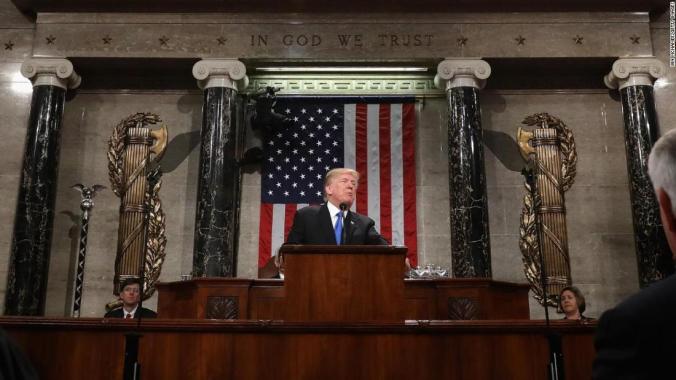
Ten Ethics Observations On The President’s 2020 State Of The Union Message

The text of the speech is here.

1. As I mentioned at the end of the previous post, my professional assessment, as a speech coach and a stage director, is that Trump’s delivery–timing, pacing, energy, focus, expressiveness, emphasis, technique–was excellent. Like other politicians (and me, frankly) the President is best, most relaxed, most persuasive and likable, when he is speaking extemporaneously. This time, though the speech was obviously scripted, he delivered it like his more familiar riffs.

And he has improved over his term in office. So many POTUSes have not.

2. As for content, I saw the speech described as “Reaganesque.” That’s high praise, but not far off. There were no ringing catch phrases, but the most important feature was that the speech was positive, optimistic, and upbeat. This was especially remarkable because many expected the President to be combative and defiant, and to directly address his impeachment. Not doing so was wise, and indeed ethical. Living well is the best revenge, and the President’s recitation of his administration’s achievements, no matter how the factcheckers spin them—it’s Trump, so we assume hyperbole—was a virtuoso dismantling of Big Lie #5: “Everything is Terrible.”

It’s not terrible, of course, far from it, and the false narratives constantly repeated by the Democratic candidates about how the middle and lower classes weren’t benefiting  were belied by Trump’s statistics asNancy Pelosi stared.

3. The repeat stunt of having all the female members of Congress on the Democratic  side wear white  was juvenile, incoherent and dehumanizing. I was reminded of the sperms in Woody Allen’s “Everything You Wanted To Know About Sex But Were Afraid To Ask.” Whatever their chant was, it didn’t work. The President deserves ethics points for specifically condemning late term abortion in front of this group, and featuring a little girl born at 23 weeks was a powerful visual aid.

Most Americans do not approve of late term abortions, and the device of making Democrats explicitly show their disapproval of Trump’s vow to stop it exposes a gaping ethics black hole on the Left.

4. At times I wish Ronald Reagan had never introduced the manipulative technique of using guests in the audience for applause and heart-rending moments, but I have to admit President Trump used it like no one before him, shamelessly but effectively.  I just hope nobody tries to top it, because that was my limit, and perhaps a bit over.

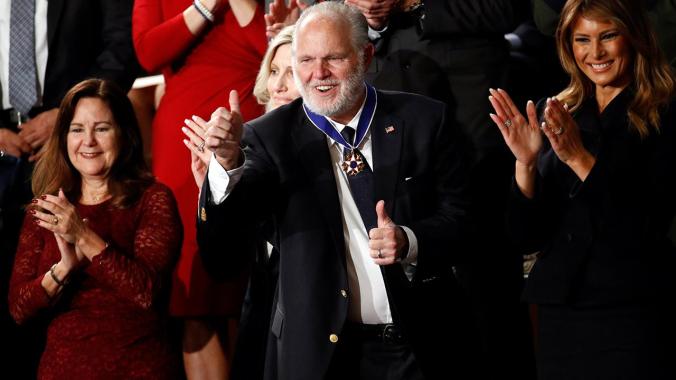
There was the African-American boy who wants to join the Space Force, and his 100 year-old Tuskegee airman great-grandfather, in uniform, having just been promoted to  general by Trump. There was the young African American girl who had been denied her application for a tax credit scholarship to attend a private school in Philadelphia because the state’s Democratic governor had vetoed a funding bill. The President told her she would get her scholarship after all, as she and her mother beamed. There was the new President of Venezuala, symbolizing a capitalist rescuer for a nation wrecked by socialism. Rush Limbaugh, recently diagnosed with Stage 4 lung cancer, appeared genuinely overcome when Mrs. Trump awarded him the Medal of Freedom on the spot. Also on the spot was a surprise reunion between a military wife and her soldier husband, back from deployment.

Great drama, great sentimentality, great showmanship. It was a combination of Oprah, Maury, and “Queen for a Day,” but schmaltz works, and the President proved himself a master of it.

5. Pelosi’s guests included Fred Guttenberg, the father of a high school freshman killed in the 2018 mass shooting at Parkland’s Marjory Stoneman Douglas High School. He got himself removed from the audience by shouting something about his daughter as the President pledged to preserve the Second Amendment. Using the victim of tragedies as political props is an objectionable stunt (Trump did this too, with Kelli Hake and her son;  Army Staff Sergeant Christopher Hake, was killed  in Iraq, a victim of the late Iranian terrorist leader Qasem Soleimani. Another guest was the brother of Rocky Jones, the victim of an illegal immigrant in Tulare County, California, and the parents of an ISIS victim, but Trump’s guests didn’t disrupt the event. They had also lost loved ones to bad people, just like Guttenberg, but do not advocate taking away law-abiding people’s rights in their grief. Continue reading

The Limits Of Graciousness: The President Rejects Nancy Pelosi’s Hand

The President in 2018 wearing a different tie.  Pelosi’s hand is the same

Though she offed it, President Donald Trump declined to shake House Speaker Nancy Pelosi’s  hand prior to delivering the 2020 State of the Union address tonight. (I’m watching the State of the Union Address as I write this.)

Perhaps those who are frequent readers here expect me to chide the President. He should remember that political disagreements aren’t personal, after all. As America’s leader, he should model the ethical virtues of forgiveness, civility, grace, and the Golden Rule. Our elected officials should always stand for the principle that though we may disagree as a people, we should never be disagreeable. In this case, such symbolic comity is especially essential. The nation has seldom been more divided, or more contentious in its division. Shaking the Speaker’s hand would be a step, albeit a small one, toward healing the rift.

Although this would be my ethics prescription under normal circumstances, this is not such a circumstance, and everyone knows it, or should.  Under Nancy Pelosi’s leadership, the partisan opposition of the Democrats to this President has breached all political norms and ethical traditions. The attacks on him, and not only him, but his family as well, have been directly personal, with Pelosi and her lieutenants using savage and unconscionable rhetoric to embarrass and insult him and, if possible, disable the President’s influence and lawful power. During the reprehensible impeachment burlesque, still ongoing,  the President has been denigrated as no Chief Executive before him, and as no leader of the United States should ever be denigrated by members of Congress, or any citizen. Continue reading

Comment Of The Day: “The Ethics Mess That Is US Race Relations, Chapter III: The Martin Luther King Day Essay”

In today’s Comment of the Day, Michael R explores the effects of college costs, student loans and ideological indoctrination on schools’ ability to provide an the valuable education students think they are paying for. Some of the factors he mentions I didn’t know about; I’m not sure  I’ve ever read about them anywhere else.

Here is the veteran Ethics Alarms contributor’s  Comment of the Day on the post, “The Ethics Mess That Is US Race Relations, Chapter III: The Martin Luther King Day Essay.”

I don’t think all universities have become worthless. There are a lot of problems with the universities and much of it has to do with student loans and leftist indoctrination.

Student loans make people forget about how much college actually costs. Students go to colleges with nicer dorms, bigger ‘Wellness Centers’, and more activities because they can ‘afford’ it with loans. This resulted in an ‘arms race’ to ditch traditional dorms for suites, and now full apartments for students. It resulted in big ‘Wellness Centers’ instead of gyms. It resulted in vast Student Activities staff and budgets. It resulted in more and more sports. I would estimate that only about 1/3 of college costs these days go to academics and academic support (academic buildings, utilities, janitorial, etc). The rest is sports, activities, and administration. If you had a lean college with good academics, but old-style dorms, no student life, and no sports, it would go bankrupt quickly. College is expensive these days because the students and the parents DEMAND it be that way. Continue reading

It’s A Super-Political Day, With Iowa, The STU, And The Impeachment Wrapping Up, So I Will Forgive Myself For Yet Another Politics-Related Post…

A. Let this be a reminder that the social media giants will try to place their fists on the scale this election cycle.

The political spot above, a creation of the Republican group America Rising, was flagged by Twitter, which warned users that   “The following media includes potentially sensitive content.”

What’s the sensitive content? The video is overwhelmingly constructed of news clips and recorded quotes from political figures, including the President, that were broadcast nationwide.   It appears that Twitter considers pro-Trump, Republican, conservative advocacy, even of a res ipsa loquitur variety, inherently offensive to its audience. That may well be true, but the Russian attempts to manipulate what voters see and here in the 2016 campaign will be  dwarfed by the domestic efforts by the social media platforms and search engines—all for the greater good, of course.

B. Nah, there’s no mainstream media bias! Go ahead, enablers and deniers, rationalize  this one. Continue reading

Ethics Quote Of The Week: Ann Althouse

“You see what they are doing? They’re blaming Iowa. It’s not the fault of the Democratic Party. It’s Iowa’s fault. After the citizens of Iowa put up with all that interaction with candidates swarming the state for the past year (and more) and after they showed up for this elaborate nighttime gathering in groups in gyms and showing support with their bodies, they are blamed for the screw-up of the party!”

Iconoclastic blogger Ann Althouse, reacting to the Democratic Party’s attempts to mitigate the Iowa Caucuses debacle.

At least they aren’t blaming it all on Trump. Yet.

Ann continues..

The other blame-shifting I’m seeing is: The computers did it. There was an app and it somehow caused all the trouble. Reminiscent of Hillary’s wipe-it-with-a-cloth computer problems. I really don’t want to hear excuses that have to do with computers getting things wrong. This cannot have been a complicated app, and the backup was to use the phones, yet they want to blame the phone lines too! It’s just not credible.”

What triggered Althouse  were Washington Post  headlines telling her that
Sen. Dick Durbin said  it was time to end the Iowa caucuses and that Howard Dean said that Iowa should no longer lead the primary parade.

What I especially like about Ann is that her academic detachment allows her to focus on aspects of an issue that most analysts miss because they care about the results more than she does. This talent is annoying when it results in her going off on tangents about how a particular word is used in a quote or article–she’s been obsessed with the word “garnered” for a couple of weeks now—but this is an example of her picking up on an ethics issue that nobody else, including me, was mentioning: the avoidance of accountability.

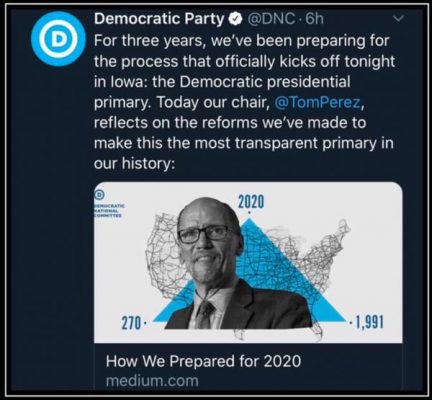
I was shocked when I woke up this morning after sleeping in—bad night—to see that the results of the Caucus still hadn’t been announced. It’s a massive embarrassment for the party, and again—commenter Michael West disagrees with me on this, but I’ll double down now—it is bad for everyone, not just Democrats. Ann was focusing on this as well, I think.

The Iowa Caucuses have long been celebrated as old fashioned democracy in action: citizens meeting in firehouse hall and churches, debating, making their preferences known. I come from Arlington, Massachusetts, the largest municipality in the nation that still uses the town meeting system of governance. Local and regional democracy, though the Left increasingly derides it in its quest for global government, is the heart of American values. This kind of breakdown, catalyzed by inflicting technology on a system that has worked just fine without it, undermines public trust in our institutions.

That is dangerous.

Moreover, it is in everyone’s interests, in a two party system, for both parties to find the best possible candidate. This was a point I kept making in 2016. For either party’s system to blow up increases the likelihood that chaos will taint the  process, and cause unforeseen and unintended results—as it did the last time.

That said, the conservative pundits are certainly having fun. Like here. And here. And here. Continue reading