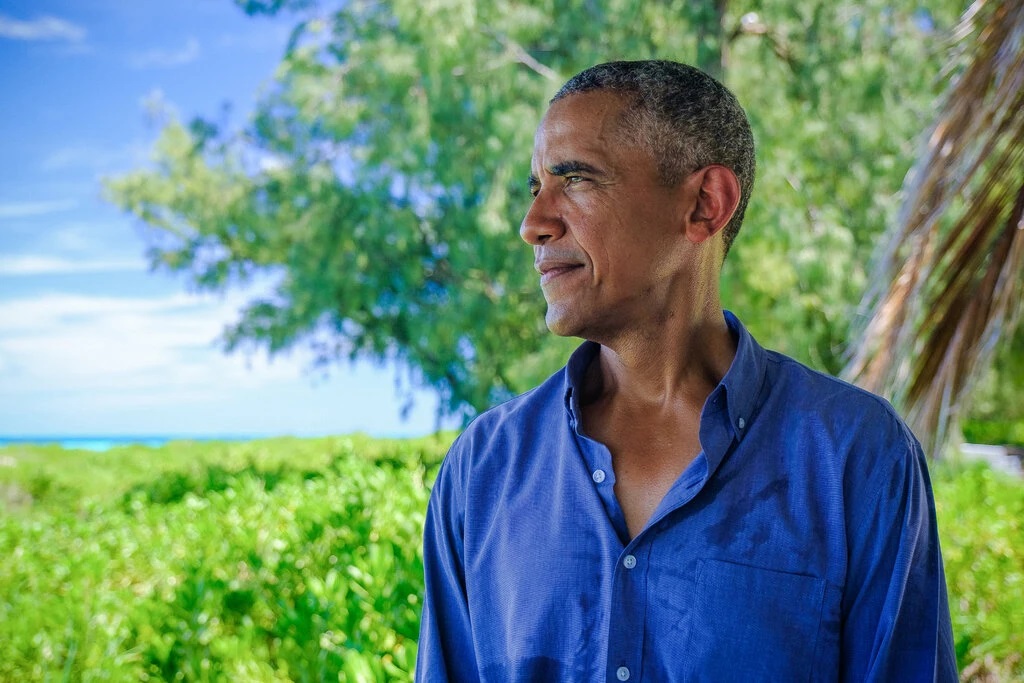
“A Promised Land” uses his improbable journey — from outsider to the White House and the first two years of his presidency — as a prism by which to explore some of the dynamics of change and renewal that have informed two and a half centuries of American history. It attests to Mr. Obama’s own storytelling powers and to his belief that, in these divided times, “storytelling and literature are more important than ever,” adding that “we need to explain to each other who we are and where we’re going.”
Has the Times ever published a single paragraph, much less an entire article, about the current President with such an admiring tone? Has anyone published a photo like that of President Trump, rather than one which made him look sinister, manic or brooding? I’m trying to think back and determine if any President has been as insufferably smug as Barack Obama, or acclaimed despite such a dearth of positive accomplishments. Clinton would be the closest in the first category, Kennedy in the latter.
1. Don’t encourage him. Donald Trump will be a disqualifying 78 years old when 2024 rolls around. He will have no business running for President at that age, but if trend hold, he will do it anyway, essentially playing Teddy Roosevelt in 1912 and letting his unrestrained ego wreck any chances the Republican might have of finding new leadership and defeating whoever the Democrats run. Trump will be back where he was in 2012 and 2016, running for President without any concern for the damage it may do.
Yesterday was the safe harbor deadline for the U.S. Presidential election and enough states have certified their election results to determine a President-elect. Given that, we will start removing any piece of content uploaded today (or anytime after) that misleads people by alleging that widespread fraud or errors changed the outcome of the 2020 U.S. Presidential election, in line with our approach towards historical U.S. Presidential elections. For example, we will remove videos claiming that a Presidential candidate won the election due to widespread software glitches or counting errors. We will begin enforcing this policy today, and will ramp up in the weeks to come.
What does the “safe harbor” date have to do with justifying YouTube’s censorship? There are live lawsuits and investigations underway. Who or what is YouTube to decide when an election is fair, legitimate, or settled? If YouTube is so concerned about not undermining public faith in U.S. elections, why is this video still available, among many others? For that matter, why is YouTube still hosting 9-11 conspiracy videos, like this one?
Not only is YouTube’s nakedly partisan censorship not “supporting” the election, it is undermining the reason for the elections, which is continuing American democracy. What this looks like is an effort to shut down dissent and prevent lingering questions about matters of legitimate disputes and suspicion, and even if they are not legitimate, YouTube, aka Google, should not be the arbiter of the matter, or any matter?
What happened to “Democracy Dies in Darkness”? Why aren’t citizens of all partisan leanings alarmed at the increasingly shameless efforts by the news media, Big Tech and social media to sanctify Joe Biden’s election in an exact reversal of how President Trump’s election was undermined from election night 2016 all the way to this moment?
Meanwhile, Ethics Alarms is dependent on YouTube, especially since WordPress, despite adding a video “block,” doesn’t make it easy for me to embed videos from other sources. I’d like to stop using this openly biased, pro-totalitarian, hypocritical, double-talking ally of single-party rule.
This is a ruthless, dangerous, unethical, Machiavellian company with far too much power to abuse.
Black, Hispanic and Native American veterans will be given priority for receiving coronavirus vaccines once they become available, according to a document published Tuesday by the Department of Veterans Affairs.
Race and ethnicity, as well as veterans’ ages and existing health conditions, will be taken into consideration by the VA when determining who should be vaccinated first. According to VA data, Black, Hispanic and Native American veterans are disproportionately affected by the virus, reflecting trends across the broader population.
I am slowly catching up on languishing Comments of the Day. Where a Humble Talent comment is involved, I don’t feel too badly about a late posting; like Mrs. Q, Chris Marschner, Glenn Logan, Steve-O and others, he is a master of the form and has hardly been neglected. This post, from November, relates to the suddenly lively topic of the duty to confront, and is also a cherished genre here, the personal reminiscence.
“Court packing” has meant the same thing since the term was devised to describe what President Roosevelt attempted in 1930, when he became frustrated with the conservative Supreme Court’s repeated ly finding his Depression programs unconstitutional. FDR decided to change the structure SCOTUS itself to allow him to create a liberal majority, expanding the number of justices so Roosevelt could appoint political allies. It was the expansion of the Court that was instantly dubbed “packing the court”; the expression had never been used before. “Packing the court” or “court packing” immediately sparked a negative backlash from the public and press: even Roosevelt’s supporters found the plan to be an ominous effort to change the rules when the existing system didn’t produce the results the President desired. FDR was forced to abandon his court-packing plan, and ever since, for 90 years, “court packing” has meant what FDR proposed…increasing the size of the Supreme Court to create an ideological majority suiting the President in power.
But when Democrats announced that their revenge for the President adding consrvatice Amy Coney Barrett to the Supreme Court would be to “pack the court,” they declared that “packing the court” was what the Republican had been doing by confirming Trump’s three nominees during his term, so their intention was fair and reasonable “tit for tat.” Coincidentally, Dictionary.com conveniently changed its definition of “court packing” to accommodate the Democratic Party’s rationalization sometime during November, sparking this Twitter thread:
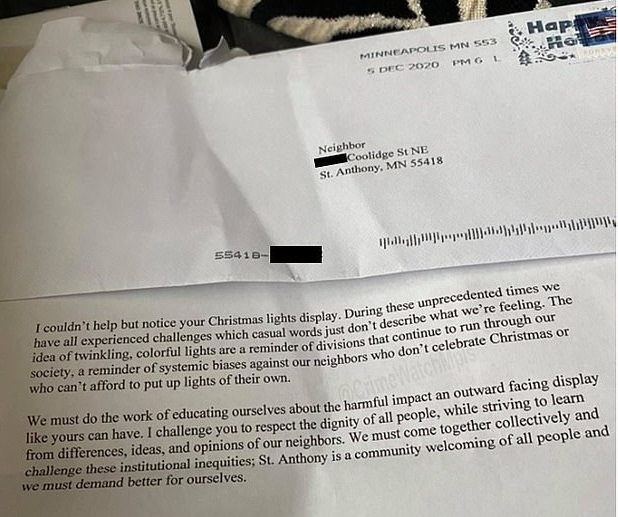
In St. Anthony Minnesota, someone sent home owner Kim Hunt an anonymous letter reprimanding her for decorating her home with the modest Christmas lights seen in the top photo above. Three other residences in the neighborhood received the same letter:
It’s not Pearl Harbor, but the assassination of John Lennon in Central Park 40 years ago today by a deranged fan is one of the saddest days in popular music history, on the level of the premature deaths of George Gershwin and Buddy Holly.
I really don’t want to talk about it.
1. Scary. The New Yorker’s Steve Coll wrote that”Those of us in journalism have to come to terms with the fact that free speech, a principle that we hold sacred, is being weaponized against the principles of journalism.” David Harsanyi writes at The National Review,
If you believe Americans are too stupid to hear wrongthink, transgressive ideas, and, yes, fake news, you’re not a fan of the small-l liberal conception of free expression. That’s fine. Those ideas seem to be falling into disfavor with many. But the sanctity of free speech isn’t predicated on making sure people hear the right things, it’s predicated on letting everyone have their say. Because as always, the question becomes who decides what expression is acceptable. I’m not keen on having the fatuous media reporters at CNN or activist “fact-checkers” at the Washington Post adjudicating what is and isn’t permissible for mass consumption…this kind of selective esteem for sacred ideals is becoming popular on the contemporary Left. Religious freedom is wonderful when the government protects Native Americans who want to smoke peyote, but it is “weaponized” when an order of nuns decides it’s not interested in chipping in for condoms or an Evangelical business owner decides he’d rather not participate in a gay marriage. Due-process rights are foundational to American life, unless they are being “weaponized” by college students accused of sexual assault….For four years, journalists acted as if Donald Trump was an existential threat to free expression because he berated and insulted reporters. Trump’s tone was certainly unpresidential, but it needs to be said that he did absolutely nothing to hinder anyone from criticizing him or reporting about him. Contra the self-canonized Jim Acosta, it was not a particularly dangerous time to tell the truth. Indeed, reporters were not only free to accuse the president of being a fascist, they could concoct entire fake scandals surrounding the Russians, and Trump was powerless to stop them….
As I will be saying for the next four years as often as possible: This is what those who voted for Joe Biden have endorsed in their determination to express their tantrum over a President whose style they found obnoxious. I really don’t know how they will be able to live with themselves.
I typically use this time of year to catch up on or revisit ethics movies, especially since the ones in the Christmas sub-category are embedded in my brain already. Two ethics movies that I recently watched again are Ben Affleck’s “Gone Baby Gone” from 2007 and “Seven Days in May” (1964).
“Gone Baby Gone” is the more obvious ethics movie thanks to its famous ending, which sparked thousands high school essay assignments at the time of its release. I can’t write too much about that ending without spoiling the film for you if you’ve never seen it; let me just state that the climactic decision made by the film’s protagonist, played by Ben’s brother Casey, is or should be an ethics no-brainer. It’s depressing to me that so many viewers agreed with the character’s ethically clueless, emotion-driven girlfriend that his solution to an admittedly wrenching ethics conflict made him a monster. There is literally no ethical system that would legitimately support her argument, which can only be backed by using an army of rationalizations. That a large proportion of the public, perhaps a majority, would back her analysis shows how miserably the education system and our culture has failed in teaching basic ethics problem-solving skills.
“Seven Days in May” presents more diverse and complex ethical issues to consider, and also is old enough after almost 60 years that I have no hesitation in revealing the plot: if you have never seen it, you should have.
That movie is also fascinating as a period piece, flashing ideas and images that seem surprisingly familiar in today’s context in rapid juxtaposition with moments that are hard to imagine today. Silent protests in front of the White House? Women picketing in dresses and men in suits and ties? I found a review of the film from The Harvard Crimson in 1964 that featured this:
“[T]he film has a civil rights tinge. The producer has dutifully used Negroes in minor roles wherever he deemed it appropriate. A Negro in the Pentagon running an automatic door receives a good deal of film footage. Negroes sit in the airports. They march in the pro and anti-treaty lines before the White House. Finally, there are Negroes at the President’s press conference as the film closes. These are simply kowtows to the New Republic set; if the producer had real guts he could have cast Sydney Poitier in Kirk Douglas’ role. But then Producer Edward Lewis would have been troubled by the script’s implication that Douglas will some day sleep with Ava Gardner, who plays Lancaster’s former mistress. Miscegenation might have confused the good guys and the bad guys, particularly for southern audiences. Anything that controversial would have detracted from the film’s propaganda force.“
Fascinating, don’t you think? Today, mixed-race couples on TV and movies are de rigeur, even when it makes no historical sense whatsoever. Today, it takes courage to resist the political correctness edicts that “actors of color” be gratuitously shoehorned into stories and casts based on skin-hue and little else. But today the motivation isn’t “civil rights” but rather affirmative action and “racial justice.” I really don’t care that in Netflix’s “Enola Holmes” blacks turn up in highly unlikely roles for Victorian England, I really don’t. OK, it’s a misrepresentation of history, but the film is a fantasy. However, such blatant virtue-signaling and diversity box-checking does take me out of the story for a moment, and that’s just bad direction. (How many black female martial arts tutors were there in Victorian England, I wonder?)
But I digress. “Seven Days in May” was indeed anti-war, nuclear disarmament propaganda in 1964 at the height of the Cold War, but that’s not one of the ethics issues central to the film.
In a video that has “gone viral,” a mall Santa, socially distanced of course, engages in conduct that by Ethics Alarms standards triggered a duty to confronton behalf of the mother of the child he mistreated.
I wish we could determine when and where this episode occurred; I half expect to find out that it was staged by Breitbart or James O’Keefe. Assuming the video is genuine, howeverit is an example of a Santa Claus seriously abusing his authority.
In the video, a little boy is seen sitting across a table from Santa who asks, “What do you want for Christmas?” The child inaudibly asks for a toy gun, and Santa responds, “No guns.” Even after the mother clarifies that her son only meant a Nerf gun—you know, these sinister playthings…
Jack said: “I’m not going to wear a mask inside my home, nor in my car, nor outside while playing with my dog, and I’m going to regard anyone who follows this edict with a “please” attached as an enemy of my future liberty as an American.“
As a person who has taken college classes in both epidemiology and virology as part of my course of study, I can tell you that yours is a sane response. I don’t style myself any kind of an expert, but I do know plenty about both subjects. The SARS-CoV-2 virus appears to require a minimum viral load to produce symptomatic disease, and that load is nearly impossible to achieve outside without being in crowded close quarters due to natural air currents.This is one likely explanation why there are so many asymptomatic infections. Viruses producing the common cold display this same characteristic, and coronavidae is one of the cold-producing families of virus. As far as wearing a mask in a car, this is unnecessary unless you have high-risk potentially exposed people other than you moving in and out of it all the time, and don’t follow basic sanitation rules. Even then, the risk of dangerous viral concentrations in a single-person car are very small.






 Ethics Alarms