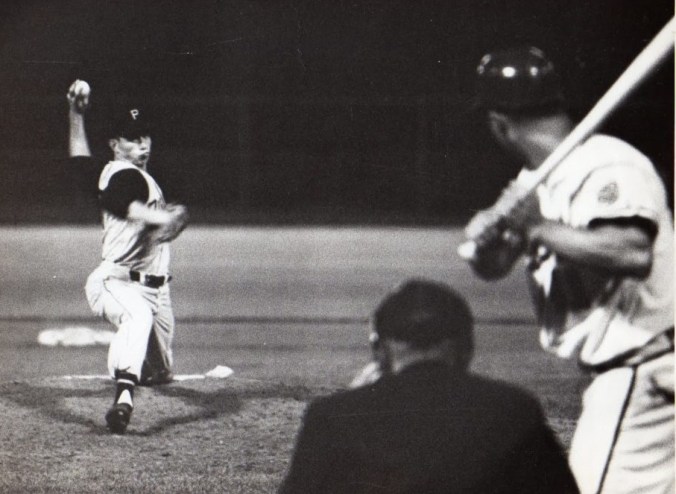
That’s Harvey Haddix about to throw a pitch above. The photo is from one of the most famous baseball games ever played: on May 26, 1959, Haddix, then a starting pitcher for the Pittsburgh Pirates pitched a perfect game—that’s no runs, hits, walks or errors, with nobody on the other team reaching base) for 12 innings against the Milwaukee Braves. It was the greatest pitching performance of all time, but because the Pirates didn’t score a run either, Haddix had to keep pitching into the 13th inning, where he lost the perfect game, the shutout and the game itself. As a result, he wasn’t even given credit for a no-hitter, which is normally when a pitcher throws nine-innings of hitless ball. That really bothered me as a kid; it made no sense.
In baseball, a no-hitter, with a perfect game being the ultimate no-hitter, has always been considered one of pinnacles of single game performance by a baseball player. A pitcher who throws one gets his name in the Hall of Fame; it’s a distinction that accents an entire career. Only the greatest pitchers throw more than one in a career; some of the very greatest, like Lefty Grove, Grover Cleveland Alexander, and Roger Clemens, never get one. (Cy Young, Nolan Ryan and Sandy Koufax, however, tossed three or more each. Johnny Vander Meer tossed two no-hitter in consecutive starts!) So being credited with a no-hitter is important; it matters.
Imagine then what it would feel like to be credited with pitching a major league no-hitter (or have your father or grandfather credited with one) and have it taken away. That’s what happened in 1991. Up until then, there had been no specific definition of no-hitter except the obvious, common sense one used by sportswriters, players, fans and baseball historians: a no-hitter was a baseball game that ended with one team having failed to get a hit. One of my favorite Commissioners of Baseball, however, Fay Vincent, the last one who wasn’t a toady for the baseball team owners (Vincent was fired for being independent, which up until then was the definition of his job), decided that the definition of no-hitter was too loose, among some other statistical anomalies. He put together a commission, and, with his influence, they redefined a no -hitter as a game that ended with one team getting no hits in at least nine innings.
Not only did the new official definition fail to recognize Haddix’s 12 inning perfect game, it resulted in wiping several no-hitters previously recognized from the record books. This included no-hitters that had been ended by weather, darkness or other reasons after becoming official (by the losing team batting at least five times), and four especially fluky games where a pitcher for the visiting team gave up a run or more due to walks or errors, and his team lost, failing to catch up in the top of the ninth inning. That ended the game without the winning home team having to bat in the last of the 9th, so the no-hitter was only 8 innings instead of 9.
I felt the rule was unfair and wrong-headed in 1991, and I still do, for several reasons:
- If the game was considered a no-hitter when it was pitched, declaring the game not to be a no-hitter years or decades later was unfair, like an ex post facto law, which our Constitution forbids. Baseball has refused to do this in other cases, as when balls that bounced into the stands were declared ground rule doubles rather than home runs, as they once were.
- It’s illogical. A game is a game, and it isn’t within the pitcher’s control how long the game lasts. The 1991 definition looked particularly bad in 2020 and 2021, when MLB declared that double-header games would only be seven innings instead of nine. (The stupid pandemic lockdown even screwed up baseball.). Two pitchers threw no-hitters in double-header games, but they don’t count because they were only seven innings rather than nine.
- Baseball still counts multi-pitcher no-hitters, with all of the pitchers involved getting credit. This drives me crazy. So Harvey Haddix throws 12 perfect innings and isn’t recognized as throwing a no-hitter, but a relief pitcher who throws two hitless innings in a game where three other pitchers pitched for his team will be considered as part of an “immortal” game. Baloney. A no-hit pitching performance should be a single pitcher, compete game distinction.
In the recent the recent Baseball Research Journal article that reminded me of the no-hitter rule mess, the author, Stew Thornley, makes an interesting point. He wrote that that rule change didn’t change what had happened in the games affected, and that nobody was obligated to accept the “official definition” of no-hitter if they didn’t feel it was reasonable or fair. He writes, “Repetitious as they are, the quotation marks around “official” are used intentionally. If readers interpret this overuse as a sign of the author’s disdain for an “official” definition, they are invited to make such an inference.”
Fay Vincent, who I think was wrong in this case, but I still have high regard for his handling of a difficult job, also made an interesting comment regarding the controversy. He told Thornley that he and Bart Giamatti, his predecessor as commissioner (Giamatti is the one who banned Pete Rose for gambling), had a philosophy: “Those are the issues that make baseball great, issues that aren’t life and death but that generate disagreement and discussion.”
That’s sort of true, in the sense that such debates energize baseball. Ethically, however, it is far preferable to be fair and consistent. Right now, the definition of no hitters isn’t either.
 Ethics Alarms
Well, if throwing a no hitter is a career distinction (which it is), as a young Astros fan I felt a perverse pride in having one of our pitchers (I think it might have been Larry Dierker?) get the more macabre distinction of throwing a genuine no hitter and also being the losing pitcher. Very few pitchers can claim that distinction.
Of course, the Astros were bad enough during their first couple decades that we needed stuff such as that to bolster us.
Of course since I am also a Rangers fan the past 25 years or so, I can also take umbrage to those sad sacks who bemoan their team not having won a World Series in the last few decades — since the Rangers have _never_ won a World Series their fans have been waiting forever. They did finally get there twice (and probably should have beaten the Cardinals) but no trophy.