
Let’s begin with the first of four troubling graduation tales, this one involving the rampant narcissism that social media and the popular culture imparts on our youth, aided and abetted by educational professionals.
Above is a newly-minted University of Arizona grad, known online as “Rachel Davenpole,” who donned a pair of see-through platform heels and a red thong to pose in a stripper-style split on a pole she had erected on campus for the task. Her erudite response to social media critics who found her photos inappropriate was was: “Graduated Magna Cum Laude (3.8 GPA) and received over $40,000 in scholarships … let’s get u a mirror so we can see who this tweets about babes.” Her non-sequitur defense was sufficient to inspire the New York Post—there are some good reasons why the rest of the media doubted you on Hunter’s laptop, guys—into giving Rachel even more of the publicity she craves with a news story.
Now watch Rachel be shocked when the employer who hires her for her first adult job thinks sexual harassment is appropriate…
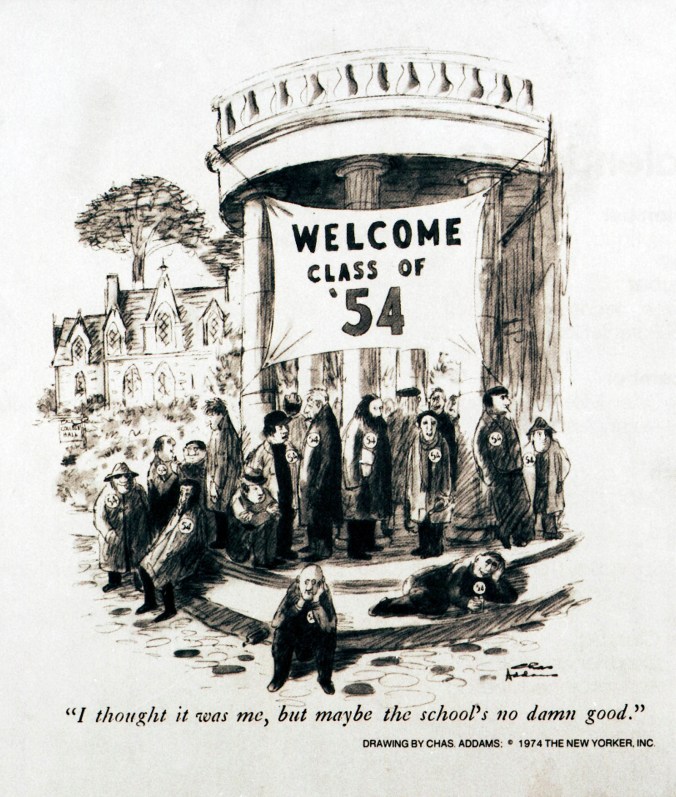
Next, there is Marlin High School near Waco, Texas. According to a statement posted to Facebook, it has postponed its graduation after just five of 33 seniors could meet the requirements for graduation because of grades or attendance problems. The school says it will reschedule the graduation until June so students will have more time to qualify. But the problem isn’t the students, is it? Here’s a chance to re-post one of my favorite Charles Addams cartoons:
Meanwhile, at CUNY law school, the graduating seniors voted to have radical classmate Fatima Mousa Mohammed speak at commencement, and she delivered a speech that attacked Israel, the New York City police, U.S. armed forces and democratic institutions as her class mates cheered.
She exhorted her fellow future lawyers to tear down capitalism, letting their “rage” be “the fuel for the fight against capitalism, racism, imperialism and Zionism around the world.” “No one person will save the world,” she continued. “No single movement will liberate the masses. ….Those who carry the revolution, the people, the masses … those who need our protection. They will carry this revolution.”
Mohammed also called for “liberation” in light of the “murder of black men like Jordan Neely by a white man on the MTA,” accusing politicians like New York City Mayor Eric Adams as “dignifying” such deaths. CUNY initially tried to keep the video of the speech off YouTube, but eventually capitulated to calls for transparency. There have been critics demanding that the school change the process by which graduates can elect such speakers, but again, the problem isn’t the process. The problem is the school.
Finally, we go back to high school, where Kenny Morales, a Grand Island Senior High (Nebraska) senior, wrote a graduation speech using OpenAI’s increasingly infamous ChatGPT to create a speech for his high-school graduation ceremony. Well, at least he used it to create the speech he submitted for approval. “I said, “Give me a speech about gratitude,” and I gave specific examples about what I wanted it to include,” Morales told Nebraska TV News. The bot produced an acceptable address in the eyes of school brass, but Morales wasn’t through with his unethical tour-de-force. The AI’s speech was just a decoy: when he got on stage, he gave a completely different oration in which he attacked the school, beginning by announcing that he hated going there.
Ethics grades: Morales gets two Fs for using ChatGPT to write a speech he was supposed to write himself, and for double-crossing the school by going off-script one he got behind a mic. The school flunks for ending up with a graduation speaker whom it failed to teach not to cheat and lie. Like the aspiring stripper and the anti-American revolutionary, Kenny deserves to face a lot of obstacles as he seeks employment going forward. If he has been accepted to a college, that college should retract its invitation.
________________
Pointer (Last item): JutGory
 Ethics Alarms
Had you not corrected me in your post, I would have continued on contentedly in my misperception and ignorance of Davenpole wearing some sort of weird sumo wrestler undergarment. Now I know better, it is her left glute and she sports a red thong. Thanks.
I’m afraid none of these “graduates” will suffer any adverse effects. The CUNY law grad interned at the National Lawyers Guild, a holdover from 1930s Communism. She’ll be on staff there and never have to practice law for a day in her lifetime. The kid who double-crossed the administration will be lionized at his college. The stripper from the U of A will be lauded by some employer. The problem is colleges and employers have gone woke. There are no responsible adults anywhere anymore. They’re all falling over each other to out-woke each other.
The pole-dancer makes me wistful for luckyesteeyoreman, the legendary commenter who was an unabashed fan of high school tart Sydney Spies. Lucky hasn’t visited the comments since 2021—I know he was having some health issues. I hope he’s well, and that he still looks in on EA from time to time.
I miss him.
When I submitted #4, I asked if it might be an ethics quiz whether using ChatGPT to write the address.
You asked if I was being tongue in cheek.
The answer was not entirely. When I sent the e-mail, I had not finished thinking about the issues. Here were things I was mulling over:
1) Having AI write a speech for you is not as bad as a lawyer using it to write a brief.
2) It is certainly not as bad as the bait and switch in the other ethics breach he committed.
3) It was still deceptive to propose a speech you had no intention of giving; so was the wrong thing committed in the proposal of the speech, or in the drafting itself, or both?
4) It would not be plagiarism to give the speech because you are not really copying anyone.
5) This reminded me of the ownership issue of the photo taken by the monkey (you covered this); if you put in the parameters to ChatGPT, how much of the product can you claim as your own (because ChatGPT can’t really copyright it (Can it? Does it?)?
6) It also reminded me of the artist who entered an AI painting into a competition (again, covered here) and there were no restrictions on such submissions in the contest.
After I sent the e-mail, I concluded it was wrong but primarily based upon the dishonesty. Actually using ChatGPT to draft an address raises some of these other issues and the answer fits somewhere in the middle of that mess that I laid out.
Follow up question: would it be even worse if he had ChatGPT draft his negative address, as well? Does he get any credit for actually writing the address he gave? (That’s a little tongue in cheek, but still an appropriate question in this context.)
-Jut
Too many interesting issues not to be a Comment of the Day.
I’m kind of ambivalent about your commentary on #2. If a school doesn’t enforce policies regarding grades and attendance, simply graduating anyone who’s dropped by the campus a few times over a three- or four-year period, the school gets blamed for foisting a cadre of undeserving graduates on the population. If they do enforce the rules, then it’s their fault that a lot of students won’t graduate on time?
I’ll certainly grant that communication could have been handled better, but in the absence of evidence I don’t know about, I’m inclined to think the school acted otherwise responsibly.
Isn’t having a senior class where 85% of the students don’t meet graduation requirements pretty conclusive evidence that the school is doing something wrong?
Quite possibly, but not necessarily. It could be they got an especially lazy class who thought they could get by without actually having to take responsibility for their own (in)actions. The delay in the ceremony might have been a necessary wakeup call. And there’s an update that suggests that the number of students eligible to graduate has increased considerably already.
Am I too cynical? That reads to me like a staff saying, “Hell, this is embarrassing. Let’s find ways to pass these stiffs.”
You may be right. That’s why I said I’m ambivalent; as you know, I’m perfectly willing to argue with you. I’m just not prepared to completely agree with you on this one.
But apparently at some level the affair was out of the school’s hands: if X, then state law says no graduation. But there were remedies. Last I read, they’re up to 29 of the 33 being qualified.
I also have several former students who teach in the area (not in that district). They tell me that virtually everyone except those 28 kids’ parents are backing the school.
Also the turnover rate for teachers has skyrocketed of late, for a variety of reasons which would take us off on a real tangent. What matters is that inexperienced teachers as a group aren’t as good as experienced ones as a group at things like classroom discipline, which seems to be one of the issues.
One last thought: this is a class that is experiencing their first real high school experience because of COVID shutdowns and the aftermath. So the interpersonal stuff related to puberty and the stupid “rebellious” things kids normally get out of the way as freshmen are now happening with seniors.
I’m going to opt for sympathy for all concerned.
How quickly we (well, I) forget. I never even thought about the Wuhan Effect. Of course that’s a valid factor to take into consideration. Thanks.
Maybe I am over-thinking this but as to #4 (the faux speech) how much distance is there between AI writing a speech and having a human speechwriter to prepare speeches? The speaker may provide the points to cover, but the clever wording, etc is the ob of the writer, or AI in the instant case. And if the speaker does not stick to the text of the speech (by either source), how far afield must he go to enter the deception zone?
Not over-thinking it at all: there is no difference, EXCEPT that the tradition of using speechwriters in political addresses is so universally known about and accepted that what matters is the speaker’s endorsement of the statements in the speech and what it communicates. It’s not an unethical practice when no deception is intended or exists. The same is true of legal briefs and judicial opinions.