
“War Is Peace. Freedom Is Slavery. Ignorance Is Strength.” The frighteningly Orwellian progressive movement and its Democratic Party facilitators have emulated Big Brother in their conviction that if you repeat an obvious lie often enough (and the news media helps out by at least looking the other way), enough lazy, careless citizens will accept whatever you say. Thus biological men have no advantage over women in athletic contests, the Southern border is secure, the economy is great, hiring people because of their color isn’t racial discrimination and a fetus isn’t a human life. On the Ethics Alarms Rationalization List, this is #64. Yoo’s Rationalization or “It isn’t what it is,” named after the Bush Administration lawyer who explained that waterboarding wasn’t torture. Totalitarian regimes depend on #64, which is why its emergence as a Democratic Party staple is especially ominous.
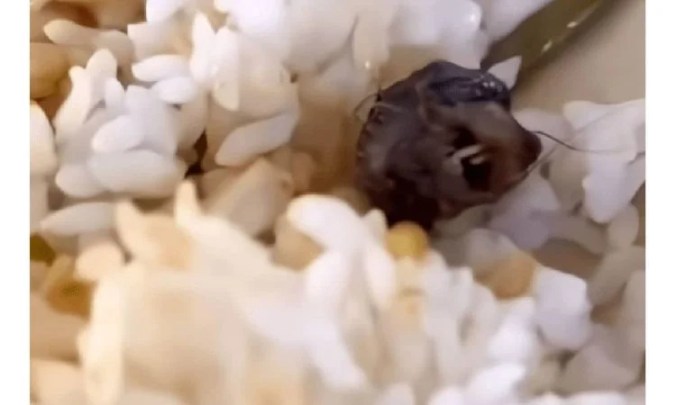
China, speaking of totalitarian regimes, has developed a culture in which “It isn’t what it is” has become the proverbial hammer for authorities who see every controversy as a nail. At the cafeteria of the Jiangxi Vocational Technical College of Industry Trade in Nanchang, China, a student found a desiccated rat’s head in his bowl of rice and memorialized the unordered meal item on his cell phone. When he confronted the cafeteria staff, however, he was assured that it wasn’t a rat’s head, but a duck’s neck. (That’s apparently considered just yummy in China. They even charged the student extra. I’m kidding…)
I’d include a photo, but it’s too disgusting; trust me, the head belonged to a rat. It has fur, it has little rat teeth. The nauseated student’s video quickly spread on Chinese social media, but the school stuck to its duck head story, because “It isn’t what it is” only works if you repeat your lie with gusto, and forever. Last week, the Jiangxi Vocational Technical College put out an official statement that the thing was duck, not rat, and the local food supervision bureau also confirmed that it was a duck neck. School officials warned students not to discuss the incident online anymore, or they would face serious consequences.
It still didn’t work: the image of Rat Head With Rice was seen by over 310 million people, and bold Chinese bloggers were mocking the Yoo disciples. One blogger wrote,
“Discovering a rat head while eating is not [even] the scariest part. What is truly frightening is that the public clearly sees a ‘rat head,’ yet they insist on claiming it to be a ‘duck neck’. If it’s really a rat head, it would be better to calmly admit it. At most, this would be a food safety incident and one or two temporary workers might get sacked and a fine could be imposed, and that would be it.The way that the school and the food supervision bureau have handled this matter is in complete opposition to the public and it is a provocation of social morality, completely inverting right and wrong and disregarding public trust in order to protect the ‘innocence’ of one or two individuals. I wonder if these leaders are actually so stupid or if netizens are too naive…”
Funny, I’ve wondered that a lot recently myself.
***
Oh all right, I know you secretly really want to see the “duck neck,” so here it is. Bon appetite!
“,”
 Ethics Alarms
Personally, I think I would much prefer a duck head in my food over a rat head. That is most certainly a rat head. Gross.
Streisand Effect for $500, Alex. I wonder if China us heading for a Berlin Wall moment…which is good since America and the West are as well.
You know me too well. I was indeed going to look up the alleged (Peking?) Duck head….
They need a bunch of Winston Smiths to tell them that 2+2=4 or a Jean-Luc Picard to declare that there are four lights.
I smell a rat.
Isn’t it the lefties who always say “it’s the cover up that’s worse than the crime.” Pious, hypocritical bastards.
Obviously some things are lost in translation. The Vo Tech actually issued a warning, saying, “It’s peeking! Duck!
Doesn’t it make you wonder where the rest of the rat is?
This reminds me of an account I read from a woman who was alive during the Japanese Empire. She talked about how the state sensors would tell people that things weren’t what they were, or that Japan was the origin of all culture, or that all inventions were Japanese inventions. She wrote about how the simplicity of pointing out something like “omelet is a French word, and why would a Japanese chef invent an omelet and name it something French?” was an act of subversion. This was particularly hard with a language that incorporates foreign words that it doesn’t have a word for by (generally) taking the foreign word and adding “su” to the end of it.
I really wish I’d kept a reference on the source, it was a short story… If anyone knows, please let me know. But it just goes to show how on a long enough scale, tyranny repeats itself.