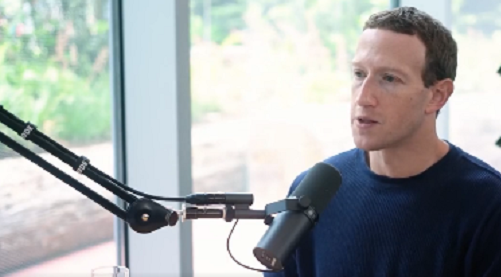
Mark Zuckerberg, the CEO of Meta, the parent company of Facebook and Instagram, said this during an interview on the “Lex Fridman Podcast”about his discovered wisdom about the difficulty of censoring social media:
“So misinformation, I think, has been a really tricky one because there are things that are obviously false, right, or they may be factual but may not be harmful. So are you gonna censor someone for just being wrong? If there’s no kind of harm implication of what they’re doing? There’s a bunch of real issues and challenges there. Just take some of the stuff around COVID earlier in the pandemic where there were real health implications, but there hadn’t been time to fully vet a bunch of the scientific assumptions. Unfortunately, I think a lot of the kind of establishment on that kind of waffled on a bunch of facts and asked for a bunch of things to be censored that, in retrospect, ended up being more debatable or true. And that stuff is really tough, right? It really undermines trust,”
Oh for God’s sake….Observations:
2. This guy is supposed to be a genius? “If there’s no kind of harm implication of what they’re doing?” What does that even mean? Isn’t “harm implication” the justification for shutting down non-woke opinions and speech all across academia and the education system?
Facebook shut down Ethics Alarms for about two years because my essay about Fred Astaire’s use of black make-up in “Top Hat” was apparently judged “harmful” (though it was accurate and correct.)
3. Not only is the question of “harm” totally subjective and subject to bias, so is the question of what statements are “wrong” much of the time. If a statement is obviously and indisputably wrong, then why censor it?
4. “There’s a bunch of real issues and challenges there.” Wow. He’s dazzling. This just occurred to Mark, did it? I wonder what “issues and challenges’ are rattling around in that money-obsessed brain. The First Amendment and the culture it helped to nourish here managed to settle most of those issues about 250 years ago.
Did you take any history, government or philosophy courses at Harvard, you putz?
5. Here, let me fix this one: “Just take what happened during the Wuhan virus freak-out throughout the pandemic when health officials, doctors and the government were claiming to have facts they didn’t have, claiming to be certain about what was speculation, and often lying outright to manipulate the public.” Much better. “What happened” was that social media and Big Tech joinded with the mainstream media to crush dissent and the circulation of contrary conclusions that impeded the case for incursions on personal liberty.
6. It often takes generations to “fully vet” scientific theories. “Assumptions” are antithetical to science.
7. That trust was unearned in the first place. Zuckerberg can’t even frame a coherent thought, and yet he has been allowed—he’s rich, so he must be smart!— to use his platform to warp public opinion while bolstering the grip of power-abusers on society.
8. The elites who presumed and are still presuming to decide what is “safe” for the public to read, hear, say and think about aren’t smart or learned enough to take on that task, and the proof is that they don’t even know it.
Zuckerberg’s babblings reveal him to be, whatever his real areas of expertise, a privileged, shallow, civically-ignorant fool. Do you want people like him controlling public debate? Because, you know, they are.
 Ethics Alarms
No one can be trusted to police free speech, especially during the great stupid. When people are seriously arguing for the removal of objectivity from everything from news media to science, the only possible application of moderation of speech is biased moderation.
Each August rural Bouckville, NY, hosts the “Madison Bouckville Antique Week”. Hundreds of dealers and buyers flock to this annual event. The promoters hire locals to handle traffic and parking control. For one week these locals who spend the other 51 weeks controlling nothing more than their cow herd or tractor are given authority to tell the multitudes what to do. And boy, do they enjoy their power. Typically pursuing it with great zeal. I imagine this phenomenon, is not peculiar to Bouckville or parking control. Nevertheless, I coined the term Bouckville Syndrome to succinctly describe the pleasure some people derive from being in control.
What is motivating Zuckerberg to want to control speech is unknown. Is he bowing to the wishes of Washington? Perhaps thinking appeasing them will avoid them from controlling him more closely? Is he drunk on power? Does he feel morally or intellectually superior? Or maybe as in the first Shrek movie, when Shrek saw the large size of Lord Farquaad’s castle, he asked Donkey if Farquaad was compensating for “something smaller”. What I do know is that regulating speech is dangerous for the people, freedom, and the country. No one person or entity is smart enough to do it. The temptation to abuse the power is too great. I shutter what will happen when they use AI to perform the task. I am sure the Teck companies will claim AI will be impartial and free from abuse. This canard conveniently will avoid the need to teach the computer what the parameters are of right and wrong, ethical and unethical, and so forth.
While I understand that Facebook can be both a useful and powerful tool for communication we existed quite fine before Facebook. If we collectively demand unregulated access or else, we
stop using Zuckerberg’s drug maybe change will occur. Nothing upsets rich people more than threatening their lifestyle. If enough people stop using Facebook Zuckerberg’s advertising revenue takes a hit. That I guarantee he will notice.