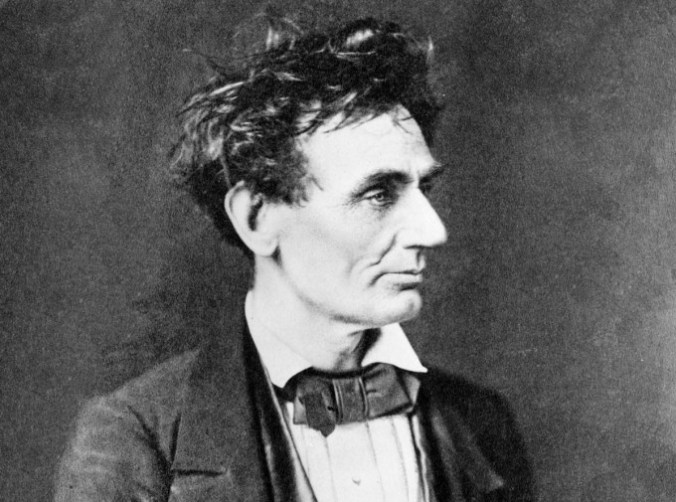
This was the day, in 1858, that Abraham Lincoln, just-nominated as the Republican Illinois candidate for the U.S. Senate, addressed the state Republican Convention in Springfield and, speaking to more than 1,000 delegates, crafted a warning for the nation adapted from the New Testament: “A house divided against itself cannot stand.” It’s ironic, or perhaps appropriate, that the anniversary of the prophetic speech occurs as “Juneteenth,” the federal holiday designed to pander to African-Americans in the aftermath of the George Floyd Freakout makes this a long weekend. Juneteenth is a divisive holiday, based on race alone.
As A.M. Golden asked two years ago at the end of his guest column here, “Any thoughts on how easily America is going to transition into two Independence Days, one for whites, one for blacks?” My thought, based on the two years since: It is likely to transition into a permanently racially-conflicted and divided society, which is apparently just what progressives and Democrats want, only relived by further divisions. I fully expect, for example, for the next push by the increasingly bold and insatiable LGBTQ lobby is for a national holiday honoring the Stonewall riots that began on June 28, 1969. That one, like the federal holiday arriving on June 19, will also be celebrated by only one segment of the public while the others metaphorically scratch their collective heads, or, in the case of weenies, celebrate just to appear sufficiently woke.
I wonder what Abe would say about the dangers of today’s divided house?
1. On the topic of divided houses: NPR host Teran Powell used Flag Day to trash the American Flag and to discuss her anxiety when “surrounded by excessive American Flags.”
“For example, I’m Black American, and over the past few years, I’ve continued to analyze what the American Flag means to me,” Powell said. “Especially considering the growth in extremism in the post-Trump-presidency and those extremists using the American Flag against people of color to say they’re the real Americans.” Then she an anecdote about seeing American flags in Illinois when she was traveling with a friend, saying, “And both of us were like, ‘Yeah, we need to hurry up and leave. And I thought about it like, ‘why did we feel like that?”
Oh, I can answer that one. You feel like that because you live and anti-American, anti-white racist bubble, because you have swallowed Black Lives Matter propaganda whole, facts don’t matter to you because you like the benefits of being a perpetual victim. If NPR wasn’t practicing “diversity,” another bit of George Floyd reparations, I greatly doubt that any radio host who says “like” in consecutive sentences would have a job in radio.
Then, as supporting authority—don’t expect NPR to put on anyone who might say, “That’s bullshit, you know,”—Marquette University philosophy professor Grant Silva got the floor to agree with Powell, though more articulately:
“I also get a little bit anxious around the excessive imagery of the flag in part because in my experience, patriotism quickly slips into nationalism. Especially the simplistic version of patriotism, the flag waving, my country love it or leave it kind of attitude. That is just a hop, skip and a jump away from becoming nationalism.As much as I would like to see the flag displayed in a proud manner, it all too quickly takes on the stakes that, as a non-white person, can mean a lot, right? It can mean a sense of inclusion or exclusion. A sense of belonging or the ascription of perpetual foreigner, perpetual outsider status; that that flag is not for me unless I’m willing to abide by the assimilatory paradigm that some of these individuals that you’re talking about tend to put forward.
Oh nooooooooooooo! Not the assimilatory paradigm! Then he compared the experience of seeing American flags to how he felt when he saw “Immigrant Hunting License” stickers for sale.
We pay taxes to support junk like this. We allow people who reason like Silva to teach the next generation.
2. A racial ethics train wreck that started rolling five years ago has finally ground to a halt. As described here at Ethics Alarms, it all began after police were called to a Philadelphia Starbucks after two African American men refused to leave the coffee store after they were told that they could not use the rest room and needed to buy something in order to stay there. The men were waiting to meet a companion to have a meeting. The store management then summoned the police. Activists turned the incident into a racial grievance, and called for a boycott of Starbucks.The self-consciously Social Justice Warrior-friendly corporation immediately groveled an apology, and even though the store’s staff were following company policy, it promised heads would roll. The company also announced that anyone could use the bathroom in its stores, which became a disaster, but that’s another story.
Shannon Phillips, who worked for Starbucks for 13 years, was the regional director responsible for overseeing 100 stores in Delaware, Maryland, New Jersey, and Pennsylvania. Various white employees were suspended or fired as Starbucks set out to prove to the black community that it was determined to fight racism…by engaging in it. Soon after the Philadelphia incident happened, was ordered to place a white 15 year veteran manager on administrative leave for alleged racial discrimination. When Phillips protested, insisting that the man had done nothing to justify punishment, she was fired. Meanwhile, the district manager of the store where the incident occurred was black, yet he wasn’t reprimanded or disciplined. Phillips sued Starbucks for racial discrimination, claiming she was fired because of the color of her skin.
This week, a federal jury agreed, awarding her $25 million in punitive damages and $600,000 in compensatory damages.



 Ethics Alarms