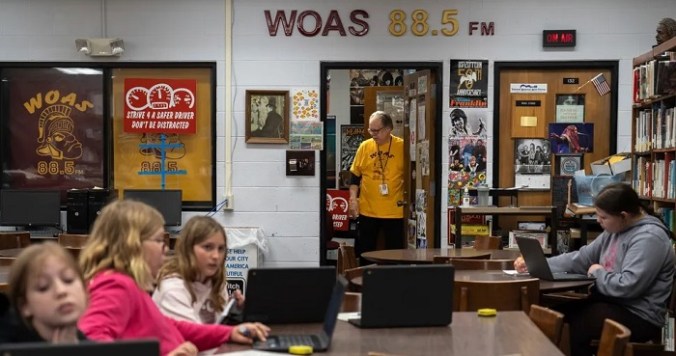
WOAS 88.5-FM is a high school radio station, one of only 200 remaining in the U.S., that has been broadcasting from the Ontonagon High School building in Michigan since 1978. It has only10 watts of broadcasting power, but is still one of only two radio stations in Ontonagon, on Michigan’s western Upper Peninsula. Not only does it provide some listening variety for the town, it also is a valuable educational and recreational vehicle for high school students. Two snack vending machines inside the school largely cover WOAS’s costs, and everyone is a volunteer. After school hours, members of the community volunteer their time as disc jockeys.
WOAS is a Class D station, the lowest FCC classification, covering low-power, noncommercial radio stations. These are considered too weak and disposable to warrant regulatory protection, so when unprotected” from other broadcasters, which can legally overpower its signal or simply apply to take over the station’s place on the dial. WHWL 95.7-FM, with10,000 times the broadcasting power of the school station, applied to the FCC to take over its frequency and place on the radio dial. The FCC said, “Sure! Go ahead!” granting a license for a new station on 88.5 FM, where WOAS lives. The high school radio station now has to find itself a frequency, which costs money, or go gently into that good night.
When the high school asked the radio giant why it chose its place on the radio dial to invade, the answer was classic Bill Clinton: it did it because it could. The big station said it needs to expand and FCC rules allow them to just take over. A consultant looked at available frequencies available to WHWL to add stations, and it deemed 88.5 FM “the best.”
The fact that a high school was currently operating from there was not, apparently, part of the equation, or considered at all.
Andy Larsen, the general manager of WHWL, gave the Detroit Free Press a rationalization salad to justify the station’s conduct. The takeover wasn’t a deliberate act of aggression, he claimed. After all, a consultant recommended it! [From the Rationalizations List: #18. Hamm’s Excuse, or “It wasn’t my fault;'” #36. Victim Blindness, or “They/He/She/ You should have seen it coming.”] Of course, nothing prevented the station from taking a frequency that didn’t put a high school’s resource out of business, but the excuse is that it was the consultant’s call (it wasn’t) and that a small station like WOAS should have seen this fate coming. It adds up to, yes, one more example of the current craze in rationalizations, #64. Yoo’s Rationalization or “It isn’t what it is.”
Larsen patted himself on the back for sending the high school a message informing it of the takeover, “even though notification is not mandated by the FCC.” [#65. Irrelevant Civility or “But I was nice about it!”]
“We just want to be a good neighbor,” Larsen said. “It’s unfortunate that they were on that frequency, but we do want to help them out. They’re only 10 watts, but it’s right in town, so they do serve that community, and so we want to make sure we help them stay on the air and do what they’re doing.”
Right. You know how the big company could “help out” if it really wanted to? By contributing enough money that Ontonagon High School can afford a new and more powerful frequency. But WHWL is quite comfortable with #4. Marion Barry’s Misdirection, or “If it isn’t illegal, it’s ethical.” They can take the frequency, it’s what the law allows, and that’s that.
“It is what it is,” Larson concluded, summing up by literally reciting #41. The Evasive Tautology, or “It is what it is.”
Yecchh. But there is hope for a happy ending as the story has spread; the Detroit Free Press report should help. An anonymous resident has comtributed $1,000, and small donations have been given to WOAS in sufficient volume to allow it to buy a new transmitter that could boost its signal strength to 100 watts. That’s the minimum required by the FCC for an upgraded license. Maybe the station can survive after all.
If it does, however, it will be just moral luck, and not diminish the unethical—-but legal!—conduct of WHWL.
 Ethics Alarms
Ironically, it appears that WHWL is part of the “Gospel Opportunities Radio Network” of “13 signals” across Michigan. Looks like they missed a great opportunity to actually practice “loving your neighbor as yourself,” doesn’t it? Good grief!
It seems like they’ve forgotten 2 Samuel 12.
Sheesh. I didn’t need this after finishing the Duggar documentary on Prime.
Not only unethical but dumb. Imagine the positive press and public goodwill had WHWL paid for better equipment, help with the paperwork, and had its engineers help the school switch to a different frequency. It would have been national news and a win-win for both sides.
Yep.
jvb
Were I of a cynical disposition, I might suggest that predatory capitalism is not always the best available strategy.
Predatory? Why, the station just wants to be a good neighbor!
Thank goodness we spend $10 billion a year for a regulatory agency to facilitate such behavior.
Yeah, I looked at getting an FCC license for a low-power FM or an AM (since there are no AM stations in my area) for a school. They refuse to issue the licenses. Why do they get to refuse to issue licenses for the public’s airwaves?
I’ve been to Ontonagon, twice; once on business, the other time by taking a wrong turn on the way to Houghton-Hancock.
It’s a lovely, quaint, unpretentious Lake Superior town surrounded by vast swathes of forest which is about as off the beaten path as you can get up that way.
WHWL is a World Class Pr!ck; would it be unethical to hope that Kismet comes a callin’?