Back in March, Ethics Alarms discussed the ethical issues implicated when marketing departments begin using Artificial Intelligence to “increase the number and diversity of our models for our products in a sustainable way,” as one retailer phrased it. The scenario echoed the plot of “Looker,” a 1981 Michael Crichton science fiction thriller in which a high-tech research firm convinces companies that real, live models, even after cosmetic surgery, can’t approach the physical perfection that will optimally influence consumers. In its diabolical scheme, models are offered a contracts to have their faces and figures scanned to create 3D computer-generated avatars, indistinguishable from the live versions, which would be animated by A.I. programs for use in TV commercials. Once their bodies are duplicated digitally, the human beings get lifetime paychecks and can retire, since their more perfect CGI dopplegangers will be doing their work for them. As he did so often during his brilliant, too-sort life, Crichton anticipated a serious ethical crisis arising out of developing technology. “Looker” is almost here.
Last week,the 160,000-member union SAG-AFTRA announced that it would join the the screenwriters union in its industry strike after failing to secure a new contract with movie studios and streaming services. The Screen Actors Guild and American Federation of Television and Radio Artists President Fran Drescher—yes, “The Nanny” herself—- condemned the AMPTP’s “shameful” and “disgusting” treatment of the union’s members. Among the major points of dispute is how to preserve acting and writing jobs that could soon be imperiled by the rapid development of computer technology and artificial intelligence.
AMPTP’s had made what it termed a “groundbreaking AI proposal” that so-called “background actors” would be “scanned, get paid for one day’s pay” and then surrender their images to the studios, which would “own that scan of their image, their likeness, and to be able to use it for the rest of eternity in any project they want with no consent and no compensation.”
Well at least with that system, the studios wouldn’t have any motivation to murder the sources of the images like the bad guys did in “Looker” to avoid paying the models lifetime royalties every time their visual clones were used.
SAG-AFTRA is whistling past the metaphorical graveyard. It’s admirable that the stars are standing up for their more humble and impecunious colleagues and trying to protect “an entire pathway to breaking into the industry, as well as a reliable source of income for many.” But this is futile, and the desperate equivalent of so many past efforts to block technology that replaces human labor.
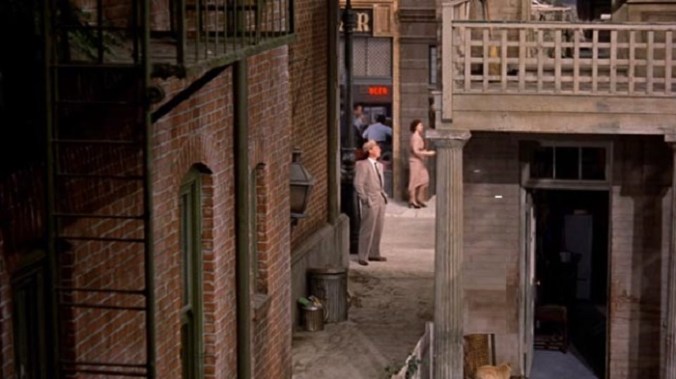
Before this issue came up, my wife and I were watching “Rear Window” again, and marveling at the way Hitchcock maintains a view through the alley of the Greenwich Village courtyard (above)where the film’s whole story takes place, constantly showing cars, trucks and pedestrians passing by. These are all in the distance and only glimpsed for seconds at a time. “If they remade the film today, all of that would be handled by CGI,” Grace observed.
Maybe not today, perhaps, but soon. The studios won’t have to scan real “people”background actors. Computer-generated images animated by artificial intelligence are becoming increasingly close to real human beings, and inevitably they will be indistinguishable. The background actors should have seen the writing on the wall when the baseball stadium crowd scenes in “The Natural” were stocked with cardboard cutouts scattered among the live actors to save money.
Actors will have as much success trying to ban the use of CGI and A.I. virtual actors in crowd scenes as they would trying to ban cartoons. The argument that it is unethical to use technology to save money and increase efficiency because it puts people out of work was lost permanently long, long ago. The ethical system at work is utilitarianism.
The Hollywood stars would do well to worry about their own jobs. For background actors, the end is near.
______________
Sources: Rolling Stone, The Verge
 Ethics Alarms
Hmm. And here all this time, for some reason, I thought “Rear Window” took place in San Francisco. Learn something every day.
Who didn’t see this coming?
The unions are just doing what unions do: protecting the jobs of their members in defiance of changing technology and industry requirements. The case of railroad firemen is a good example. In the days of steam locomotives, the railroad fireman was a person whose job it was to keep the locomotive’s engine running. This included management of the fuel and water that the locomotive required. As diesel locomotives replaced steam power, the firemen’s jobs were preserved by the unions for decades even though the actual need for firemen had passed and they had to cobble together job descriptions that kept them employed. Eventually the fireman job transitioned to sort of an assistant engineer. (Today, those few railroads that maintain the fireman position at all utilize it as an engineer-in-training slot.) Much the same could be said for railroad brakemen. I’m sure there are many other examples.
Maybe when AI moves on to take over the Hollywood creative and production processes, they will be able to generate some entertainment products that people actually want to see, even if the “talent” is computer generated. Of course, that will depend on who does the programming. “Garbage in – garbage out,” but then, we are there already.
Ah yes. “Featherbedding.” One of the great, mysterious terms that appeared in the papers of my youth.
This is just great !! “Invasion of the Body Snatchers” without those messy pods. Brave new world indeed.
Unfortunately, I do think background acting is going the way of stuntwork, practical effects, properties and set dressing; it might be insisted upon for a particular scene or project, but generally is going to be replaced by computer-generated imagery.
This has already happened in movie mass crowd scenes. Part of what makes “The Ten Commandments” so cool is that DeMille has scenes with such huge numbers of extras, sometime layered all the way to the vanishing point. The Exodus is spectacular, and we shall never see the like again…
Too bad.
I am certain that what is being produced by screenwriters today, can be produced by AI programs. Personally, I cringed when I first saw CGI in films, wondering years ago when human actors will be replaced. Apparently, it is soon! The Hollywood industry will experience what telephone operators, elevator operators, checkout clerks, etc have already experienced. At this point, “Frankly, I don’t give a damn!”