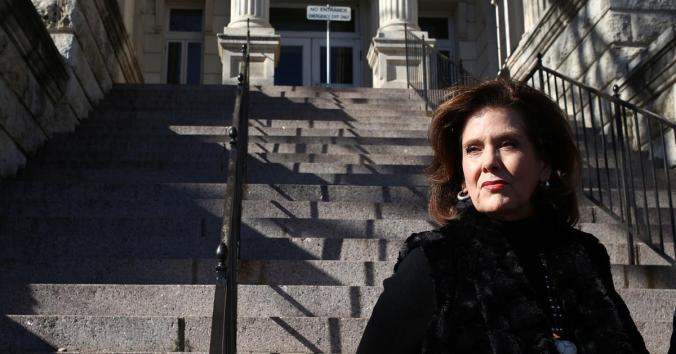
The ABA Journal reports that Waco, Texas, Justice of the Peace Dianne Hensley objects to performing same-sex weddings because of her religious beliefs, and makes such couples seek to get hitched elsewhere. Now she is claiming that her stance is supported by the U.S. Supreme Court’s June 30 decision in 303 Creative v. Elenis. That one, I’m sure you recall, declared that it was “forced speech” and a violation of a web designer’s First Amendment rights to require her to create websites for same-sex weddings.
The Texas’ State Commission on Judicial Conduct slapped Hensley with a public warning for refusing to perform same-sex weddings. Hensley filed a lawsuit against the Commission in December 2019, but it was dismissed. Now she is appealing, using the new SCOTUS decision as her ammunition.
In a letter to the Texas Supreme Court, Hensley’s attorney acknowledged that 303 Creative was based on the web designer’s First Amendment speech rights rather than religious freedom, but argued that the decision supports the magistrate’s stand because it “rejects the idea of a ‘compelling interest’ in forcing wedding vendors to participate in same-sex and opposite-sex marriage ceremonies on equal terms.”
Good luck with THAT. It’s a lame theory, and legally incompetent. There is obviously a compelling interest in judges doing their jobs.
What this story most brightly illuminates is the low quality of judges in some areas. The two situations are not comparable legally or ethically. Hensley is a judge acting in an official capacity with duties defined by the state. Performing weddings is one of her duties, and refusing to execute that duty for a couple because of their respective genders is discrimination. 303 Creative involves a private business in which the owner has latitude over the business’s activities. The magistrate’s lawsuit is a Hail Mary: not quite frivolous, but still based on dubious legal reasoning.
First Liberty Institute is representing Hensley. Same-sex marriages are legal, a Constitutional right, and they aren’t going away. For religions and conservatives, these defiant stands are futile and destructive to their own respect, credibility and influence in society. It is redolent of the South’s justifications for Jim Crow.
The Texas Tribune talked to Dale Carpenter, a professor at Southern Methodist University’s Dedman School of Law, who doesn’t think much of the judge’s logic but says that he expects similar attempts to use 303 Creative to justify discrimination against same-sex unions. I’m sure he’s right. The law responds to the evolution of ethical standards in society, and moral codes always lag behind both.
 Ethics Alarms
Judges must follow the law not their beliefs. If you cannot do that step down because every other judgement will be viewed as her imposing her religion on everyone else.
I can think of only one justification for her behavior.
In The State that Mondale Won, performing weddings is not a judge’s duty. They can do it but they do not have to. They can also charge for it. The Judge I worked for performed them, but did it in his spare time: lunch breaks, after hours, or on the weekends. He did not do them during working hours.
Because (if?!) it is not required, she may have as much a basis for not performing them as a Catholic priest would.
However, that she performs them by virtue of her office and not as an officiant or religious person does complicate the issue.
-Jut
Remove all the frippery and it is a contract between two parties. Two yeses and sign the paper. If you want a ceremony go find a willing person
Alabama solved this issue by deleting the necessity of anyone to officiate a wedding. A couple does not need to stand before a priest, minister, rabbi, iman, or even uncle joe who got his “credentials online.”
All the nuptial couple needs to do is fill in an online document, sign it before a notary public (eg at a bank, real estate office, or local library), then register it with any probate office, paying the required fee. No ceremony, no public declaration, no witnesses, nothing, just an affidavit with a notarized signature. Poof, you have declared yourself married, you can even choose whether you are the bride, groom, spouse 1 or spouse 2.
In my opinion, what you just described is the upper limit of how much involvement any State (and government in general) should have in marriages.
–Dwayne