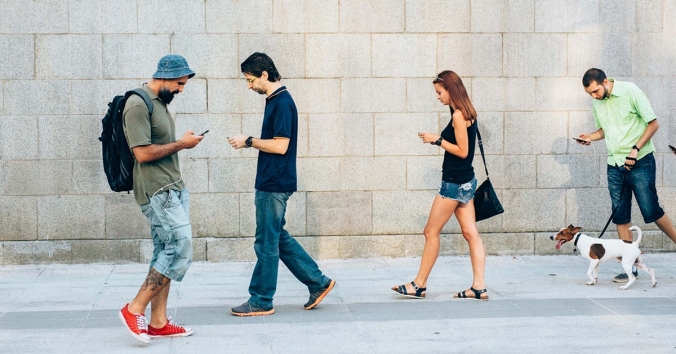
I’ve mentioned this toxic phenomenon before, but yesterday I was in Hell. While walking Spuds and driving I saw 14 pedestrians striding along staring at their phones. Three were walking their dogs, and paying no attention to them. One was pushing a baby carriage.
In contrast, I saw only nine adults who were not staring at their phones.
The phenomenon is one of many that is isolating members of society, crippling social skills, undermining the interaction between strangers and neighbors, and giving social media and remote communication an outsized influence over society and the culture. We paved the way for it with such developments as the Sony Walkman, now, if self-isolation and absorption in public isn’t a social norm, it is rapidly becoming one.
Is the conduct unethical? It is tempting to argue that it hurts no one but the phone screen addict, though that definitely doesn’t apply to those behaving like this while caring for dogs, babies and children (or crossing the street). The counter argument would be Kant’s Universality Principle: would we want a world where everyone walks through the world oblivious to everyone and everything but their phone? Well, that’s what we are on the way to creating.
The conduct is thought of as generational, but yesterday that didn’t seem to be the case: I saw as many 40+ phone addicts as under-30s. There was, however, a group of four teenage girls walking along together, all of them focused on their phone, not saying a word to each other. I stopped my car and watched them for a full block. They never spoke a word to each other.
I know I’m old fashioned (don’t bother writing in “Get off my lawn!,” Neil; I’ll assume that’s your reaction), but I believe in experiencing the world, paying attention to companions, interacting with neighbors and strangers, smiling at children and treating infants and dogs as more than just inert appendages. An ethical, responsible society is supposed to encourage behavior, habits and norms that benefit everyone, and discourage trends and pathologies that undermine ethical values. But what can be done? No law regulating such conduct would pass Constitutional muster. As much as I advocate the duty to confront, I can’t imagine getting a positive response from a stranger I called out for staring at their phone.
Would a public service campaign work, like”Don’t be a litterbug!” and “Only you can prevent forest fires!”? I doubt that Big Tech Big Brother would allow such an effort.
The phenomenon might just be more societal standards entropy, the tendency of behavior to degrade rather than improve, like incivility, sloppy attire and hygiene in public, and hostility to non-conforming views and ideas. The fact that “everybody does it” doesn’t make unethical conduct ethical, but when just about everybody does do it, it usually means the battle is lost.
 Ethics Alarms
Maybe there are subliminal messages embedded in cell phones. I just thought of this now.
Battles are lost by the side that wins the war. Victory goes to the most tenacious.
Have you seen “The Social Dilemma”?
From Wikipedia:
This documentary dives into the psychological underpinnings and the manipulation techniques by which, it claims, social media and technology companies addict users. People’s online activity is watched, tracked, and measured by these companies, who then use this data to build artificial intelligence models that predict the actions of their users. Tristan Harris, former Google design ethicist and co-founder of the Center for Humane Technology, explains in the documentary that there are three main goals of tech companies:
1) The engagement goal: to increase usage and to make sure users continue scrolling.
2) The growth goal: to ensure users are coming back and inviting friends that invite even more friends.
3) The advertisement goal: to make sure that while the above two goals are happening, the companies are also making as much money as possible from advertisements.
The “monkey see, monkey do” aspect of this behavior bugs me. It’s much like the “hydrating” obsession. I remember a time when not everyone had a water bottle within arm’s reach at all times and everywhere. Are water bottles pacifier substitutes? Virtue signaling? They just strike me as somehow uncivil.
to an extent, yes… but in my case I am a bladder and renal cancer survivor living in a desert environment and I drink at least 5 liters of water per day, 16 ounces at a time… and I always seem to have a bottle with me, so there can be more than meets the eye…
Of course. But everyone is suffering with a medical condition? Everyone under forty or so?
I don’t see a solution. Those folks aren’t doing anything wrong, per se, provided they’re not bumping into people or wandering into traffic (yes, I know, that happens–I still drive on a college campus not infrequently). And some small percentage are actually in need of the phone–they’re finding their way with a map app, or getting an update on a loved one’s surgery, or whatever.
I wonder if the antecedent to all this was another kind of phone. I have certainly gotten more than a little perturbed when my in-person conversation with some office worker was interrupted so they could take a phone call from someone whose business was no more pressing than mine. I was there first, after all. And that phenomenon has been happening for decades.
This also, of course, ties into larger issues–streaming taking over from going seeing a play or concert live, or even going to a cinema, for example. “Dehumanizing” seems too strong a term, given its connotative value, but it’s literally that.
At least it is an easy way of tracking people. It is so easy to hack, even with the latest updates to phone security. The hackers have already bypassed using voice, fingerprints & face recognition. Nothing like convenience for a total loss of privacy and security.
Granny,
The electronic monsters are manufactured to be hacked/tracked/monitored.
My dog has found a solution to this problem. She walks up, knocks the phone out of my hand and sits on it. No solitaire for me!
The tech companies are deliberately making their software addictive so they can mass gather data and monetize people’s existence. It’s creepy, but laws would be needed to stop it and lawmakers are thoroughly bribed by the tech companies not to make such laws. The police state likes things the way they are because it gives them control over people. I don’t think there is anything that can be done about it.
NP
Perhaps the problem isn’t people mindlessly on phones but something far more detrimental.
Too often we try to address a symptom rather than it’s cause. Could the reason people are glued to their screens be as you and others have suggested or is it because it becomes a haven of safety for a particular political thought? Could it be possible that social media reduces the potential of immediate intellectual conflict so we remain comfortable in our own beliefs?
Jack routinely reminds us we have a duty to confront but how many of us do that. As I turned into a gas station I once saw a mother leave her child in a stroller in a traffic lane near the pumps as she sat on the curb smoking. I saw a police woman who was inside and asked her to talk to the woman about the potential harm for her child. ( I could have hit the stroller had I come in from a different angle). The police officer told me basically to mind my own business and questioned why I was getting so riled up at her response.
At what point does the duty to confront become so costly that we choose to live obliviously to that which surrounds us? One could argue that looking at a screen is simply the means to keep one’s head down to avoid harm.
Maybe that is the real problem that needs to be addressed.
If you look at the history of big data analytics and where the statistical models come from, it is quite obvious that a lot of the addictive properties of social media and other types of technology are intentional. I don’t think the corporations which created and used this technology quite anticipated what would happen when you add politics to the mix. They were to busy looking at dollar signs.
Then three letter agencies realized they could exploit these technologies for regime change purposes all around the world, and were later surprised when they discovered that they are not the only ones who can use it for such purposes.
People may be hiding in their technology, but it isn’t just politics they are hiding from. Honestly, I think what we have seen so far is only the tip of the iceberg. AI got thrown into the mix a couple of years ago, and I think that is why we are seeing the massive cultural upheavals that we are seeing. It’s only going to get worse. It’s a many pronged problem that is tied into a Gordian knot with much of the knot hidden from the public so it cannot be unraveled. The more cultural upheaval there is, the more people hide in their technology and the worse it gets. It’s a doom loop. The loop will crash somewhere, but there is no telling where that will be.
Great points. I know from your earlier posts that this is in your wheelhouse with respect to the tactics used. For that protective legislation is warranted. I was approaching the issue from the psychology of the user such that the costs of putting yourself out there may be higher than the expected benefit.
Social media is like drugs. From the supply side sellers exploit human weaknesses and pain avoidance while users get the temporal benefit of pleasure.
Question
Would there be the same issue if people were reading a book by Kant, Rousseau some other classical philosopher as they walked their dog or sat on a park bench? My brother – the whiz kid in our family- rarely engaged with anyone except those in his esoteric peer group. He could recite chapter and verse from various classics which allowed him to be viewed by people he is introduced to as extraordinarily erudite – unlike me.
He was also a visual learner that gave him the ability to master various crafts such as wood and metalworking as well as being a self taught musician. I assume he was happy with his minimalist interactions and he did not seem to be isolated from the world he chooses to live within.
I believe we need to evaluate what people are reading on their screens as well as their daily habits as a whole before passing judgment.
What does bother me are employees who stare at their phones when they are supposed to be on duty. In that case I don’t care if they are brushing up on Euclidean Geometry or checking out the latest fashion trend it is wrong.
You’re just seeing the tail-end demise of community that was first noted by a person in the 1950s wondering why no one chats with neighbors and passersby anymore and why architects stopped designing houses with the front porches that played host to those interactions.
The TV had entered the home.
Well, now, little entertainment and information boxes are with us everywhere. So now, even as passersby, we can avoid interactions.
A bit simplistic, yes, as widespread access to AC meant people could be comfortable inside instead of relying on the breeze of a shaded porch and the car meant there were fewer passersby anyway.
But the big driver? We could get simulated, no personal cost, interaction a lot easier on a TV. Conversation with a real person takes a little bit of effort, and just as often as it does, it doesn’t have any payoff (except the intrinsic value of just interacting). The negative affects of social isolation were negligible given other interactions necessary at the time – such as jobs and errands and family.
So the TV didn’t seem harmful.
Sure, the ‘human’ interactions simulated on the screen didn’t have ALL the benefits of interacting with real people, but it had enough of them.
Wonder how the move from in-person interactions being the primary source of entertainment to TV and other electronic forms tracks with overall levels of mental health in the world.
Good question. If it can be measured.
While in pre-Covid Beijing a few years ago, I was gobsmacked to see the number of folks who were totally immersed their mobile phone screens. On the subway, on the sidewalk, or crossing the street, the vast majority of folks had their heads buried in their phones. In fact, there’s a Chinese expression for such folks: 低头族 dītóu zú (https://zh.wikipedia.org/zh-hans/低头族). Roughly translated: “The clan of the lowered heads”.
That said, like Curmie, I frequently encounter even more ‘impressive’ phone-related behaviors at our university campus. Students routinely walking out of classrooms, up/down stairs, on crowded sidewalks, walking in crosswalks – with their heads buried in their phones and totally oblivious to their environment. Ethics and/or manners notwithstanding, I’m even more concerned for safety of both the phone-ies and those in their proximity.
At ASU and in surrounding areas of Tempe, AZ, you can see young people riding bikes no hands and staring into their phones. And as I recall, it was not uncommon in Amsterdam, The Netherlands.
And of course, people do it while driving their cars. I’ve even seen a truck driver staring into his phone while driving on I-10.
When I still had a dog and used to walk her I once ran into a guy answering his phone and saying something like “Hey, what’s up?” (using small earphones, so it was not clear he was not politely greeting me.) I cheerfully replied back. He got annoyed and essentially said “Not talking to you.” I made a point of talking loudly to my dog every time I saw him on the street after that to the point he started crossing the street to avoid me. (Yes, I know, petty.)
The book “The Power of Habit” has some fascinating information on how habits begin. Think about the automatic checking of email or social media accounts. How much of the cell phone use has become a simple unthinking habit? A lot, I bet.
Absolutely. A lot of these habits develop because of the expectations of other people, though, so breaking the habits is more than just training yourself not to do something. You have to also train people to stop expecting you to do something. Some of those people may be very difficult to resist.
For example, employers in my field now expect developers to be available any time, day or night, to deal with any issues that arise with the applications we work on. It doesn’t matter what day it is or what time it is, you are supposed to answer the phone on the first couple rings to be at their beck and call. You cannot just decide to get rid of your cell phone.
Employers also expect all emails to be read and answered within about 5 minutes of sending them. You cannot just decide to limit your email checking intervals. You will get chewed out for doing something like that.
Then there are the instant messaging applications like teams that they expect you to install on your phone and answer any time of day or night.
I would love to just tell them all I’m killing my smart phone, but I rather need an income.
I understand all of that, and society has a lot of influence on our habits but I don’t think a PSA is going to cut it, it will need to be a “study” that proves (again, because it’s already been done) that in fact doing one task at a time is actually the most productive and there’s no such thing as “multitasking”. One of my weak spots of my life is time management, I believe the people who are masters of this will be the only productive ones in the future. The book 168 hours has evidence that “less is more” even bosses have to concede the habit of constant interruptions is distracting at best and unproductive at worst and management would benefit by giving everyone the luxury of scheduling emails instead of having a them spread like glitter during your workday. I know…not possible right now, is it?
The nicest compliment I’ve received from friends after a lunch, dinner, walk, or visit is, “You never looked at your phone…” almost in awe. Mt comment if pressed is usually, “It would be rude to do so.”
I just know the reaction of anyone under 30 reading this thread—if EA HAS any readers under 30—will be, Boy, what a bunch of silly old fogeys!”
Jack,
Good article, excellent point, but one (small) counter:
“There was, however, a group of four teenage girls walking along together, all of them focused on their phone, not saying a word to each other. I stopped my car and watched them for a full block.”
I realize your actions in this situation bore no ill intent. However, taken out of context, both your words — and the action itself — could be seen as inappropriate. How would the situation have appeared to an outsider walking by? It reminds me of the story you once wrote about concerning the father who confronted a photographer he believed had photographed his children.
None of this changes the point of your article, but hoped you might appreciate the perspective.
PS – GET OFF MY LAWN!
“Thanks, Neil; I appreciate the engaged commentary.”
No problem, Jack. Happy to contribute to the discussions!
In the area of my life where I pastorally prepare couples for marriage, there is a focus on communication. The first nonverbal sign I look for is to notice, where are their phones, as we speak. If the phones are within reach I ask they put the phones away and notice the angst that ensues. It is unbelievable what level of twitching goes on. We then discuss their ability to set aside the electronics while dining or conversing with each other. It is shocking how anxiety-ridden this topic is. Perhaps there needs to be a movement like AA or NA called Electronics Anonymous.