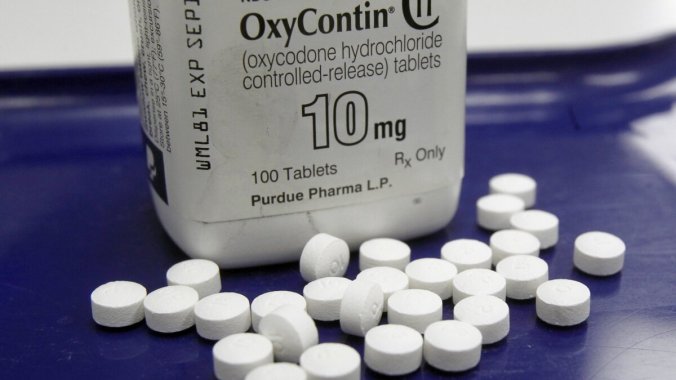
Most of the comments on EA posts come from a solid base of experience and knowledge, but it is especially welcome when a commenter enlightens us on a subject he or she really knows well. Thus Tom P.’s observations on the pharmaceutical industry in light of the EA post on the Perdue Pharma/Sackler/ OxyContin horror as dramatized in “Painkiller” is a special pleasure. Here it is, a Comment of the Day:
***
I apologize for the length of this post, but the topic is complicated and does not lend itself to sound bites. What follows is my experience and opinions based on working in the pharmaceutical industry and extensive reading on my part.
Full disclosure: I am a retired pharmaceutical company executive. During my career, I worked for various cosmetic and pharmaceutical companies. I held positions in R&D, manufacturing, quality control, and supply chain management. For most of my career, I was responsible for a major Pharma manufacturer’s anticancer and biologics global supply chains. As a point of reference, I have not seen “Dopesick” or “Painkiller”. I am familiar, however, with the travesty the Sacklers perpetrated on the sick and society. The best summary of their unethical and probably criminal behavior I have read is in an LA Times May 5, 2016, article: https://www.latimes.com/projects/oxycontin-part1/
Based on my experience, Perdue Pharma’s actions are not typical of the major pharmaceutical manufacturers. I am familiar however with at least one generic vitamin manufacturer who slapped a 3-year ex-date on their product knowing it lost 50% of its potency within 6 months of manufacture. This, however, is not life-threatening. Likewise, many generic manufacturers in China and India have questionable quality practices. Major Pharma companies have too much to lose to engage in the same practices that Perdue did.
As it relates to Perdue Pharma and the Sackler family, except for the death penalty there is no punishment too severe for them to be subjected to. They represent what can happen when the lust for financial benefit replaces science and ethical business practices. Except for mob-style hits, the Sacklers appear to operate their company much the way the Corleone family conducted business in the Godfather movies. I believe most major pharmaceutical companies operate in an ethical manner. The Sacklers are known to trade in favors and apply leverage to achieve the ends that they wanted. If you read the entire LA Times article, you will see that Purdue was aided and abetted in foisting fraud on pain patients by physicians, FDA officials, Federal and State Justice Departments, judges, government regulators, and politicians. All the individuals were bought off or influenced one way or another by Purdue to look the other way. Purdue could not have defrauded the sick without the willful cooperation of the aforementioned. It is also known that some physicians operate drug distribution mills. They charge a fee to write scripts for pain meds knowing they are not used to treat a medical condition.
Patients are not blameless either. When being prescribed a drug, you should question why a particular drug was selected. Question what therapeutic effect you should expect and what other treatments are available for your condition. If you have a drug that is not working, you need to demand alternative drugs or treatments. This is particularly true if your condition requires long-term use of a medication(s). In my opinion, you should not blindly put something in your body. You should do so only with informed consent. If your physician balks at this, you need a different physician.
Doctors prescribe a particular drug or treatment for one of three reasons: their experience with successfully treating other patients with similar maladies, their reading of medical journals, or they will try new drugs based on the promotional efforts of a drug company’s sales representatives. To the best of your ability, you should educate yourself on a medication’s side effects and treatment alternatives. This is very important because doctors’ compensation models are built on the quantity of patients seen, not the quality of care delivered. This is not to suggest that most doctors do not provide high-quality care. Rather it is just a statement of fact. The physician’s compensation model is basically piecework or as with attorneys in billable hours.
Early in my career, before PC speech rules, the pharma industry sales representatives were called “Detail Men” or “Bag Men”. The reps were well-schooled in the benefits of using the company’s drugs. They were also proficient in flattery and schmoosing techniques. They would arrive with bags of promotional materials and goodies to distribute to the medical and office staff. Once in the door, medical staff, doctors, and nurses that hit certain prescribing thresholds were presented with opportunities to earn honorariums promoting the drug company’s products to other professionals at local or distant conferences. The bribes work; otherwise, the companies wouldn’t spend the money. The entire lobbying industry in DC and State capitals is predicated on this business model.
Regarding pharma’s direct advertising to patients, I think it can do more good than harm provided patients do their own homework. For example, I suffer from Psoriatic Arthritis. My rheumatologist suggested I try one of two biologic drugs for my condition. After my own research, I explained I wanted to try a new drug being touted on television. My review of independent research showed it was just as efficacious as the drugs suggested by my rheumatologist but had only 1/4 of the side effects. We went with my choice of drug with positive results. Patients need to research and advocate for themselves. Patients should look at independent research papers and medication websites and then speak with their physicians to reach a mutually agreeable decision on treatment. I like rxlist.com but there are others. I stay away from the websites put up by the drug manufacturer and blogs of other disease sufferers. Physicians are not Gods. They are hired help. You are ultimately responsible for your healthcare.
 Ethics Alarms
Great post/comment! My only issue and point of disagreement is with your statement “except for the death penalty there is no punishment too severe for them,” which I read as suggesting you don’t think they should get it. I’m a strong believer and supporter of capital punishment, and I think we, as society, are not using it enough and definitely not as effective as we should (it’s laughable that sometimes it takes 20+ yrs to carry), and I cannot think of anyone more deserving of the death penalty than those SOBs. They literally have the blood of thousands on their hands. Also, I think they should have all of their wealth confiscated and given to their victims. ALL of it. So whomever of those SOB is spared the death penalty will be forced to live on the streets, among many of their victims, till the end of their lives.
Personally, I wouldn’t mind if there was a corporate version of the death penalty where the company is dissolved and its assets sold off by the state. Of course this would result in putting people out of work, but, too bad. People should know what they are signing up for when they sign on with a company that engages in unlawful practices.
This is essentially what happened to Enron, Johns-Manville and Arthur Andersen, no?
Enron, definitely. The other two I will have to take a quick look back at before I can say yay or nay.
Well, remember, AA was an accounting firm. Simply indicting it was a death sentence, because accounting firms exits to confer trust and reliability by their vouching. It didn’t matter that the case was thrown out later.
I have no problem with a death sentence for the Perdue Pharma corporation. It would send a powerful message to the industry. Putting individuals at Perdue Pharma to death would probably be difficult to impossible. From an ethical perspective, I am not sure where I stand on that. However, I have no problem with incarcerating the principal individuals responsible for the horror they foisted on society.
Contrast the likely penalties the Sacklers face with the threatened punishment of Donald Trump for a new type of fraud that wouldn’t kill anybody even if it took place.
While it may not be constitutional, I think it’s ethical to let the punishment fit the crime, especially when it comes to corporate profit as a motive for harming others.
Yep. You and your doctor are supposed to be partners in your healthcare. You’re supposed to ask questions and not simply accept whatever the doctor says as gospel. Some doctors think otherwise, there’s a reason there is the joke about the difference between God and the doctor being God not thinking He’s a doctor. However, like ordinary humans, many doctors fall victim to greed, and prescribe according to what they will get paid the most for. I get my flu shot every year, because it’s just smart for someone of my agent in my health to do, however it does sometimes cross my mind that for every flu shot my doctor gives, he gets paid a certain amount by insurance. I took the shingles vaccine because the nurse practitioner recommended it, although I have never fallen victim to shingles. In retrospect, I probably could have done without it, because it gave me a horrible case of chills and shakes about two afternoons later. I literally had to put on my canvas coat, the warmest garment I have, and wait to warm up. I have also worked the case in which a plaintiff suffered only bulges in an auto accident, but received two surgeries which did nothing for him, partly because his treating doctor over prescribed oxycodone like it was candy and he became dependent on it. He was working at the time but did not own a vehicle, so he had no no fault coverage and the workers compensation carrier denied coverage. So, there was no one overseeing pre-certification or other treatment to stop this doctor from treating and billing, treating and billing, treating and billing until the civil case stalled out and it became evident that they would get nothing from workers comp. There’s a very good chance that the defendant is probably going to have to pay far more than he should in a simple auto accident resulting in bulges because of this gross overtreatment. In the meantime this doctor has been stripped of his license and just narrowly avoided going to jail. Nonetheless, here we are and someone is going to have to pay to resolve this mess.
The one incident that really soured me on the pharmaceutical industry as being trustworthy was Martin Shkreli and his actions after jacking up the price of a helpful drug by a ridiculous amount, together with his dismissive and obnoxious behavior before Congress. There’s being an asshole because your line of work justifies being ruthless or requires being ruthless, and there’s being an asshole for the sake of being an asshole. His behavior fits firmly within the latter category. I’m glad he finally drew prison time, and it would just be a bonus if he got brutally raped while in prison. I know that’s not a nice thing to say at all, but someone like him, who outside of his business is basically just a twerp, deserves to suffer for arrogance far greater then what a twerp should have.
The fact that this individual did the things he did leads me to be unsurprised at what happened here as well. Some say power corrupts, but I’m not sure that’s quite how it goes. I do believe power attracts the corruptible, and too many powerful individuals or wealthy individuals decide they just want more power and more wealth and damned be anyone who gets hurt as a result. That’s what got us to where we are here.
Yes, a mass failure of ethics and a pronounced increase in cultural rot.
My analysis exactly.
And yet, I swear this is true, every time a hear “Opioid crisis” I envision little malign clones of Ron Howard swarming over the landscape
Between 1999 and 2019, nearly 80,000 people aged 55 and older died of opioid overdose. The majority of these individuals did not crush or snort pills. They were older individuals who trusted their health care providers.
The reason this information is so important is because the crisis isn’t with the junkie. The crisis is with grandma and grandpa. They never intended to get hooked on anything, they just did what the doctor prescribed.
There is an entire generation of people who were raised to respect advanced education, or those who are considered better. Doctors fall into the respected category. If a doctor tells you a medication is what you need, then you have no business questioning them. After all, they know more than you.
My father was one of those people. His doctor put him on a medication to lower his blood pressure. And when it got too low, the doctor put him on a medication to raise BP, without stopping the medication to lower it. My dad never questioned it, because the doctor was educated, and my father was not.
I work for a health care company, and see this over and over. We often view these situations through our own lense, but when we understand the wider view, we can see how this issue is far, far worse then junkies abusing the system. We have elderly individuals being given the equivalent of heroin, without the support or resources they need to understand the dangers.
Michelle K
You state: “Between 1999 and 2019, nearly 80,000 people aged 55 and older died of opioid overdose.”
I am unfamiliar with this statistic. Could you please provide the source? I was not able to find it via an internet search. I am not disputing the stat. I just couldn’t find it.
This source does provide some good information on overdose deaths in the US with some age differentiation but not what you reported.
https://drugabusestatistics.org/drug-overdose-deaths/
One thing this site does show is that there is a significant difference in deaths per 100,000 between various states. This could imply there is a cultural difference not associated with medically prescribed drugs by physicians. If the problem was only caused by Perdue Pharma, you would think the rate would be more uniform across the states.
You also state: “There is an entire generation of people who were raised to respect advanced education, or those who are considered better. Doctors fall into the respected category.”
I don’t discount your assertion. My dad, a WWII vet, was in that category. I made it my responsibility to help him manage his and my mom’s healthcare. This Included sometimes going to occasional doctor appointments with them.
I can only give people the value of my knowledge and experience on this topic. What they do with it is their concern. As I said in a response to another commenter: I urge people to manage their healthcare themselves because they have the most to lose.
Here’s the source: https://jamanetwork.com/journals/jamanetworkopen/fullarticle/2787930#:~:text=Results%20During%20the%20period%201999,to%2010%20292%20in%202019.
I think it’s important to note that I’m not disputing anything at all that you said. I’m merely adding an additional perspective.
I agree people should manage their health care, while knowing from personal experience that they either can’t always do so, or wouldn’t even think of questioning a doctor.
I’ve work for a large health insurance organization for a long time. The number of opioid addictions and overdoses spiked a few years ago, and caused our industry to work with state and federal regulatory bodies to find ways to help curb the issue. There are programs in place to help identify over prescribers and over utilizers at the pharmacy level. These programs are effective, but unfortunately came too late for some.
I mostly wanted to provide an additional perspective to the idea that opioid overdoses or addictions happen by someone knowingly abusing the prescribed medication. For many elderly, it happened in good faith, through misplaced trust in their health care provider.
Michelle K,
Thanks for the source. Much appreciated.
Boy, it’s annoying sitting in a doctor’s office (always well past the appointment time, of course) and seeing sorority girls prance in with a large bag of goodies or lunches for the entire staff and be promptly ushered into the bowels of the office. Why is the public paying for these chick’s salaries and clothing and car allowances and trips to Hawaii when we get a prescription filled?