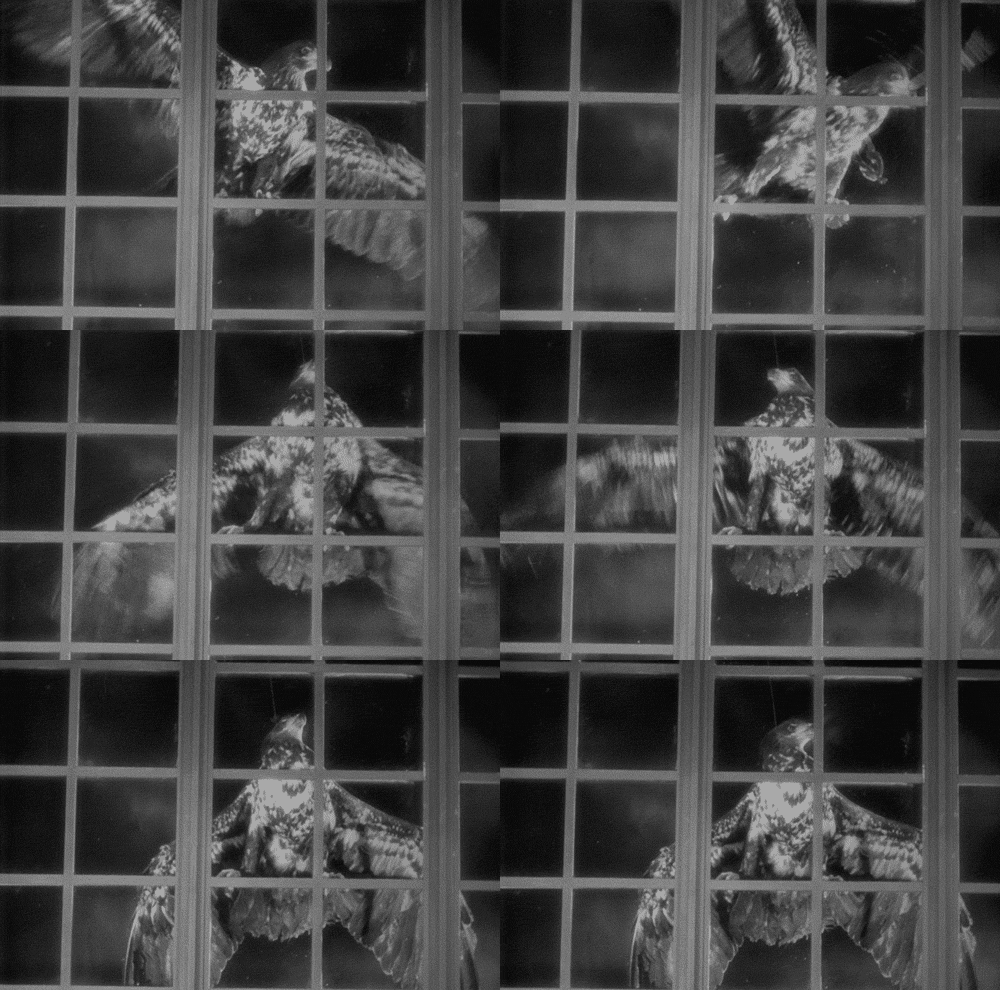
How? We can’t. Next?
The National Audubon Society, the famous non-profit dedicated to the conservation of birds and their habitats, wants to make the U.S. “bird safe” by shaming homeowners into “turn[ing] off unnecessary lights at night” and “clos[ing] blinds, [and] curtains,” along with other precautionary measures. Businesses should install bird-safe glass, for example, which has patterns that make it more visible to birds. This, the Audubon’s ornithologists claim, will save the lives of “up to a billion birds a year.” The group told WBAL-TV viewers in Baltimore that “lighting and reflectivity, specifically during migration for birds, is a really dangerous problem and kills up to one billion birds in North America per year.”
Sure. Advocacy groups love fake statistics, and this one screeches “Made-up!” like a bald eagle in heat. That “up to one billion” number is partially based on a 2014 abstract estimating that between “365 and 988 million birds” are killed annually by “building collisions” in the United States. Of course, since the objective isn’t to fairly communicate facts but to support the extreme positions of single-issue activists, the Society chose the highest estimate, already probably polluted by confirmation bias, and rounded up. The society used estimated bird collisions with walls to assess the deadliness of windows alone. In addition, the fake number mixed in ball park estimates that North America has lost 3 billion birds since 1970, and oh, let’s say a third of those died in “building collisions.” Yes, let’s.
Oddly, the environmentally conscious group, a prominent climate change hysteria purveyor, doesn’t seem to be as concerned with how many birds wind-farms kill, a much easier number to determine. Those feathered victims have given their lives to save the planet, however, so their deaths are justified.
Over at RedState, Mike Miller makes the accurate observation that bird collisions with windows seem to happen overwhelmingly in the daytime: that’s my experience in bird-flocking Alexandria. In 40 years here, I’ve seen and heard many birds hit our windows in daylight, and never in the dark, though I may have missed one or two, I suppose.
If the Audubon Society wants me to support it as it tries to keep the Woke Mob from trying to cancel the trailblazing ornithologist and artist without whom the Society wouldn’t exist, it needs to stop this unethical abuse of its prestige and influence. Yes, as you might have guessed, the social justice warriors want James Audubon to be erased from ornithology and history because a black lifetime criminal died at the knee of a brutal cop in a non-racial incident in Minnesota. Audubon, you see, was a slaveholder, and must be punished (the theory goes) for engaging in a practice that was legal and common in the U.S.—so say today’s history police, who had the benefit of almost 200 years of accumulated experience, wisdom and ethical enlightenment to understand why slavery is wrong.
Right now, the society is trying to weather the assault by insulting Audubon on its website…
“His contributions to ornithology, art, and culture are enormous, but he was a complex and troubling character who did despicable things even by the standards of his day. He was contemporaneously and posthumously accused of—and most certainly committed—both academic fraud and plagiarism. But far worse, he enslaved Black people and wrote critically about emancipation. He stole human remains and sent the skulls to a colleague who used them to assert that whites were superior to non-whites.”
That’s gratitude for you. Audubon’s importance to ornithology has nothing to do with his personal conduct, character, or his slaveholding. An organization that makes up statistics to support its own agenda ought to be more forgiving.
 Ethics Alarms
Ethical or not, here is my response to the National Audubon Society…

Sometimes “Bite Me” is just not enough.
That said, I’ve observed that much of our culture has shifted to outright intimidation, transparently obvious persecution and pure indoctrination to push totalitarian controls of “We the People” and this is spreading like pandemic. It’s clear to me that totalitarians see this kind of outright manipulation of “We the People” as effective ends justify the means methods of achieving their agendas. Too many of “We the People” are damn fools for becoming their sheeple.
I can certainly applaud the desire to mitigate damage to our native fauna that our cities create, but I would think there are several things that any advocacy group should keep in mind.
1. Sensationalism might spur the gullible, but it trashes credibility among anyone who bothers to investigate. Once you’ve lost credibility, it is an enormous uphill battle to regain trust.
2. In the same vein, even accurate numbers need to be placed in context. A billion birds a year sounds like a frighteningly high number. But it gives no context for how severe the problem is. It could be an imminent threat to all bird populations, or it could be a very minor issue. Killing a billion humans would be devastating to the human race. Killing a billion ants doesn’t even make a dent in their overall population. I Googled around and found that estimates put the bird population in the US and Canada at about 7.2 billion. However, that doesn’t mean that in 8 years, there would be no more birds. Yes, since 1970, that number has declined from over 10 billion, but that means 3 billion overall over 50 years. However, even that doesn’t provide the full context, because people need to understand the various causes that impacted bird population loss (which is largely due to loss of habitat), and they need to understand that killing a billion birds a year doesn’t lead to an overall decline of a billion birds in the total population. Instead, many of those birds will have died of predators, disease, old age, or other accidents, and their deaths often mean resources made available to the remaining birds who will then survive and reproduce. The real question is how quickly the overall bird population is declining, and whether that decline is accelerating or leveling off.
3. Solutions should not simply target the problem, but provide a better alternative. If new windows are needed, then there should be an offer for patterned windows that are also better insulators, so that people who sign on reap the benefit of HVAC savings as well the moral pat-on-the-back. People who are motivated by the problem alone, especially if it requires sacrifices to mitigate, are not sufficiently prevalent to spur the changes needed to truly impact the problem. However, everyone needs to replace things at some point in time, and if the needed replacement is already better than what they had, and has the added bonus of some ecological friendliness, that makes it an obvious choice.
4. Back on the theme of trust, I think we as a society aren’t afraid to admit that everyone falls short of perfection, and that everyone’s life story is complicated. I think it is fair to offer a full picture of a society’s founder, but trashing the founder has problems that a society has to consider. If the founder were such a depraved individual, how much of his philosophy infects the society? Why should the society be trusted if its founder was so untrustworthy? Moreover, when a society decides its founder has to be denigrated, it faces a dilemma of whether to keep the founder’s name, and have it tarnish all efforts going forward, or abandon the founder’s name, and risk losing name recognition. Instead of stepping into that ethical trap, it seems far more prudent to simply say applaud the good things the founder did, and perhaps add a statement that the complications in the founders’ life do not diminish his contributions. And remember that a wise man once said that nothing before the word “but” really counts.
Comment of the Day, and who was that wise man???
So, that quote is actually from G.R.R. Martin’s “Game of Thrones”, purportedly said by Ned Stark and reiterated by Jon Snow. Where Martin might have derived it from, or if it really is his own nugget of wisdom, I can’t say. But I really like the quote…
Regarding #2, The use of comparative statistics without any context really irks me at times.
If someone tells me that drinking water increases your chance of cancer by 27%, I always think — increase what by what? If I had a 1 in 10 chance before and now I have a 1 in 4 chance — that’s significant. If I had a 1 in 10 million chance before and now it’s 1 in 4 million — not so much, and how much of that is rounding error?
If I’m told that manufacturing a product will add 1000 tons a year of quadrotriticale to the atmosphere, well compared to what? If a billion tons are already emitted, does this actually make a difference? Context matters.
When the subject of bird deaths is broached, cats deserve mention:
Cats Pose Even Bigger THREAT TO BIRDS Than Previously Thought
‘Course that link is to audubon.com, so…
I’ve not watched the Hitchcock classic since a child. Ought to remedy that.
Oh, and there’s this: https://youtu.be/zUfRTA-hU4k
Society twerps – don’t even know whose shoulders they’re standing on, as they struggle lamely and dissimulatively to be relevant .. to anything. As though all they’d self-righteously tear down they could at one time have built themselves .. better, with more equity and inclusive of various and sundry ideological abberations du jour. What’s the end-game of distorting science? This might be the greatest of the alarms we should, must hear, closer to home in consequences than other garden variety, bizarre ethics and ethics’ violations.